
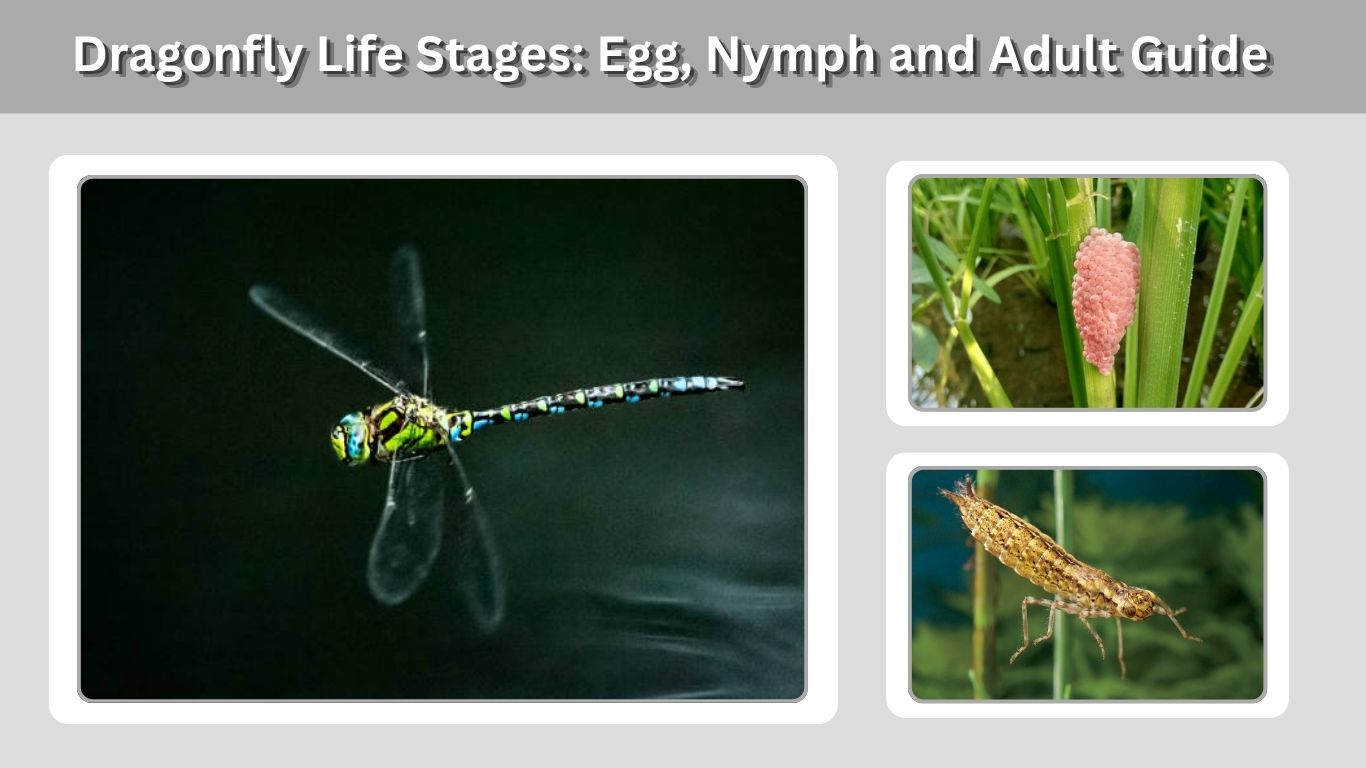
Dragonflies have a simple but fascinating life cycle that begins in water and ends in the air. Unlike butterflies, dragonflies do not have a pupal stage. They grow through three main stages: egg, nymph, and adult. The nymph stage happens underwater and is usually the longest part of life. This guide explains the dragonfly life stages in clear language for students, kids, teachers, and anyone who wants to understand or label the dragonfly life cycle.
How Many Life Stages Does a Dragonfly Have?
A dragonfly has three main life stages: egg, nymph, and adult. This is called incomplete metamorphosis because there is no pupa or chrysalis stage. Many people search for four dragonfly stages, but that idea usually comes from butterfly life cycles, which are different from dragonfly development.
The 3 Main Stages
- Egg: The dragonfly begins life in or near water.
- Nymph: The young dragonfly lives underwater and grows by molting.
- Adult: The mature dragonfly flies, hunts, mates, and lays eggs.
Why Some People Search for Four Stages
Some people search for “four stages of dragonfly life cycle” because they are thinking of insects like butterflies, moths, or mosquitoes. Those insects have a pupal stage. Dragonflies do not. A dragonfly nymph changes directly into an adult during its final molt.
Incomplete Metamorphosis
Incomplete metamorphosis means the insect changes without a pupal stage. Dragonflies, damselflies, grasshoppers, and some other insects develop this way. The young stage does not look exactly like the adult, but it gradually grows and changes until it is ready to emerge.
Dragonfly Life Cycle Stage 1: Egg
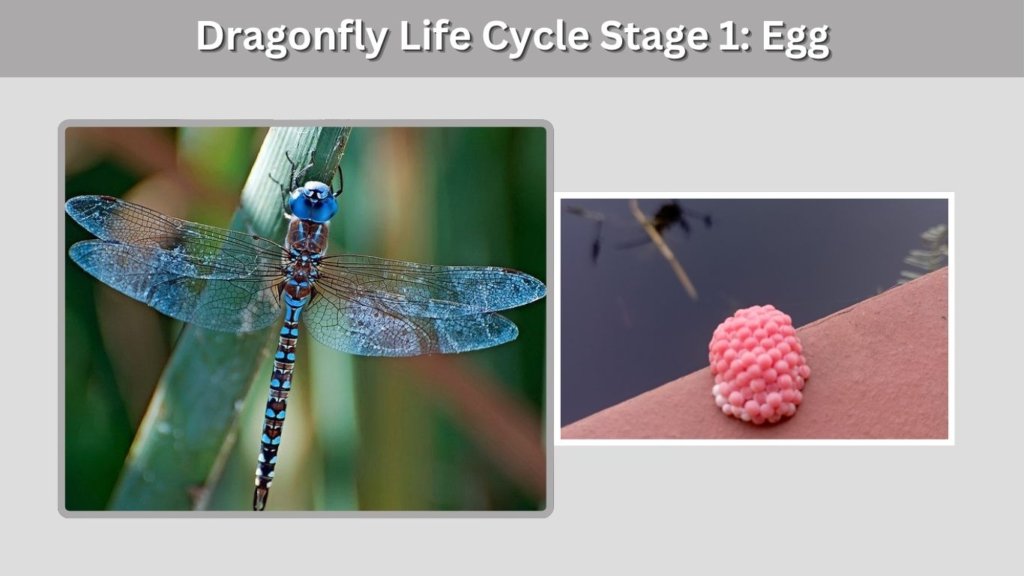
The egg is the first stage in the dragonfly life cycle. Adult female dragonflies lay eggs in places where the young can survive after hatching. Because dragonfly nymphs live in water, eggs are usually placed in or near freshwater habitats such as ponds, lakes, marshes, streams, or wetlands.
Where Dragonflies Lay Eggs
Female dragonflies may lay eggs directly in water, on floating plants, inside plant stems, in mud, or near the edge of wet places. The exact egg-laying method depends on the species. Some dragonflies dip the tip of the abdomen into water while flying, while others place eggs carefully into plant tissue.
What Dragonfly Eggs Look Like
Dragonfly eggs are very small and difficult to see without close inspection. They may be laid one by one, in groups, or inside plants. Most people never notice the egg stage because it is hidden in water, mud, or vegetation.
What Happens After Eggs Hatch?
After the eggs hatch, tiny dragonfly nymphs enter the water. They do not look like adult dragonflies yet. They have no full wings and cannot fly. Instead, they begin life as underwater hunters, feeding on tiny aquatic animals and growing through repeated molts.
Dragonfly Life Cycle Stage 2: Nymph
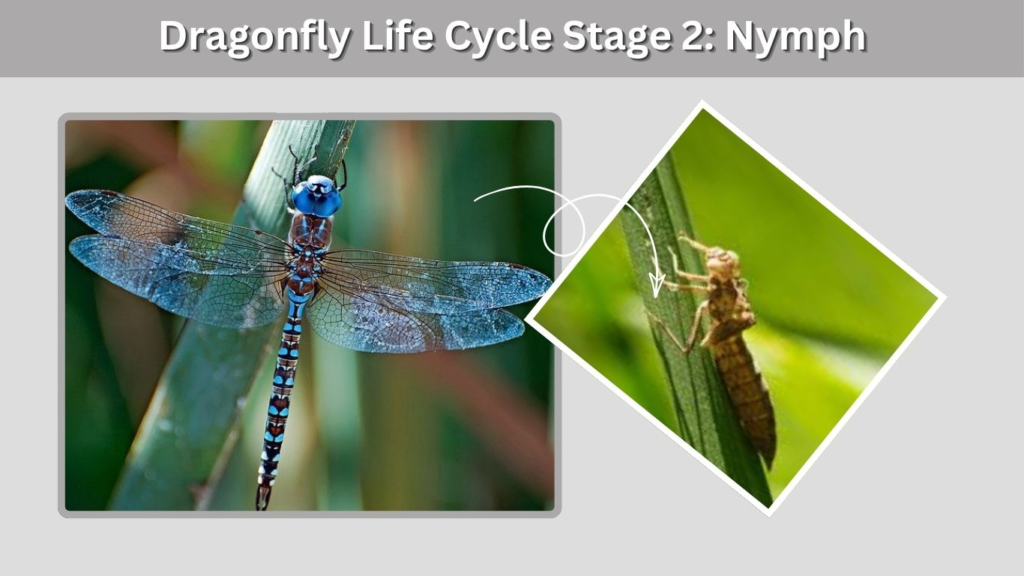
The nymph stage is the underwater stage of a dragonfly’s life. It is also the main growth stage and often lasts much longer than the adult stage. Dragonfly nymphs live in ponds, marshes, streams, or wetlands, where they hide, hunt, molt, and slowly develop wing pads.
What Is a Dragonfly Nymph?
A dragonfly nymph is the young form of a dragonfly. It has six legs, large eyes, a strong body, and a special lower jaw that can shoot forward to catch prey. Nymphs usually crawl instead of swim quickly, and they often hide among plants, mud, roots, or leaves.
What Dragonfly Nymphs Eat
Dragonfly nymphs are predators. Their food may include:
- Mosquito larvae
- Small aquatic insects
- Tiny worms
- Water fleas
- Small crustaceans
- Small tadpoles
- Fish fry
- Other tiny pond animals
How Nymphs Grow
Nymphs grow by molting. Their outer skin cannot stretch enough as they get larger, so they shed it and form a new one. This happens many times during the nymph stage. Older nymphs may show small wing pads, which later become adult wings.
Dragonfly Life Cycle Stage 3: Adult
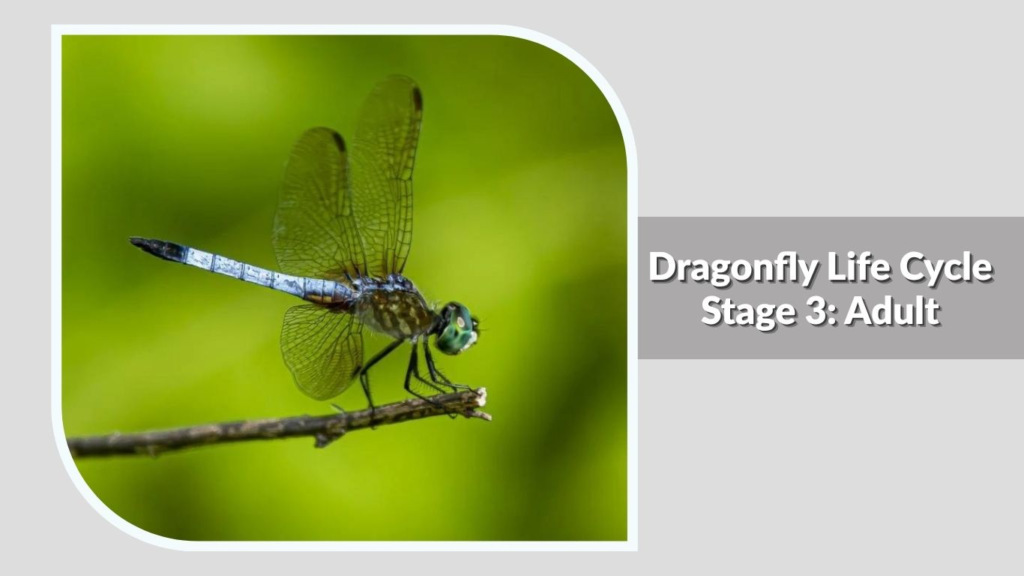
The adult stage begins when the fully grown nymph leaves the water for its final molt. It may climb onto a plant stem, rock, dock, or pond edge. Then the adult dragonfly slowly emerges from the old nymph skin. This stage changes the dragonfly from an underwater predator into a flying hunter.
Emerging From the Nymph Stage
Emergence is the moment when the adult dragonfly comes out of the nymph skin. The empty skin left behind is called an exuvia. At first, the new adult is soft, pale, and weak. It needs time for its body to harden and its wings to expand.
Young Adult Dragonfly
A young adult dragonfly cannot fly strongly right away. Its wings must dry, stretch, and harden. During this short period, the dragonfly is vulnerable to birds, frogs, wind, and other dangers. Once the wings are ready, it can fly away from the water.
Mature Adult Dragonfly
A mature adult dragonfly spends its time flying, hunting, mating, and laying eggs. Adults eat mosquitoes, flies, gnats, midges, and other small flying insects. After mating, females lay eggs in suitable wet habitats, and the life cycle begins again.
Dragonfly Life Cycle for Kids
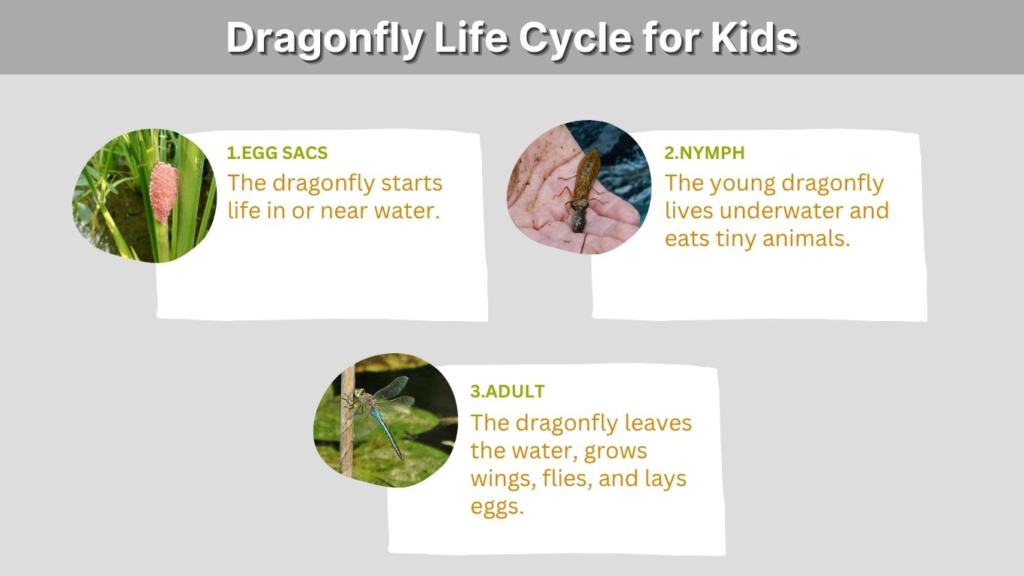
The dragonfly life cycle is easy for kids to understand because it has only three main stages. A dragonfly begins as an egg, grows underwater as a nymph, and later becomes a flying adult. This simple cycle is a good way to learn about insects that grow without a pupa stage.
Simple Life Cycle Labels
- Egg: The dragonfly starts life in or near water.
- Nymph: The young dragonfly lives underwater and eats tiny animals.
- Adult: The dragonfly leaves the water, grows wings, flies, and lays eggs.
Easy Explanation for Children
A dragonfly starts as a tiny egg near water. After it hatches, it becomes a nymph that lives underwater. The nymph eats small water animals and grows bigger. When it is ready, it climbs out of the water, sheds its old skin, and becomes a flying dragonfly.
Dragonfly Life Cycle Diagram Ideas
A dragonfly life cycle diagram should show both water and air because dragonflies live in both places during their development. The early stages happen in or near water, while the adult stage happens above water. A clear diagram helps students label the stages correctly and avoid confusion with butterfly life cycles.
What to Label in a Diagram
A simple dragonfly life cycle diagram can include:
- Eggs near water
- Aquatic nymph
- Growing nymph
- Molting nymph
- Empty skin, or exuvia
- Adult dragonfly
- Mating adult
- Eggs laid again
Why Diagrams Show More Than 3 Parts
Some diagrams show more than three parts because they include extra events such as molting, emergence, mating, or egg laying. These are important steps, but they are not separate main life stages. The main life stages of a dragonfly are still egg, nymph, and adult.
Dragonfly Life Cycle Timeline
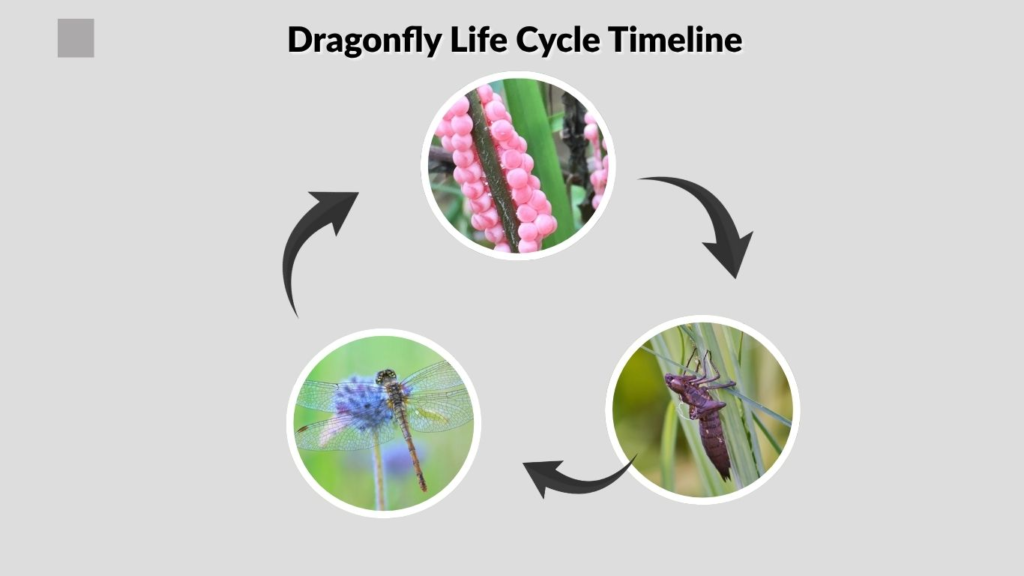
The time needed to complete the dragonfly life cycle depends on the species, climate, water temperature, food supply, and habitat. Some dragonflies develop quickly, while others spend a long time underwater as nymphs. In many species, the nymph stage is the longest part of the life cycle.
Egg Timing
Dragonfly eggs may hatch in a short time or remain inactive longer, depending on the species and weather. Warm water can speed up development, while colder conditions may slow it down. Eggs must be placed near suitable water because the nymphs need an aquatic home after hatching.
Nymph Timing
The nymph stage can last for months or even years. During this time, the nymph hunts, grows, and molts many times. This is often the longest stage of a dragonfly’s life. When the nymph is fully developed, it prepares for the final molt and leaves the water.
Adult Timing
The adult stage is usually shorter than the nymph stage. Adult dragonflies spend their time flying, feeding, defending territory, mating, and laying eggs. Even though adults are the most visible stage, much of a dragonfly’s life may have already happened underwater.
Common Mistakes About Dragonfly Life Stages
Many people confuse dragonfly development with butterfly development. This is why they may search for four dragonfly life cycle stages. Others count emergence or molting as a separate stage. These steps are important, but they do not change the main three-stage life cycle.
Do Dragonflies Have a Pupa Stage?
No, dragonflies do not have a pupa stage. They do not form a chrysalis or cocoon. Instead, the aquatic nymph climbs out of the water and changes directly into an adult during the final molt. This is one of the main differences between dragonflies and butterflies.
Are Nymph and Larva the Same?
Many people use the words nymph and larva for young dragonflies. However, nymph is the better term because dragonflies have incomplete metamorphosis. Larva is more often used for insects with complete metamorphosis, such as butterflies, beetles, and mosquitoes.
Is Emergence a Separate Stage?
Emergence is not usually counted as a separate main life stage. It is the transition between nymph and adult. During emergence, the adult dragonfly leaves the old nymph skin. Although this moment is dramatic, the three main stages remain egg, nymph, and adult.
FAQs
What are the life stages of a dragonfly?
The three main life stages of a dragonfly are egg, nymph, and adult. The egg is laid in or near water, the nymph lives underwater and grows by molting, and the adult flies, hunts, mates, and lays eggs.
How many stages are in a dragonfly life cycle?
A dragonfly has three main life cycle stages. These stages are egg, nymph, and adult. Dragonflies do not have a pupa or chrysalis stage like butterflies, so their life cycle is known as incomplete metamorphosis.
What is the nymph stage of a dragonfly?
The nymph stage is the underwater stage of a dragonfly’s life. Dragonfly nymphs live in ponds, streams, marshes, or wetlands. They hunt small aquatic animals, molt many times, and later climb out of the water to become adults.
Do dragonflies have four life cycle stages?
No, dragonflies do not have four main life cycle stages. They have three: egg, nymph, and adult. Some diagrams may show extra steps like molting or emergence, but those are events, not separate main stages.
What happens when a dragonfly becomes an adult?
When ready, the nymph climbs out of the water and sheds its old skin. The adult dragonfly emerges soft and pale. Its wings then expand and harden. After that, it can fly, hunt insects, find a mate, and lay eggs.