
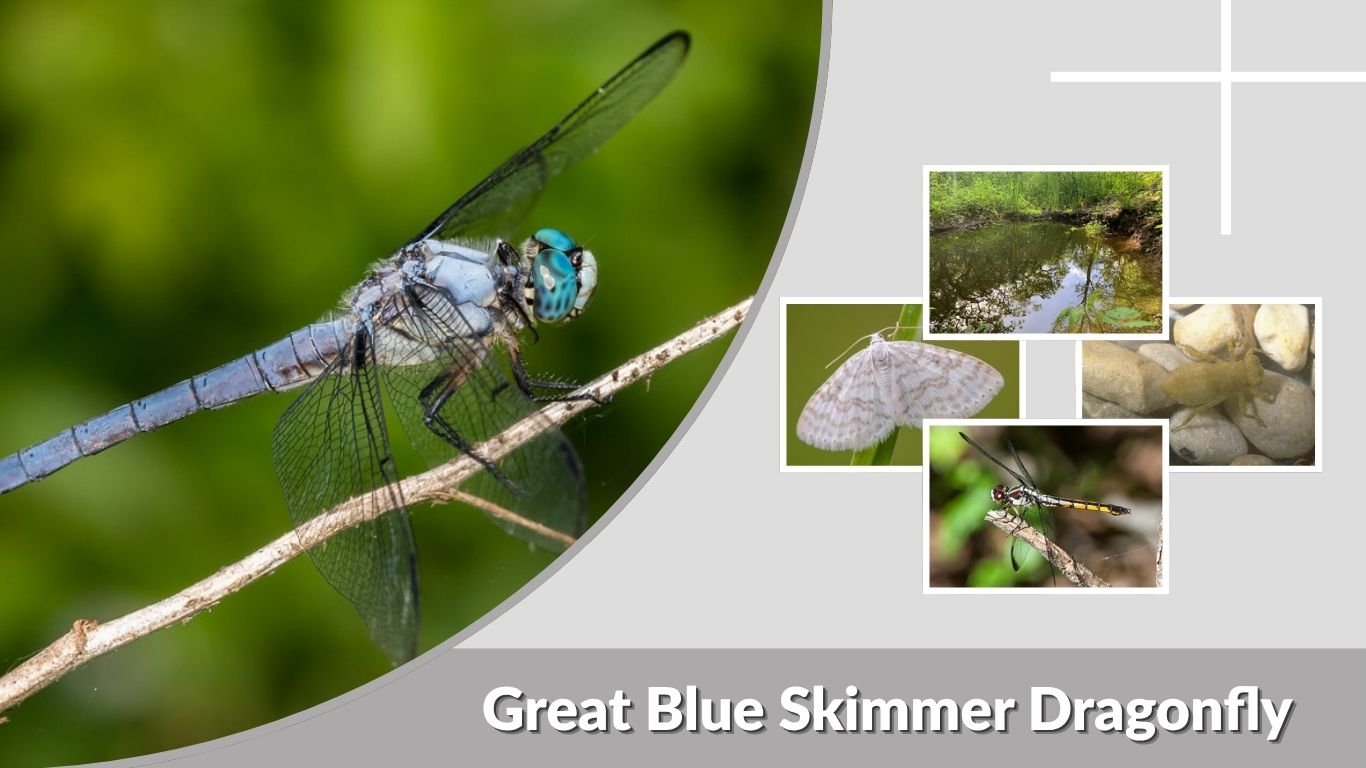
The Great Blue Skimmer is one of the largest and most impressive skimmer dragonflies in North America. Mature males are recognized by their powdery blue bodies, pale faces, and blue-green eyes. Females and immature males look different, displaying brown or yellowish bodies with dark markings. This dragonfly prefers shaded ponds, wooded swamps, and slow-moving streams rather than exposed, sunny lakeshores. Although its large size can appear intimidating, the Great Blue Skimmer is harmless to people. It is a beneficial aerial predator that consumes mosquitoes, flies, gnats, and other insects.
Great Blue Skimmer Scientific Name
The scientific name of the Great Blue Skimmer is Libellula vibrans. It belongs to the family Libellulidae, whose members are commonly called skimmers.
| Classification | Name |
|---|---|
| Kingdom | Animalia |
| Phylum | Arthropoda |
| Class | Insecta |
| Order | Odonata |
| Suborder | Anisoptera |
| Family | Libellulidae |
| Genus | Libellula |
| Species | Libellula vibrans |
The genus Libellula contains several large, strongly built dragonflies known as king skimmers. Other members include the Slaty Skimmer, Flame Skimmer, Widow Skimmer, and Twelve-spotted Skimmer.
What Does a Great Blue Skimmer Look Like?
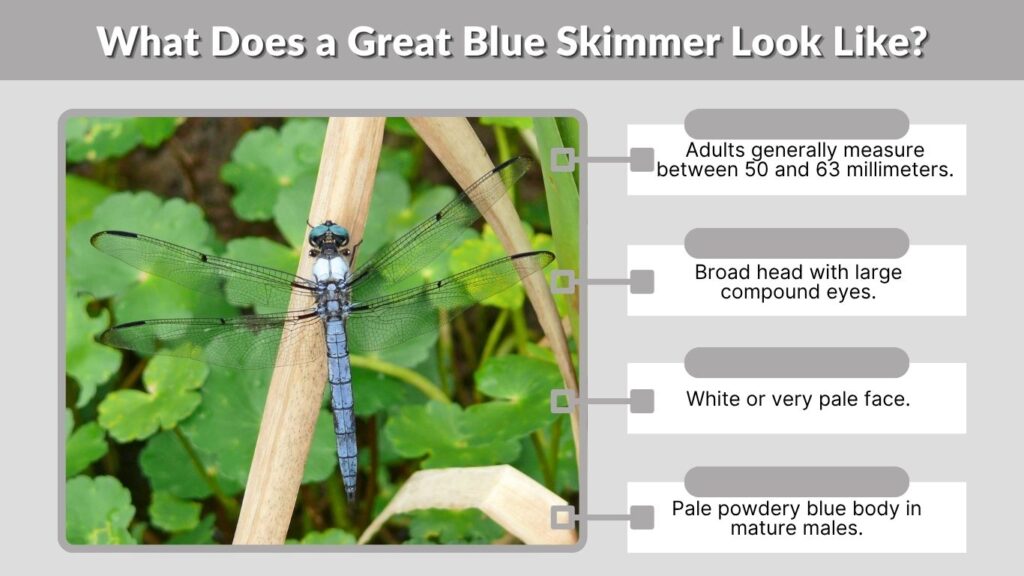
The Great Blue Skimmer is a large dragonfly with a sturdy body, broad head, and long, powerful wings. Adults generally measure between 50 and 63 millimeters, or approximately 2–2.5 inches, in body length.
Its wings are mostly transparent, although some individuals have darkened areas around the tips or leading edges. A small dark rectangular structure called a pterostigma appears near the outer edge of each wing.
Main Identification Features
Look for the following characteristics:
- Large body measuring as much as 2.5 inches
- Broad head with large compound eyes
- White or very pale face
- Mostly clear wings with dark pterostigmas
- Pale powdery blue body in mature males
- Brown or yellow body in females and immature males
- Preference for wooded or shaded freshwater habitats
The white face is an especially valuable identification feature. It separates the Great Blue Skimmer from the darker-faced Slaty Skimmer.
Male Great Blue Skimmer
A mature male has a pale blue or bluish-gray thorax and abdomen. The blue appearance comes from a waxy coating known as pruinosity, which develops as the dragonfly reaches maturity.
The male’s abdomen may appear slightly darker than its thorax. Its face is white, while the eyes are generally blue-green, gray-blue, or greenish. These pale features contrast with the dark legs and dark areas around the wing joints.
Young males look much more like females. They are initially brown or yellowish with darker abdominal markings. As a male ages, the powdery blue coating gradually covers its original pattern.
Mature males often sit on prominent branches near breeding water. Their large size, pale blue bodies, and aggressive territorial flights make them relatively easy to notice.
Female Great Blue Skimmer
A young female is generally yellowish, tan, or brown. Dark brown markings appear on the sides of the thorax, while the abdomen has a dark stripe along its upper surface. Pale yellow or cream-colored markings may run along the sides.
Females usually have white or pale faces, just like mature males. Their eyes may initially appear reddish brown over green but can become bluish as they age.
Older females become darker and may develop gray or blue pruinosity. Consequently, a mature female can sometimes be mistaken for a male. However, her blue coating is usually less uniform, and portions of the original abdominal pattern often remain visible.
Some females also have amber coloring near the bases of their hindwings. Their wing tips may look slightly smoky or darkened.
Male vs. Female Great Blue Skimmer
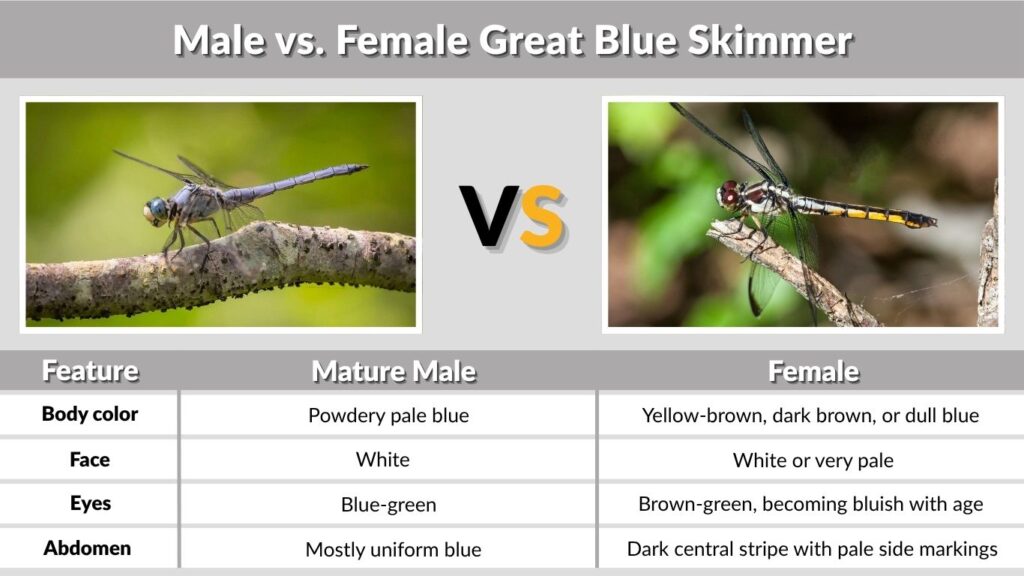
Males and females can look dramatically different when young, but the differences become less obvious as females age.
| Feature | Mature Male | Female |
|---|---|---|
| Body color | Powdery pale blue | Yellow-brown, dark brown, or dull blue |
| Face | White | White or very pale |
| Eyes | Blue-green | Brown-green, becoming bluish with age |
| Abdomen | Mostly uniform blue | Dark central stripe with pale side markings |
| Wings | Mostly clear | Clear, sometimes with amber bases |
| Behavior | Territorial near water | Frequently hunts away from water |
Young males are often difficult to separate from females using color alone. Their terminal abdominal appendages and reproductive structures provide the most reliable differences.
Great Blue Skimmer Range
The Great Blue Skimmer is primarily an eastern North American species. It occurs across much of the eastern and southeastern United States, with its strongest populations in warm, humid regions.
Its range extends from the Atlantic Coast westward into portions of the central United States. It is particularly common in the Southeast, including coastal plains, wooded river valleys, and swampy areas.
The species becomes less common toward the northern edge of its range. Individuals occasionally appear farther north than expected, including in parts of New England and southern Ontario. Some of these northern observations may involve wandering adults rather than established breeding populations.
Adults can be active from late spring through early fall. In warmer southern regions, they may fly from April through October. Their season is generally shorter in northern locations.
Habitat of the Great Blue Skimmer
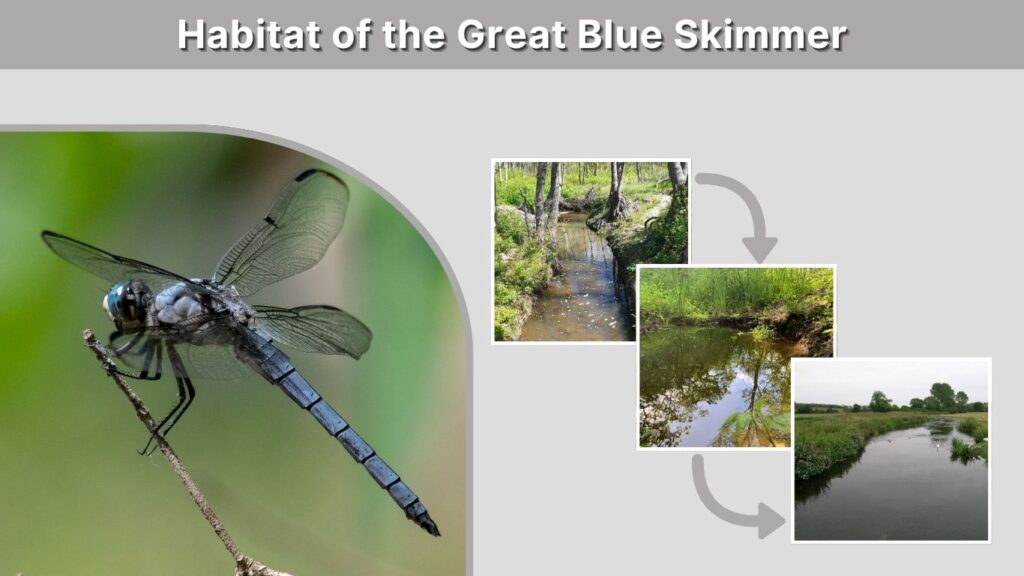
Unlike many dragonflies that prefer open, sunny ponds, Great Blue Skimmers are strongly associated with shaded or partially shaded water.
Typical habitats include:
- Wooded ponds
- Forest pools
- Swamps
- Slow-moving streams
- Beaver ponds
- Shaded ditches
- Bottomland forests
- Marshy woodland
- Quiet river edges
- Temporary muddy pools
They often select shallow water with muddy bottoms, fallen leaves, branches, and surrounding trees. Females may even deposit eggs in small water-filled depressions when conditions are suitable.
Adults remain close to forested areas and frequently perch on branches several feet above the ground. They can also be observed along woodland roads, trails, bridges, and forest clearings near wetlands.
Diet and Hunting Behavior
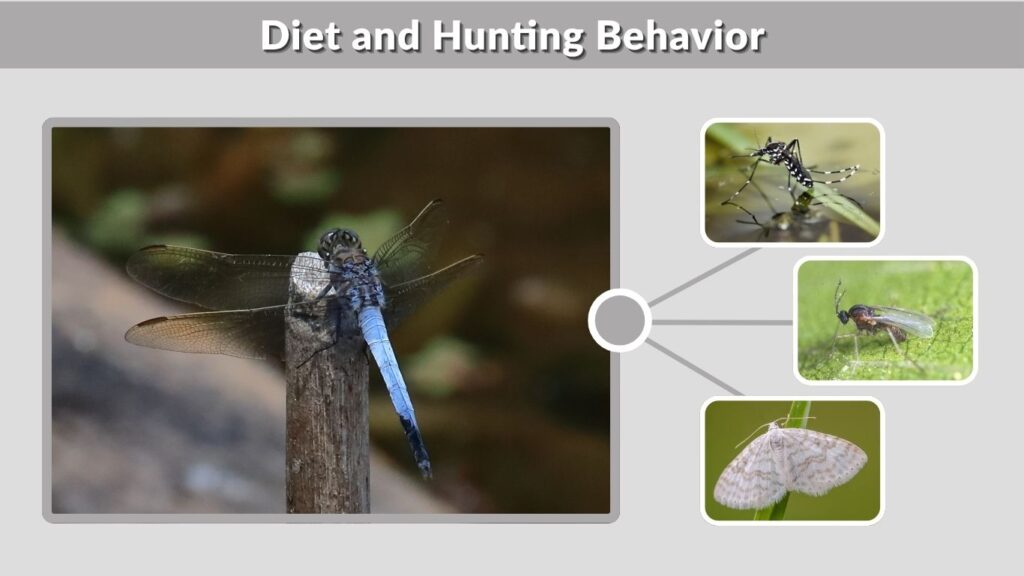
Great Blue Skimmers are carnivorous throughout their lives. Both the aquatic nymphs and flying adults prey on other animals.
What Do Adult Great Blue Skimmers Eat?
Adults commonly consume:
- Mosquitoes
- Midges
- Gnats
- Flies
- Small moths
- Flying ants
- Mayflies
- Other small dragonflies
A Great Blue Skimmer normally hunts from a perch. It waits on a branch, twig, or tall plant and watches for passing prey. When an insect flies nearby, the dragonfly launches into the air, catches it with its legs, and often returns to a resting place.
Its six legs form a basket beneath the body during flight. This allows it to trap insects without using its mouth until the prey has been secured.
What Do the Nymphs Eat?
Great Blue Skimmer nymphs live underwater and hunt among mud, leaves, and plant material. Their brown coloring helps them remain hidden from prey and predators.
Nymphs may feed on mosquito larvae, mayfly nymphs, aquatic fly larvae, small crustaceans, tadpoles, worms, and other aquatic animals. Large nymphs may occasionally capture very small fish.
Territorial Behavior
Male Great Blue Skimmers can be highly territorial. A male selects an area that may attract egg-laying females and repeatedly patrols it.
He often returns to the same exposed perch after chasing another dragonfly or investigating movement near the water. Males may aggressively pursue rivals, including other Great Blue Skimmers and different dragonfly species.
Territorial disputes usually involve rapid flights and aerial chasing rather than serious physical fighting. Once an intruder leaves, the resident male generally returns to his preferred branch.
Females are less frequently seen at the water. They may spend much of their time hunting in surrounding woodland and visit ponds mainly for mating and egg laying.
Reproduction and Life Cycle
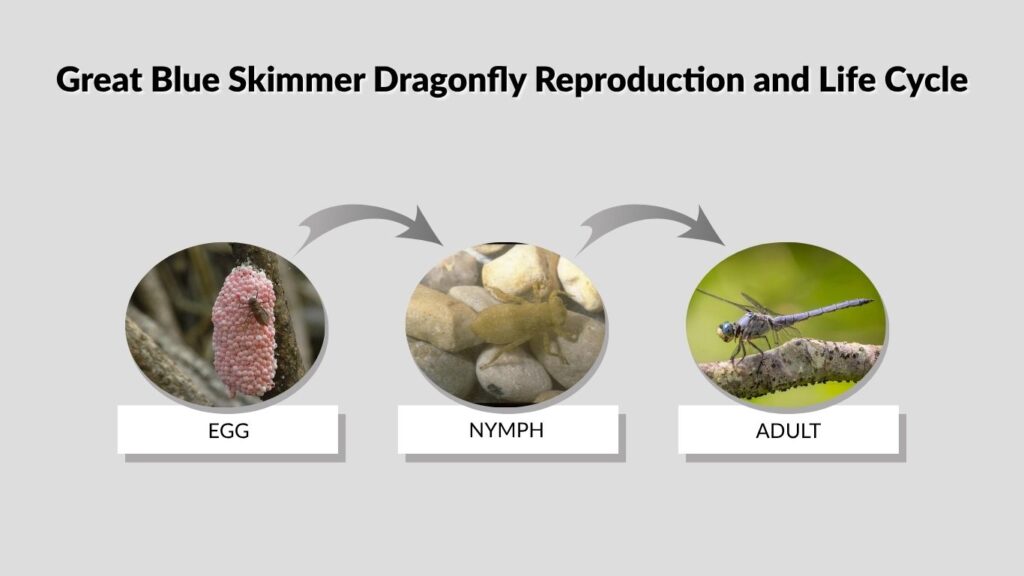
The Great Blue Skimmer undergoes incomplete metamorphosis. Its life cycle has three stages: egg, aquatic nymph, and adult.
Mating and Egg Laying
A male uses specialized appendages at the end of his abdomen to grasp a female behind the head. The pair forms the characteristic dragonfly mating-wheel position.
After mating, the female flies low over the water and repeatedly touches the surface with the end of her abdomen, releasing eggs. The male may hover nearby and guard her from other males.
Eggs are usually deposited in shallow, quiet water with mud, leaves, or submerged vegetation.
Nymph Development
The eggs hatch into aquatic nymphs, also called naiads. These nymphs spend most of their lives beneath the water. They molt repeatedly as their bodies grow.
When a nymph is ready to become an adult, it climbs out of the water onto a plant, branch, log, or other surface. Its outer skin splits, and the adult slowly emerges.
The new dragonfly expands its wings and waits for its body to harden. It then flies away to hunt and mature. The empty skin left behind is called an exuvia.
Great Blue Skimmer vs. Slaty Skimmer
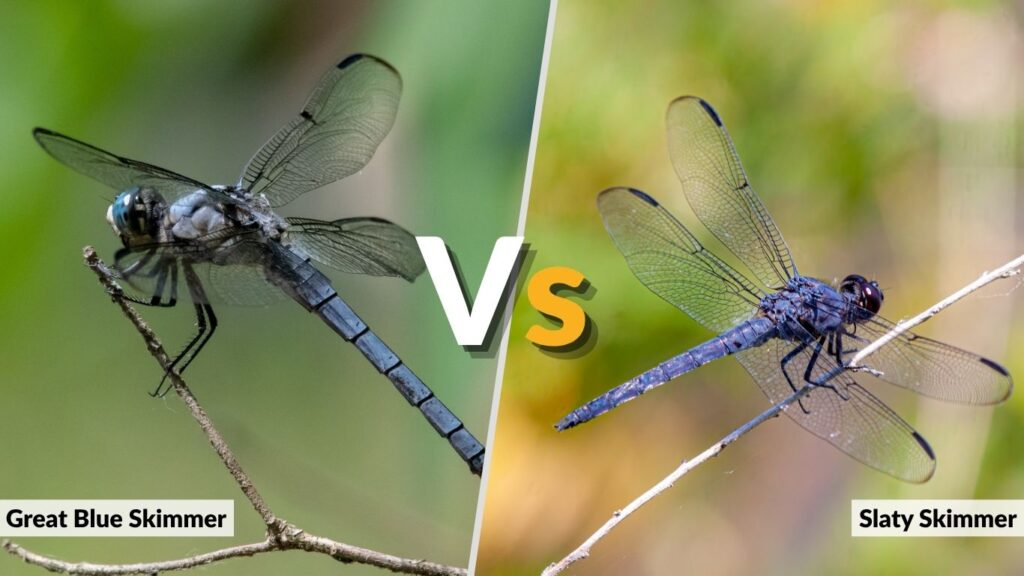
The Great Blue Skimmer and Slaty Skimmer are both large blue dragonflies found in eastern North America. They may also occupy similar wooded ponds and wetlands.
| Feature | Great Blue Skimmer | Slaty Skimmer |
|---|---|---|
| Scientific name | Libellula vibrans | Libellula incesta |
| Male color | Pale powdery blue | Dark slate blue or blue-black |
| Face | White | Dark blue or blackish |
| Eyes | Blue-green | Dark brown, red, or blackish |
| Size | Up to about 2.5 inches | Usually around 2 inches |
| Preferred habitat | Shaded swamps and wooded pools | Quiet ponds near woodland |
The Great Blue Skimmer is generally larger and paler. Its white face and blue-green eyes provide the easiest identification clues. A Slaty Skimmer has a much darker body, face, and eyes.
Are Great Blue Skimmers Dangerous?
Great Blue Skimmers are not dangerous to humans, pets, or garden plants. They do not have stingers, and they do not intentionally attack people.
A dragonfly that is captured and held may attempt to bite defensively. However, its mouthparts are designed for eating insects, and a defensive bite is unlikely to cause significant harm.
These dragonflies are beneficial because they consume mosquitoes, flies, and other insects. Their aquatic nymphs also help control mosquito larvae before the mosquitoes become flying adults.
FAQs
Is the Great Blue Skimmer rare?
The Great Blue Skimmer is common in suitable wooded wetlands across much of the southeastern United States. It becomes less common toward the northern and western edges of its range, where observations may involve wandering adults.
How can you identify a Great Blue Skimmer?
Look for a large dragonfly with a white face and mostly clear wings. Mature males have powdery pale blue bodies and blue-green eyes. Females are generally brown or yellowish with dark abdominal markings.
Where do Great Blue Skimmers live?
They live near shaded ponds, forest pools, swamps, beaver ponds, muddy ditches, and very slow-moving streams. Adults commonly perch on branches along woodland edges and bottomland forest roads.
What do Great Blue Skimmers eat?
Adults eat mosquitoes, gnats, flies, midges, moths, and other flying insects. Aquatic nymphs feed on mosquito larvae, aquatic insects, small crustaceans, tadpoles, and other small animals living in the water.
When are Great Blue Skimmers active?
Adults are normally active from late spring through early fall. Their season may extend from April into October in warm southern regions but is considerably shorter near the northern edge of their range.