
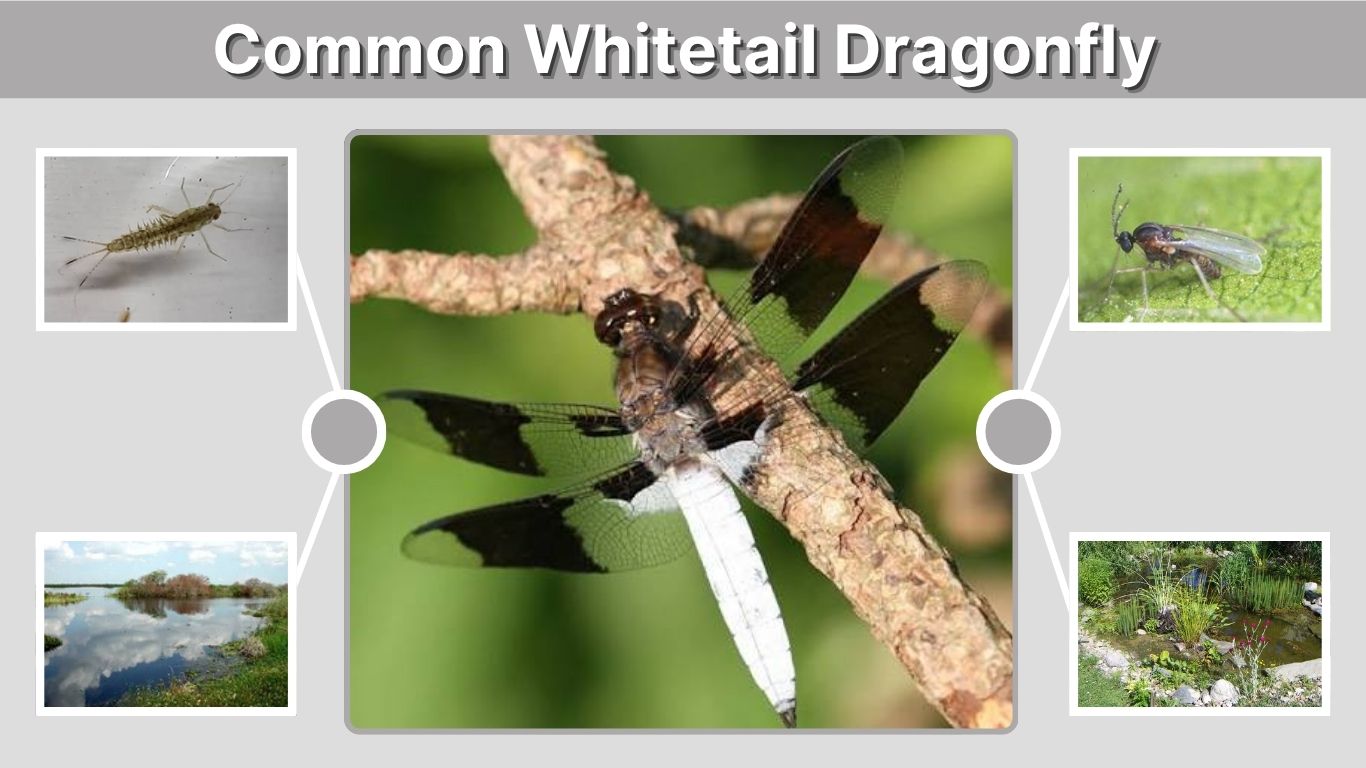
The common whitetail dragonfly is a striking North American species recognized by the mature male’s chalky-white abdomen and broad dark wing bands. Females look remarkably different, displaying brown bodies, pale abdominal markings, and three dark spots on each wing.
Its scientific name is Plathemis lydia, and it belongs to the skimmer family, Libellulidae. Common whitetails frequently rest on low vegetation, rocks, paths, and bare ground near ponds. They are harmless to humans and beneficial predators of mosquitoes, flies, and other small insects.
Common Whitetail Dragonfly Overview
Common whitetails are stocky, medium-sized dragonflies with noticeably different male and female appearances. They are widespread across much of the United States and southern Canada and readily occupy both natural and human-modified wetlands.
| Characteristic | Information |
| Scientific name | Plathemis lydia |
| Other name | Long-tailed skimmer |
| Family | Libellulidae |
| Typical length | Around 1.7–2 inches |
| Male color | White abdomen with dark wings |
| Female color | Brown with pale abdominal marks |
| Range | Much of the United States and southern Canada |
| Habitat | Ponds, lakes, marshes, and slow streams |
| Diet | Small flying insects |
| Dangerous to humans | No |
How to Identify a Common Whitetail
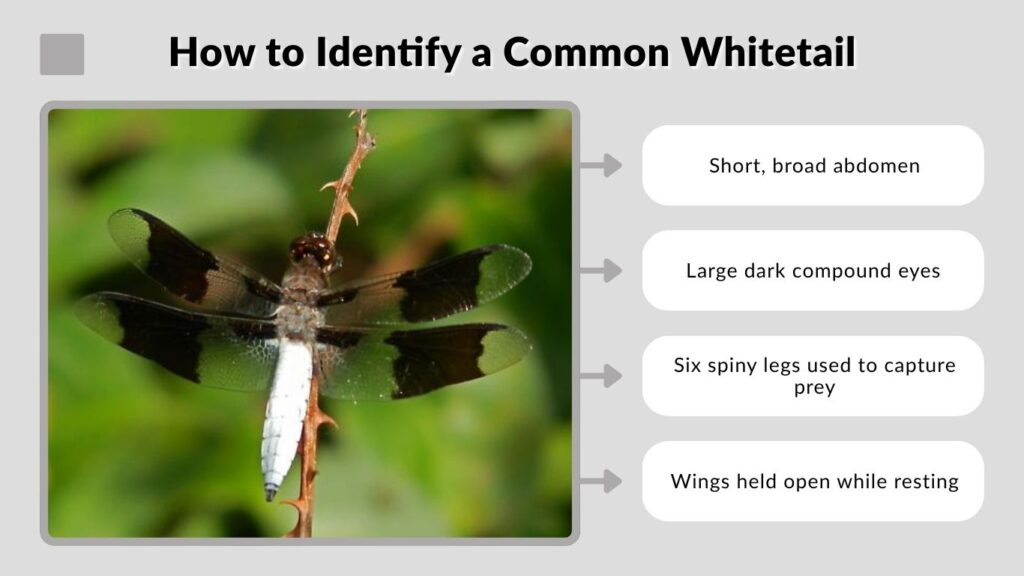
Mature males are relatively easy to identify. Females and immature males require closer inspection because they can resemble twelve-spotted skimmers.
Key Identification Features
- Short, broad abdomen
- Large dark compound eyes
- Broad wings with black or brown patches
- Dark thorax with pale markings
- Six spiny legs used to capture prey
- Wings held open while resting
- Frequent use of low, exposed perches
- Fast, direct flight over open water
The mature male’s abdomen appears white because it develops a powdery wax coating called pruinescence. This coating may look white, pale blue, or silvery depending on the light.
Male Common Whitetail Dragonfly
A mature male has a thick, chalky-white abdomen with a dark tip. Its otherwise clear wings possess broad black or dark-brown bands and smaller dark patches near their bases.
The male has two main dark patches on each wing: one close to the body and one broad band farther outward. The wing tips normally remain clear.
Immature males initially have brown abdomens marked with pale spots, making them look somewhat like females. However, their wing pattern already resembles that of mature males. As they age, white pruinescence gradually covers the youthful abdominal pattern.
Male whitetails are strongly territorial. They patrol sections of shoreline and chase away competing males. The bright abdomen is also displayed during territorial encounters.
Female Common Whitetail Dragonfly
A female common whitetail looks very different from a mature male. Her abdomen is brown or dark brown with pale yellowish or whitish markings along its sides.
Females generally have three dark patches on each wing:
- One near the wing base
- One near the middle
- One toward the wing tip
They lack the male’s powdery white abdomen. Their body pattern provides useful camouflage when resting on soil, bark, fallen leaves, or dried vegetation.
Females usually spend less time defending the water’s edge. They may visit a pond mainly to mate and lay eggs before returning to nearby feeding areas.
Male vs Female Common Whitetail
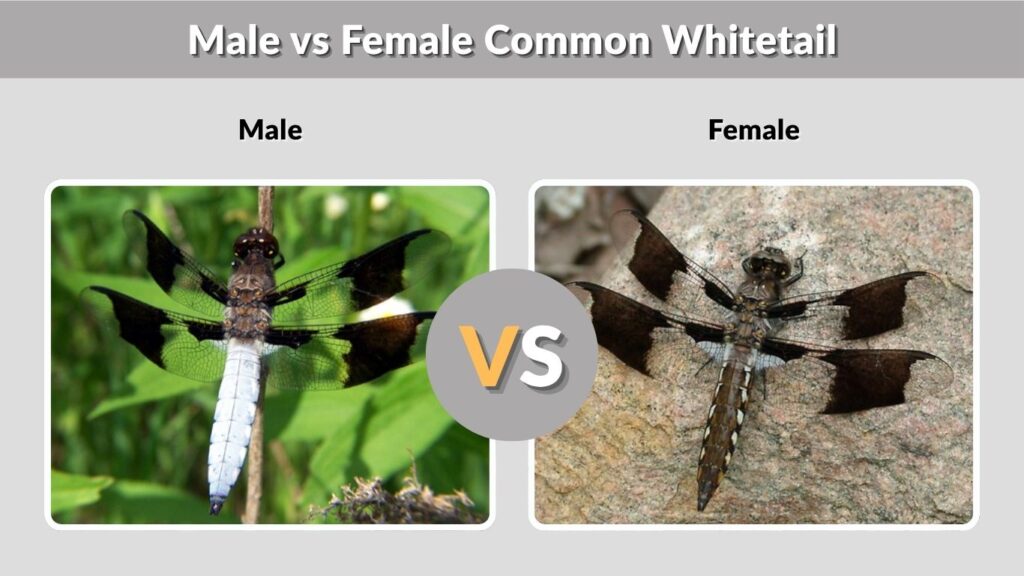
| Feature | Male | Female |
| Abdomen | Chalky white when mature | Brown with pale marks |
| Wing spots | Two main patches per wing | Three patches per wing |
| Wing tips | Usually clear | Dark patch near tips |
| Behavior | Territorial near water | Less territorial |
| Appearance when young | Brown before turning white | Remains brown |
| Visibility | Often rests openly near ponds | Frequently blends into vegetation |
Immature males can be separated from females by examining their wings. An immature male has the male’s two-patch wing pattern even while its abdomen still resembles the female’s body pattern.
Common Whitetail Dragonfly Size and Wingspan
The common whitetail is a medium-sized dragonfly. Adults generally measure around 1.7–2 inches in body length, although size varies slightly among individuals and regions.
Their wide wings give them a wingspan of roughly 2.5–3 inches. Females may have proportionally broader wings, while males possess wing shapes suited to fast acceleration and agile territorial flight. A 2024 morphological study found measurable wing-shape differences between the sexes.
Despite their sturdy appearance, common whitetails are lightweight insects capable of sudden turns, hovering, rapid acceleration, and brief gliding.
Common Whitetail Dragonfly Habitat
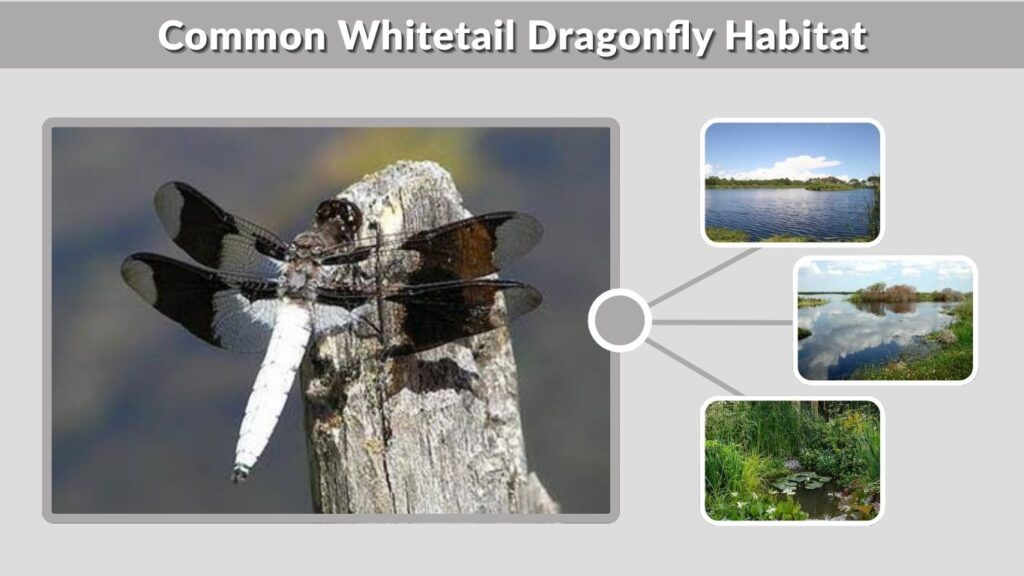
Common whitetails occupy open freshwater habitats, especially places with still or gently moving water. They tolerate disturbed environments and can be found around artificial ponds, drainage areas, and stock ponds as well as natural wetlands.
Common Habitats
- Ponds
- Small lakes
- Marshes
- Slow-moving streams
- Quiet stream pools
- Reservoir margins
- Muddy wetlands
- Farm and stock ponds
- Gravel pits
- Garden ponds
They often favor sunny shores with open patches of soil, rocks, logs, and low vegetation. These surfaces provide convenient places for basking and watching for prey.
Adults may also leave the water and hunt in fields, gardens, woodland openings, and roadside clearings.
Range and Distribution
The common whitetail occurs throughout much of North America. Its range covers most of the continental United States and extends into southern Canada.
It is absent or less frequently encountered in some very dry areas, cold northern regions, and high mountain environments where suitable warm, slow-moving water is limited.
The exact flight season varies with climate. Adults may appear during spring in warmer southern areas and remain active through summer or early fall. In cooler northern regions, they generally emerge later and have a shorter season.
In Wisconsin, for example, adults are commonly observed from approximately mid-May through late August.
Common Whitetail Dragonfly Diet and Hunting Behavior
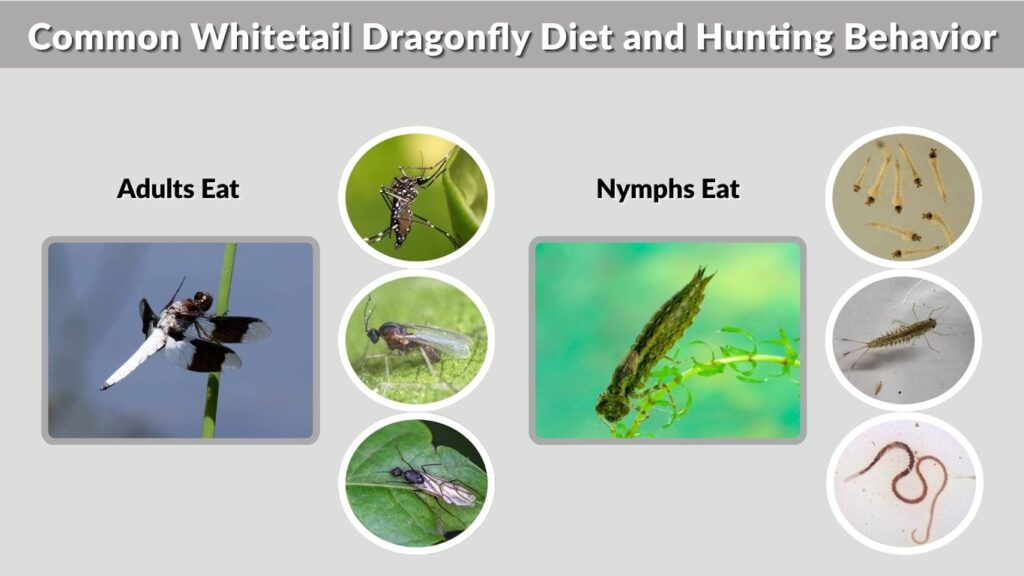
Common whitetails are predators during both their adult and aquatic stages.
What Adults Eat
Adults consume small airborne insects, including:
- Mosquitoes
- Midges
- Gnats
- Houseflies
- Flying ants
- Mayflies
- Small moths
- Aphids
- Smaller dragonflies
A whitetail often waits on a low perch until an insect passes. It then launches quickly, captures the prey with its spiny legs, and may return to the same perch to eat.
This hunting style is called perching or sallying. It differs from dragonflies that patrol continuously for long periods.
What Nymphs Eat
Aquatic nymphs prey on:
- Mosquito larvae
- Mayfly nymphs
- Aquatic worms
- Small crustaceans
- Other insect larvae
- Tadpoles
- Tiny fish
- Smaller dragonfly nymphs
The nymph uses an extendable lower mouthpart to seize prey rapidly. It may hide in mud, plant material, or algae while waiting for an animal to approach.
Common Whitetail Lifecycle
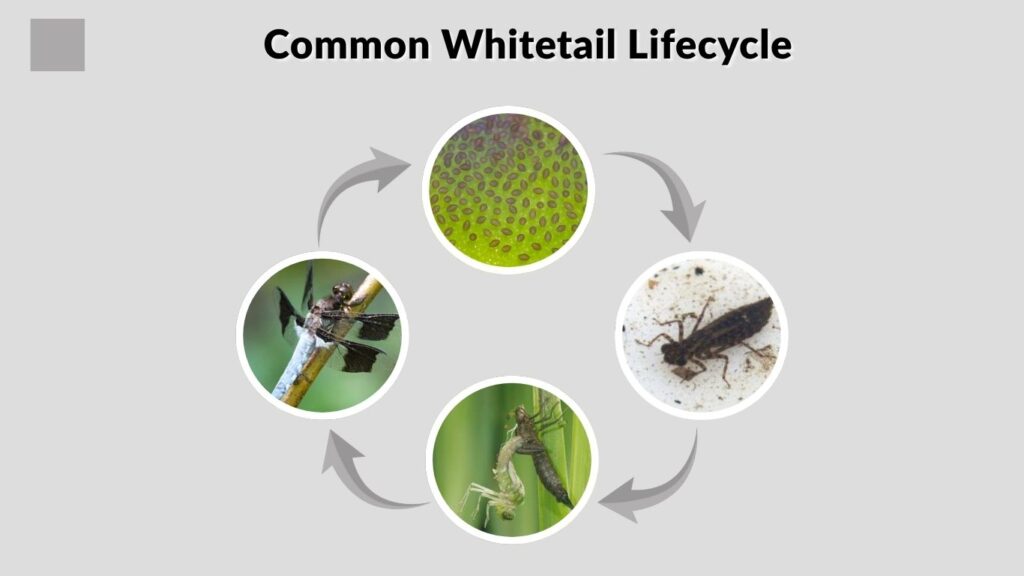
The common whitetail undergoes incomplete metamorphosis, progressing through egg, aquatic nymph, and adult stages. It has no caterpillar or pupal stage.
Egg Stage
After mating, the female flies low over the water and repeatedly touches the surface with the tip of her abdomen. This action releases eggs into suitable shallow areas.
A male may hover nearby and chase away rivals while the female lays her eggs. The parents provide no care after the eggs are deposited.
Aquatic Nymph Stage
The eggs hatch into aquatic nymphs, also called naiads. These nymphs are generally brown or dark green and may become coated with algae, helping them blend into the bottom.
They feed, grow, and shed their outer skin several times. Dragonflies spend most of their lives underwater, and larval development commonly takes months or longer, depending on water temperature, food, and climate.
Emergence
When fully developed, the nymph climbs out of the water onto a stem, rock, log, or bank. Its skin splits, allowing the winged adult to emerge.
The new adult is initially soft and pale. Its wings expand and harden before it can fly effectively. The empty nymph skin, called an exuvia, remains attached to the emergence surface.
Adult Stage
The adult spends several weeks hunting, maturing, defending territory, mating, and producing the next generation.
A young male does not immediately have a white abdomen. The characteristic pale coating becomes stronger as he matures.
Common Whitetail Nymph Identification
The aquatic nymph has a compact body, six legs, developing wing pads, and a broad abdomen. Its dark brown or green coloration helps it disappear among mud and plant debris.
Common whitetail nymphs can be difficult to distinguish from the immature stages of related skimmers without close examination. They breathe underwater using internal gills located in the rectal chamber.
By rapidly expelling water, a nymph can propel itself forward to escape a predator. This jet-like movement is one of the dragonfly nymph’s most notable adaptations.
Common Whitetail vs Twelve-Spotted Skimmer
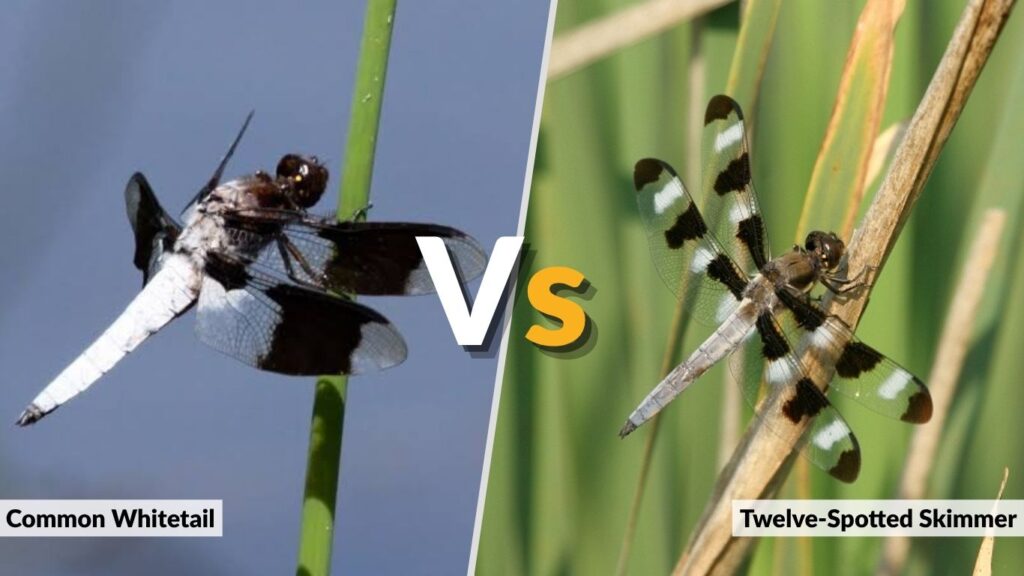
Female common whitetails are frequently confused with female twelve-spotted skimmers because both have brown bodies and spotted wings.
| Feature | Common Whitetail | Twelve-Spotted Skimmer |
| Female abdomen | Shorter and broader | Longer and slimmer |
| Female body markings | Pale zigzag or angled marks | Straighter yellow stripes |
| Mature male abdomen | White or pale blue | Powdery blue-gray |
| Male wings | Broad central dark bands | Alternating dark and white spots |
| General build | Stocky | More elongated |
The male twelve-spotted skimmer has white patches between the dark wing spots, producing a more strongly checkered wing pattern. A mature male common whitetail has broad dark bands but lacks the same series of white wing patches.
Are Common Whitetail Dragonflies Dangerous?
Common whitetails are not dangerous to people. They have no stinger, no venom, and no interest in attacking humans.
Their jaws are adapted for crushing small insects. A captured dragonfly might attempt a minor defensive nip, but it is unlikely to cause a meaningful injury.
They are beneficial visitors around ponds and gardens because they eat mosquitoes, midges, flies, and other insects. However, one dragonfly cannot eliminate an entire mosquito population.
Adaptations
Common whitetails possess several adaptations that help them survive as aerial and aquatic predators.
Their large compound eyes detect movement across a broad visual field. Their independently controlled wings allow rapid turns, hovering, and acceleration, while their spiny legs form a basket for catching insects.
The nymph’s camouflage helps it ambush underwater prey. Its extendable mouthpart provides a fast strike, and its ability to propel itself by expelling water offers an emergency escape mechanism.
Mature males also use their conspicuous white abdomens during territorial displays, making body coloration part of their reproductive behavior.
Common Whitetail Dragonfly Meaning and Symbolism
Dragonfly symbolism varies among cultures and individuals. The common whitetail is sometimes associated with transformation, adaptability, clarity, confidence, and personal change.
Its symbolic connection with transformation comes from its lifecycle: it begins as an aquatic nymph and later emerges as a highly mobile flying adult. The male’s change from a patterned brown abdomen to a bright white one may also inspire ideas of maturity or renewal.
These interpretations are cultural and spiritual beliefs rather than biological facts. Scientifically, seeing a common whitetail usually indicates that freshwater habitat and sufficient insect prey exist nearby.
FAQs
What is the scientific name of the common whitetail?
The common whitetail’s scientific name is Plathemis lydia. It belongs to the family Libellulidae, which contains skimmers and many other familiar pond-dwelling dragonflies.
How can you identify a male common whitetail?
A mature male has a broad chalky-white abdomen, a dark thorax, and broad black or brown bands across otherwise transparent wings. Its wing tips are generally clear, and it frequently rests on low exposed surfaces near water.
What does a female common whitetail look like?
A female has a brown abdomen marked with pale yellowish or white patches. Each wing usually displays three dark areas, including a patch near the tip. She does not develop the mature male’s powdery white abdomen.
Do common whitetail dragonflies bite?
They do not normally bite humans and cannot sting. A dragonfly held roughly might attempt a small defensive nip, but it is not venomous and does not present a meaningful danger.
How long does a common whitetail dragonfly live?
Most of its life is spent underwater as a nymph, potentially lasting many months or longer depending on environmental conditions. The winged adult generally lives for only several weeks, during which it feeds, mates, and lays eggs.