
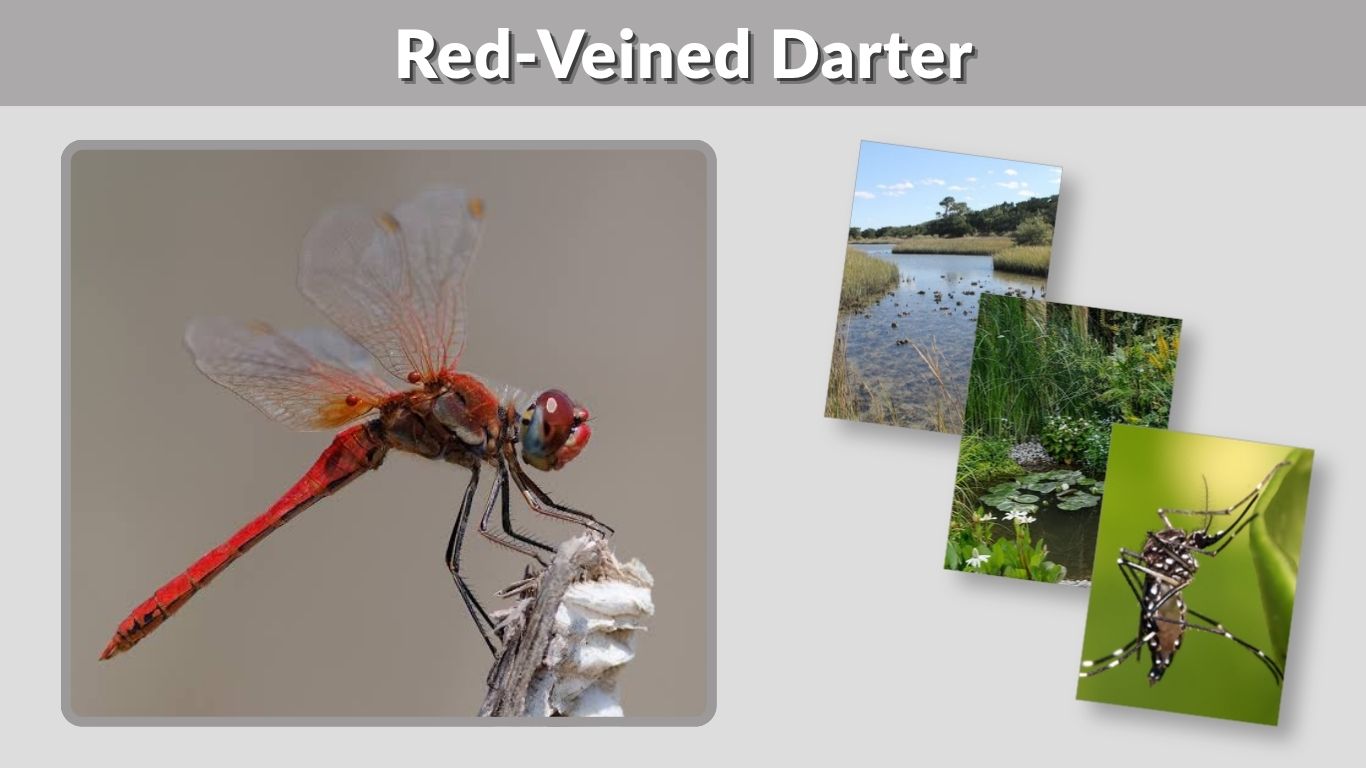
The red-veined darter is a colorful, highly mobile dragonfly recognized by its bright abdomen, tinted wing bases, distinctive eyes, and colored wing veins. Its scientific name is Sympetrum fonscolombii, and it is also sometimes called the nomad because individuals can travel considerable distances between suitable wetlands.
The species is widespread across warmer regions of Europe, Africa, and Asia. It regularly migrates northward, occasionally appearing in Britain and Ireland during warm weather. Although its vivid red coloring can look dramatic, the red-veined darter is harmless to people.
Red-Veined Darter Overview
The red-veined darter belongs to the family Libellulidae, which includes many of the familiar skimmers and darters seen around ponds. It is a medium-sized dragonfly that frequently rests on exposed vegetation, bare ground, stones, and low perches.
| Characteristic | Information |
| Scientific name | Sympetrum fonscolombii |
| Common name | Red-veined darter |
| Order | Odonata |
| Family | Libellulidae |
| Body length | Approximately 38–40 mm |
| Male color | Bright red |
| Female color | Yellow, ochre, or light brown |
| Diet | Small flying insects |
| Habitat | Ponds, marshes, lakes, rivers, and shallow wetlands |
| Conservation status | Least Concern |
| Dangerous to humans | No |
The species is considered widespread and common across much of its range. Its European population has been assessed as increasing, although numbers can fluctuate considerably because of its migratory lifestyle.
Red-Veined Darter Identification
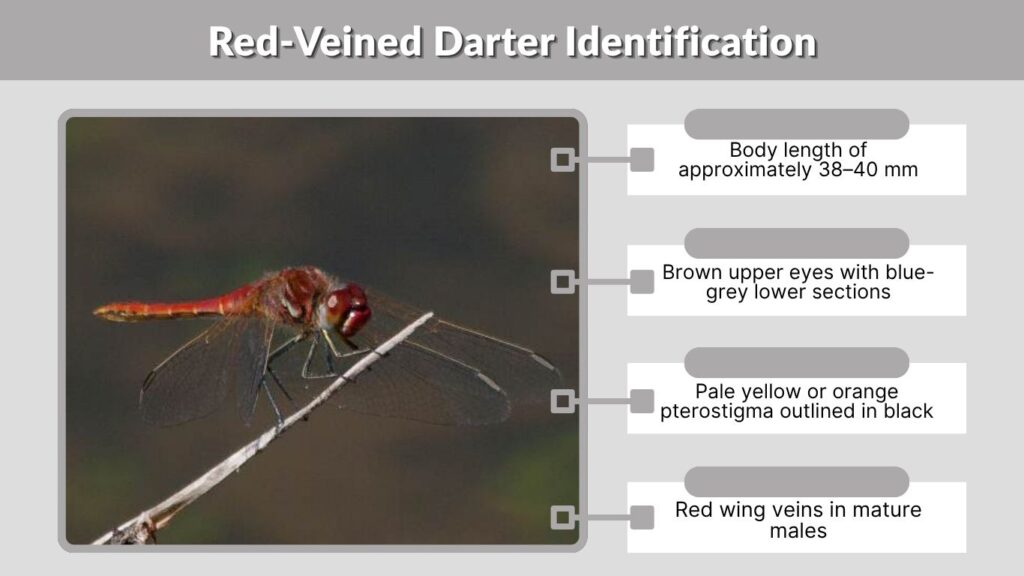
Identifying this dragonfly requires more than looking for a red abdomen. Several related darters also become red when mature, so observers should examine the eyes, legs, wings, abdomen, and pterostigma.
Key Identification Features
- Body length of approximately 38–40 mm
- Brown upper eyes with blue-grey lower sections
- Pale yellow or orange pterostigma outlined in black
- Yellow patches near the bases of the hindwings
- Slender legs marked with yellow
- Red wing veins in mature males
- Yellowish wing veins in females
- Long, narrow abdomen
- Dark markings near the final abdominal segments
The blue-grey underside of the eyes is one of the most useful identification features. The contrasting pale pterostigma and yellow hindwing bases also help separate it from common, ruddy, and broad-bodied darters.
Male Red-Veined Darter
A mature male has a vivid red abdomen, reddish-brown thorax, and red veins running through parts of the wings. The veins are often most noticeable along the front edges of the wings.
Its eyes are distinctly two-toned, appearing brown or reddish above and blue-grey below. The legs are generally dark with lighter yellow markings rather than entirely black.
Immature males can be confusing because they initially resemble females. Their bodies begin yellow or ochre and gradually become red as they mature. The wing veins also develop a stronger reddish appearance.
Female Red-Veined Darter
Female red-veined darters are usually yellow, ochre, or pale yellow-brown rather than bright red. Two narrow dark lines may run along the sides of the abdomen, and small black markings are visible near its tip.
The veins along the front edges and bases of the wings are commonly yellow. Females also possess the same brown upper eyes and blue-grey lower eyes seen in males.
Older females may develop reddish or brownish tones, making them harder to distinguish from immature or weakly colored males. Body structure, abdominal markings, and reproductive appendages may need to be examined for confident identification.
Red-Veined Darter Habitat
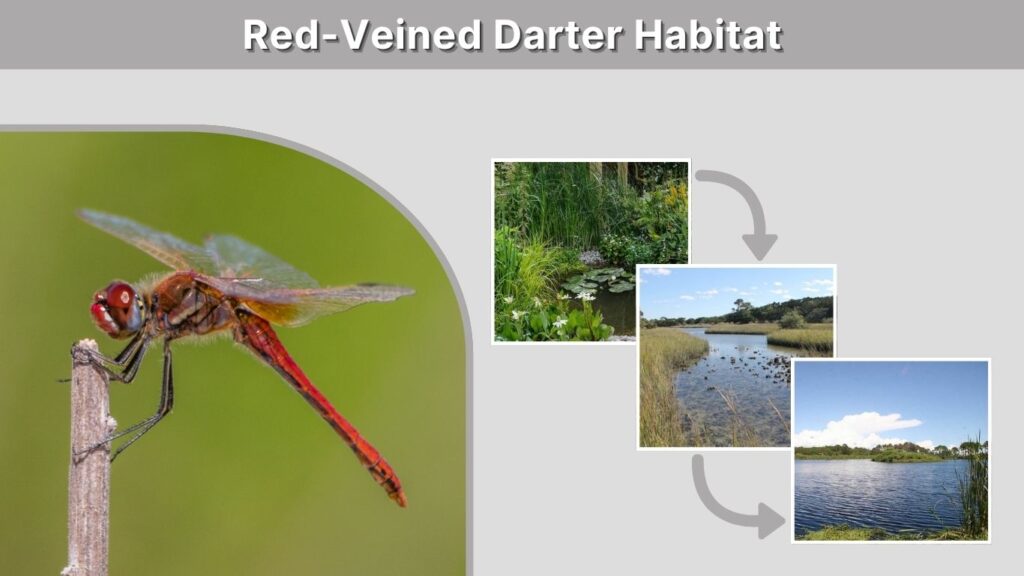
Red-veined darters can use a broad selection of freshwater environments. They are especially successful around warm, sunny, shallow water where aquatic vegetation and open muddy margins are available.
Common Habitats
- Shallow ponds
- Temporary pools
- Marshes and wetlands
- Gravel pits
- Lakes and reservoirs
- Slow and seasonal rivers
- Rice fields
- Brackish coastal pools
- Recently created wetlands
The species can reproduce in both permanent and temporary waters. It is often among the first dragonflies to occupy recently flooded pools or newly created ponds.
Warm water allows the larvae to develop quickly. This helps the species reproduce in temporary habitats that may dry out later in the season.
Distribution and Range
The red-veined darter has an exceptionally broad distribution. It occurs across much of Africa, southern and central Europe, the Middle East, and parts of Asia.
Its populations are strongly migratory and dispersive. Large numbers can move north during favorable weather, reaching regions beyond their usual breeding range.
In southern Europe, it can be locally common around shallow lakes, marshes, river margins, and rice paddies. In northern Europe, its presence is less predictable and often depends on warm winds and suitable breeding conditions.
Red-Veined Darter in the UK
The red-veined darter is considered a fairly frequent migrant to Britain, especially in southern England. Records have increased since the 1980s, and breeding has been observed repeatedly. However, many colonies are temporary rather than permanently established.
Sightings are most likely during warm migration years at:
- Coastal wetlands
- Shallow gravel pits
- Newly flooded pools
- Reservoir margins
- Marshes
- Warm ponds with open banks
Individuals may also appear farther north, including Norfolk and other regions with suitable shallow wetlands. Numbers vary greatly from year to year.
Red-Veined Darter in Ireland
The species is much less frequently recorded in Ireland than in southern Britain. However, confirmed observations have been documented through Ireland’s National Biodiversity Data Centre.
Most Irish appearances are likely associated with long-distance migration from continental Europe or Britain. Warm southerly winds may carry adults across the sea, especially during major dragonfly migration events.
A single sighting does not necessarily indicate a permanent breeding population. Repeated observations of freshly emerged adults would provide stronger evidence of local reproduction.
Diet and Hunting Behavior
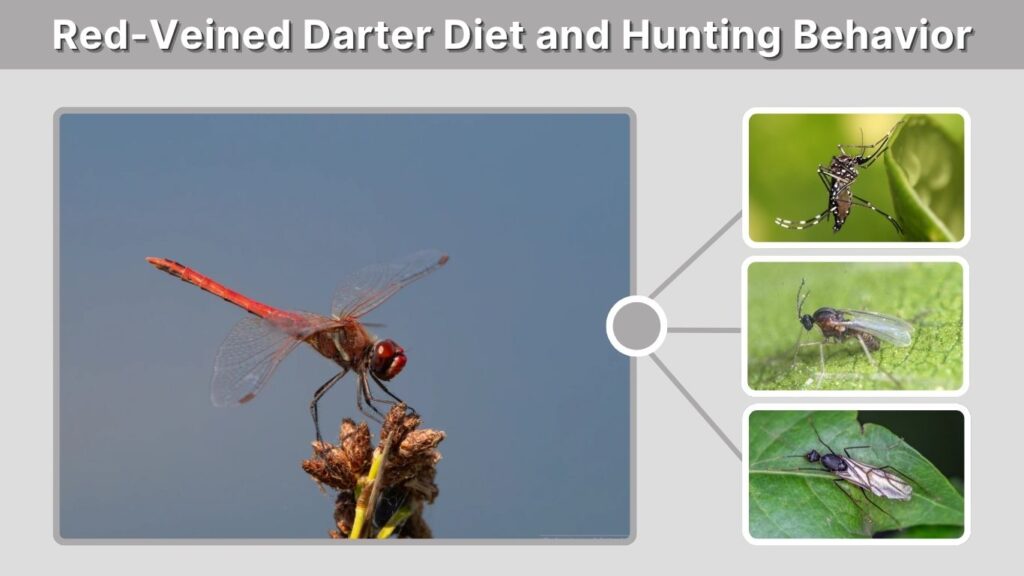
Adult red-veined darters are carnivorous aerial hunters. They capture small insects in flight using their spiny legs, which form a basket around the prey.
Their diet may include:
- Mosquitoes
- Midges
- Small flies
- Flying ants
- Tiny moths
- Aphids
- Other small airborne insects
An adult commonly waits on a perch and watches for movement. When prey passes nearby, the dragonfly launches rapidly, captures the insect, and may return to the same perch to feed.
The aquatic larvae are also predators. They consume mosquito larvae, small worms, aquatic insects, tiny crustaceans, and other animals small enough to overpower.
Lifecycle and Reproduction
The red-veined darter undergoes incomplete metamorphosis, passing through egg, aquatic nymph, and adult stages.
Mating dragonflies form the familiar wheel-shaped position. After mating, the female deposits eggs over or near shallow water. The male may remain attached or fly close beside her during egg-laying.
The eggs hatch into aquatic nymphs that hunt among mud and vegetation. Development can be relatively rapid in warm temporary waters. Once fully grown, the nymph climbs from the water, sheds its final skin, and emerges as a winged adult.
This fast lifecycle allows the species to establish temporary breeding populations after major migrations.
Is the Red-Veined Darter Dangerous?
The red-veined darter is not dangerous to humans. It has no sting, produces no venom, and does not attack people.
A dragonfly has strong jaws designed for eating small insects, but it cannot seriously harm a person. A captured individual might attempt to nip in self-defense, although such an incident would be minor and unusual.
Red-veined darters are beneficial because they consume mosquitoes, midges, flies, and other small insects. Their presence often indicates that a wetland supports a productive aquatic food web.
Red-Veined Darter vs Common Darter
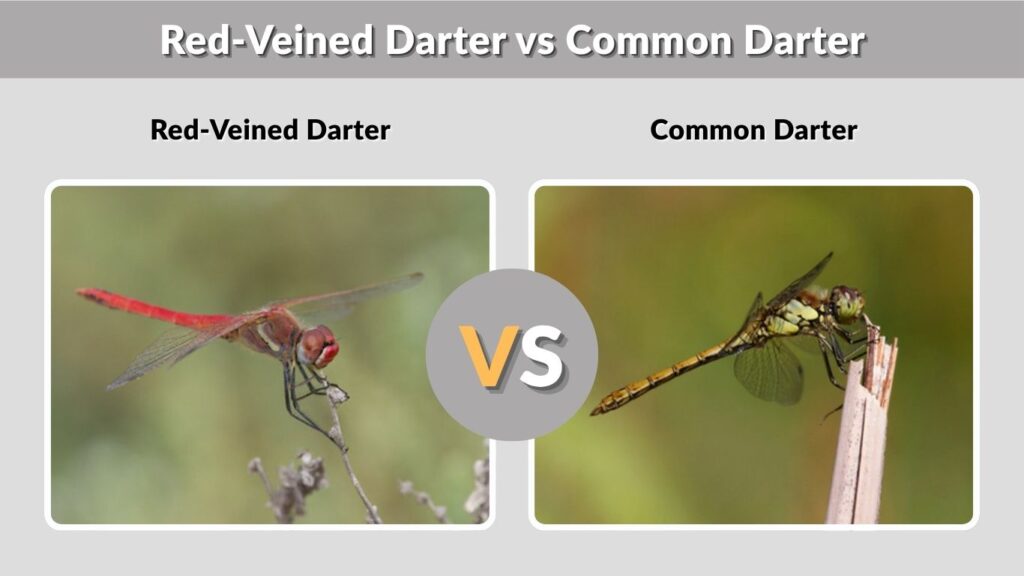
These two species may be confused because mature males of both can appear red.
| Feature | Red-Veined Darter | Common Darter |
| Male abdomen | Bright red | Orange-red to brick red |
| Lower eyes | Blue-grey | Usually not strongly blue-grey |
| Male wing veins | Noticeably red | Usually less extensively red |
| Wing bases | Yellow patches | Generally clearer |
| Pterostigma | Pale with strong black border | Often darker brown |
| Behavior | Strong migrant | Common local resident in much of Europe |
The eye color, wing bases, and pale pterostigma are generally more reliable than body color alone.
Conservation Status
The red-veined darter is classified as Least Concern in the European assessment. It remains widespread, can occur in high densities, and is capable of colonizing new wetlands quickly. Its European population trend is currently considered increasing.
Nevertheless, local populations can be affected by:
- Wetland drainage
- Water pollution
- Pesticide use
- Destruction of shallow ponds
- Excessive vegetation removal
- Introduction of predatory fish
- Changes in seasonal rainfall
Creating sunny, shallow ponds without fish can provide valuable breeding habitat for this and many other dragonflies.
FAQs
What is the scientific name of the red-veined darter?
The scientific name of the red-veined darter is Sympetrum fonscolombii. It belongs to the family Libellulidae and is sometimes called the nomad because of its strong migratory and dispersive behavior.
How big is a red-veined darter?
An adult red-veined darter usually measures approximately 38–40 mm in body length. It is considered a medium-sized dragonfly, with a slender abdomen, broad transparent wings, and a relatively compact thorax.
Are red-veined darters rare in the UK?
They are migrant dragonflies rather than consistently common residents. They appear most frequently in southern Britain, and records have increased over recent decades. Breeding occurs in some years, but many colonies do not remain permanently established.
Can a red-veined darter bite?
A red-veined darter does not normally bite people. It may try to nip when roughly handled, but it cannot deliver a dangerous or medically significant bite. It has no sting and no venom.
What does a female red-veined darter look like?
A female usually has a yellow, ochre, or pale brown abdomen with dark lines along the sides. Her wing veins are yellowish, while her eyes are brown above and blue-grey below. Older females sometimes develop reddish coloring.