
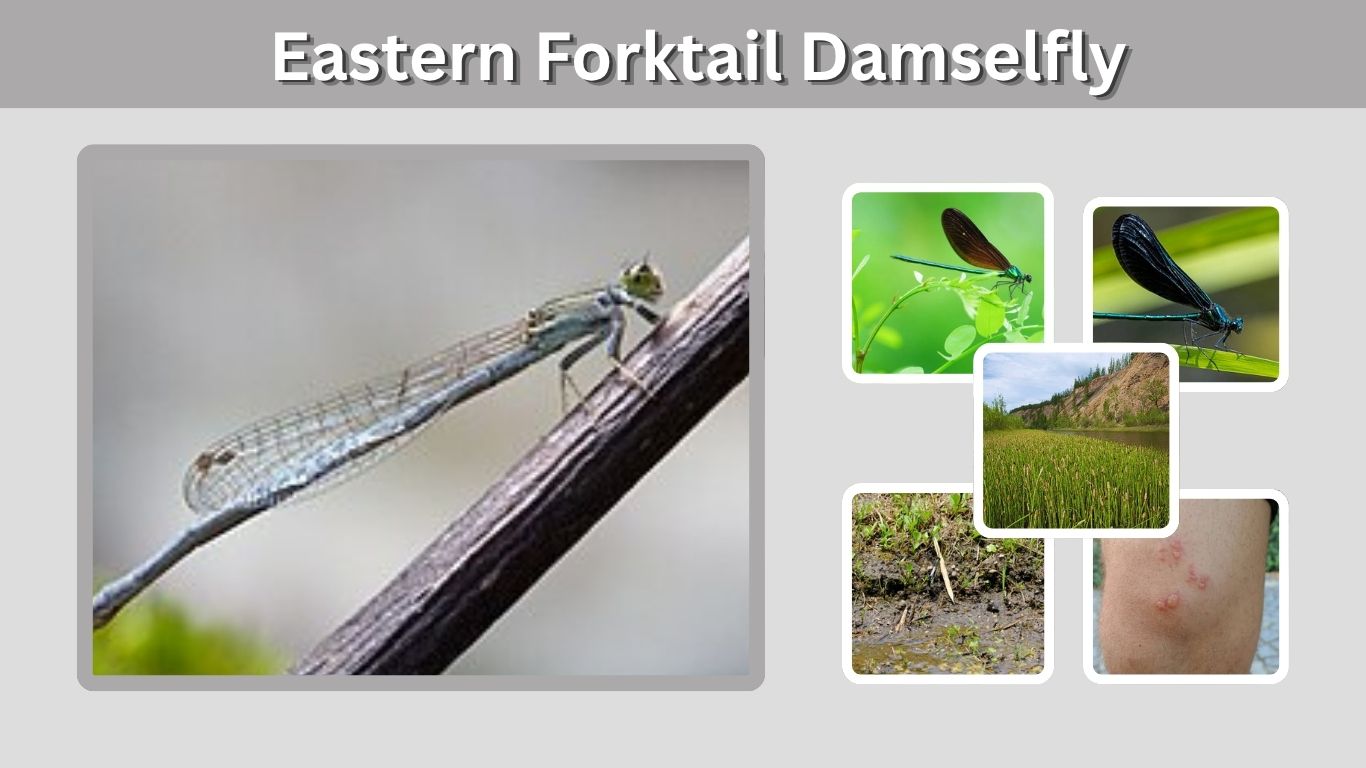
The eastern forktail, Ischnura verticalis, is a small green, black, and blue damselfly found around ponds, marshes, lake edges, ditches, and slow-moving streams. Mature males are recognizable by their green-striped thorax and bright blue abdominal tip. Females are more challenging because their coloration changes from orange when young to powdery blue-gray as they mature.
Eastern Forktail Quick Facts
The eastern forktail belongs to the narrow-winged damselfly family Coenagrionidae. It is a damselfly—not a true dragonfly—although both belong to the insect order Odonata. Adults typically measure about 22–30 millimeters, or approximately 0.9–1.2 inches.
| Feature | Description |
| Scientific name | Ischnura verticalis |
| Family | Coenagrionidae |
| Order | Odonata |
| Adult length | About 22–30 mm |
| Main colors | Green, black, blue, orange, or gray |
| Habitat | Vegetated ponds, marshes and slow water |
| Diet | Small insects |
| Flight season | Spring through early fall |
| Danger to humans | Harmless |
Eastern Forktail Identification
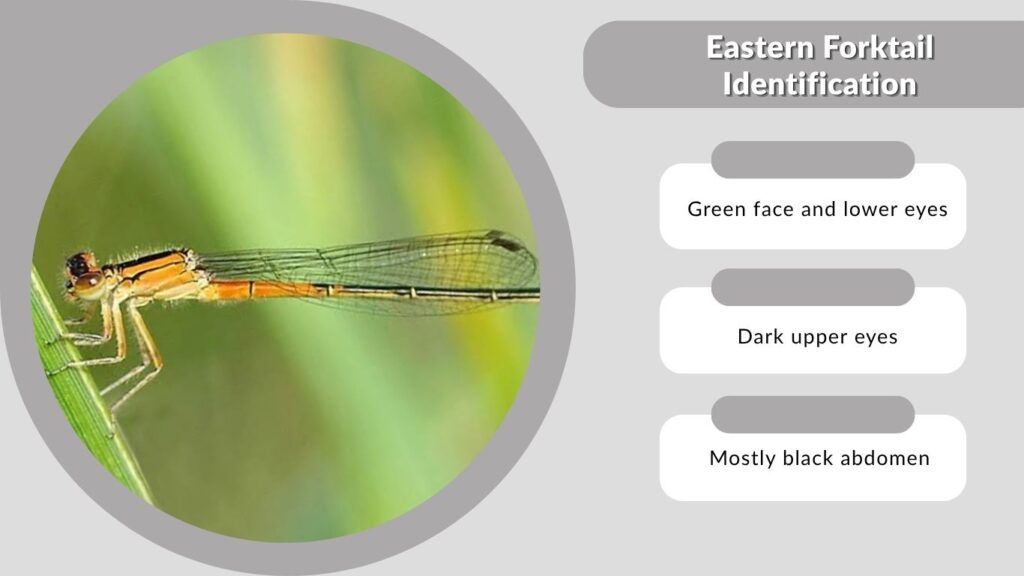
Eastern forktails are extremely slender, with large separated eyes, six thin legs, and two pairs of clear wings. At rest, they usually hold their wings together over the abdomen. The adult’s exact appearance depends heavily on sex and age.
Male Eastern Forktail
A mature male has one of the species’ most recognizable patterns:
- Green face and lower eyes
- Dark upper eyes
- Small green or blue spots behind the eyes
- Black upper thorax with green shoulder stripes
- Pale-green sides of the thorax
- Mostly black abdomen
- Thin pale rings between abdominal segments
- Bright blue coloration on abdominal segments eight and nine
- Small black marks along the sides of the blue tip
The tiny projections at the male’s abdominal tip give members of the genus Ischnura the name “forktails.” These structures are reproductive appendages used to hold the female during mating.
Female Eastern Forktail
Female eastern forktails change dramatically as they age. A newly emerged or immature female commonly has a bright-orange thorax, orange spots behind the eyes, and orange coloration around the abdomen’s base. Black stripes run along the upper thorax, while most of the abdomen becomes dark.
As the female matures, the orange coloration fades and is replaced by a dusty or powdery blue-gray coating. Older females may have few obvious markings because this waxy coating obscures the original pattern. Rare females retain a male-like blue-and-green appearance but usually show more black on the eighth abdominal segment.
Back of the Eastern Forktail’s Head
Small colored patches behind the compound eyes are called postocular spots. Males usually have small greenish or blue spots on the back of the head. Immature females have orange postocular spots, while mature females develop pale-blue ones.
These spots help with identification, but they should be considered together with the thoracic stripes and abdominal pattern. Lighting can make green spots appear blue in photographs.
Eastern Forktail Damselfly vs Dragonfly
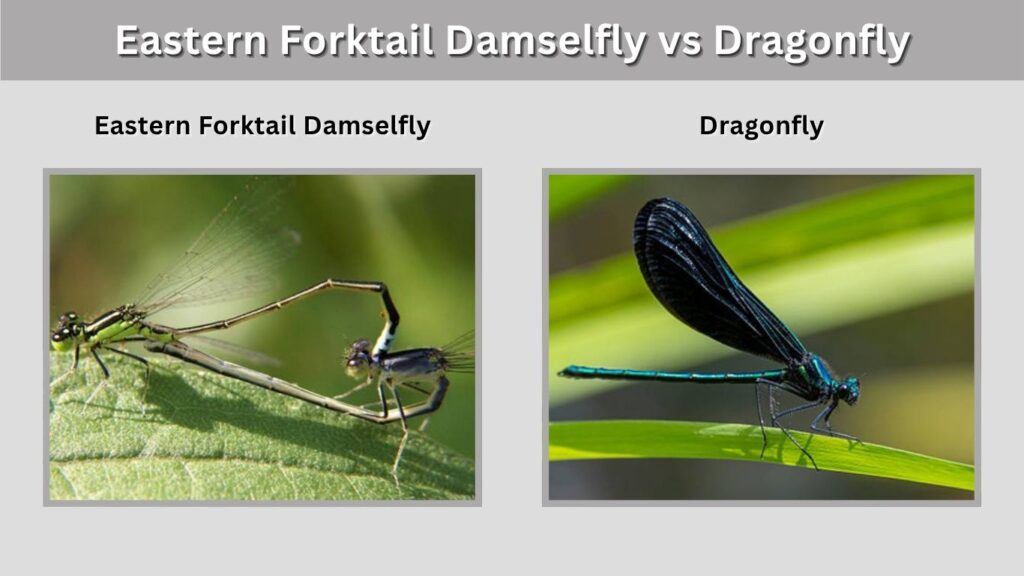
The eastern forktail is sometimes called an “eastern forktail dragonfly,” but it is technically a damselfly.
| Eastern forktail damselfly | Typical dragonfly |
| Very slender body | Usually thicker body |
| Eyes clearly separated | Eyes often touch or nearly touch |
| Wings usually folded over abdomen | Wings usually held open |
| Weak, fluttering flight | Faster, stronger flight |
| Usually remains close to vegetation | Often patrols open water |
Damselflies and dragonflies are both predators as adults and during their aquatic juvenile stages. The differences mainly involve body shape, eye position, wing posture, and flight behavior.
Eastern Forktail Habitat and Range
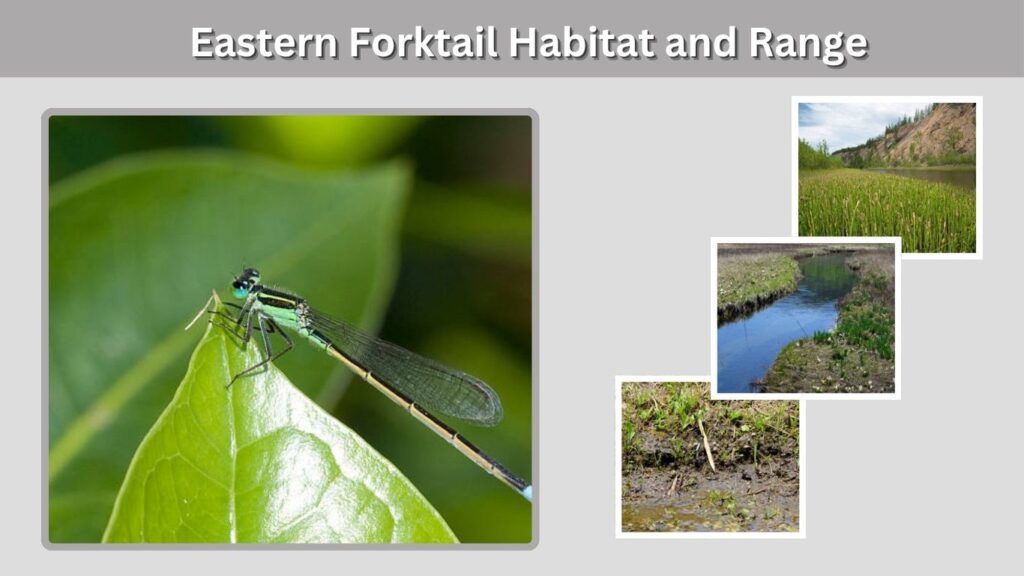
Eastern forktails occupy many freshwater environments but are particularly common around small, well-vegetated ponds. They also live along marshes, lakes, slow streams, quiet river edges, spring-fed ditches, and wetlands with grasses or sedges.
Adults usually remain low among plants beside the water, where they hunt, rest, mate, and avoid larger dragonflies. Their range extends from the Atlantic Coast through the Midwest and parts of the Great Plains, from southern Canada southward into much of the eastern United States.
When Are Eastern Forktails Active?
Eastern forktails are often among the first damselflies to appear in spring. Their exact flight period varies with latitude and weather, but adults may be observed from spring into early fall. In warmer areas, the season may be longer, while northern populations are most noticeable during late spring and summer.
Eastern Forktail Diet and Hunting Behavior
Eastern forktails are predators that capture tiny insects. Adults hunt mosquitoes, gnats, midges, small flies, and other soft-bodied prey in vegetation surrounding wetlands.
They usually perch on a leaf or stem, watch for movement, and make short flights to seize passing insects. Females can be especially aggressive hunters and may capture other damselflies. This predatory behavior helps control small flying-insect populations around freshwater habitats.
Mating and Life Cycle
During mating, the male uses the appendages at the end of his abdomen to hold the female behind her head. The female then bends her abdomen forward, creating the wheel-shaped mating position associated with dragonflies and damselflies.
Female eastern forktails generally lay eggs without the male attached. They insert eggs into floating or emergent plant material, including grasses, sedges, stems, and dead leaves.
The eggs hatch into aquatic nymphs that live underwater. These nymphs are predators of mosquito larvae, small aquatic insects, and other tiny animals. After growing through several molts, a mature nymph climbs onto vegetation, sheds its skin, and emerges as a winged adult.
Eastern Forktail vs Fragile Forktail
The fragile forktail, Ischnura posita, is one of the species most likely to be confused with an eastern forktail.
| Feature | Eastern forktail | Fragile forktail |
| Shoulder stripe | Usually long and continuous | Broken like an exclamation mark |
| Male tail | Bright blue on segments 8–9 | Usually lacks a bright blue tip |
| Young female | Bright orange | Not normally orange |
| Mature female | Powdery blue-gray | Blue-gray with markings obscured |
| Habitat | Many vegetated wetlands | Dense vegetation around wetlands |
The fragile forktail’s broken green shoulder stripe resembles a sideways exclamation mark. Eastern forktails normally have longer continuous stripes, although occasional males may develop a partly broken pattern.
Eastern Forktail vs Citrine Forktail
The citrine forktail, Ischnura hastata, is easier to recognize in its male form. Males are primarily yellow, with black triangular or spearhead markings along the upper abdomen. Their abdominal tips are yellow rather than blue.
A small forktail with a strongly yellow abdomen is therefore more likely to be a male citrine forktail than a mature male eastern forktail. Female citrine forktails can be orange when young and blue-gray when older, so female identification may require careful examination.
Eastern Forktail vs Rambur’s Forktail
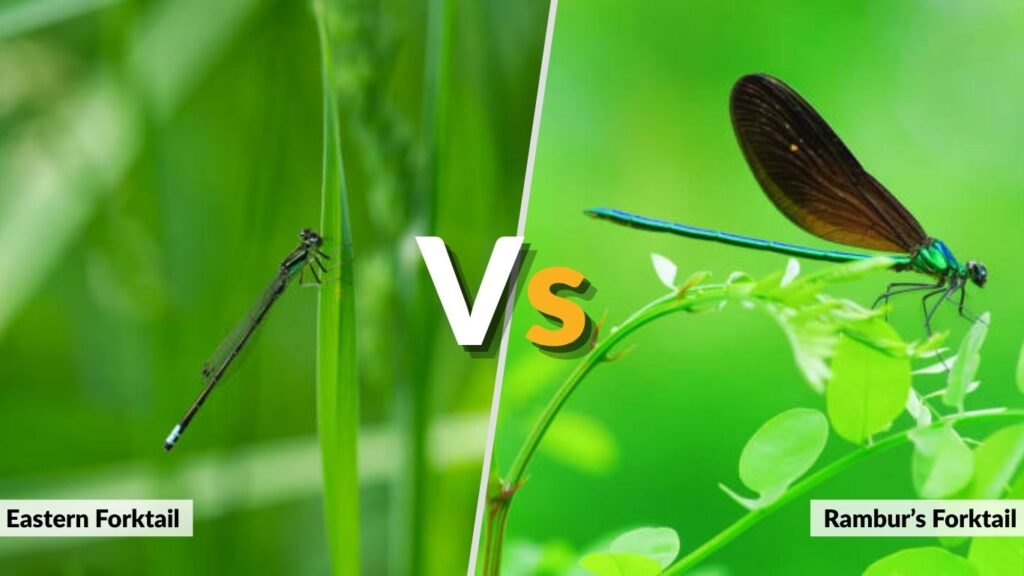
Rambur’s forktail, Ischnura ramburii, is generally larger and more southern. Males have green eyes with dark caps, tiny blue postocular spots, and a bright-green thorax with a dark metallic upper surface.
Rambur’s females occur in several color forms, including orange immature females and male-like females. Geographic location is especially useful because Rambur’s forktail is primarily associated with warmer southern regions, while eastern forktails extend farther north.
Eastern vs Western Forktail
Male eastern and western forktails are extremely similar. Range is often the most practical clue, but the two may overlap in parts of the Great Plains and Rocky Mountain region.
Where both species occur, reliable identification may require close examination of the appendages at the abdomen’s tip. A distant photograph showing only the blue tail and green thorax may not provide enough detail for a confident identification.
Are Eastern Forktails Dangerous?
Eastern forktails are harmless to humans. They have no stinger and do not feed on blood. Their mouthparts are designed to capture tiny insect prey and are not capable of causing a medically significant bite.
They are beneficial wetland predators and should be left undisturbed. Their presence often indicates nearby standing or slow-moving water with enough vegetation to support aquatic insect life.
FAQs
What does a male eastern forktail look like?
A male has a green face, green-and-black thorax, mostly black abdomen, and bright-blue coloration on abdominal segments eight and nine. Small green or blue spots are visible behind its eyes.
What does a female eastern forktail look like?
Young females are bright orange and black. As they mature, they become powdery blue-gray. Rare females resemble males but generally have a bluer thorax and more black on the abdomen’s blue tip.
Is an eastern forktail a dragonfly?
It belongs to the dragonfly order Odonata but is specifically a damselfly. It has a thin body, separated eyes, and narrow wings that are normally folded together over the abdomen.
Why does an eastern forktail have a blue tail?
The blue tip is part of the mature male’s normal coloration and helps distinguish it from many similar damselflies. The blue usually covers the eighth and ninth abdominal segments.
Where can eastern forktails be found?
Look around vegetated ponds, marshes, slow streams, ditches, lake margins, and quiet river edges. Adults commonly perch low on grasses, sedges, and other plants close to the water.