
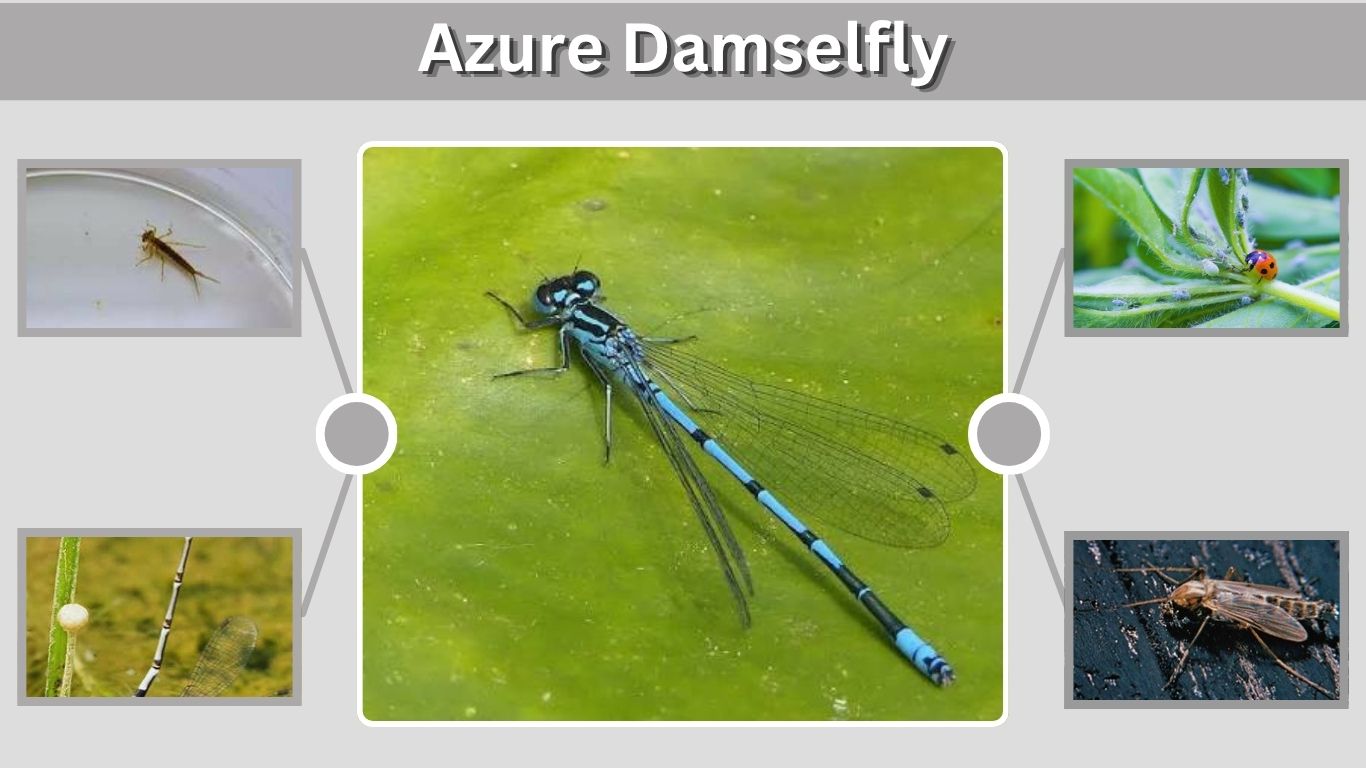
The azure damselfly is a small, slender insect known for the striking blue-and-black pattern of mature males. Scientifically named Coenagrion puella, it is commonly seen around ponds, ditches, slow streams, lakes, and garden water features. Females are usually green and black, while newly emerged adults appear much paler. Because several damselflies share similar blue markings, close attention to the thorax and abdomen is needed for reliable identification.
What Is an Azure Damselfly?
The azure damselfly belongs to the family Coenagrionidae, a large group of small pond damselflies. It grows to approximately 33 millimeters long and has a narrow abdomen, widely separated eyes, and two pairs of transparent wings that are usually held together over the body when resting.
| Feature | Azure Damselfly |
| Scientific name | Coenagrion puella |
| Family | Coenagrionidae |
| Length | About 33 mm |
| Male color | Pale blue and black |
| Female color | Usually green and black |
| Main male marking | Black U shape on abdominal segment two |
| Habitat | Ponds, streams, ditches, and lake margins |
| UK flight season | May to September |
The species is widespread across much of Europe. In Britain, it is very common throughout England and Wales and occurs in the lowlands of southern and central Scotland, with its distribution expanding farther north.
Azure Damselfly Identification
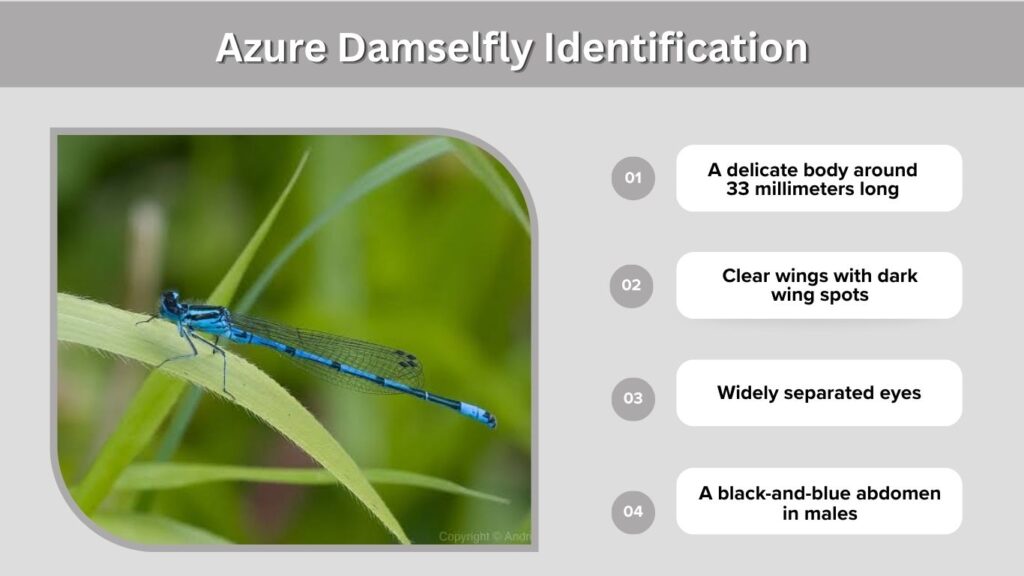
Mature males are easier to identify than females because they display a distinctive blue-and-black pattern. However, the azure damselfly can still be confused with the common blue, variable, northern, Irish, and other closely related damselflies.
Key Identification Features
Look for the following combination:
- A delicate body around 33 millimeters long
- Two narrow blue or green shoulder stripes on the thorax
- A short black line, called the Coenagrion spur, on the thorax’s side
- Clear wings with dark wing spots
- Widely separated eyes
- A black-and-blue abdomen in males
- A green-and-black abdomen in most females
- A flat-bottomed black U-shaped marking on the male’s second abdominal segment
The U-shaped marking is one of the most useful features, but the thin shoulder stripes and Coenagrion spur should also be checked before confirming the species.
Male Azure Damselfly
A mature male has a pale azure-blue body patterned with black bands. Directly behind the thorax, the second abdominal segment carries a black U-shaped mark. The U is normally broad and relatively flat along its bottom.
The thorax has two thin blue stripes on top. A short black spur projects from the dark line on each side of the thorax, providing another valuable clue when the insect is viewed from the side.
Female Azure Damselfly
A typical female is green and black rather than bright blue. Her abdomen is more extensively dark than that of the male, and the pale areas may appear green, yellow-green, beige, or bluish.
A less common female form has blue abdominal markings and may resemble a male. Female identification is more difficult because several related species have similar green-and-black patterns. Specialists may examine the shape of the pronotum behind the head and the precise abdominal markings.
Teneral Azure Damselfly
A teneral is an adult that has recently emerged from its aquatic larval skin. Its body is soft and weakly colored, while its wings may look pale, glossy, or slightly milky.
Teneral males may not yet display the intense blue of mature individuals. Their colors strengthen as their bodies harden, so a newly emerged azure damselfly may initially appear cream, gray, pale green, or light brown.
Azure vs Common Blue Damselfly
The common blue damselfly, Enallagma cyathigerum, is the azure damselfly’s best-known lookalike. Both have pale blue males with repeated black markings, and both may occur at the same pond.
| Characteristic | Azure Damselfly | Common Blue Damselfly |
| Segment-two mark | Flat-bottomed U shape | Mushroom or club-shaped mark |
| Shoulder stripes | Thin | Usually broader |
| Thoracic spur | Present | Absent |
| Overall appearance | More heavily black-marked | Often appears more extensively blue |
| Typical habitat use | Often near vegetated margins | Frequently active over open water |
The pattern on the second abdominal segment is the easiest starting point. A U-shaped mark suggests an azure damselfly, while a mushroom-shaped or club-like mark suggests a common blue damselfly.
The Coenagrion spur is especially valuable when the segment-two pattern is unclear. It appears as a short black extension along the thorax’s side and is present in the azure damselfly but absent in the common blue.
Azure Damselfly Habitat and Distribution
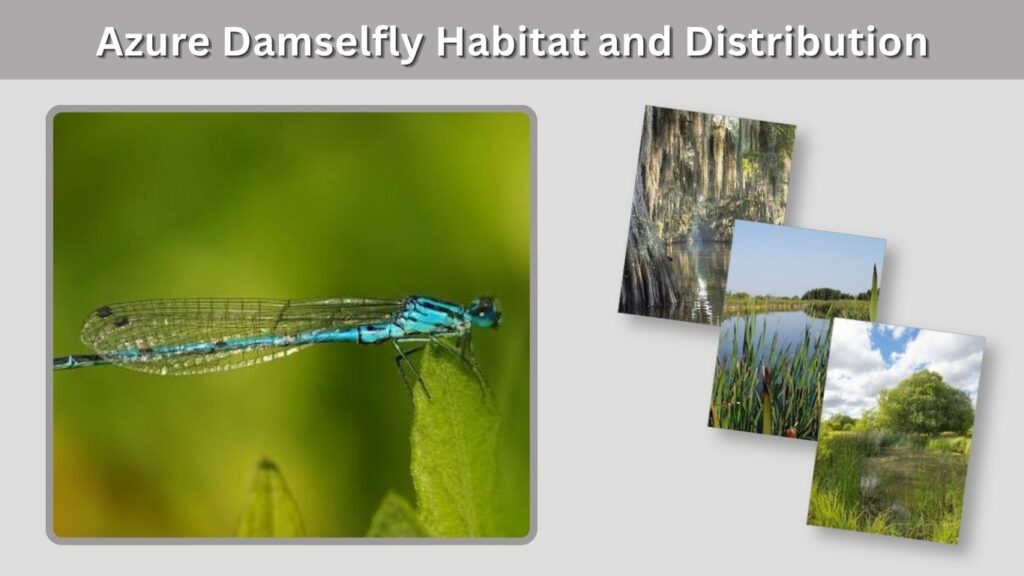
Azure damselflies occupy vegetated freshwater habitats. They are especially common around small ponds and slow streams but also occur beside larger lakes and other water bodies.
Common Habitats
They may be found around:
- Wildlife and garden ponds
- Slow-moving streams
- Drainage ditches
- Marshes and wetlands
- Lake and reservoir margins
- Woodland pools
- Vegetated canals
- Grassland close to breeding water
Adults frequently rest on grasses, reeds, rushes, and low shrubs. They may also travel away from their breeding site into nearby woodland or grassland to hunt.
In the UK, adults are generally visible from May through September. Weather and location affect the exact timing, with warm southern areas often producing earlier activity than cooler northern regions.
What Do Azure Damselflies Eat?
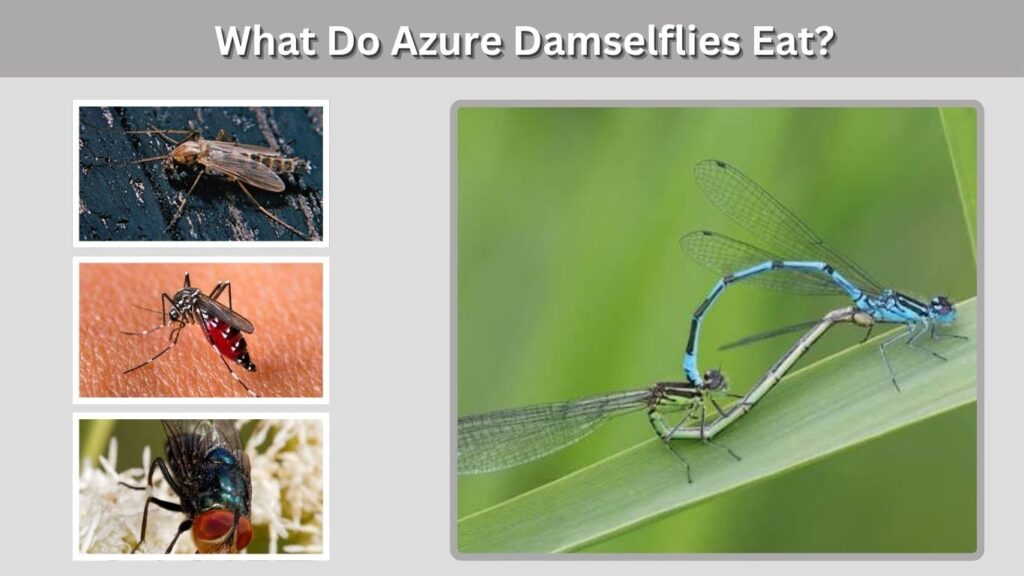
Azure damselflies are predators, despite their delicate appearance. Adults wait on vegetation and then fly out to capture tiny insects with their legs.
Their food may include:
- Midges
- Mosquitoes
- Small flies
- Aphids
- Mayflies
- Tiny moths
- Other small flying insects
After catching prey in midair, an adult may return to a perch to eat it. Damselflies are generally weaker fliers than dragonflies and frequently use this sit-and-wait hunting method.
Azure Damselfly Nymph Diet
The aquatic nymph is also a predator. It hunts small animals among submerged vegetation, mud, and debris.
Typical prey includes mosquito larvae, bloodworms, water fleas, small crustaceans, and other aquatic invertebrates. Larger odonate larvae may occasionally capture tadpoles or very small fish, although tiny invertebrates form the usual diet.
Azure Damselfly Life Cycle
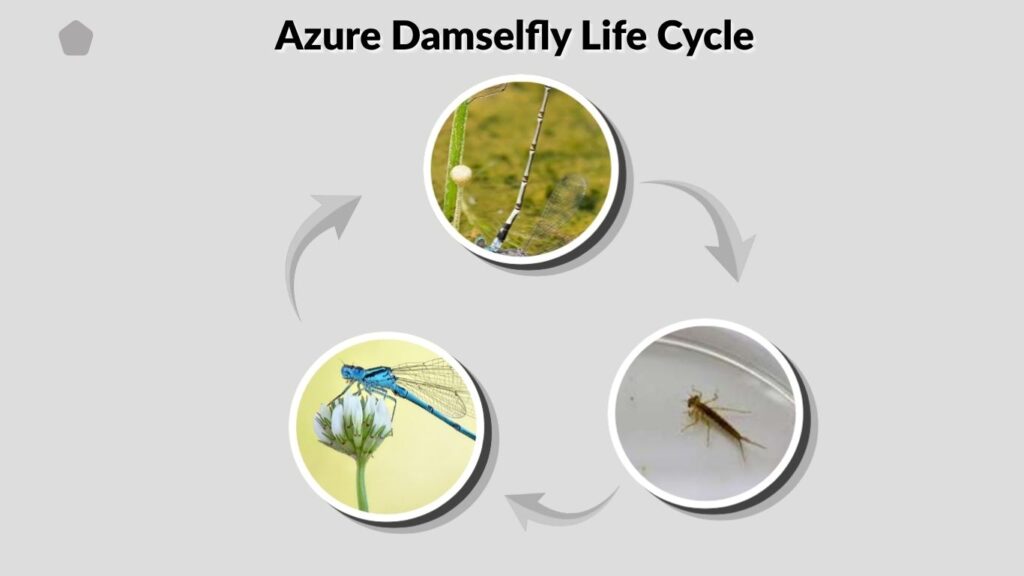
The azure damselfly undergoes incomplete metamorphosis with three main stages:
- Egg
- Aquatic nymph
- Winged adult
After mating, the female inserts her eggs into aquatic plant tissue. The eggs hatch into nymphs that live underwater, feed on small prey, and molt repeatedly as they grow.
Larval development in damselflies commonly lasts one or two years, although water temperature, food, climate, and species can alter the duration. Once fully developed, the nymph climbs out of the water onto a stem or leaf. The adult then emerges from the old skin, expands its wings, and waits for its body to harden.
Mating Behavior
The male grasps the female behind her head using appendages at the tip of his abdomen. The female then bends her abdomen forward, creating the characteristic heart-shaped mating wheel.
After mating, the pair may remain connected in tandem while the female lays eggs. This allows the male to guard her from competing males during egg deposition.
Threats and Conservation
The azure damselfly is currently common across much of its range, but local populations depend on healthy freshwater habitats. Pollution, excessive dredging, removal of aquatic vegetation, introduced fish, and the drainage of ponds or ditches can reduce suitable breeding areas.
Maintaining submerged, floating, and emergent vegetation provides places for nymphs to hide, adults to emerge, and females to deposit eggs. Fish-free garden ponds can also create useful habitat because fish frequently consume damselfly eggs and larvae.
Are Azure Damselflies Dangerous?
Azure damselflies are harmless to people and pets. They have no stinger, do not inject venom, and do not attack humans.
Their small mouthparts are designed for eating tiny insects. A damselfly might attempt to nip when tightly restrained, but it is unlikely to break the skin or cause meaningful injury. Observation and photography are better than handling because its thin legs and transparent wings are easily damaged.
FAQs
Is an azure damselfly the same as a common blue damselfly?
No. The azure damselfly is Coenagrion puella, while the common blue is Enallagma cyathigerum. Male azures have a black U-shaped mark on abdominal segment two. Common blue males usually have a mushroom-shaped or club-like marking.
What does a female azure damselfly look like?
Most females are green and black with a heavily darkened abdomen. Some appear yellow-green or brownish, while a rarer form has blue markings. Female identification may require examining the pronotum and precise abdominal pattern.
Where do azure damselflies live?
They live around ponds, ditches, streams, marshes, lake margins, and other vegetated freshwater habitats. Adults may also hunt in nearby grassland, gardens, and woodland away from their breeding water.
What do azure damselflies eat?
Adults capture midges, mosquitoes, aphids, flies, and other small aerial insects. Their underwater nymphs eat mosquito larvae, bloodworms, water fleas, small crustaceans, and other aquatic invertebrates.
When can you see azure damselflies?
In the UK, adults are normally active from May to September. They are most easily observed on warm, calm days while resting on vegetation or flying around pond and stream margins.