
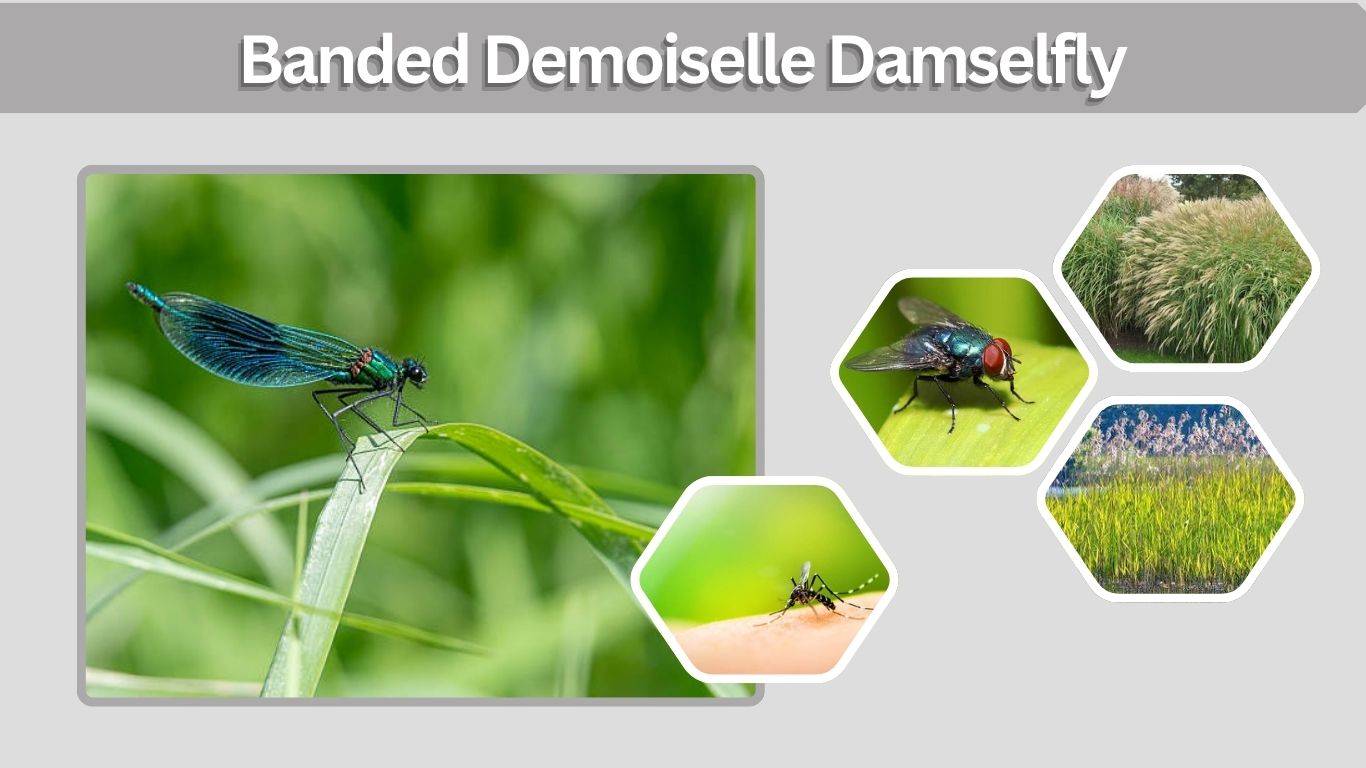
The banded demoiselle, Calopteryx splendens, is a large, metallic damselfly known for its slow, butterfly-like flight. Males have shimmering blue-green bodies and broad dark bands across their wings, while females are metallic green with pale, translucent wings. Sometimes called a banded dragonfly, it is technically a damselfly found mainly beside slow-flowing rivers, streams, and canals with abundant bankside vegetation.
Banded Demoiselle Quick Facts
The banded demoiselle belongs to the dragonfly and damselfly order Odonata. At approximately 45 millimeters long, it is considerably larger and broader-winged than many familiar blue damselflies.
| Feature | Description |
| Scientific name | Calopteryx splendens |
| Order | Odonata |
| Family | Calopterygidae |
| Adult length | Around 45 mm |
| Male color | Metallic blue-green |
| Female color | Metallic green |
| Main habitat | Slow-flowing rivers and streams |
| Adult season | Mainly May to August |
| Diet | Small flying and aquatic insects |
| Danger to humans | Harmless |
Banded Demoiselle Identification
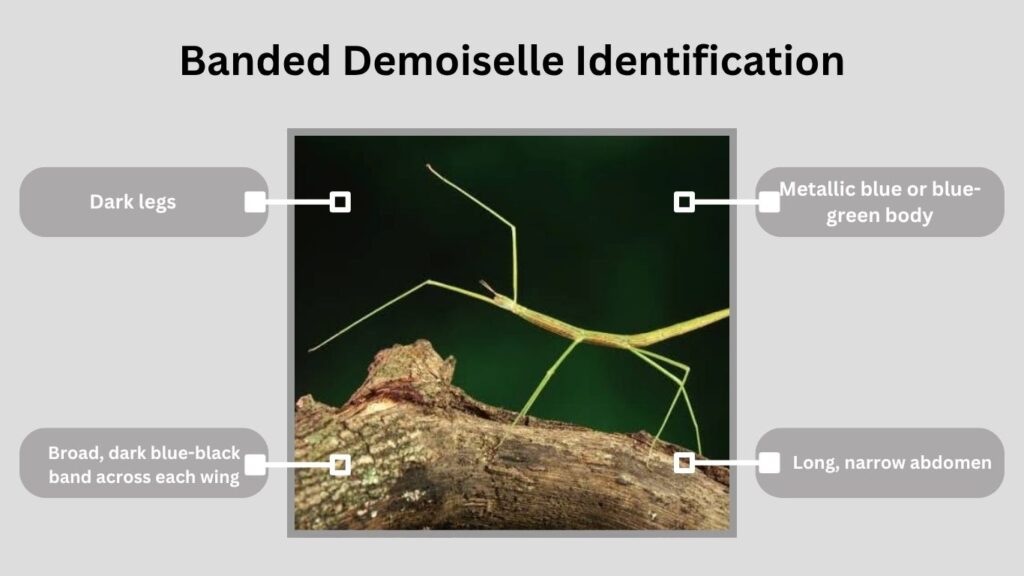
The banded demoiselle has a slender abdomen, widely separated eyes, long legs, and four broad wings. Its wings are noticeably wider than those of most other damselflies, contributing to its floating, butterfly-like flight.
Male Banded Demoiselle
A mature male is the easiest sex to identify.
- Metallic blue or blue-green body
- Broad, dark blue-black band across each wing
- Clear wing bases and tips surrounding the dark band
- Dark legs
- Large, widely separated eyes
- Long, narrow abdomen
- Wings generally held together when resting
- Body length of approximately 45 millimeters
The male’s dark wing patches are sometimes compared to fingerprints. Their position is particularly important: the color forms a central or outer band rather than covering the entire wing.
Female Banded Demoiselle
Females lack the male’s dark wing bands and can appear much less conspicuous.
A female has a metallic green or bronze-green body and pale green, translucent wings. Close inspection may reveal a small white false wing spot, or pseudopterostigma, near the tip of each wing. This white spot is especially useful when separating females from similar demiselles.
Freshly emerged adults are paler and less metallic. Their full blue or green coloration develops as their bodies harden and mature.
Is It a Damselfly or Dragonfly?
“Banded dragonfly” is a common search term, but the banded demoiselle is specifically a damselfly. Dragonflies and damselflies both belong to Odonata, yet they differ in body shape, eye position, resting posture, and flight.
| Banded demoiselle | Typical dragonfly |
| Long, slender body | Usually thicker-bodied |
| Eyes widely separated | Eyes often touch or nearly touch |
| Wings usually folded together | Wings usually held open |
| Gentle, fluttering flight | Faster, stronger flight |
| Often stays near bankside plants | Frequently patrols open water |
Demoiselles are the largest British damselflies, and their broad wings make their flight look more like that of a butterfly than that of a small blue damselfly.
Banded Demoiselle in Flight
A flying banded demoiselle moves with slow, fluttering wingbeats. Males often patrol short stretches of riverbank, returning repeatedly to favored perches on reeds, grasses, or overhanging leaves.
Their dark wing bands play an important role in visual communication. Males display their wings during territorial encounters and courtship, flashing the markings as they fly above the water or around bankside vegetation.
Damselflies often wait on vegetation before making short flights to capture passing insect prey. Their legs form a basket beneath the body that helps secure small insects in midair.
Banded Demoiselle Habitat and Distribution
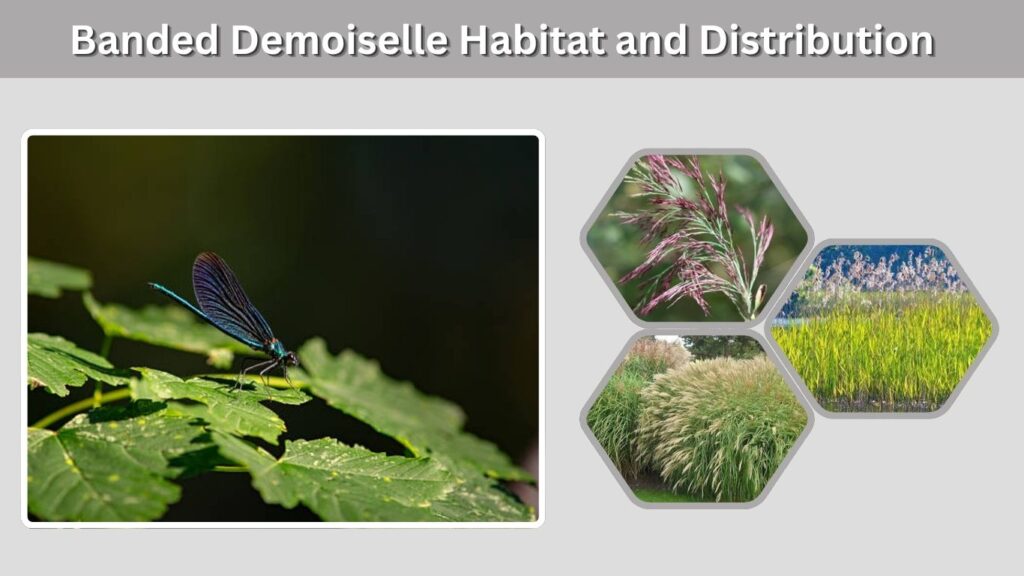
Banded demoiselles are most closely associated with sunny, slow-flowing lowland rivers and streams. They prefer waterways with muddy or silty bottoms and plenty of aquatic and bankside vegetation.
They may also be found along canals and occasionally around ponds or lakes, particularly where water movement and vegetation create suitable conditions. Adults often rest in lush grasses, reeds, shrubs, and nearby woodland edges.
Banded Demoiselle in Britain
The species is common in Wales and across much of England, although it has traditionally been less widespread in northern areas. Its range has expanded northward, with the first Scottish record reported in 2002 and later records along parts of southern Scotland’s eastern and western coasts.
Banded Demoiselle in Ireland
The banded demoiselle is an established Irish damselfly. National biodiversity records document it across hundreds of 10-kilometer grid squares, with records extending from the late nineteenth century into recent survey periods.
What Does a Banded Demoiselle Eat?
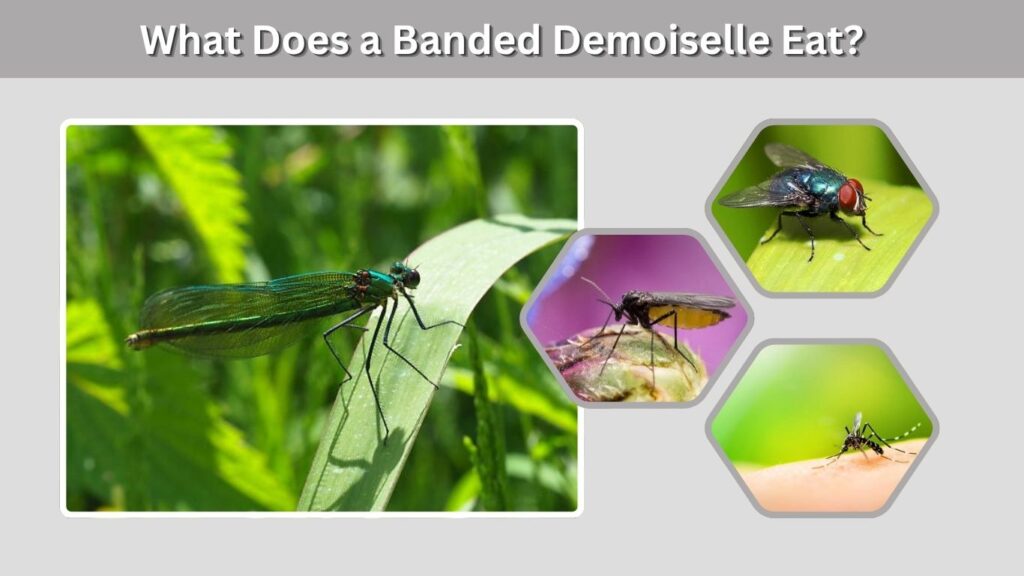
Adult banded demoiselles are predators that catch midges, mosquitoes, gnats, flies, and other small flying insects. They usually hunt from low vegetation beside the water, making short flights after passing prey.
Their aquatic larvae are also predators. They use specialized extendable mouthparts to capture small aquatic insects and other invertebrates living among submerged plants, roots, mud, and leaf litter.
They do not eat plants, damage crops, or feed on human blood.
Banded Demoiselle Life Cycle
The life cycle has three main stages: egg, aquatic larva, and winged adult.
Eggs
After courtship and mating, the female inserts her eggs into aquatic vegetation. She may enter the water while laying, sometimes becoming completely submerged beneath the surface.
Banded demoiselle eggs generally hatch after approximately two weeks under suitable conditions.
Larvae and Nymphs
The terms larva and nymph are both commonly used for the aquatic juvenile stage. Banded demoiselle larvae have elongated bodies, long horn-like antennae, and three short, spiky tail-like gills called caudal lamellae.
They live underwater for approximately two years, growing through repeated molts. During periods of strong flow, larvae may shelter among vegetation or burrow into mud and silt to reduce the chance of being swept away.
Adult Emergence
When fully developed, the larva climbs out of the water onto a plant stem or other support. Its skin splits, and the winged adult gradually pulls itself free.
The newly emerged adult expands and hardens its wings before flying away. The empty larval skin, known as an exuvia, remains attached to the vegetation.
Banded Demoiselle Flight Season
Adults are most commonly seen from May through August, with activity generally strongest during warm, sunny weather. Local records may occur earlier or later depending on latitude, temperature, and seasonal conditions.
They are easiest to find by slowly walking beside a sunny river during late morning or afternoon. Look for males repeatedly flying between the same waterside perches.
Banded Demoiselle vs Beautiful Demoiselle
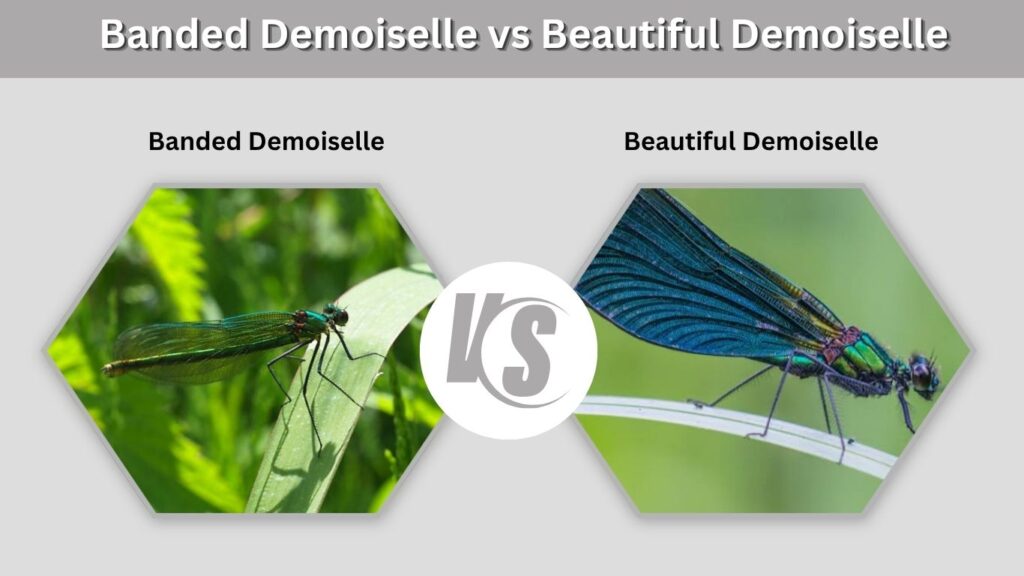
The beautiful demoiselle, Calopteryx virgo, is the species most likely to cause confusion.
| Feature | Banded demoiselle | Beautiful demoiselle |
| Male wings | Dark central bands | Almost entirely dark |
| Female wings | Pale green | Brown-tinged |
| Main habitat | Slow-flowing lowland rivers | Smaller, faster-flowing streams |
| Riverbed | Often muddy or silty | Often sandy or gravelly |
| Distribution | Widespread in much of England and Wales | Strongest in western Britain |
The clearest difference is the male wing pattern. A male banded demoiselle retains clear areas at the wing base and tip, while the beautiful demoiselle’s wings are almost completely dark.
Banded Demoiselle Pronunciation
A simple English pronunciation is:
BAN-did dem-wah-ZEL
The word “demoiselle” comes from French and refers to a young woman or maiden, reflecting the insect’s delicate appearance.
Are Banded Demoiselles Dangerous?
Banded demoiselles are harmless to humans. They have no stinger, do not feed on blood, and are not aggressive.
Although they possess mouthparts for eating small insects, they are not capable of delivering a medically significant bite. Their presence is beneficial because adults and larvae consume other insects.
Threats and Conservation
The banded demoiselle remains common, but individual populations can be harmed by water pollution, excessive shade, intensive dredging, water removal, and loss of aquatic or bankside vegetation. Maintaining cleaner rivers and varied riverside plants provides places for larvae to develop, adults to perch, and females to lay eggs.
FAQs
What does a male banded demoiselle look like?
A male has a metallic blue-green body and a broad dark blue-black band across each wing. Clear areas remain at the bases and tips of the wings.
What does a female banded demoiselle look like?
The female has a metallic green body and translucent pale-green wings. A small white false wing spot may be visible near the tip of each wing.
Where do banded demoiselles live?
They mainly live beside slow-flowing rivers, streams, and canals with muddy bottoms and abundant aquatic and bankside vegetation.
How long do banded demoiselle larvae live underwater?
The aquatic larval stage generally lasts about two years. Larvae hunt small underwater animals before climbing onto vegetation and emerging as winged adults.
When is the best time to see banded demoiselles?
May through August is the main viewing season. Warm, sunny days are best, especially along open stretches of slow-moving river with tall waterside vegetation.