
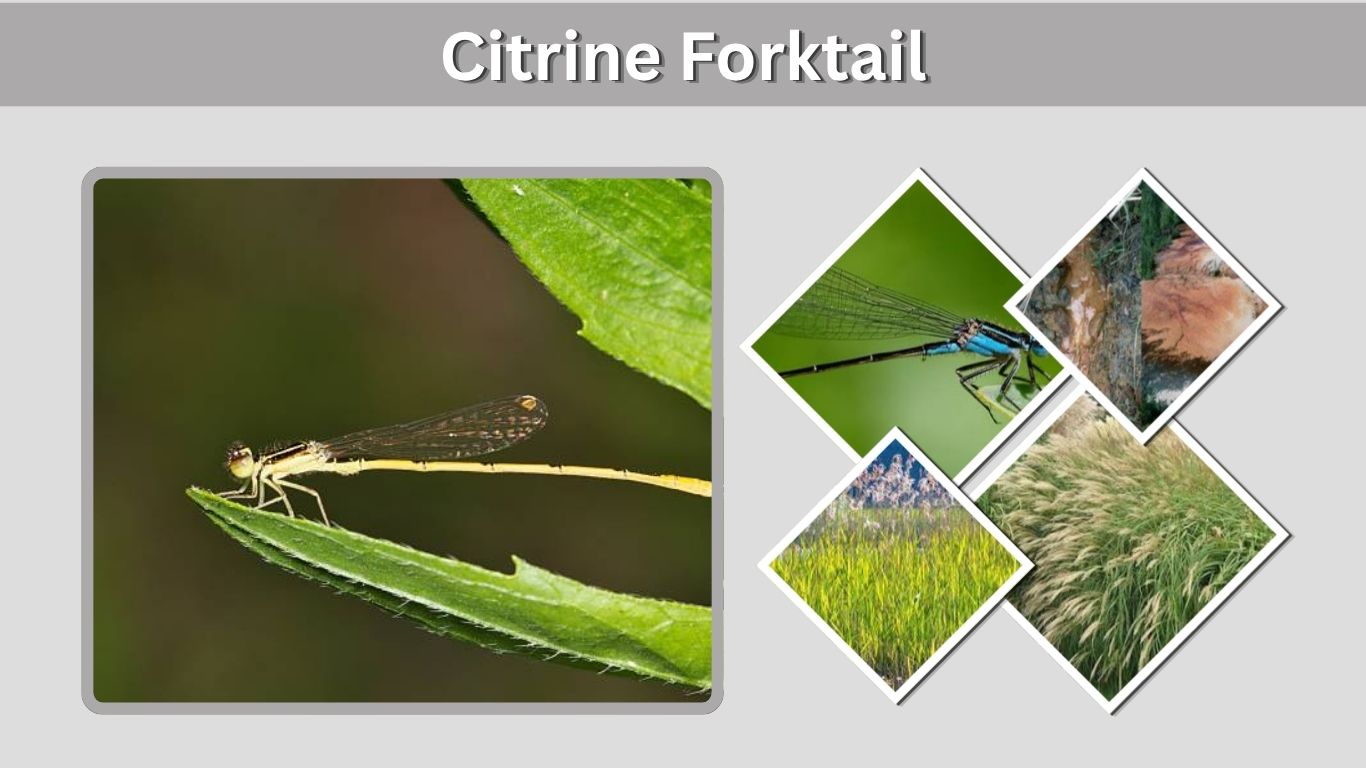
The citrine forktail, Ischnura hastata, is a tiny yellow, green, orange, and black damselfly commonly found around grassy ponds, marshes, bogs, and other shallow wetlands. Mature males are especially distinctive because of their bright-yellow abdomen and black spear-shaped markings. Females change color as they mature, making identification more challenging. The species is also scientifically remarkable because populations in the Azores can reproduce without males.
Citrine Forktail Quick Facts
Citrine refers to the yellow or lemon-like coloration of the mature male. The species belongs to the pond-damselfly family Coenagrionidae and is accepted taxonomically as Ischnura hastata.
| Feature | Description |
| Scientific name | Ischnura hastata |
| Family | Coenagrionidae |
| Order | Odonata |
| Adult length | About 0.8–1.1 inches |
| Male coloration | Yellow, green, and black |
| Female coloration | Orange when young; gray-blue when mature |
| Habitat | Ponds, marshes, bogs, seeps, and slow water |
| Diet | Small flying and aquatic insects |
| Special feature | Unusual forewing pterostigma in males |
| Danger to humans | Harmless |
Citrine Forktail Identification
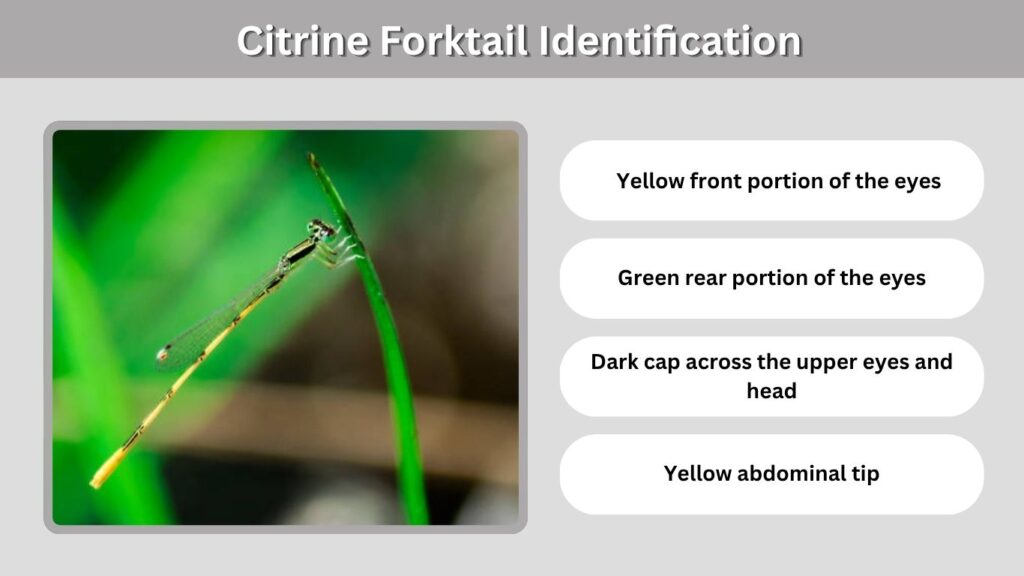
Citrine forktails are among the smallest damselflies in North America. They have slender bodies, widely separated eyes, six delicate legs, and two pairs of transparent wings usually held together above the abdomen while resting. Their exact appearance depends heavily on age and sex.
Male Citrine Forktail
A mature male is much more yellow than most other North American forktails.
Key identification features include:
- Yellow front portion of the eyes
- Green rear portion of the eyes
- Dark cap across the upper eyes and head
- Green thoracic stripes bordered by broader black stripes
- Green coloration near the abdomen’s base
- Bright-yellow sides and underside of the abdomen
- Black triangular or spearhead markings along the abdomen
- Yellow abdominal tip
- Clear, narrow wings
- Reddish forewing spots and darker hindwing spots
The male lacks the bright-blue abdominal tip associated with many other Ischnura species. Its combination of a yellow abdomen and black spearhead pattern is usually visible even without capturing the insect.
Female Citrine Forktail
Female citrine forktails pass through noticeable color changes.
Newly emerged and immature females are generally orange or yellow-orange. Their thorax has a broad black stripe down the center and thinner dark shoulder stripes. The abdomen is mostly orange with black markings, becoming more extensively black toward the rear.
As the female ages, the bright orange fades. Mature females become dusty gray, gray-blue, or nearly black, with pale lower surfaces and dark abdominal bands. Older females can therefore be difficult to separate from mature females of eastern, fragile, and other forktails.
A Unique Wing Feature
The pterostigma is the small colored spot near the tip of a dragonfly or damselfly wing. In most damselflies, it touches the wing’s leading edge.
The male citrine forktail is exceptional because its forewing pterostigma is positioned away from that leading edge and surrounded by clear wing cells. This unusual arrangement is considered unique among living damselflies, although it is generally too small to see clearly without a macro photograph or close examination.
Is It a Damselfly or Dragonfly?
The citrine forktail is sometimes casually called a dragonfly, but it is specifically a damselfly. Both groups belong to the order Odonata.
| Citrine forktail | Typical dragonfly |
| Extremely slender body | Usually thicker body |
| Eyes widely separated | Eyes often touch or nearly touch |
| Wings usually folded together | Wings normally held open |
| Slow, hovering flight | Faster, more powerful flight |
| Perches within dense grasses | Often patrols open water |
Its small size and habit of remaining low within shoreline vegetation make it easy to overlook.
Citrine Forktail Habitat and Range
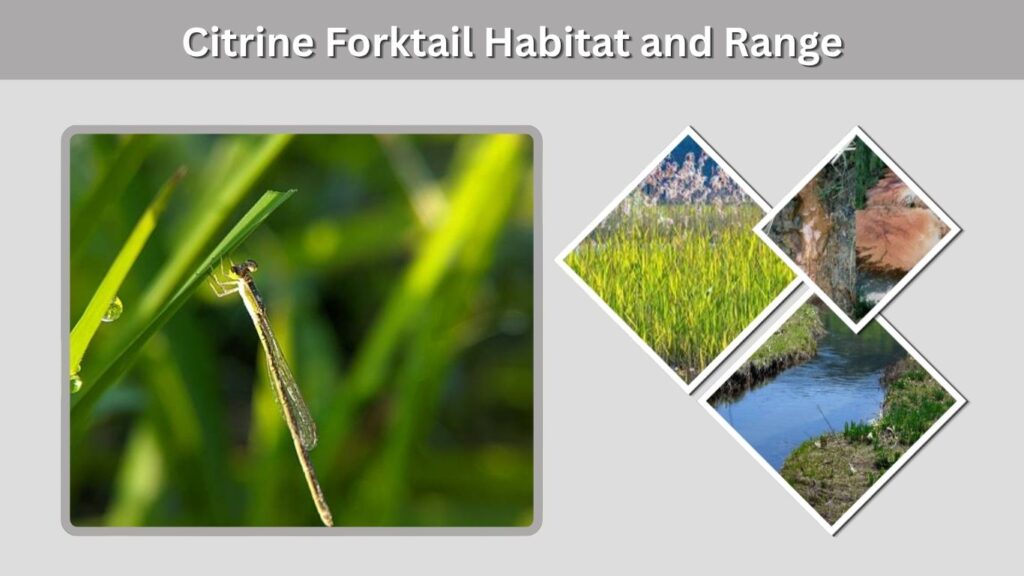
Citrine forktails prefer wetlands with thick grassy or floating vegetation. Typical habitats include:
- Vegetated ponds and small lakes
- Marshes and shallow wetlands
- Sphagnum bogs
- Vernal and temporary pools
- Stream backwaters
- Seepage areas
- Slow-moving river margins
- Retention and farm ponds
Adults usually perch low among grasses, sedges, rushes, and floating plants. Their slow, hovering flights frequently remain inside dense vegetation rather than extending over open water.
The species is broadly distributed across much of the Americas, including large parts of the United States, the Caribbean, and regions farther south. Its abundance and flight period vary significantly by location; in warm areas, adults may be recorded during most or all months of the year.
Citrine Forktail in the Azores
The Azorean population is the most unusual aspect of this species. Researchers found female-only populations capable of thelytokous parthenogenesis, meaning females produce female offspring from unfertilized eggs.
Laboratory rearing confirmed that Azorean females could continue reproducing without mating. This remains the only confirmed natural example of parthenogenesis within Odonata. Sexual populations containing both males and females occur elsewhere in the species’ range; studies in Cuba and the Galápagos did not find the same exclusively parthenogenetic pattern.
Citrine Forktail Male vs Female
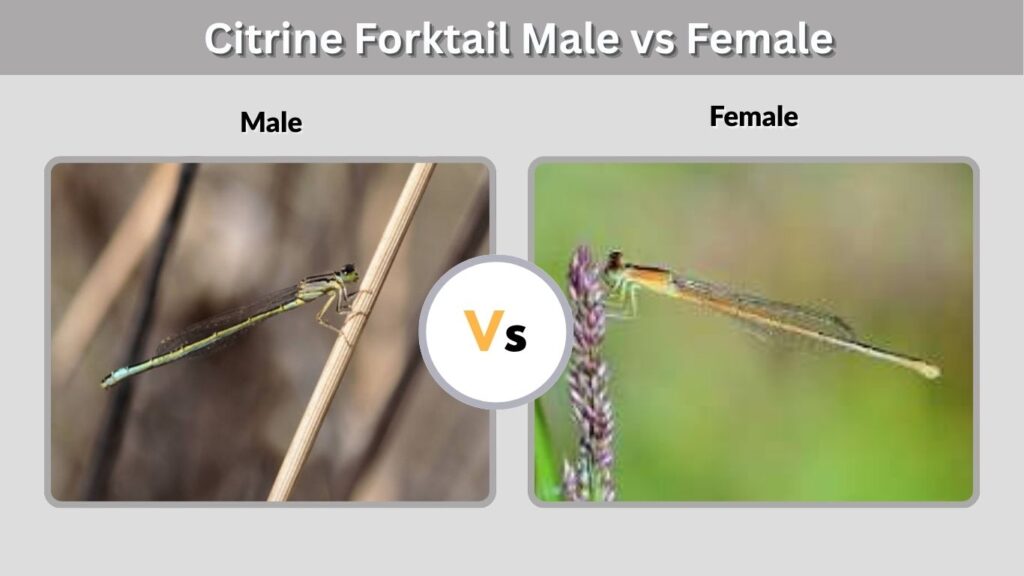
| Feature | Male | Female |
| Main color | Bright yellow | Orange when young |
| Mature coloration | Yellow remains prominent | Fades to gray-blue or dark gray |
| Abdominal pattern | Black spearhead markings | Broader black dorsal markings |
| Wing spot | Forewing stigma uniquely displaced | Normal wing-spot position |
| Identification difficulty | Usually distinctive | Mature females can be confusing |
Young females may appear as brightly colored as males, but their orange bodies and different abdominal markings distinguish them from the more lemon-yellow males.
Citrine Forktail vs Eastern Forktail
The eastern forktail, Ischnura verticalis, is another small damselfly that may share the same pond.
A mature male eastern forktail has a green-and-black thorax, mostly black abdomen, and bright-blue markings on abdominal segments eight and nine. The male citrine forktail instead has an extensively yellow abdomen with black triangular markings and no prominent blue tail.
Immature females of both species may be orange. Female identification therefore requires attention to the thoracic stripes, abdominal pattern, age, and geographic location.
Citrine Forktail vs Fragile Forktail
The fragile forktail, Ischnura posita, is primarily dark rather than yellow. Its most useful feature is the broken shoulder stripe, which resembles a sideways exclamation mark.
Fragile forktails generally have black bodies with green sides and pale markings. They occasionally show blue near the abdominal tip but lack the male citrine forktail’s bright-yellow abdomen and black spearhead pattern. Both species inhabit heavily vegetated ponds, ditches, marshes, and slow streams.
Citrine Forktail vs Rambur’s Forktail
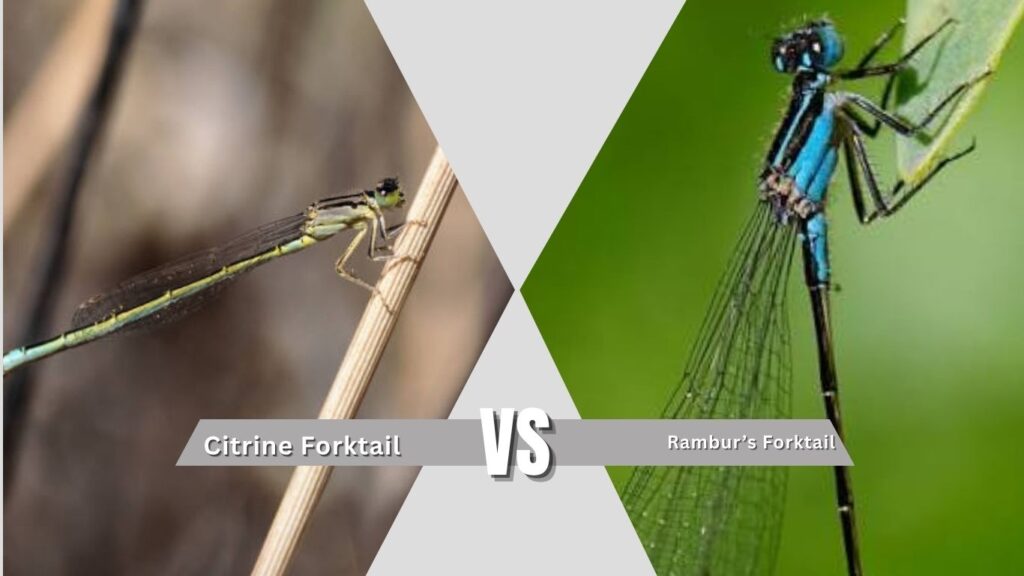
Rambur’s forktail, Ischnura ramburii, is larger, often reaching approximately 1–1.5 inches. Males have a bright-green thorax with a dark metallic upper surface rather than the citrine male’s strongly yellow abdomen.
Rambur’s females occur in orange, mature dull-green, and male-like forms. These orange females can resemble immature female citrine forktails, so size, abdominal pattern, thoracic color, and local distribution should all be considered.
Diet and Hunting Behavior
Adult citrine forktails are predators of tiny flying insects, including midges, gnats, mosquitoes, and small flies. They usually wait on low vegetation before making short flights to capture prey.
Their aquatic nymphs eat small underwater invertebrates. Like other damselfly nymphs, they use an extendable lower mouthpart to seize passing prey. Citrine forktails are therefore beneficial predators rather than plant pests.
Citrine Forktail Life Cycle
The citrine forktail develops through three stages:
- Egg: Females place eggs inside upright or floating aquatic vegetation, including leaves, stems, lilies, and sphagnum moss.
- Aquatic nymph: The young damselfly lives underwater, molts repeatedly, and hunts small aquatic animals.
- Adult: The mature nymph climbs out of the water, sheds its final skin, expands its wings, and becomes a flying adult.
There is no pupal stage. The empty nymphal skin, called an exuvia, may remain attached to a stem after emergence.
Are Citrine Forktails Dangerous?
Citrine forktails are harmless to humans and pets. They do not sting, suck blood, damage plants, or deliberately attack people. Their small mouthparts are adapted for capturing tiny insects and cannot cause a medically significant bite.
FAQs
How big is a citrine forktail?
Adults measure approximately 0.8–1.1 inches long. They are tiny even by damselfly standards and may remain hidden among grasses and sedges around a pond.
What does a male citrine forktail look like?
A male has yellow-and-green eyes, a green-and-black thorax, and a bright-yellow abdomen marked with black triangles or spearhead shapes. Its abdominal tip is yellow rather than blue.
What does a female citrine forktail look like?
Young females are orange with black thoracic and abdominal markings. As they mature, their bright coloration fades to dusty gray, blue-gray, or nearly black.
Where can citrine forktails be found?
Look around heavily vegetated ponds, marshes, bogs, vernal pools, seeps, lake margins, and quiet sections of rivers. Adults usually remain low inside shoreline vegetation.
Can citrine forktails reproduce without males?
Most populations reproduce sexually. However, female-only populations in the Azores reproduce parthenogenetically, producing daughters from unfertilized eggs.