
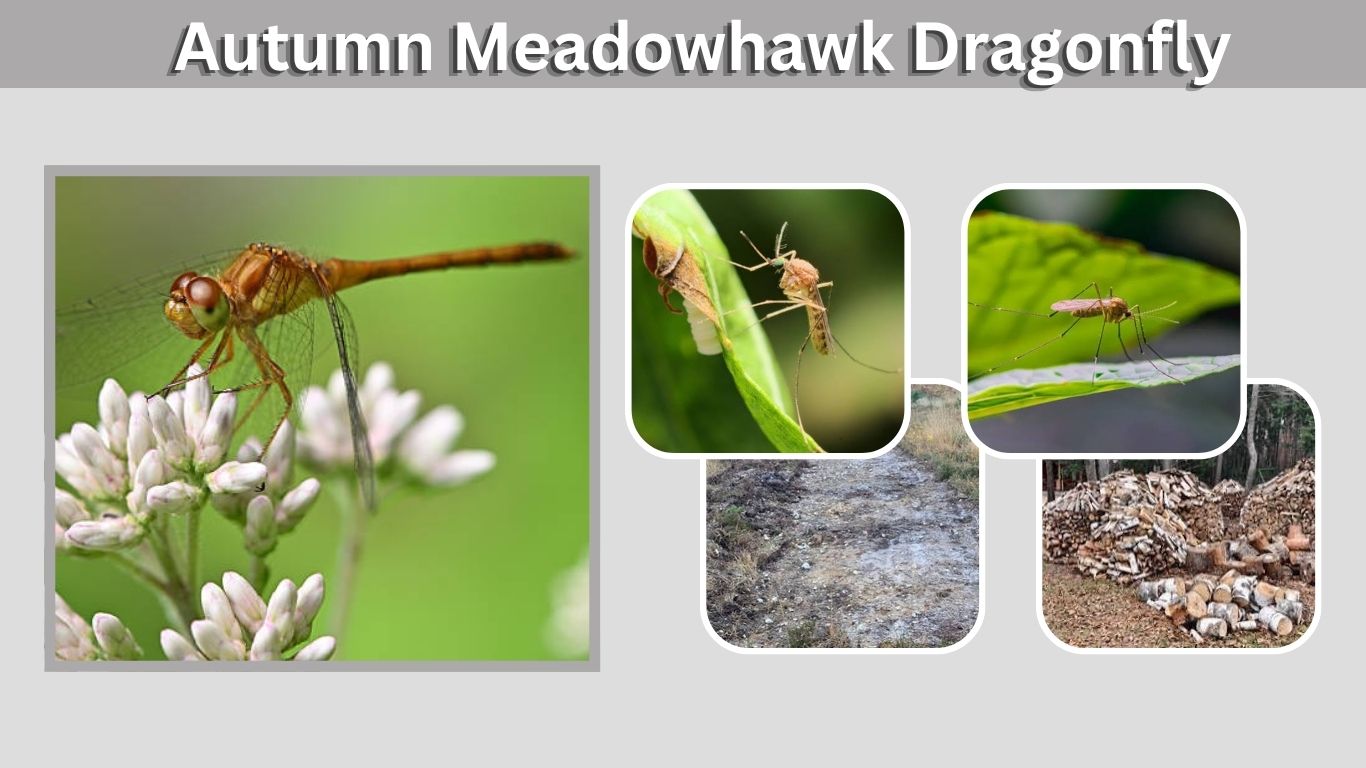
The autumn meadowhawk is a small North American dragonfly known for remaining active later in the year than most other species. Mature males develop a pale red body, while females and young adults are usually yellow, orange, or reddish brown. Often seen basking on sunny paths, logs, and vegetation near ponds, this cold-tolerant meadowhawk may continue flying well into fall—even after other dragonflies have disappeared.
Autumn Meadowhawk Fact File
| Feature | Information |
| Scientific name | Sympetrum vicinum |
| Family | Libellulidae |
| Common group | Meadowhawks or skimmers |
| Body length | Approximately 1.2–1.4 inches |
| Main colors | Yellow, orange, brown, or pale red |
| Habitat | Vegetated ponds, lakes, marshes, bogs, and slow streams |
| Adult diet | Small flying insects |
| Nymph diet | Aquatic insects and other small aquatic animals |
| Flight period | Mainly late summer through fall |
| Danger to people | Harmless |
The accepted scientific name is Sympetrum vicinum. It belongs to the skimmer family, Libellulidae, and its common name refers to its unusually late flight period.
How to Identify an Autumn Meadowhawk
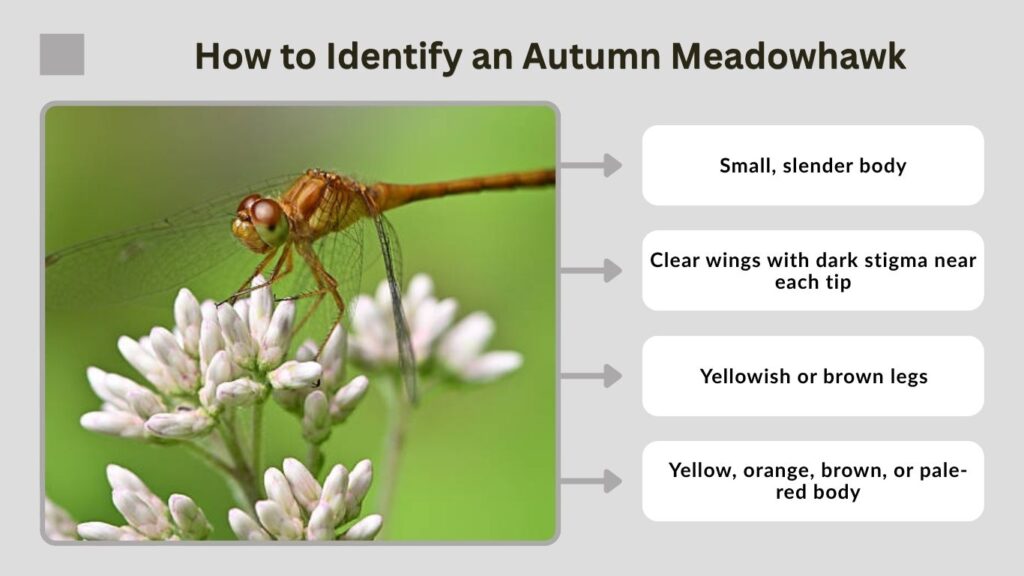
Autumn meadowhawks are slender dragonflies measuring approximately 1.2–1.4 inches long. They have mostly clear wings, relatively little black coloring on the abdomen, and legs that range from yellowish to brown. The species was once commonly called the yellow-legged meadowhawk, but that name became confusing because mature individuals often have brown rather than clearly yellow legs.
Key Identification Features
Look for the following characteristics:
- Small, slender body
- Clear wings with dark stigma near each tip
- Yellowish or brown legs
- Minimal black markings on the abdomen
- Yellow, orange, brown, or pale-red body
- Red or brownish face in mature adults
- Frequent basking behavior during cool weather
- Late-summer and autumn flight season
Meadowhawks can be difficult to separate because several species develop red abdomens and have similar body shapes. Leg color, facial color, wing veins, abdominal markings, sex, and maturity should all be considered rather than relying on red coloration alone.
Male vs. Female Autumn Meadowhawk
Male and female autumn meadowhawks change color as they mature, so newly emerged individuals may look noticeably different from older adults.
Male Autumn Meadowhawk
An immature male begins with a yellowish or orange body. As it matures, its abdomen becomes pale red or brick red. Mature males normally have minimal dark markings compared with many other meadowhawks, while their legs become yellow-brown or brown.
Unlike many territorial dragonflies, male autumn meadowhawks generally do not spend long periods defending a section of shoreline. Pair formation frequently occurs away from the breeding water, and paired adults arrive together when they are ready to mate or lay eggs.
Female Autumn Meadowhawk
Females are generally yellowish, orange-brown, or reddish brown. Older females can become surprisingly red, making them easy to mistake for males.
The most reliable female feature is a distinctive, projecting subgenital plate beneath the end of the abdomen. Viewed from the side, this reproductive structure resembles a small spout. It is yellow in immature females and becomes redder as the insect matures.
Where Do Autumn Meadowhawks Live?
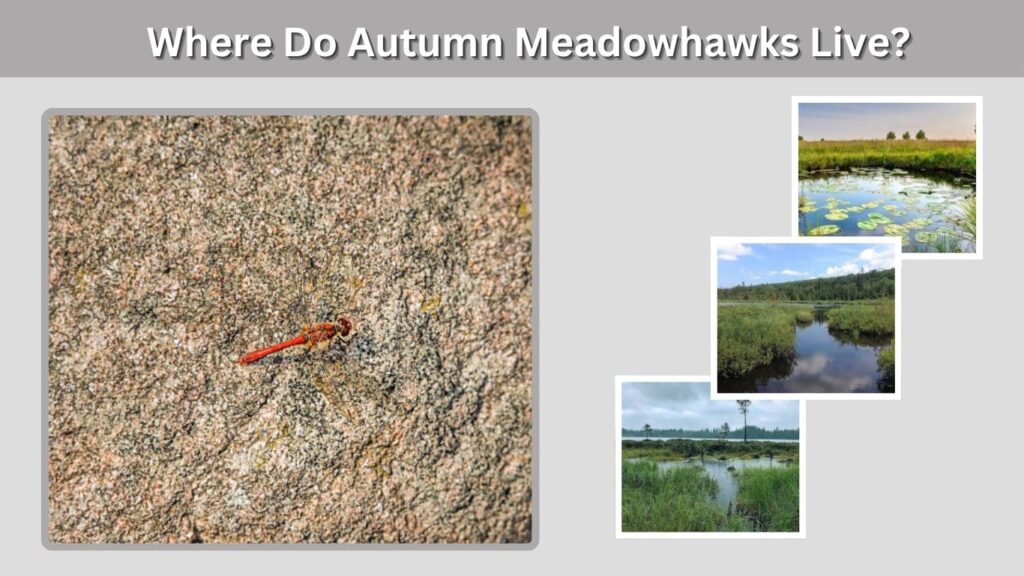
Autumn meadowhawks occupy a broad North American range. Records extend from southern Canada through much of the United States, including areas from the Atlantic Coast to California and south into Texas and Florida. They are scarce or absent from parts of the northern Great Plains, Rocky Mountains, and Great Basin.
Suitable habitats include:
- Permanent ponds and lakes
- Marshes and bogs
- Vegetated pools
- Slow-moving streams
- Wet meadows
- Woodland ponds
- Forest clearings near water
They prefer calm or slow water with abundant shoreline vegetation. Breeding sites are frequently surrounded by woodland, giving adults sheltered places to hunt, rest, and bask. Some populations also use temporary ponds when those habitats retain enough water for the aquatic young to develop.
When Is the Autumn Meadowhawk Active?
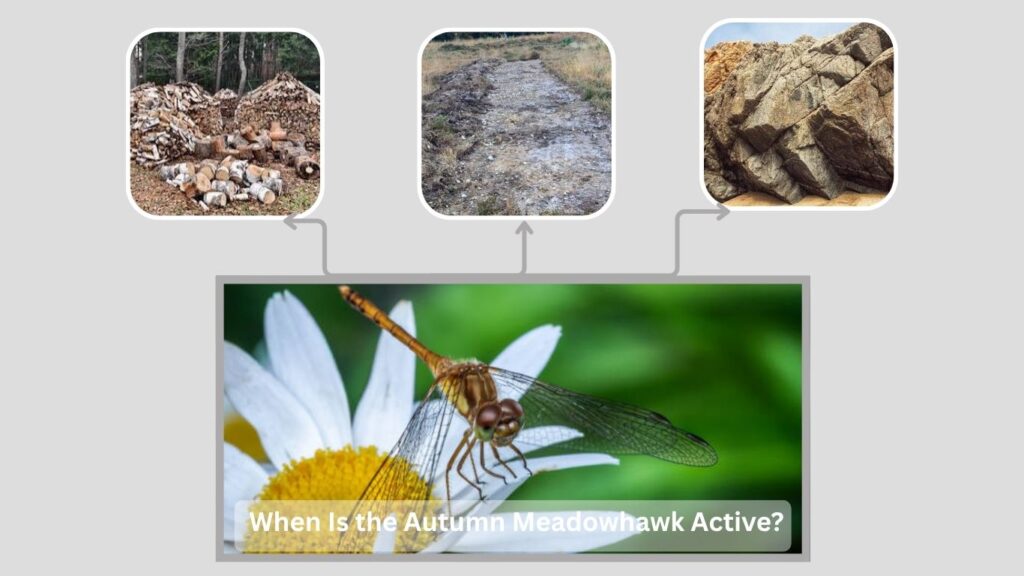
As its name suggests, the autumn meadowhawk is among the last dragonflies seen each year. In Wisconsin, its recorded flight period extends from late July to around mid-November. Timing varies by latitude and weather, with southern populations potentially remaining active later than northern ones.
Adults tolerate cool conditions better than many summer dragonflies. They warm themselves by basking in direct sunlight on:
- Tree trunks
- Wooden fences
- Logs and woodpiles
- Bare ground
- Rocks
- Shrubs and tall grasses
On cold mornings, an adult may remain still until sunlight raises its body temperature enough for flight. This behavior helps explain why individuals can sometimes be found after light frosts or during warm periods late in fall.
In New Jersey and Virginia, the species is primarily associated with late summer and autumn. Exact local flight dates change from year to year according to temperature, water availability, and the timing of adult emergence.
What Do Autumn Meadowhawks Eat?
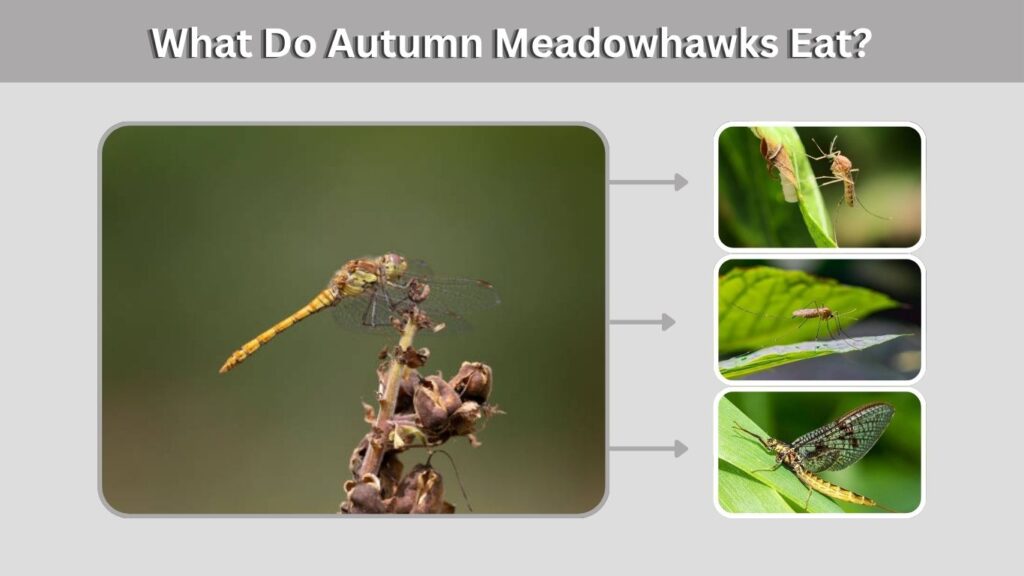
Adult autumn meadowhawks are aerial predators. They launch from a perch, capture a small flying insect, and often return to the same or a nearby resting place.
Their prey may include:
- Mosquitoes
- Small flies
- Midges
- Mayflies
- Flying ants
- Termites
- Small moths
- Other soft-bodied flying insects
Dragonflies do not specialize in eating only mosquitoes. They take whichever suitably sized insects are abundant and within reach.
What Do the Nymphs Eat?
The immature aquatic stage is called a nymph or larva. It lives underwater and hunts mosquito larvae, aquatic fly larvae, mayfly larvae, freshwater shrimp, and other small animals. Larger nymphs may occasionally capture tiny fish or tadpoles.
The aquatic stage lasts much longer than the adult stage. Once fully developed, the nymph climbs onto vegetation or another surface, sheds its skin, and emerges as a winged dragonfly.
Mating and Egg Laying
A male and female first form the wheel position during mating. Afterward, they commonly remain connected in tandem, with the male holding the female behind her head while they fly together toward the breeding habitat.
Where Do Autumn Meadowhawks Lay Eggs?
Tandem pairs fly low along the shoreline while the female repeatedly taps the tip of her abdomen against:
- Shallow water
- Wet shoreline mud
- Damp moss
- Low vegetation
- Moss-covered logs
The eggs are deposited at or near the boundary between land and water. Autumn meadowhawk eggs typically remain dormant through winter and hatch when suitable warmth and moisture return. Research has found that eggs can overwinter in both shoreline and submerged habitats, reflecting the varied places where females deposit them.
The nymphs develop underwater, feeding and molting repeatedly. When development is complete, they leave the water and transform into flying adults.
Why Do Autumn Meadowhawks Sit on the Ground?
Ground perching is usually a temperature-regulation behavior rather than a sign that the dragonfly is injured. A sunlit trail, stone, wooden surface, or patch of soil absorbs heat and helps the insect warm quickly.
Adults also perch while watching for prey. Their large compound eyes give them a broad field of vision, allowing them to detect passing insects before launching into flight.
An autumn meadowhawk that flies away when approached is normally healthy. One that remains motionless during a cold morning may simply need more warmth before it can fly effectively.
Are Autumn Meadowhawks Dangerous?
Autumn meadowhawks are harmless to people. They have no stinger and do not attack humans. A dragonfly caught by hand may attempt to bite defensively, but its mouthparts are designed for small insect prey and are unlikely to cause meaningful injury.
Their presence around a pond is generally beneficial because both adults and nymphs prey on numerous small insects. Avoid using broad-spectrum pesticides around breeding sites, as these chemicals can kill dragonflies and reduce the aquatic prey on which their nymphs depend.
FAQs
What is the scientific name of the autumn meadowhawk?
Its scientific name is Sympetrum vicinum. It belongs to the order Odonata and the skimmer family Libellulidae. The species name vicinum refers to its similarity to another meadowhawk described around the same time.
How can you identify a female autumn meadowhawk?
Females are generally yellow, orange-brown, or reddish and have yellowish-to-brown legs. The clearest feature is the projecting, spout-shaped subgenital plate beneath the end of the abdomen, best observed from the side.
When can autumn meadowhawks be seen in Virginia?
They are mainly observed from late summer through fall. Warm weather may allow them to remain active well into November. The exact flight period varies with elevation, local climate, emergence timing, and the arrival of persistent freezing weather.
Do autumn meadowhawks migrate?
They are not known for large, long-distance seasonal migrations like green darners. Adults generally remain around suitable regional wetlands, woodland clearings, and feeding areas during their late-season flight period.
Where do autumn meadowhawks lay their eggs?
Females deposit eggs near shorelines by tapping their abdomens against shallow water, wet mud, moss, low plants, or moss-covered wood. The eggs overwinter before hatching and beginning the aquatic nymph stage.