
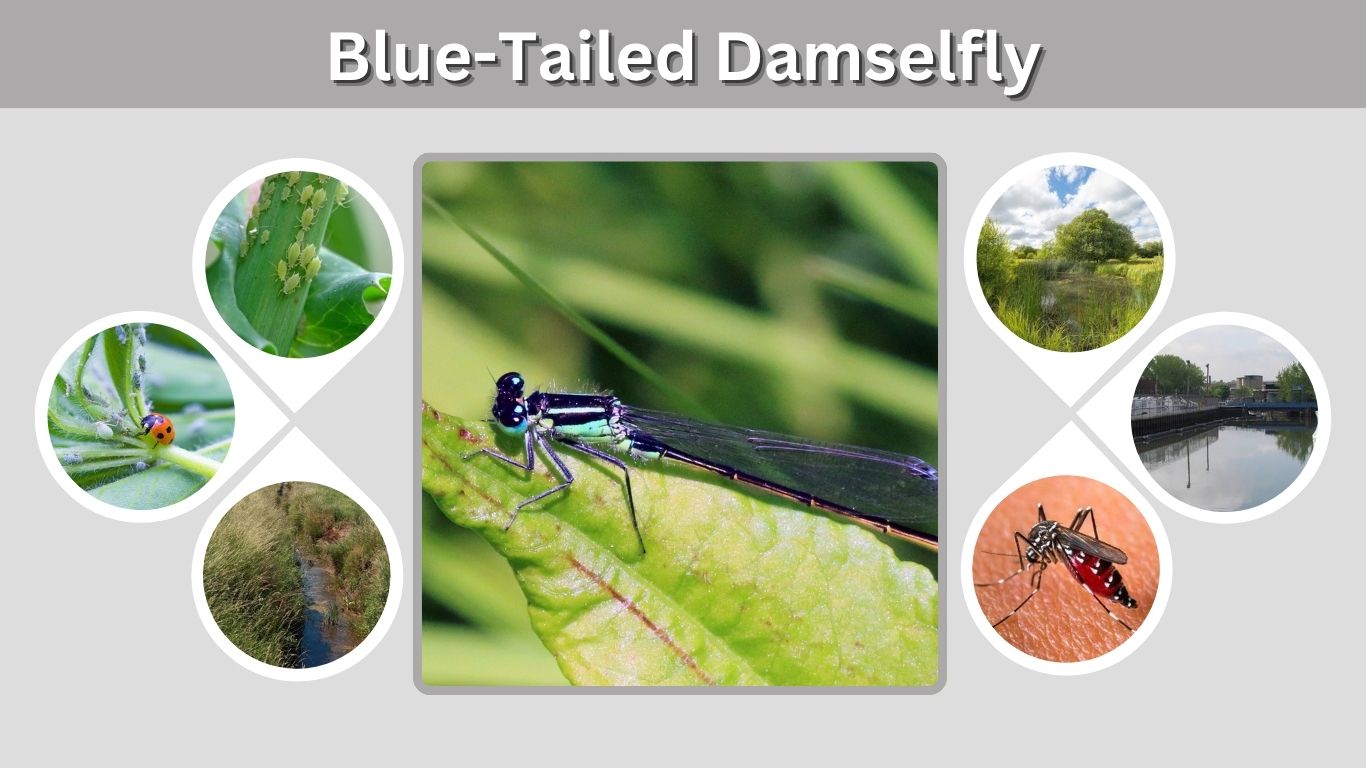
The blue-tailed damselfly is a delicate waterside insect recognized by its mostly dark abdomen and a bright blue segment near the tip. Scientifically named Ischnura elegans, it is widespread across Britain, Ireland, Europe, and parts of Asia. However, females occur in several colors, including violet, pink, brown, green, and blue, which can make identification surprisingly challenging.
What Is a Blue-Tailed Damselfly?
The blue-tailed damselfly belongs to the pond-damselfly family Coenagrionidae. Adults have slender bodies, separated eyes, and two pairs of nearly equal-sized wings. At rest, they typically hold their wings together along the abdomen rather than spreading them outward like most dragonflies.
The species is approximately 31 millimeters long. It is also called the common blue-tailed damselfly, particularly when distinguishing it from the much less widespread scarce blue-tailed damselfly.
| Feature | Blue-Tailed Damselfly |
| Scientific name | Ischnura elegans |
| Typical length | Around 31 mm |
| Male color | Mostly dark with blue thorax markings and a blue tail spot |
| Female color | Violet, pink, green, brown, olive, or blue |
| Habitat | Ponds, canals, ditches, lakes, and slow waterways |
| Diet | Midges, mosquitoes, flies, and other small insects |
| Lifestyle | Adult aerial predator; aquatic larval stage |
Blue-Tailed Damselfly Identification
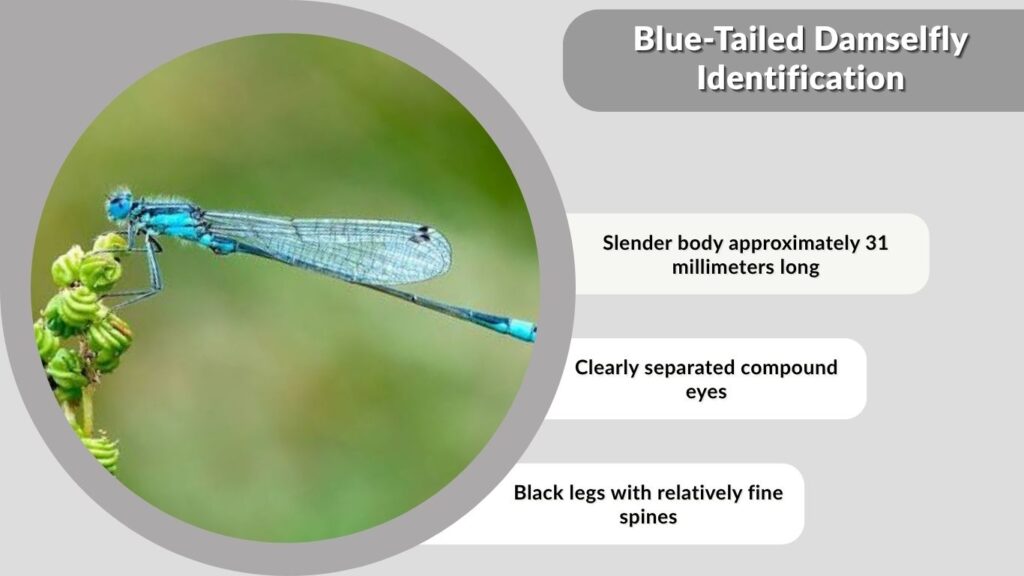
Color alone is not always reliable because immature males and females can look very different from mature males. The location of the blue abdominal segment, wing spots, thorax markings, and body structure provide stronger identification clues.
Key Identification Features
- Slender body approximately 31 millimeters long
- Abdomen that is mostly bronze-black or very dark
- Bright blue marking on abdominal segment eight
- Two blue or green shoulder stripes on the thorax
- Clearly separated compound eyes
- Two-colored wing spots called pterostigmata
- Narrow, transparent wings usually folded over the abdomen
- Black legs with relatively fine spines
The two-toned wing spots are particularly useful because they help separate this species from the scarce blue-tailed damselfly, whose wing spots are more uniformly colored.
Male Blue-Tailed Damselfly
A mature male is predominantly blue and black. Its thorax has two blue shoulder stripes, while most of the long abdomen is dark. The eighth abdominal segment forms the conspicuous light-blue “tail” near the end.
Newly emerged males are much paler. Their thorax may initially appear green before gradually developing the mature blue coloration.
Female Blue-Tailed Damselfly
Females are unusually variable and occur in at least five recognized color forms. Some resemble mature males, while others appear pink, violet, olive, green, or brown.
The main female forms include:
- Violacea: Immature violet form that can mature into blue
- Typica: Mature blue form resembling the male
- Rufescens: Immature pink or orange-red form with a blue tail
- Infuscans: Mature olive-green form with a brown tail marking
- Infuscans-obsoleta: Brown mature form developing from rufescens
These changes mean that a red-bodied damselfly with a blue tail may be an immature female rather than a separate red species.
Teneral Blue-Tailed Damselfly
A teneral is a newly emerged adult whose body and wings have not completely hardened. Tenerals are usually pale, with soft-looking bodies and milky or glossy wings.
Their markings become stronger as they mature. Because damselfly colors also darken with age, identification should rely on patterns and structure rather than the insect’s current shade alone.
Blue-Tailed Damselfly vs Common Blue Damselfly
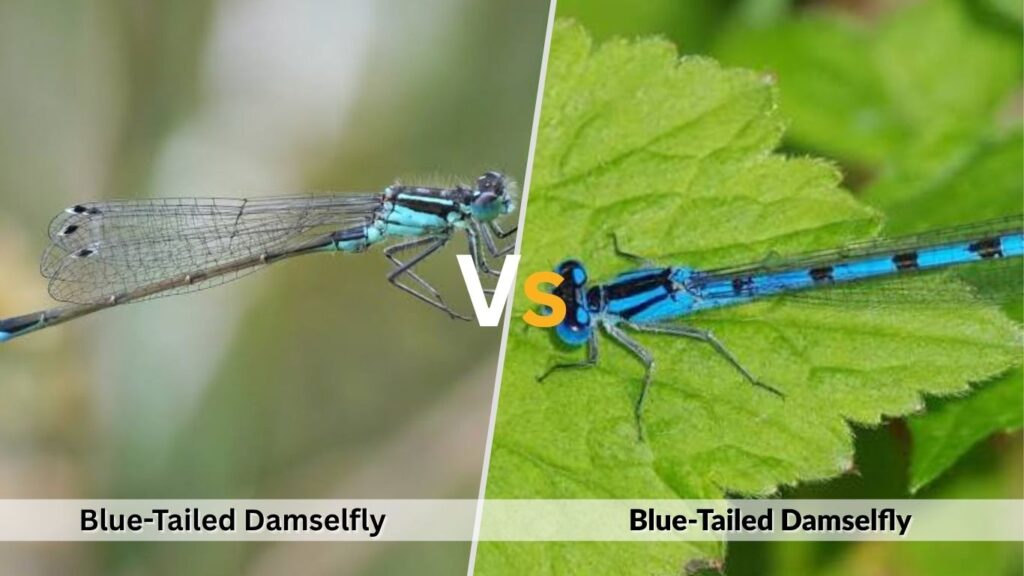
The common blue damselfly, Enallagma cyathigerum, is another widespread blue species. Mature males look much bluer overall than blue-tailed damselflies.
| Characteristic | Blue-Tailed Damselfly | Common Blue Damselfly |
| Abdomen | Mostly dark with one blue segment near the tip | Mostly blue with repeated black markings |
| Second abdominal segment | No mushroom-shaped marking | Usually has a black mushroom-shaped marking |
| Wing spots | Distinctly two-toned | Usually single-colored |
| Open-water activity | Often stays near marginal vegetation | Frequently flies over open water |
| Female forms | Highly variable | Usually blue, green, or brown with dark markings |
The common blue damselfly is widespread across Britain and occurs around many freshwater habitats. It is often especially abundant at larger lakes and uses open water more frequently than several other blue damselflies.
Blue-Tailed vs Scarce Blue-Tailed Damselfly
The scarce blue-tailed damselfly, Ischnura pumilio, is a similar but more localized species. It is often associated with shallow, recently created, disturbed, or sparsely vegetated wetlands.
A male scarce blue-tailed damselfly has reddish eyes, broken shoulder stripes, single-colored wing spots, and a blue marking positioned differently near the abdomen’s end. A dark X-shaped pattern may also be visible on the terminal abdominal segments.
Photographs should show the side of the thorax, wing spots, eyes, and the final abdominal segments. A distant image showing only a blue tail may not provide enough detail for confident identification.
Blue-Tailed Damselfly Habitat and Distribution
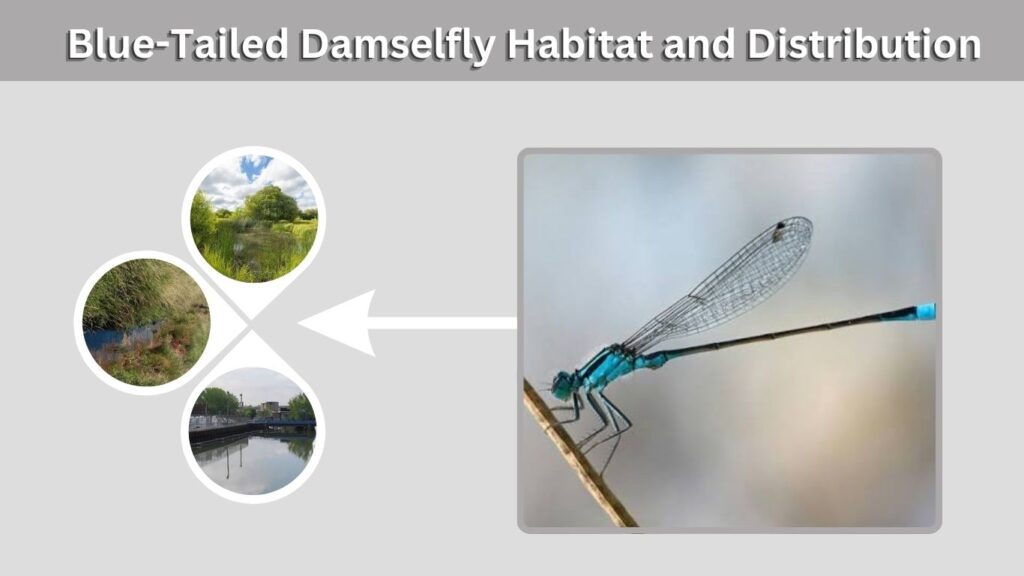
Blue-tailed damselflies occupy a wide variety of freshwater environments. They tolerate conditions that some more specialized damselflies avoid and may even occur around mildly polluted or slightly brackish water.
Common Habitats
They may be found around:
- Garden ponds
- Lakes and reservoirs
- Canals
- Drainage ditches
- Marshes
- Slow-flowing rivers
- Gravel pits
- Coastal pools with slightly salty water
Adults commonly perch on reeds, grasses, rushes, and other low vegetation near the water. The species is widespread across England, Scotland, Wales, and Ireland, and its broader distribution extends through much of Europe and across Asia toward Japan.
What Do Blue-Tailed Damselflies Eat?
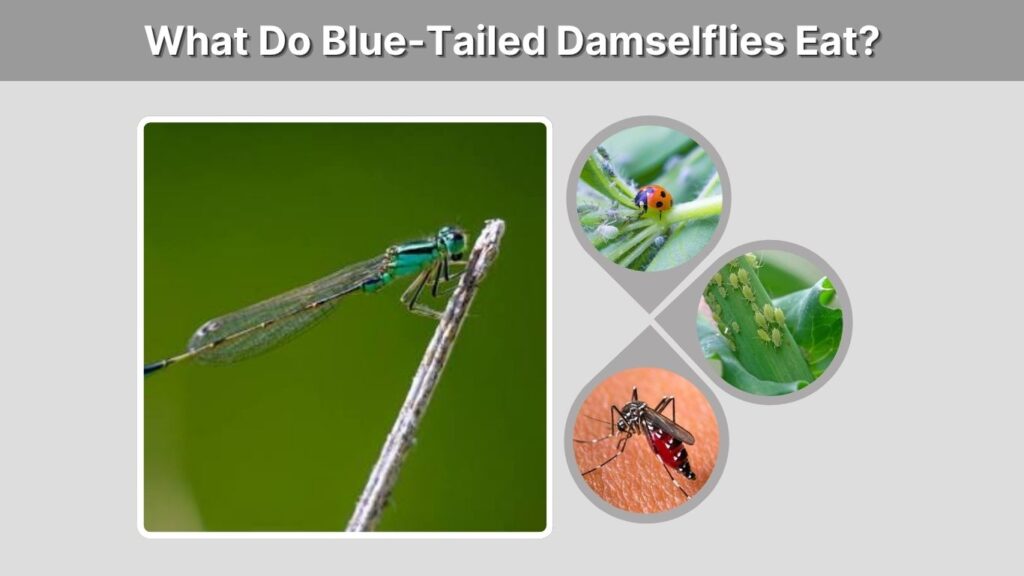
Adult blue-tailed damselflies are predators that capture small insects. They use their legs to form a basket around flying prey before transferring it to their chewing mouthparts.
Their diet can include:
- Midges
- Mosquitoes
- Small flies
- Aphids
- Tiny moths
- Mayflies
- Other small aquatic insects
Damselfly larvae are also predators. They live underwater and feed on bloodworms, mosquito larvae, water fleas, small insect larvae, and other aquatic animals small enough to capture.
Life Cycle of a Blue-Tailed Damselfly
Blue-tailed damselflies undergo incomplete metamorphosis with three main stages: egg, aquatic larva, and winged adult.
Eggs and Aquatic Larvae
After mating, the female lays eggs in or around aquatic vegetation. The eggs hatch into larvae that remain underwater, where they hunt small prey and molt repeatedly as they grow.
Dragonflies and damselflies spend most of their lives in the larval stage. Development often lasts one or two years, although the exact time depends on species, water temperature, climate, and food availability.
Emergence
When fully developed, the larva climbs onto a plant stem or another object above the water. The adult emerges through the larval skin, expands its wings, and waits for its body to harden.
The newly emerged teneral moves away from the water while maturing. It later returns to suitable wetland habitat to feed, mate, and reproduce.
How Do Blue-Tailed Damselflies Mate?
Mating begins when the male grasps the female behind the head with appendages at the tip of his abdomen. The pair may form a heart-shaped mating wheel.
After mating, the female deposits eggs into aquatic plant tissue or other suitable material near the water. Males may remain attached during egg-laying or guard nearby to reduce the chance of another male mating with the female.
Are Blue Damselflies Dangerous?
Blue-tailed and common blue damselflies are harmless to people and pets. They do not sting, inject venom, or intentionally attack humans.
Their mouthparts are designed for eating tiny prey. A damselfly might attempt to nip when roughly restrained, but it is too small to cause a medically significant injury. Handling should nevertheless be avoided because its wings and legs are delicate.
Spiritual Meaning of a Blue-Tailed Damselfly
In symbolic interpretations, a blue damselfly may represent transformation, emotional balance, adaptability, clarity, or peaceful change. Its aquatic youth and flying adult stage are sometimes associated with personal growth and moving into a new phase of life.
These meanings come from cultural and personal beliefs rather than biological science.
FAQs
Is a blue-tailed damselfly the same as a common blue damselfly?
No. The blue-tailed damselfly is Ischnura elegans, while the common blue damselfly is Enallagma cyathigerum. The blue-tailed species has a mostly dark abdomen with one bright blue segment. The common blue is much more extensively blue.
What does a female blue-tailed damselfly look like?
Females can be violet, pink, orange, olive, green, brown, or blue. Their color changes as they mature, and some eventually resemble males. The pale or colored marking near abdominal segment eight remains an important identification feature.
Why does a damselfly have a red body and blue tail?
It may be an immature rufescens-form female blue-tailed damselfly. These females initially appear pink or orange-red with a contrasting blue abdominal segment. They normally become browner as they reach maturity.
Where do blue-tailed damselflies live?
They inhabit ponds, marshes, canals, lakes, ditches, gravel pits, and slow-moving waterways. They tolerate a broader range of conditions than many damselflies, including mildly polluted and slightly brackish water.
What is a black damselfly with a blue tail?
A mostly black damselfly with a bright blue segment near the abdomen’s tip is likely a male blue-tailed damselfly. Confirm it by looking for blue shoulder stripes and two-toned wing spots.