
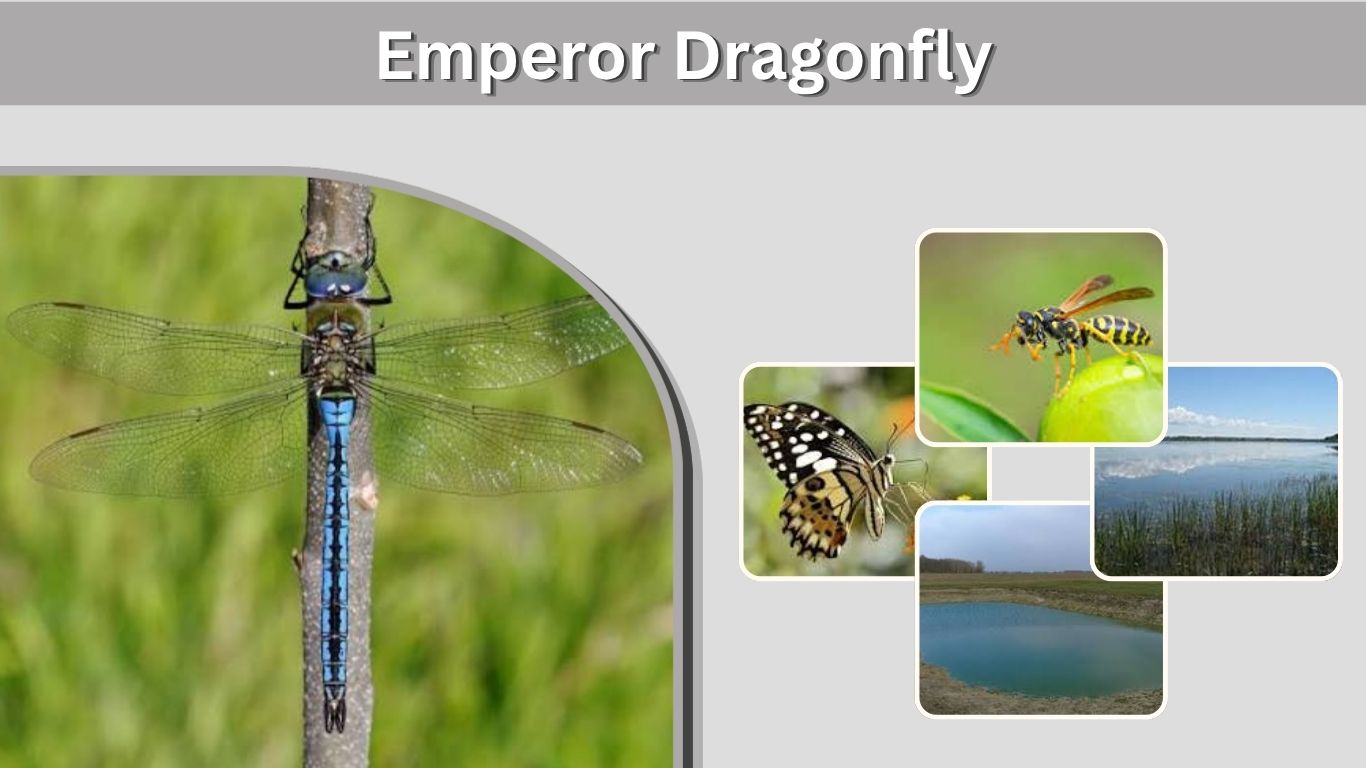
The emperor dragonfly is one of Europe’s largest and most powerful dragonflies. Recognized by its apple-green thorax and long blue or green abdomen, it spends summer patrolling ponds, lakes, canals, and slow rivers. Its scientific name is Anax imperator, and it is also called the blue emperor. Despite its intimidating size and fast flight, this colorful aerial predator is harmless to people and beneficial because it consumes mosquitoes, midges, and other insects.
Emperor Dragonfly Quick Facts
The emperor belongs to the hawker family, Aeshnidae. Its streamlined body, enormous eyes, and independently controlled wings make it an agile hunter capable of catching and eating small prey while flying.
| Feature | Description |
| Scientific name | Anax imperator |
| Other name | Blue emperor |
| Family | Aeshnidae |
| Order | Odonata |
| Adult length | Approximately 78 mm |
| Typical wingspan | Around 10–11 cm |
| Male color | Blue abdomen and green thorax |
| Female color | Mainly green or blue-green |
| Larval length | Approximately 45–56 mm |
| Habitat | Vegetated ponds, lakes, canals, and slow rivers |
| Diet | Flying insects and aquatic animals |
| UK flight season | Mainly late spring through summer |
At approximately 78 mm long, it is Britain’s bulkiest dragonfly. The bright yellow leading vein of each wing, known as the costa, is another helpful identification feature.
Emperor Dragonfly Identification
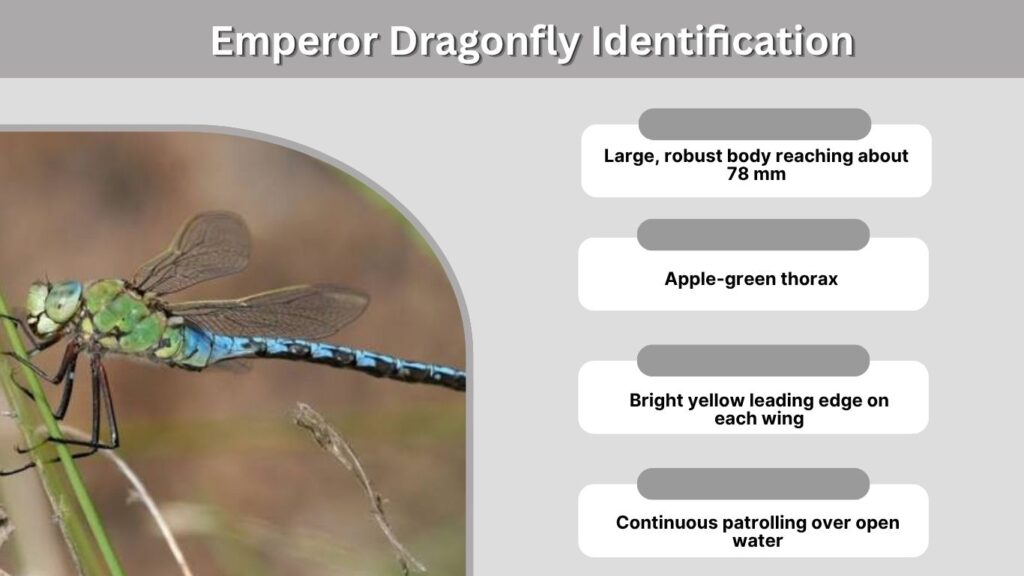
Emperor dragonflies have long abdomens, broad hindwings, powerful thoraxes, and exceptionally large eyes. They rarely remain perched for long, so their appearance and distinctive patrolling flight are both useful for identification.
Key Identification Features
- Large, robust body reaching about 78 mm
- Apple-green thorax without broad dark shoulder stripes
- Greenish-blue or blue compound eyes
- Bright yellow leading edge on each wing
- Dark central stripe running along the abdomen
- Long, clear wings with dark pterostigmata
- Slightly downward-curved abdomen during flight
- Continuous patrolling over open water
The combination of a green thorax, yellow wing costa, central abdominal stripe, and slightly drooping flight posture separates the emperor from most other British hawkers.
Male and Female Emperor Dragonflies
Male and female emperors have the same basic body structure but differ noticeably in color. Newly emerged adults may appear pale, so their mature coloration develops gradually.
Male Emperor Dragonfly
A mature male has a brilliant sky-blue or turquoise abdomen marked by a continuous black line down the center. Its thorax is apple green, while its large eyes usually appear blue or blue-green.
Males are strongly territorial. One may patrol the same stretch of pond for extended periods, repeatedly chasing other large dragonflies. It rarely rests and may capture, carry, and consume prey without landing.
Female Emperor Dragonfly
The female normally has a green or blue-green abdomen with a broad dark central line. Some females develop considerable blue coloration and can initially be mistaken for males.
Females are often noticed while laying eggs rather than continuously patrolling. They settle on pondweed or floating vegetation and insert their eggs into living or decaying plant material. Unlike females of some other dragonflies, an emperor female usually lays eggs alone rather than remaining attached to the male.
Where Do Emperor Dragonflies Live?
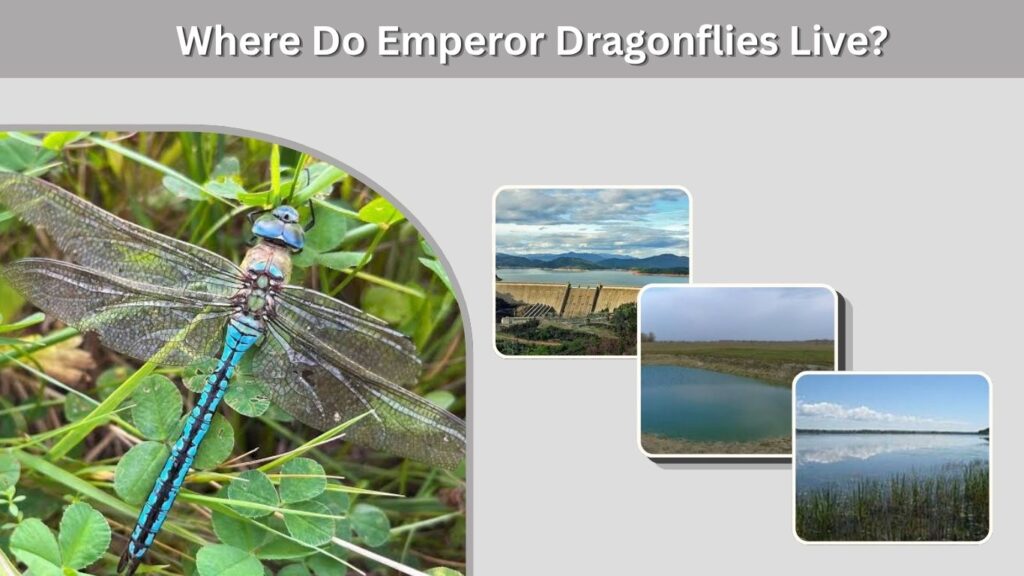
The emperor dragonfly has an extensive distribution covering much of Africa, Europe, the Middle East, and parts of central and southern Asia. It is particularly successful in warm, sunny regions containing permanent or seasonally stable freshwater habitats.
Preferred Habitat
Emperor dragonflies commonly inhabit:
- Large, well-vegetated ponds
- Lakes and reservoirs
- Flooded gravel pits
- Marsh pools
- Canals and drainage channels
- Slow-moving rivers
- Garden and ornamental ponds
- Vegetated river backwaters
Breeding sites generally contain open water for patrolling and abundant vegetation for egg-laying, larval shelter, and adult emergence. The species readily colonizes newly created ponds and flooded gravel pits.
Emperor Dragonflies in the UK
Emperors are widespread across most of England and Wales. Their British range has expanded considerably since the 1990s, with records extending into southern and eastern Scotland. Strong flight and the ability to breed in several freshwater habitats have supported this expansion.
Emperor Dragonflies in Ireland
The species was first officially recorded in Ireland in 2000 and has since spread rapidly. Irish biodiversity records now show it across hundreds of mapped areas, with observations extending from spring into autumn.
Emperor Dragonfly Diet
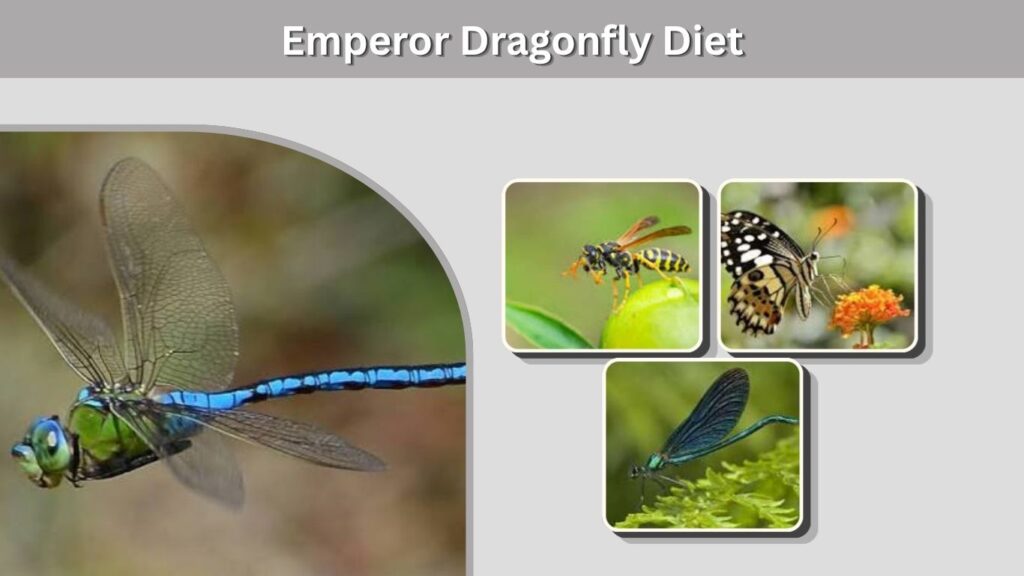
Both adult and larval emperor dragonflies are predators. Adults hunt above water, woodland edges, grassland, and nearby vegetation, while larvae ambush prey beneath the surface.
What Do Adult Emperor Dragonflies Eat?
Adults commonly eat:
- Mosquitoes
- Midges and gnats
- Flies
- Moths
- Wasps
- Butterflies
- Damselflies
- Smaller dragonflies
Small flies form an important part of their diet, but their size and strength allow them to capture comparatively large insects. They intercept prey in flight using their legs like a basket before transferring it to their jaws.
What Do Emperor Dragonfly Nymphs Eat?
The aquatic nymphs consume insect larvae, worms, small crustaceans, tadpoles, and occasionally small fish. They possess an extendable lower jaw called a labium, which shoots forward to seize prey. Large emperor nymphs can become dominant predators within small ponds.
Emperor Dragonfly Life Cycle
The emperor undergoes incomplete metamorphosis, progressing through egg, aquatic nymph, and winged adult stages. There is no pupal stage.
Eggs and Hatching
A female lands on floating vegetation and uses her ovipositor to place eggs inside plant tissue. The surrounding vegetation helps protect the eggs until they hatch and enter the water as tiny nymphs.
Aquatic Nymph Stage
The nymph grows through repeated molts while living among submerged plants and bottom debris. Emperor nymphs are long and streamlined, with large rounded eyes, and can reach approximately 45–56 mm in length.
Dragonfly larval development generally takes one or two years in temperate climates, although temperature and food availability can shorten or lengthen it. Research from warm Mediterranean habitats has documented emperor development and emergence in as little as approximately 80 days under exceptional conditions.
Emerging and Exuvia
When development is complete, the nymph climbs a plant stem above the surface. Its outer skin splits, allowing the adult to pull itself free. The empty skin left attached to the vegetation is called an exuvia.
The new adult expands its wings and abdomen before its body hardens. It then leaves the water to feed and mature, often remaining away from the breeding pond during its early adult period.
Emperor Dragonfly Lifespan
Most of an emperor dragonfly’s life is spent underwater as a nymph. The adult flying stage usually lasts only several weeks, during which it feeds, mates, defends territory, and reproduces. Development is generally faster in warm water and slower in cool habitats.
Emperor Dragonfly Predators
Although emperors are formidable hunters, they are also eaten by other animals. Adult predators include birds, frogs, large spiders, and occasionally other dragonflies. Fish, water beetles, water bugs, larger dragonfly nymphs, and waterfowl may prey upon eggs or nymphs.
Camouflage and rapid acceleration help adults escape danger. Nymphs rely on their brown or green coloration, aquatic vegetation, and sudden jet-propelled movements to avoid predators.
Emperor Dragonfly vs Similar Species
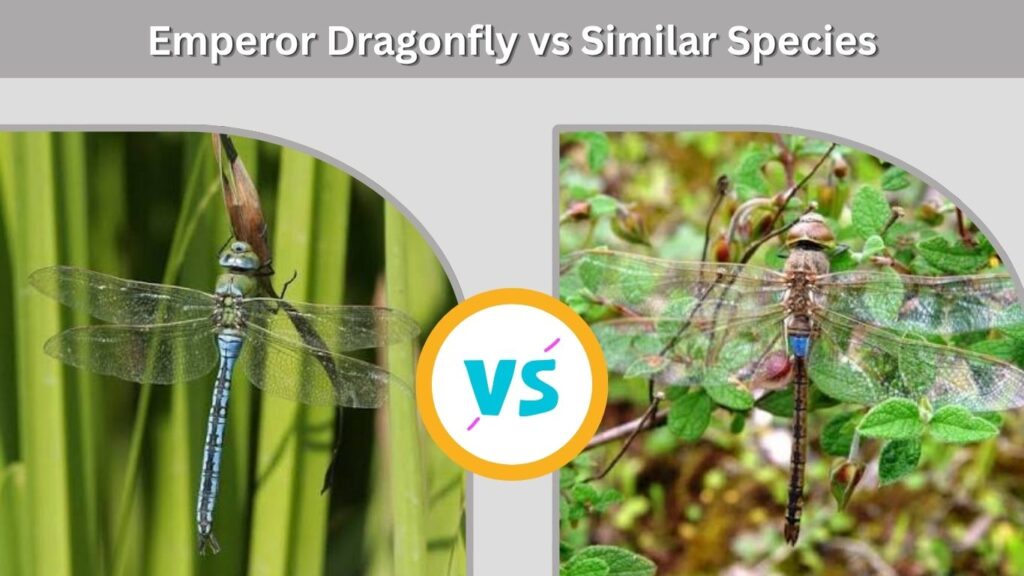
Several large dragonflies carry “emperor” in their names, but they are separate species with different identification features and distributions.
Emperor vs Lesser Emperor
The lesser emperor, Anax parthenope, is slightly smaller and usually duller. A mature male has a distinctive bright blue saddle near the front of an otherwise brown abdomen. The common emperor has much more extensive blue coloration across the male’s abdomen.
Emperor vs Vagrant Emperor
The vagrant emperor, Anax ephippiger, is generally brownish with a prominent blue patch near the abdomen’s base. It is a migratory visitor in northern Europe, whereas the emperor is an established resident across much of Britain.
Emperor vs Golden-Ringed Dragonfly
The golden-ringed dragonfly has a black body covered with bright yellow rings. It is associated primarily with streams and rivers, while emperors commonly breed in ponds and lakes. Some female golden-ringed dragonflies may be longer because of their extended ovipositors, but emperors have bulkier bodies.
Australian Emperor Dragonfly
The Australian emperor, also called the dinkum emperor, is a separate species commonly classified as Anax papuensis. Research showing motion camouflage during territorial encounters involved the Australian emperor rather than the European Anax imperator.
Are Emperor Dragonflies Dangerous?
Emperor dragonflies are not dangerous to people. They do not possess stingers, produce venom, or attack humans. Their fast territorial flights are directed at other dragonflies rather than nearby observers.
A captured dragonfly may use its jaws defensively and produce a small pinch, but it cannot cause a medically significant bite. Watching or photographing one without handling it presents no danger.
FAQs
How big is an emperor dragonfly?
An adult emperor dragonfly is approximately 78 mm long and may have a wingspan of around 10–11 cm. Its thick thorax and powerful abdomen make it one of the largest and bulkiest dragonflies commonly encountered in Britain and Europe.
Do emperor dragonflies sting?
No. Emperor dragonflies have no stinger and cannot inject venom. Their abdomen may look pointed, especially in females with egg-laying structures, but these structures are not designed to sting people.
Do emperor dragonflies bite?
They use strong jaws to kill insect prey and may pinch when roughly handled. However, they do not normally bite humans, and any defensive pinch is unlikely to cause significant injury.
How fast can an emperor dragonfly fly?
Emperor dragonflies are exceptionally fast and agile, but dependable species-specific maximum speeds are not well established. Their powerful flight allows them to patrol large territories, intercept flying insects, hover briefly, and rapidly pursue competing males.
What does an emperor dragonfly symbolize?
In modern interpretations, the emperor dragonfly may represent strength, authority, transformation, and confidence. These meanings come from its commanding size, territorial behavior, vivid appearance, and dramatic transformation from an aquatic nymph into a flying adult.