
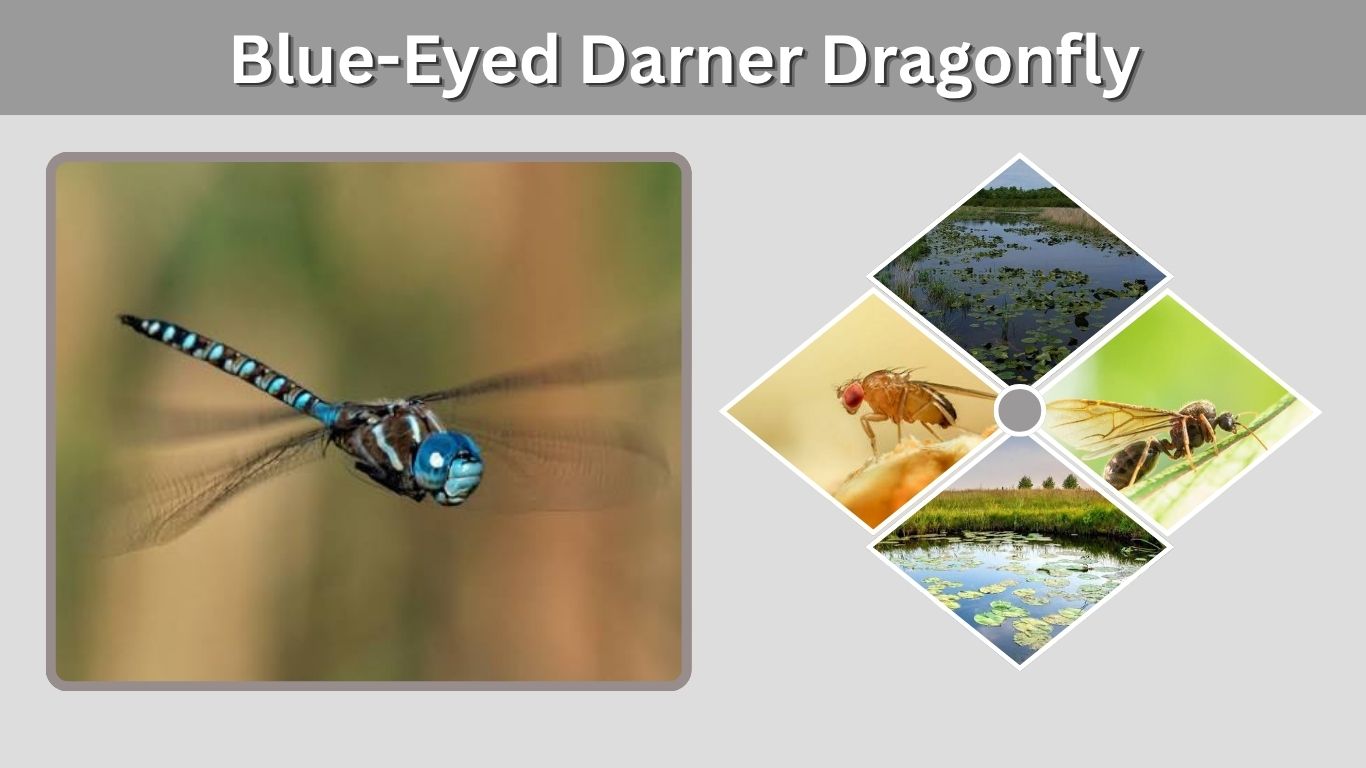
The blue-eyed darner is a large, fast-flying dragonfly recognized by its vivid blue eyes and colorful body markings. Scientifically named Rhionaeschna multicolor, it occurs mainly across western North America, although sightings extend eastward into parts of the Midwest. This powerful aerial predator patrols ponds, lakes, marshes, fields, and shorelines while hunting smaller insects. Females may display either blue or greenish-yellow markings, making them more difficult to identify than adult males.
Blue-Eyed Darner Overview
The blue-eyed darner belongs to the darner family, Aeshnidae. It was formerly classified as Aeshna multicolor, but its accepted scientific name is now Rhionaeschna multicolor. It is a true dragonfly in the order Odonata and suborder Anisoptera.
| Feature | Information |
| Common name | Blue-eyed darner |
| Scientific name | Rhionaeschna multicolor |
| Family | Aeshnidae |
| Adult length | Approximately 2.6–2.9 inches |
| Male coloration | Blue eyes, blue face and blue body spots |
| Female coloration | Blue or greenish-yellow markings |
| Diet | Small flying insects |
| Habitat | Ponds, lakes, marshes and slow streams |
| Activity | Mainly daytime |
| Development | Egg, aquatic nymph and adult |
Although people sometimes use “blue darner” for any large blue dragonfly, the blue-eyed darner is a specific species. Other darners may also have blue abdominal markings, so eye color alone does not always confirm identification.
How to Identify a Blue-Eyed Darner
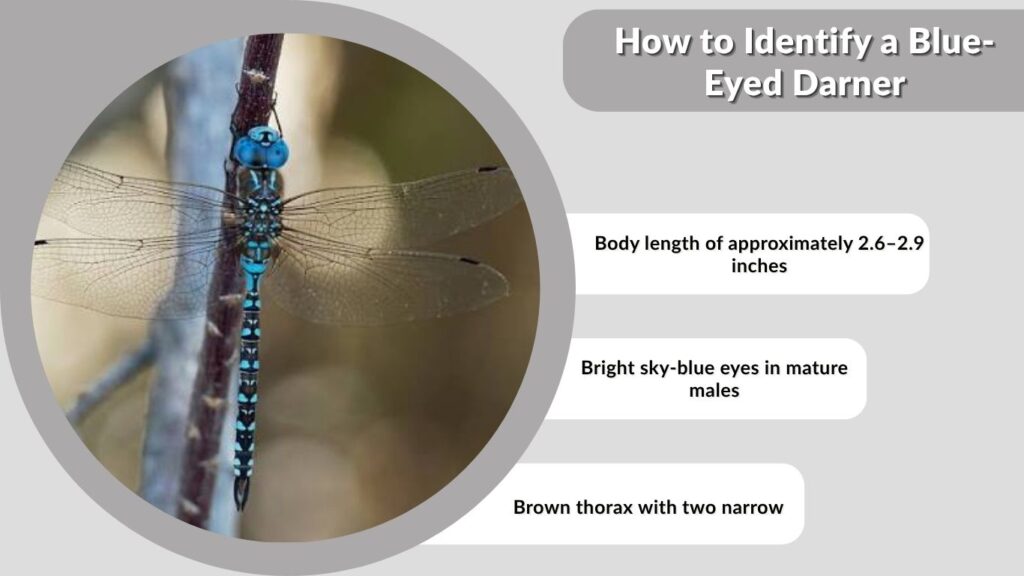
Adult blue-eyed darners have a long, slender abdomen, a strong thorax and four large transparent wings. They are powerful flyers that may be difficult to observe while moving but occasionally hang vertically from vegetation while resting.
Identification Features
- Body length of approximately 2.6–2.9 inches
- Bright sky-blue eyes in mature males
- Blue face without a dark horizontal facial line
- Brown thorax with two narrow, relatively straight blue stripes
- Brown-and-black abdomen with blue and pale triangular spots
- Clear wings with dark stigma marks near the tips
- Long legs that become darker toward the ends
- Forked upper abdominal claspers in males
The forked male claspers are especially useful for separating this species from many other darners, although close examination may be needed. The male’s bright face, eyes and abdominal markings make it one of the most colorful western darners.
Male Blue-Eyed Darner
A mature male has an intensely blue face and eyes. Narrow blue stripes cross the sides of the brown thorax, while blue and whitish spots form a mosaic pattern along the dark abdomen.
Males frequently patrol back and forth over open water or along shorelines. They are strong, active flyers and generally hover less than some other darner species. They may also leave the water and join feeding swarms over yards, parks, roadsides or open fields.
Female Blue-Eyed Darner
Females occur in two main color forms. An andromorph female has blue markings resembling those of a male, while a heteromorph female displays greener or yellowish markings. Female wings may also have a yellowish tint.
Because females vary in color, they can be confused with paddle-tailed, California, spatterdock and other darners. Association with an identifiable male can make field identification easier.
Blue-Eyed Darner Size and Wingspan
The blue-eyed darner is a relatively large dragonfly. Adults generally measure approximately 68–72 millimeters, or about 2.7–2.8 inches, from the head to the end of the abdomen. Some identification guides give a broader average of 2.6–2.9 inches.
Its wings extend outward beyond the sides of its body, producing a wingspan that may appear considerably wider than its body length. The combination of size, rapid flight and brilliant blue coloration makes a patrolling male highly noticeable.
Blue-Eyed Darner Habitat and Range
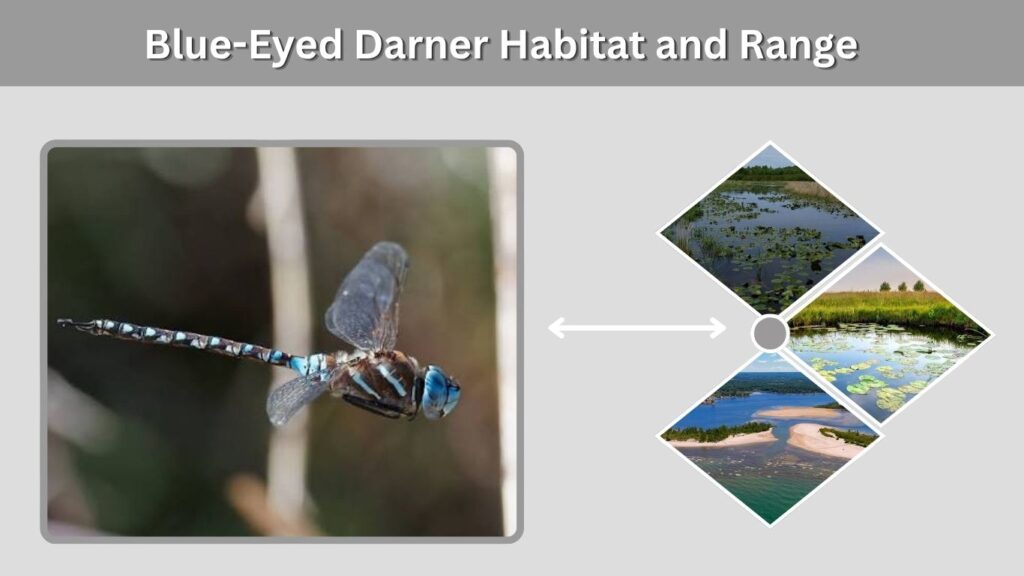
Blue-eyed darners use a variety of permanent and semi-permanent freshwater habitats. They are commonly associated with open water bordered by emergent or floating vegetation.
Preferred Habitat
Suitable environments include:
- Ponds
- Open lakes
- Marshes
- Shallow lake bays
- Slow-moving streams
- Cattail-lined wetlands
- Vegetated reservoirs
- Fields and parks near breeding water
In parts of the Midwest, the species is frequently associated with open landscapes, dense cattails and soft, muddy substrates. Adults may patrol large areas of open water or hunt far from the shoreline.
Geographic Range
The blue-eyed darner is primarily a western North American species. Its native distribution includes parts of Canada, the continental United States and Mexico. In the Great Plains, records include Texas, Oklahoma, Kansas, Nebraska, South Dakota, New Mexico, Colorado, Wyoming, Montana and Iowa.
The species has also been recorded farther north and east, including Minnesota and Wisconsin. Observations in those areas have become more frequent, although local abundance and distribution remain less fully documented than in its western range.
What Does a Blue-Eyed Darner Eat?
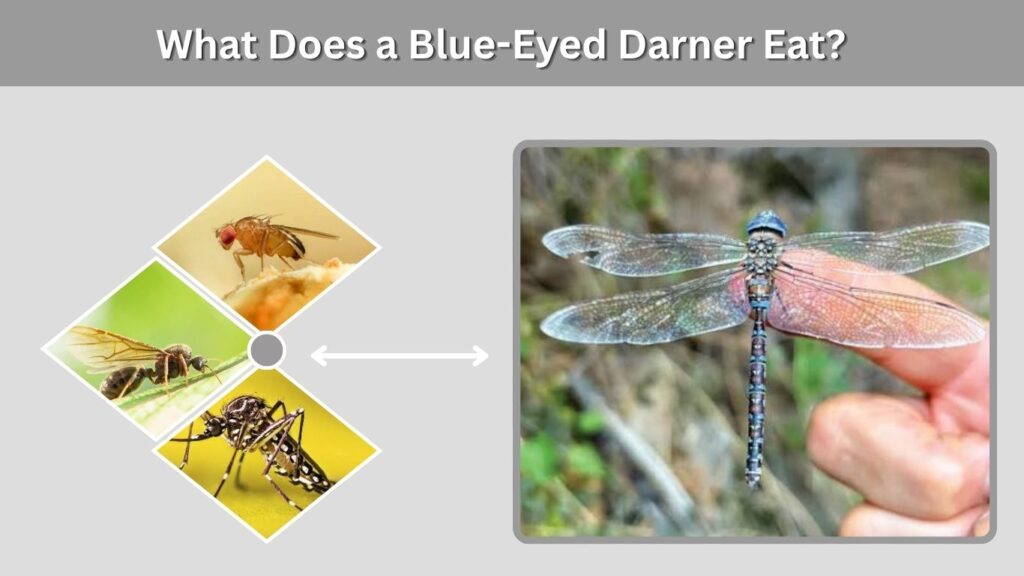
Adult blue-eyed darners are aerial predators. They use their legs to form a basket beneath the body, capturing prey while flying.
Their diet may include:
- Mosquitoes
- Midges
- Gnats
- Small flies
- Winged ants
- Small moths
- Other dragonflies and damselflies
- Various small flying insects
Blue-eyed darners may gather in feeding swarms when prey is abundant. Like other adult dragonflies, they are important predators of mosquitoes, midges and other insects, although they eat many different prey species rather than specializing in mosquitoes.
Nymph Diet
The aquatic nymph is also predatory. It waits among submerged vegetation, mud or debris and rapidly extends its specialized lower jaw to seize nearby animals.
Young nymphs consume mosquito larvae, midges, small crustaceans and other aquatic invertebrates. Larger individuals may capture bigger insect larvae and other small aquatic animals.
Blue-Eyed Darner Behavior and Adaptations
Blue-eyed darners are adapted for active aerial hunting. Their large compound eyes provide a broad field of vision, while their two pairs of independently controlled wings allow rapid turns, hovering, acceleration and changes in direction.
Strong Flight
Males regularly patrol territories over ponds or along their edges. They may fly continuously for long periods, investigating other dragonflies and searching for females.
Adults are also frequently seen away from water in parks, yards and open fields. During very warm parts of the day, they may rest by hanging vertically from sheltered tree branches. Large feeding groups can form when concentrations of flying insects become available.
Blue Coloration
The bright blue markings help observers distinguish mature males, but coloration can change with sex, age and individual form. Newly emerged males may appear duller, and some females closely resemble males.
The blue-eyed darner’s coloration does not indicate that it is poisonous. Its primary protection comes from excellent eyesight, speed, maneuverability and the ability to detect approaching threats.
Blue-Eyed Darner Reproduction and Life Cycle
The blue-eyed darner develops through three stages: egg, aquatic nymph and winged adult. Dragonflies undergo incomplete metamorphosis, meaning they do not form a pupal stage.
Mating and Egg Laying
Pairs usually mate in the characteristic wheel position. Mating may occur in trees, and connected pairs can fly for an extended period while searching for a suitable resting place.
The female deposits eggs into emergent plants, floating logs, leaves or other vegetation around the waterline. Eggs may be placed either above or below the surface.
Aquatic Nymph
After hatching, the nymph lives underwater. It grows through repeated molts while hunting aquatic prey. Most of a dragonfly’s life is normally spent in this immature aquatic stage, which can last from months to several years depending on species and environmental conditions.
Adult Emergence
When fully developed, the nymph climbs out of the water onto a plant, rock or other support. The adult emerges through a split in the nymphal skin, expands its wings and waits for its body to harden.
The empty skin, called an exuvia, remains attached near the water. After hardening, the adult begins hunting and eventually returns to suitable aquatic habitat to reproduce.
Blue-Eyed Darner vs. Paddle-Tailed Darner
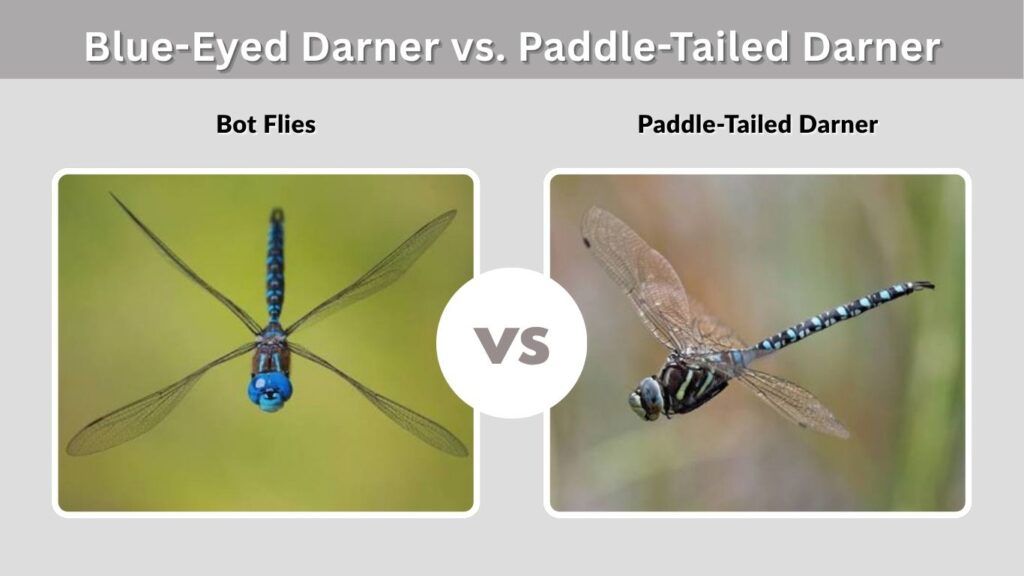
Both species are large western darners with blue markings, but several characteristics help separate them.
| Feature | Blue-eyed darner | Paddle-tailed darner |
| Eyes | Brilliant blue in mature males | Usually blue or blue-green |
| Face | Sky blue without a cross line | Different facial pattern |
| Thoracic stripes | Narrow and relatively straight | Often broader or differently shaped |
| Male claspers | Distinctly forked | Broad and paddle-shaped |
| Female forms | Blue or greenish-yellow | Also variable |
| Typical habitat | Open ponds, lakes and slow streams | Often ponds, lakes and marshes |
Male appendages provide the most dependable distinction. Females can be much more difficult to separate from related species without detailed examination.
Is the Blue-Eyed Darner Dangerous?
Blue-eyed darners are harmless to people. They have no stinger and do not inject venom. A trapped dragonfly may attempt to bite defensively, but it does not pursue or attack humans.
These dragonflies are beneficial because adults consume flying insects and nymphs prey on aquatic invertebrates. Avoid grabbing one by its wings, as the delicate wing membranes can be permanently damaged.
FAQs
Are blue-eyed darners rare?
They are widespread and can be abundant within much of western North America. However, they are uncommon or recently documented in some northern and eastern locations, including parts of Wisconsin. Local rarity therefore depends on geographic location and available wetland habitat.
When can you see blue-eyed darners?
The flight season varies by climate. In parts of the Great Plains, adults commonly fly from late May through August. In some locations, activity peaks from early June to mid-August, while late-emerging individuals may remain active into fall.
Why do blue-eyed darners enter yards?
Adults frequently travel away from breeding water to hunt. A yard with abundant flying insects, trees and open flight space can attract them, even when the nearest pond is some distance away. They may also temporarily rest on walls, fences or vegetation.
Do female blue-eyed darners have blue eyes?
Some females have blue coloration and may resemble males, while others have greenish or yellowish markings and less intensely blue eyes. This variation is why female blue-eyed darners are often harder to identify accurately.
Do blue-eyed darners eat mosquitoes?
Yes. Adults can capture mosquitoes along with midges, flies and other small airborne insects. Their aquatic nymphs may also consume mosquito larvae. However, mosquitoes represent only one part of their varied predatory diet.