
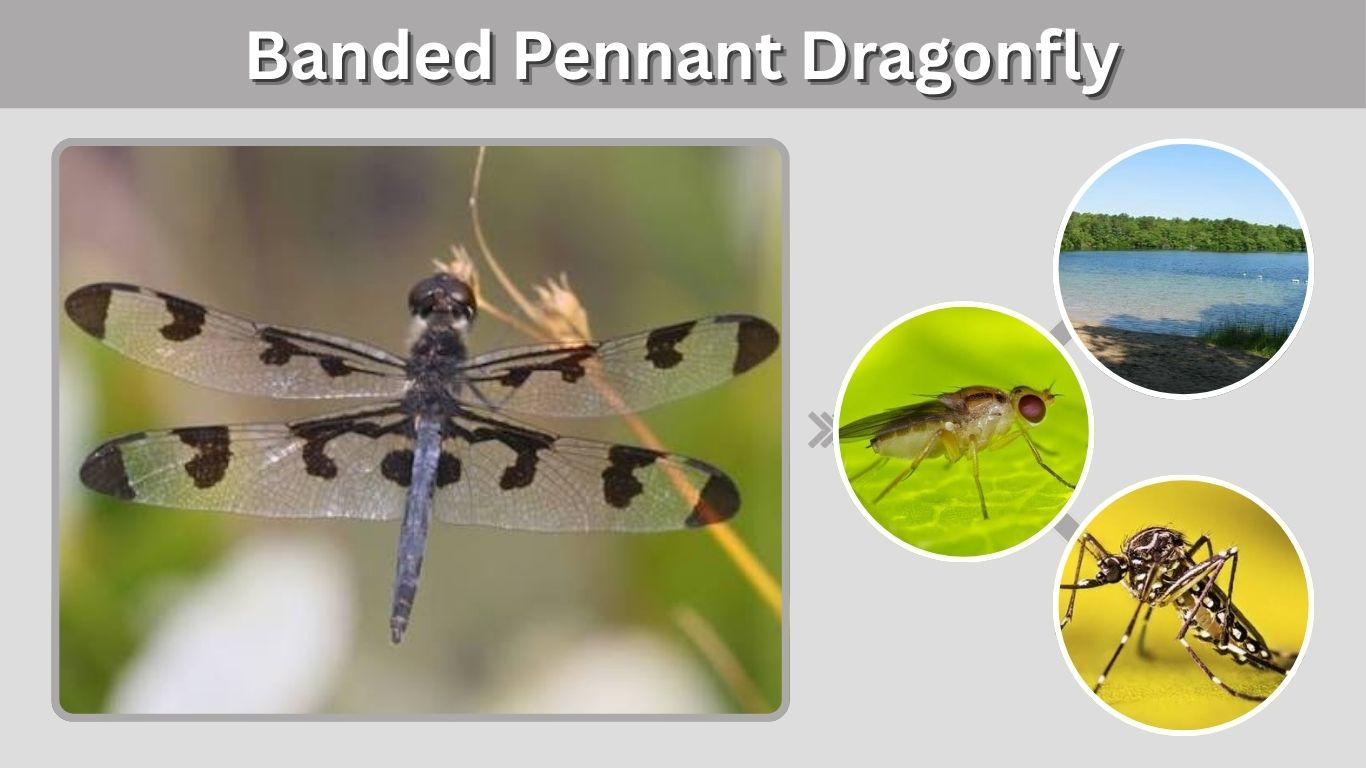
The banded pennant is a small but striking dragonfly known for the bold black markings across its transparent wings. Scientifically named Celithemis fasciata, it usually lives around warm, vegetated ponds and lakes in eastern and south-central North America. Adults often perch at the tips of grass stems or branches, where their wings catch the sunlight like patterned flags. Despite their dramatic appearance, banded pennants are harmless to people and beneficial predators of mosquitoes, midges, and other flying insects.
Banded Pennant Overview
The banded pennant belongs to the skimmer family, Libellulidae, and the dragonfly order Odonata. The word “pennant” refers to the insect’s habit of perching near the end of a stem, where its patterned wings may resemble small flags moving in the breeze.
| Feature | Information |
| Common name | Banded pennant |
| Scientific name | Celithemis fasciata |
| Family | Libellulidae |
| Adult length | Up to about 1½ inches |
| Main colors | Black, pale yellow, blue-black and brown |
| Eye color | Reddish or dark brown |
| Habitat | Vegetated ponds, lakes and some slow streams |
| Diet | Mosquitoes, midges and other small insects |
| Range | Eastern and south-central North America |
The species occurs from parts of New Mexico, Kansas, Michigan, Ontario, and Massachusetts southward to Texas and Florida. Its distribution is concentrated primarily in the eastern and southeastern parts of the United States.
How to Identify a Banded Pennant
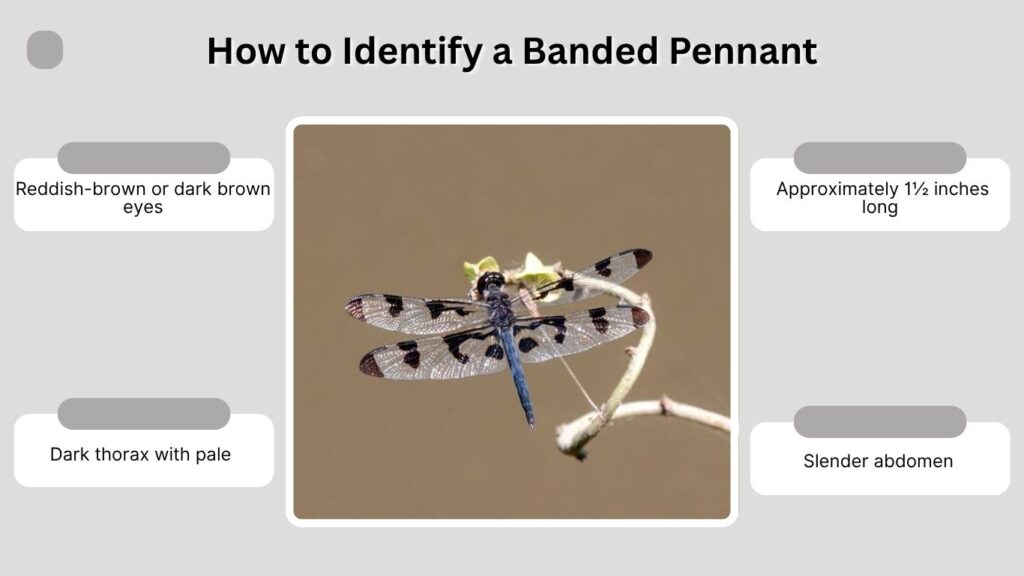
The extensive black patterns on all four wings are the banded pennant’s most noticeable characteristic. Unlike a dragonfly with only small spots near the wing bases, this species displays several separate bands and blotches along the length of each wing.
Identification Features
- Transparent wings with sharply defined black markings
- Dark patches near the wing bases, middle sections and tips
- Reddish-brown or dark brown eyes
- Small body reaching approximately 1½ inches long
- Dark thorax with pale or metallic markings
- Slender abdomen with different patterns in males and females
- Habit of perching on exposed grass or branch tips
The exact amount of dark wing coloration varies among individuals, but the combination of heavily patterned wings, reddish eyes, and small body size is usually distinctive.
Male Banded Pennant
Mature males generally have dark brown eyes and a dark metallic blue-black area on the upper face. Their thorax and abdomen become predominantly black, although pale markings and dusty whitish coloration may remain near the abdomen’s base.
Males frequently perch on grass stems, leaves, and branches near the shoreline. From these elevated positions, they watch for prey, females, and competing dragonflies. They may also patrol by flying low over the water.
Female Banded Pennant
Females tend to look more patterned than mature males. They have reddish-brown coloring over pale green eyes, a pale cream face, and yellow dash-like markings along the abdomen.
Immature males may resemble females until their bodies darken with age. Examining the abdominal markings and reproductive structures may therefore be necessary when identifying younger individuals.
Where Do Banded Pennant Dragonflies Live?
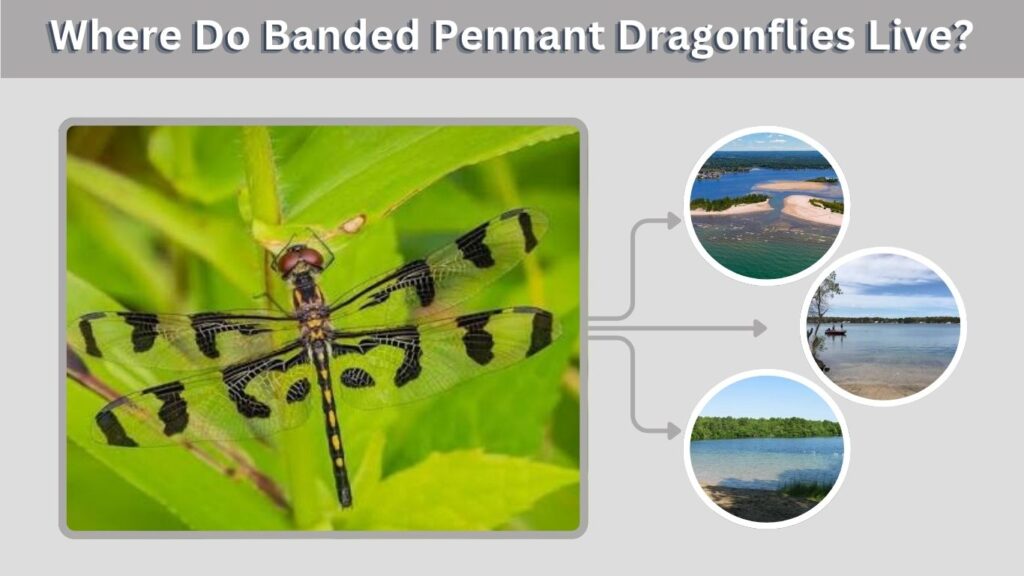
Banded pennants are associated mainly with permanent freshwater habitats. They favor ponds and lakes with sandy bottoms, clear or relatively clean water, shoreline vegetation, and open areas where adults can hunt and perch.
Preferred Habitat
Suitable habitats include:
- Sandy ponds
- Clear-water lakes
- Borrow pits filled with water
- Vegetated reservoirs
- Marshy pond margins
- Slow-moving streams
- Sunny shorelines with tall grasses
Adults may remain near the breeding water, but both sexes also travel into trees and nearby open areas to rest and hunt. Wisconsin’s Odonata Survey describes permanent ponds and lakes—especially clear-water borrow pits and sand-bottomed lakes—as preferred habitats.
When Are They Active?
Adult banded pennants generally appear during the warmer months. The exact flight period varies according to latitude, weather, and local climate. Virginia records, for example, place adult activity from mid-May into October, although the season may be shorter in northern locations.
They are most easily observed on warm, sunny days. A resting individual may return repeatedly to the same grass stem or twig after making short hunting flights.
What Do Banded Pennants Eat?
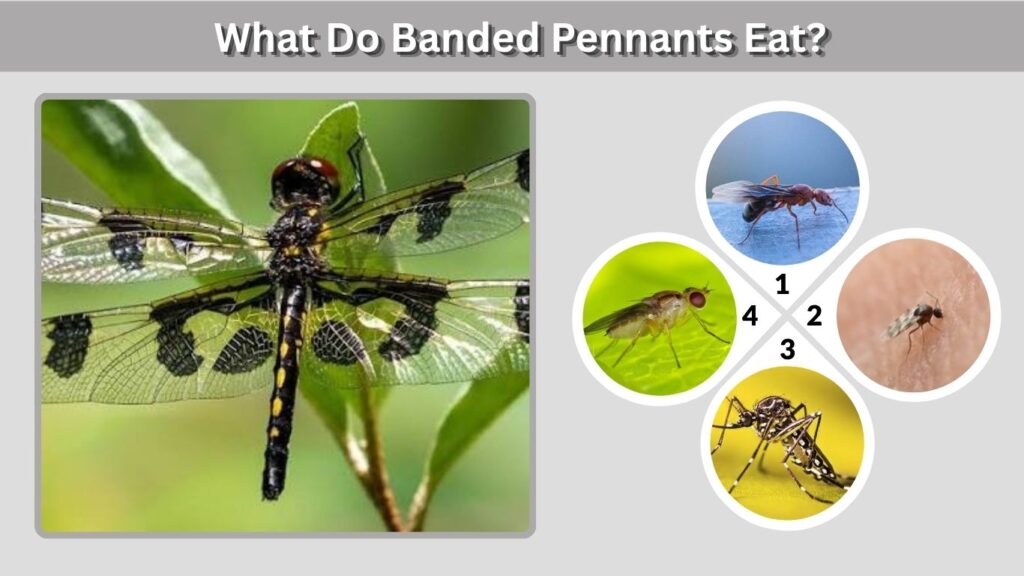
Banded pennants are predators throughout their lives. Adults capture small flying insects in the air using their legs, which form a basket-like structure around the prey.
Their food may include:
- Mosquitoes
- Midges
- Small flies
- Winged ants
- Gnats
- Small moths
- Other tiny flying insects
Dragonflies are beneficial because they help control populations of mosquitoes and other insects. They do not feed on plants, damage crops, or seek blood from people.
What Do Banded Pennant Nymphs Eat?
Young banded pennants live underwater as aquatic nymphs, also called naiads. Like other dragonfly nymphs, they are ambush predators that wait among submerged vegetation, sediment, and underwater structures.
They capture mosquito larvae, aquatic insect larvae, worms, small crustaceans, and other appropriately sized animals. Larger dragonfly nymphs may also take tadpoles or very small fish, although prey size depends on the nymph’s own size.
Banded Pennant Life Cycle
The life cycle has three main stages: egg, aquatic nymph, and winged adult. Dragonflies undergo incomplete metamorphosis and do not form a pupal stage.
Eggs and Nymphs
Banded pennant pairs may fly together while depositing eggs. The female approaches the water, taps its surface with the tip of her abdomen, rises, and repeats the movement. A male may remain attached to her or guard her from nearby while she lays eggs.
After hatching, the nymphs live underwater and molt repeatedly as they grow. Most of a dragonfly’s life is spent in this aquatic form rather than as a flying adult.
Emergence as an Adult
When development is complete, a mature nymph climbs out of the water onto a plant stem, rock, or other surface. Its skin splits, and the adult slowly pulls itself free.
The newly emerged dragonfly is initially soft and pale. Its wings expand, dry, and harden before it can fly. The empty nymphal skin, called an exuvia, remains attached near the water.
Banded Pennant Behavior
Banded pennants commonly rest on exposed vegetation around ponds. Their upright perching position provides a clear view of the surrounding area and allows them to launch quickly after passing insects.
Both males and females may also feed or roost higher in trees. Males often patrol low above the water or return to prominent shoreline perches. During breeding, pairs may fly rapidly and unpredictably over a large area before the female begins depositing eggs.
On extremely hot, sunny days, dragonflies may point their abdomens toward the sun in an “obelisk posture.” This position reduces the amount of body surface exposed directly to solar radiation and helps prevent overheating.
Is the Banded Pennant Dangerous?
Banded pennants are not dangerous to people. They have no stinger, do not inject venom, and do not attack humans. A dragonfly may attempt to bite defensively when firmly trapped in a hand, but it cannot cause a medically significant injury.
It is better to observe the insect without catching it. Dragonflies have delicate wings that can be damaged through careless handling.
Banded Pennant vs. Similar Dragonflies
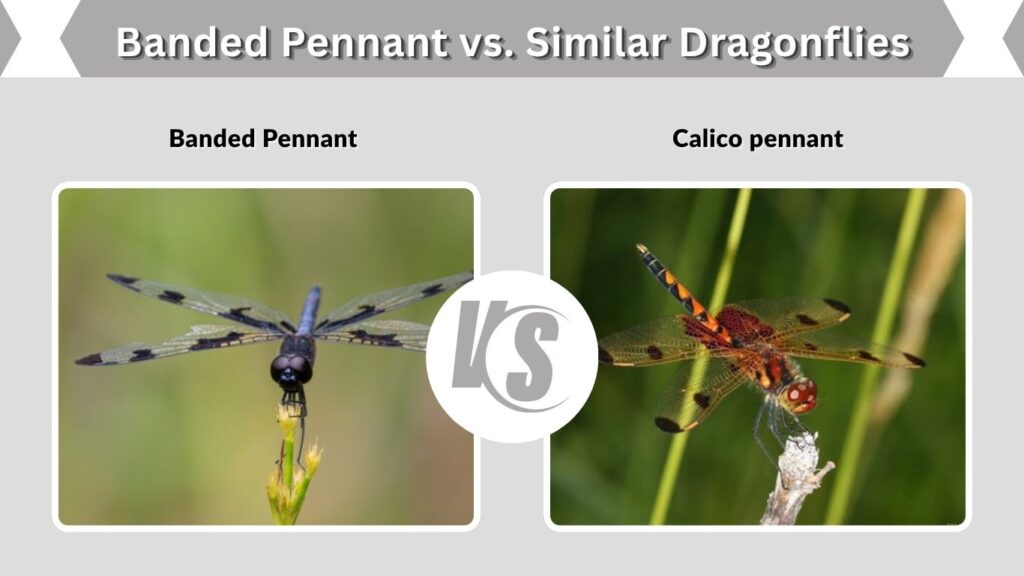
Banded pennants may be confused with calico pennants, Halloween pennants, twelve-spotted skimmers, or other dragonflies with dark wing markings.
| Species | Key difference |
| Banded pennant | Several sharply defined black bands and patches |
| Calico pennant | Smaller wing spots rather than broad, complete bands |
| Halloween pennant | Orange-and-black body and broadly amber-colored wings |
| Twelve-spotted skimmer | Larger body with three dark spots on each wing |
| Widow skimmer | Large dark patches concentrated near the wing bases |
The calico pennant’s dark mark near the wing tip does not extend fully to the trailing edge, while the banded pennant has more extensive and complex dark wing markings.
FAQs
Is a banded pennant a dragonfly or damselfly?
The banded pennant is a true dragonfly in the family Libellulidae. Dragonflies generally have broader bodies and hold their wings open or outward while resting. Damselflies are usually slimmer and often fold their wings together over the abdomen.
How large is a banded pennant dragonfly?
An adult banded pennant reaches approximately 1½ inches in body length. It is considered a relatively small dragonfly, although its broad wings and dramatic black patterns can make it appear larger when flying.
Why is it called a banded pennant?
“Banded” describes the black bands and blotches across its wings. “Pennant” refers to its tendency to perch near the tip of a grass stem or branch, where the wings resemble a small patterned flag.
Are female and male banded pennants different?
Yes. Mature males become primarily dark or black, while females retain pale facial coloring and yellow dashes along the abdomen. Females also have reddish-brown coloring over pale green eyes. Immature males can look similar to females.
Do banded pennants eat mosquitoes?
Yes. Adult dragonflies consume mosquitoes, midges, flies, and other small flying insects. Their aquatic nymphs may also capture mosquito larvae, making both life stages useful predators in freshwater ecosystems.