
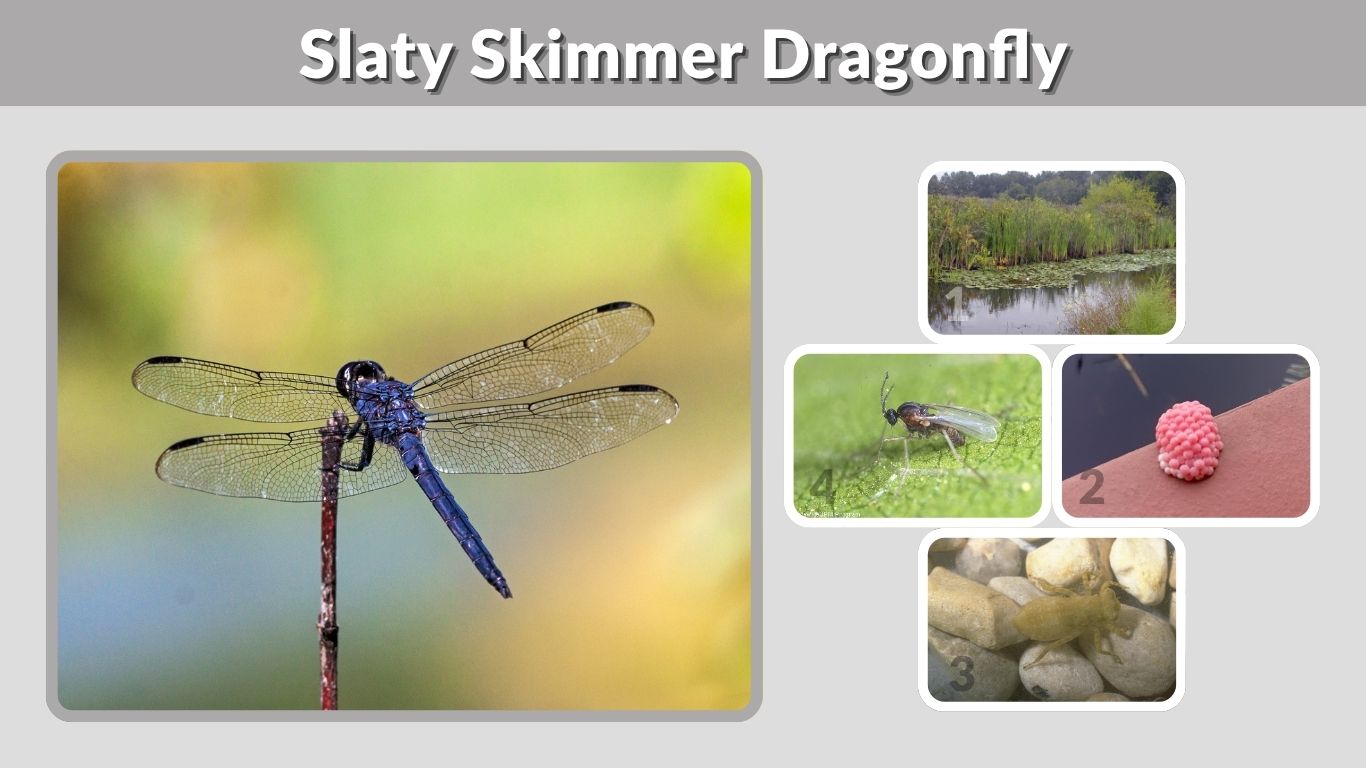
The Slaty Skimmer is a medium-to-large dragonfly known for the dark slate-blue appearance of mature males. It is commonly seen around wooded ponds, marshes, lakes, and slow-moving streams in eastern North America. Although mature males are easy to recognize, females and young males look noticeably different, with brown bodies and dark abdominal stripes. Like other skimmer dragonflies, this species is a fast aerial predator that catches mosquitoes, flies, and other insects. Its presence can also indicate that the surrounding area provides suitable freshwater habitat for aquatic wildlife.
Slaty Skimmer Scientific Name and Classification
The scientific name of the Slaty Skimmer is Libellula incesta. It belongs to the skimmer family, Libellulidae, which contains many familiar pond and garden dragonflies.
| Classification | Name |
|---|---|
| Kingdom | Animalia |
| Phylum | Arthropoda |
| Class | Insecta |
| Order | Odonata |
| Suborder | Anisoptera |
| Family | Libellulidae |
| Genus | Libellula |
| Species | Libellula incesta |
The common name refers to the slate-blue or bluish-black coloration that develops across the body of a mature male.
What Does a Slaty Skimmer Look Like?
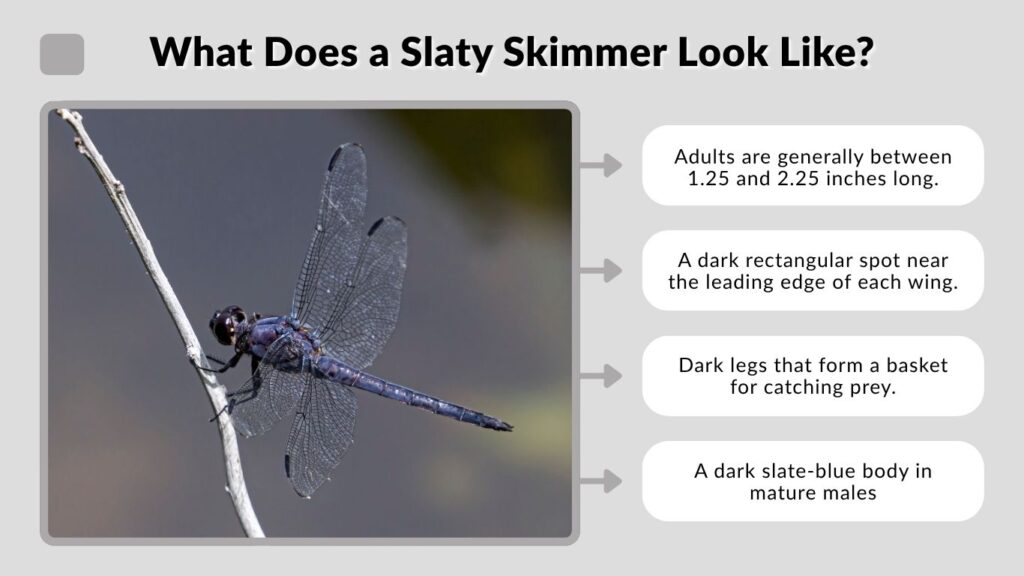
A Slaty Skimmer has a strong body, a large rounded head, six dark legs, and two pairs of clear wings. Adults are generally between 1.25 and 2.25 inches long, although individuals near the upper end of that range are more commonly noticed.
Main Identification Features
Important characteristics include:
- A body approximately 2 inches long
- Four mostly transparent wings
- A dark rectangular spot near the leading edge of each wing
- A broad head with large compound eyes
- Dark legs that form a basket for catching prey
- A habit of resting on exposed twigs and plant stems
- A dark slate-blue body in mature males
Unlike the Widow Skimmer or Twelve-spotted Skimmer, this species does not have large black and white patches covering its wings.
Male Slaty Skimmer
A mature male is almost entirely dark slate blue. Its face, thorax, and abdomen may appear blue-black, grayish blue, dark purple, or nearly black, depending on the lighting. The head and eyes are also very dark, giving the male a relatively uniform appearance.
The blue-black coating that develops over the body is called pruinosity. It is a waxy substance that becomes more extensive as the male matures. Young males initially have brown bodies with dark abdominal markings and can resemble females.
The mature male’s nearly unmarked wings and solid dark body make it easier to identify than many other blue dragonflies.
Female Slaty Skimmer
Young females are usually cream-colored, yellow-brown, or light brown. The thorax has darker brown markings, while a dark stripe runs down the top of the abdomen. The sides of the abdomen may have pale yellow or cream coloring.
A female’s appearance can change considerably with age. Mature females often become darker and may develop a dusty blue or gray coating. Very old females sometimes resemble males, although their bodies are generally duller and their abdominal patterns may remain partially visible.
Females and immature males can be difficult to separate using color alone. A close examination of the terminal appendages and reproductive structures provides a more reliable identification.
Male vs. Female Slaty Skimmer
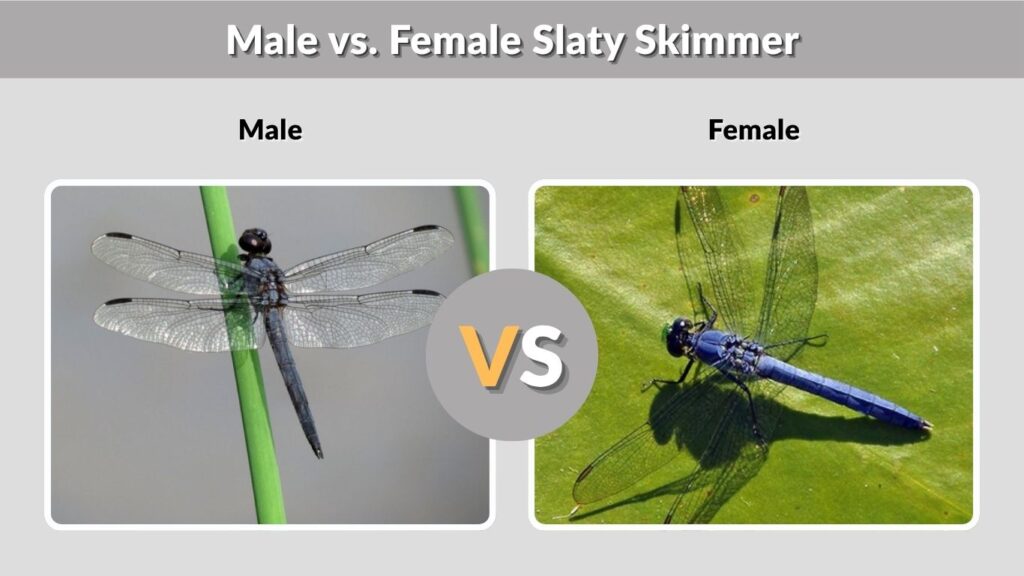
Sexual dimorphism causes males and females to look different once they become mature. However, newly emerged males closely resemble females.
| Feature | Mature Male | Female |
|---|---|---|
| Body color | Slate blue to blue-black | Cream, brown, or dull blue-gray |
| Head | Very dark or blackish | Usually brown |
| Eyes | Dark red, brown, or nearly black | Brownish |
| Abdomen | Uniformly dark and powdery | Brown with a darker central stripe |
| Wings | Mostly clear | Clear, sometimes with slightly darkened tips |
| Behavior | Frequently patrols breeding water | Often remains away from water except when breeding |
Males are seen more frequently because they occupy exposed perches near ponds. Females may spend much of their time hunting around woodland edges, meadows, and nearby vegetation.
Slaty Skimmer Range
The Slaty Skimmer is native to eastern North America. Its range covers much of the eastern United States and extends into southeastern Canada, including portions of Ontario, Quebec, and New Brunswick.
It is particularly widespread in the southeastern, central, and mid-Atlantic United States. Populations become more scattered near the northern and western edges of the range.
Adults are usually active during summer. In northern regions, they are most often observed from June through August. In warmer southern areas, the flight period may begin earlier and continue into fall.
Weather affects their activity. Slaty Skimmers are most visible during warm, calm, sunny days. They normally become less active during rain, strong wind, or cold conditions.
Habitat of the Slaty Skimmer
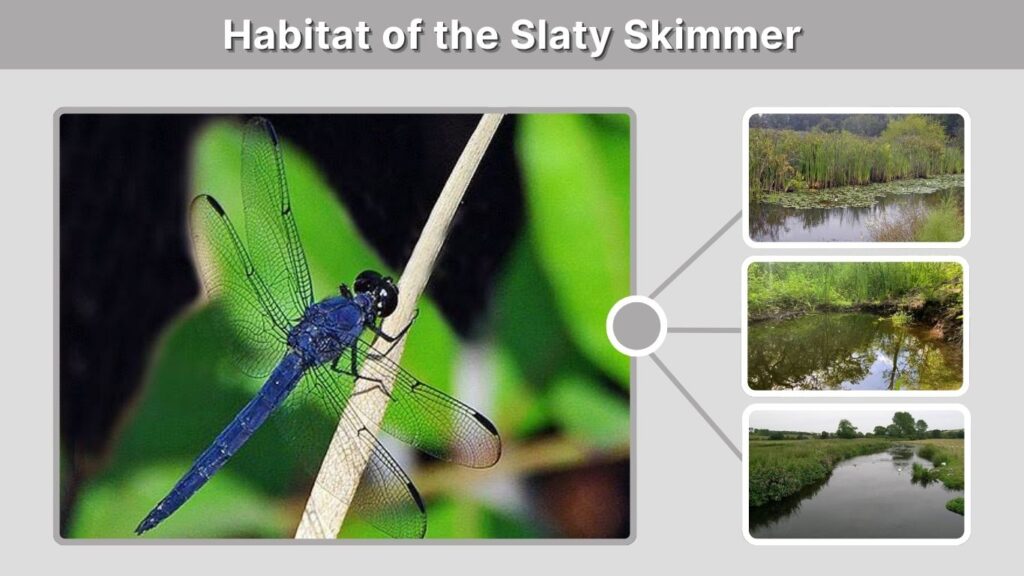
Slaty Skimmers prefer quiet freshwater with muddy or soft bottoms. They are often associated with forested areas, although adults may hunt in nearby open spaces.
Typical habitats include:
- Woodland ponds
- Small lakes
- Marshes and swamps
- Bog lakes
- Flooded woodland
- Slow-moving streams
- Quiet sections of rivers
- Permanent wetland pools
They usually require water that remains available long enough for their aquatic nymphs to develop. A pond with muddy edges, aquatic vegetation, and surrounding trees may provide particularly suitable habitat.
Adults need exposed stems, branches, shrubs, and reeds for resting. Males select perches that provide a clear view of the water and approaching dragonflies.
Diet and Hunting Behavior
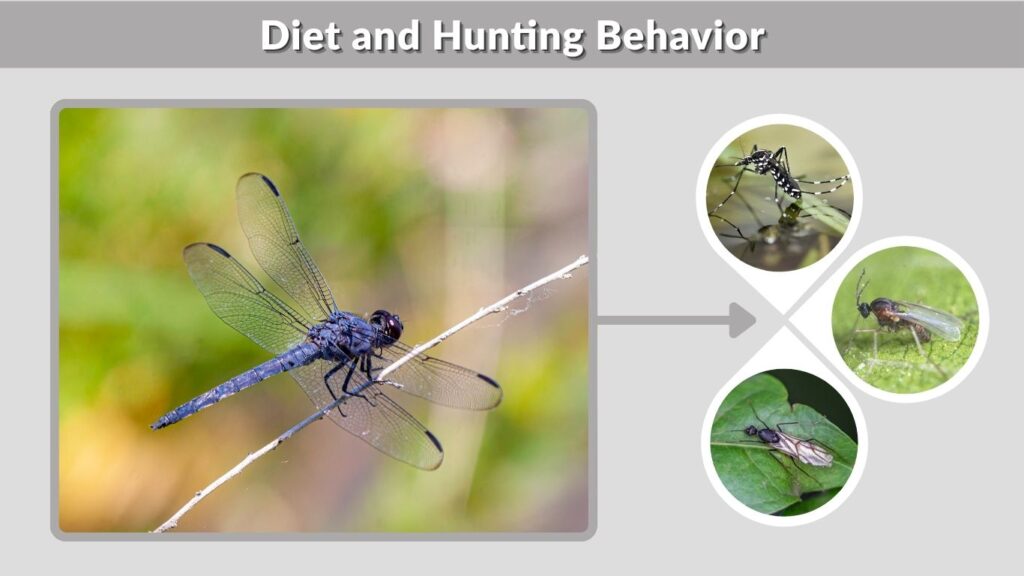
Adult Slaty Skimmers are carnivorous. They feed on mosquitoes, midges, gnats, small flies, moths, flying ants, and other insects they can capture.
How Slaty Skimmers Hunt
The Slaty Skimmer is primarily a perch-and-sally predator. It waits on a plant stem, twig, or low branch while watching the surrounding air. When a suitable insect passes, the dragonfly quickly launches from its perch.
It captures prey using its legs, which form a basket beneath the body. The dragonfly may eat a small insect while flying, but it generally returns to a perch before consuming larger prey.
Its large compound eyes provide an extremely wide field of vision. This allows the dragonfly to detect prey, rivals, predators, and potential mates approaching from different directions.
What Do Slaty Skimmer Nymphs Eat?
The aquatic nymphs are also predators. They remain on or near the muddy bottom, where their brown coloring provides camouflage.
Their diet may include:
- Mosquito larvae
- Aquatic fly larvae
- Mayfly nymphs
- Small aquatic insects
- Tiny crustaceans
- Tadpoles
- Other small aquatic animals
Nymphs capture prey using an extendable lower mouthpart. This specialized structure shoots forward rapidly and pulls the prey back toward the mouth.
Territorial and Mating Behavior
Male Slaty Skimmers defend territories along pond and lake shorelines. They frequently choose a prominent perch and return to it after making short patrol flights.
A male may chase away other males entering its area. Territorial activity is often strongest during the morning, although it can continue throughout warm portions of the day.
After mating, the female flies low over the water and deposits her eggs. She may touch the surface with the tip of her abdomen or use water droplets to flick eggs toward shallow water and the shoreline. The male often flies above or close to her, guarding her against competing males.
Females usually lay eggs without remaining physically attached to the male. Depositing eggs in several locations may improve the chances that some young will survive.
Slaty Skimmer Life Cycle
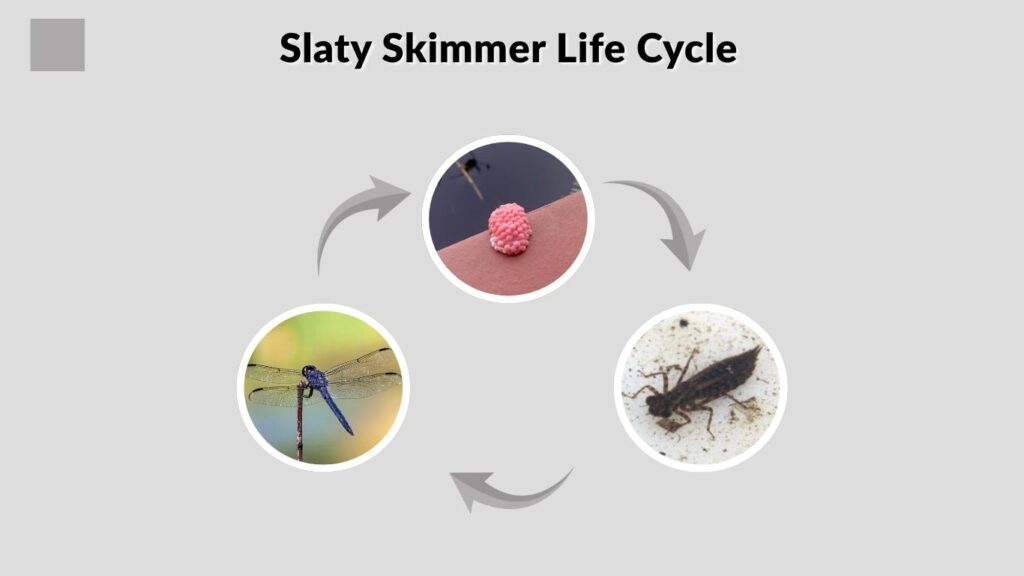
The Slaty Skimmer undergoes incomplete metamorphosis. Its life cycle consists of three stages: egg, aquatic nymph, and winged adult.
Egg and Nymph Stage
Eggs laid near the water hatch into small aquatic nymphs. The nymphs live among mud, plants, and organic debris at the bottom of ponds or slow waterways.
They molt numerous times while growing. Most of the species’ life is spent underwater, where the developing nymph feeds and avoids fish, frogs, larger insects, and other predators.
Adult Emergence
When development is complete, the nymph climbs onto a plant stem, rock, log, or other surface above the water. Its outer skin splits, and the adult slowly pulls itself free.
The newly emerged dragonfly has soft, folded wings and a pale body. It pumps fluid into its wings until they expand and then waits for its body to harden. The empty nymph skin, called an exuvia, remains attached to the emergence site.
Young adults generally leave the water temporarily to feed and mature. Males return after developing their darker coloration and begin defending breeding territories.
Slaty Skimmer vs. Great Blue Skimmer
The Great Blue Skimmer is one of the species most likely to be confused with the Slaty Skimmer. Both have blue mature males and often live near wooded freshwater habitats.
The Great Blue Skimmer is generally larger and paler. A mature male usually has a light blue body, greenish or blue-green eyes, and a noticeably pale face. Dark marks may also appear near the bases of its wings.
A male Slaty Skimmer is darker and more uniform. Its body is slate blue or nearly black, its face is dark, and the wings generally lack prominent basal markings.
Blue Dashers are also similar, but they are smaller and usually have a pale face, greenish eyes, and dark marks near the wing bases.
Are Slaty Skimmers Dangerous?
Slaty Skimmers are not dangerous to people or pets. They do not have stingers, and they do not attack humans. A dragonfly may attempt to bite if it is caught and handled roughly, but any defensive bite is unlikely to cause serious harm.
These dragonflies are beneficial because they consume mosquitoes, flies, and other insects. Their nymphs also help control mosquito larvae and aquatic insect populations.
The best approach is to observe them without catching or disturbing them. Avoiding pesticides around ponds and preserving shoreline vegetation can help support local Slaty Skimmer populations.
FAQs
Is a Slaty Skimmer rare?
The Slaty Skimmer is common in suitable habitats across much of eastern North America. However, it may be absent from apparently similar ponds. Its distribution becomes more scattered near the northern and western limits of its range.
How do you identify a male Slaty Skimmer?
A mature male has a nearly uniform slate-blue, blue-black, or dark purple body. Its head and eyes are dark, while its wings are mostly transparent. It lacks the bold wing patches seen on Widow Skimmers and Twelve-spotted Skimmers.
What does a female Slaty Skimmer look like?
A young female is cream or brown with dark markings on the thorax and a blackish stripe along the abdomen. Older females become darker and may develop a dull bluish or gray coating that makes them resemble males.
When can you see Slaty Skimmers?
Adults are commonly seen from June through August in northern parts of their range. Their flight season may extend from late spring into fall in warmer southern regions. They are most active on warm, sunny days.
Where do Slaty Skimmers lay their eggs?
Females lay their eggs in quiet freshwater, such as ponds, marshes, lakes, and slow streams. A female flies low over the surface and releases or flicks eggs into open water or toward shallow muddy edges.