
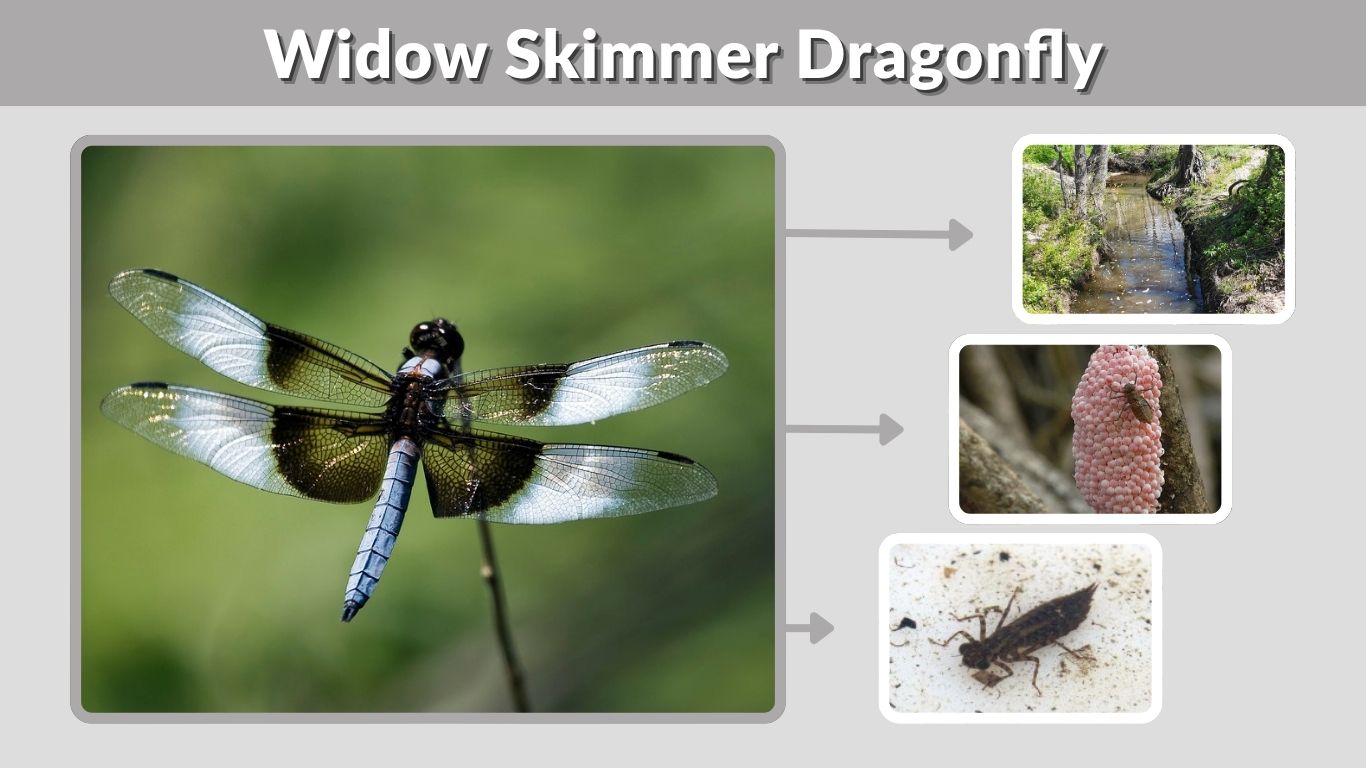
The Widow Skimmer is a large, striking dragonfly recognized by the dark patches covering the bases of its wings. Mature males develop contrasting white wing bands and a powdery blue-white abdomen, while females remain brown and yellow. This useful insect is commonly observed near ponds, lakes, marshes, and other slow-moving waters across much of North America. Despite its dramatic appearance and unusual name, the Widow Skimmer is harmless to people. It is an agile aerial predator that helps control mosquitoes, flies, and other small insects.
Widow Skimmer Scientific Name and Classification
The scientific name of the Widow Skimmer is Libellula luctuosa. It belongs to the family Libellulidae, whose members are commonly called skimmers.
| Classification | Name |
|---|---|
| Kingdom | Animalia |
| Phylum | Arthropoda |
| Class | Insecta |
| Order | Odonata |
| Family | Libellulidae |
| Genus | Libellula |
| Species | Libellula luctuosa |
The species is part of a group sometimes called the king skimmers. These dragonflies generally have strong bodies, broad wings, and powerful flight.
What Does a Widow Skimmer Look Like?
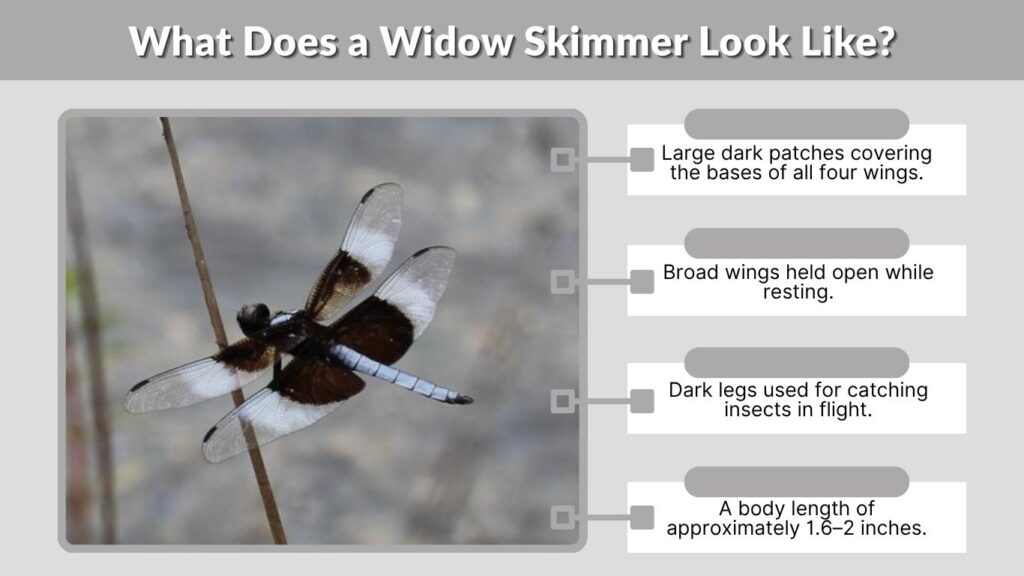
Widow Skimmers have large heads, robust bodies, and four broad wings. Their dark wing patches make them easier to recognize than many other dragonflies. Adults usually measure around 1.6–2 inches long.
Main Identification Features
Look for the following characteristics:
- Large dark patches covering the bases of all four wings
- Broad wings held open while resting
- A strong, thick-bodied appearance
- Large compound eyes that nearly meet on top of the head
- Dark legs used for catching insects in flight
- A body length of approximately 1.6–2 inches
The dark wing patches are present in both sexes, but the white wing bands of mature males provide the clearest identification feature.
Male Widow Skimmer
A mature male has a dark brown or blackish thorax and a powdery white or pale blue abdomen. This powdery coating is called pruinosity, a waxy substance that develops as the dragonfly matures.
Male wings have large dark patches at their bases followed by broad white bands near the middle. The outer portions of the wings are generally clear. From a distance, the wing pattern can appear black, white, and transparent.
Young males initially look more like females. Their bodies are brown and yellow, and they do not yet have the white wing bands or powdery abdomen seen in mature individuals.
Female Widow Skimmer
Female Widow Skimmers do not have the bold white wing bands of mature males. Their wings have brown or blackish patches at the bases and often darker coloring near the tips.
A female’s body is mostly brown, with a dark central stripe along the abdomen. A yellow stripe runs down each side of this darker central area. The thorax may have tan or yellowish markings.
Females can be confused with immature males because both have yellow-striped bodies and lack the male’s white wing patches. The appearance of an immature male gradually changes as it reaches maturity.
Widow Skimmer Range and Habitat
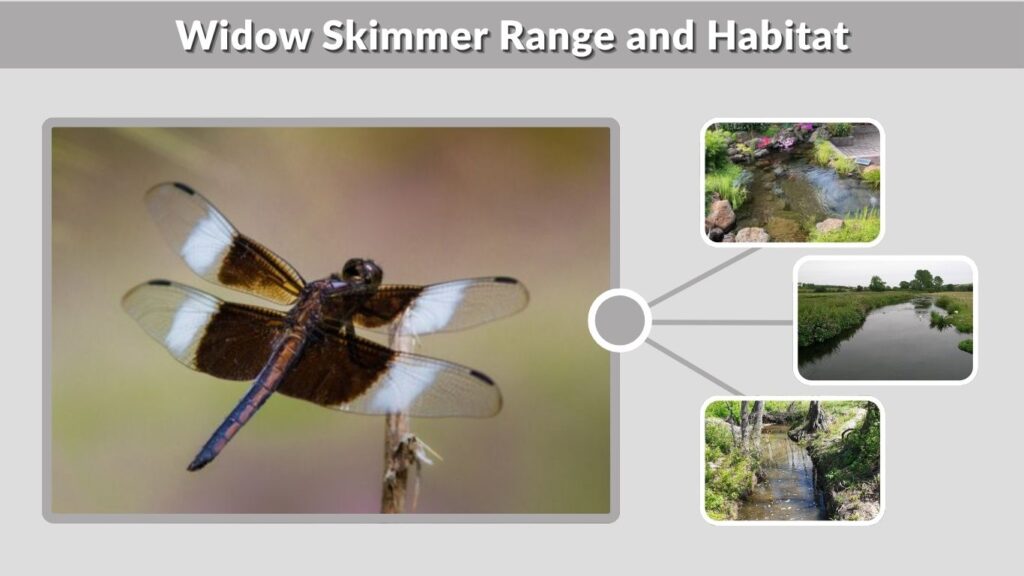
The Widow Skimmer is widely distributed across the United States and portions of southern Canada and Mexico. It is common in many eastern, central, and southern states. It also occurs in much of the West, although it may be absent or less common at higher elevations and in dry areas without suitable water.
Widow Skimmers prefer open, sunny locations near still or slow-moving freshwater. Their typical habitats include:
- Ponds
- Small lakes
- Marshes
- Lagoons
- Slow streams
- Flooded fields
- Borrow pits
- Garden ponds
Adults may fly a considerable distance from the water. They can sometimes be seen in meadows, gardens, roadsides, and woodland clearings. Males usually remain closer to breeding water, while females may spend more time hunting in surrounding vegetation.
Widow Skimmer Diet and Hunting Behavior
Adult Widow Skimmers feed on mosquitoes, gnats, midges, flies, small moths, and other flying insects. They capture prey with their legs, which form a basket beneath the body during flight.
An adult often rests on a branch, plant stem, fence, or exposed twig. When it detects prey, it launches into the air, captures the insect, and may return to the same perch. This hunting style is sometimes described as “perch and sally.”
Males can be territorial around breeding sites. They patrol sections of shoreline and chase other males away. However, Widow Skimmers are also known to wander through fields and open habitats while searching for food.
Life Cycle of a Widow Skimmer
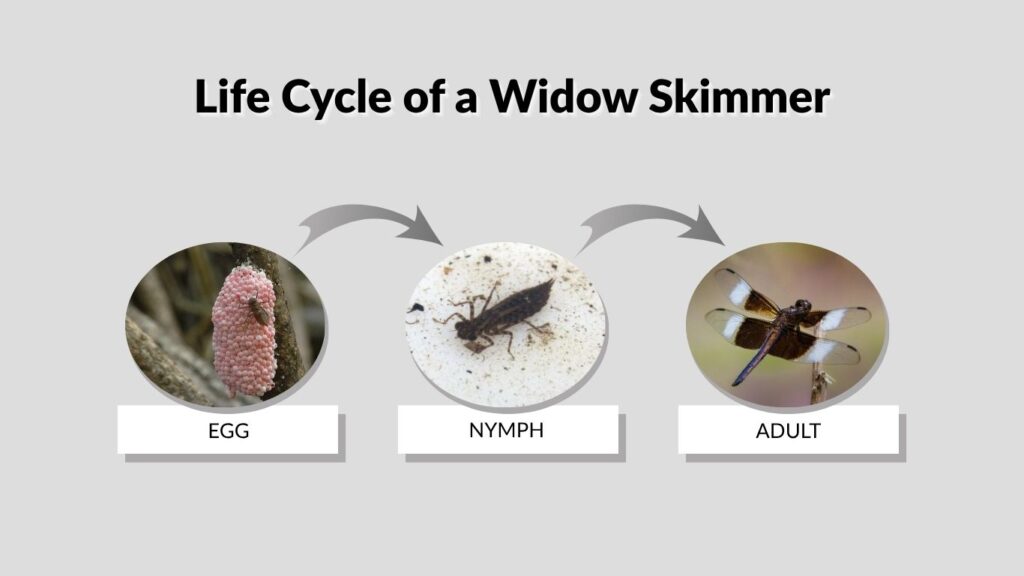
The Widow Skimmer undergoes incomplete metamorphosis, passing through egg, nymph, and adult stages. It does not have a caterpillar-like larval stage or a pupa.
Eggs and Aquatic Nymphs
After mating, the female deposits her eggs in or near the water. Depending on the situation, a male may remain nearby and guard her against competing males.
The eggs hatch into aquatic nymphs, also called naiads. These young dragonflies live underwater among mud, aquatic plants, and decaying material. They are predators that eat mosquito larvae, aquatic insects, small crustaceans, tadpoles, and other suitably sized animals.
Emergence as an Adult
A nymph molts repeatedly as it grows. Once fully developed, it climbs out of the water onto a rock, reed, or plant stem. Its outer skin splits, and the adult slowly pulls itself free.
The new adult expands its soft wings and waits for its body to harden. It then leaves the water to feed and mature. The empty nymph skin, known as an exuvia, may remain attached to the plant.
Widow Skimmer vs. Common Whitetail
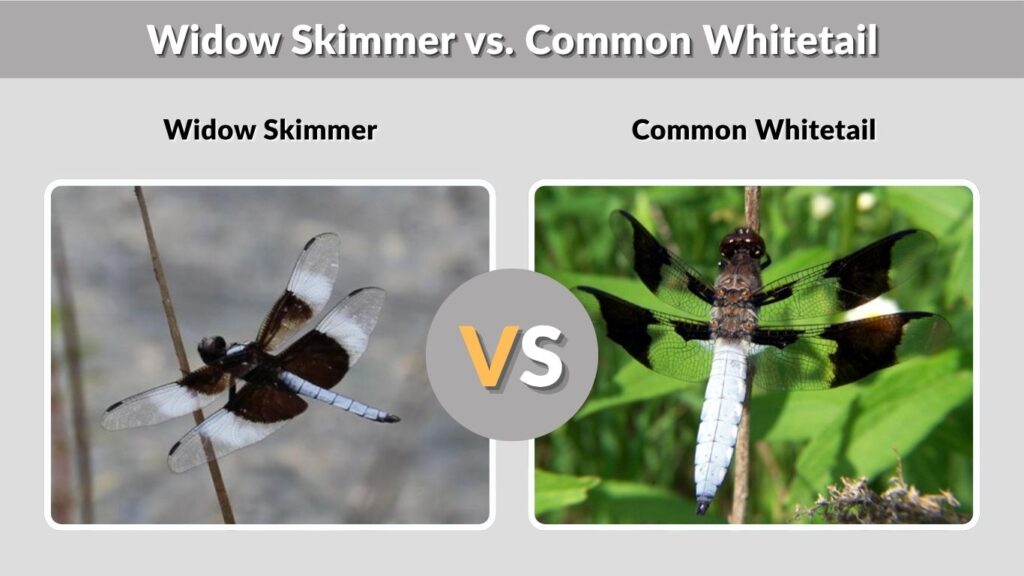
The Widow Skimmer and Common Whitetail can look similar because mature males of both species have pale, powdery abdomens and dark markings on their wings. Examining the arrangement of those wing markings makes identification easier.
| Feature | Widow Skimmer | Common Whitetail |
|---|---|---|
| Scientific name | Libellula luctuosa | Plathemis lydia |
| Male wing pattern | Dark bases followed by white bands | Dark bands near the middle |
| Male abdomen | Long and powdery blue-white | Broad, short, and white |
| Female abdomen | Yellow lengthwise stripes | Pale zigzag or angled markings |
| Female wings | Dark bases and tips | Three separate dark spots on each wing |
| General build | Large, broad-winged | Shorter with a wider abdomen |
A male Widow Skimmer has dark patches beginning at the wing bases. The nearby white patches create a dark-white-clear arrangement. The male Common Whitetail has mostly clear wing bases with a dark band farther outward.
Similar Skimmer Dragonflies
Several other species may be mistaken for the Widow Skimmer when viewed from a distance.
The Twelve-spotted Skimmer has three dark spots on each wing. Mature males develop white patches between those dark areas, creating a highly patterned appearance. Females have yellow stripes along the abdomen but lack white wing spots.
The Eight-spotted Skimmer has two major dark patches on each wing, producing eight spots in total. It is primarily found in western North America.
The Slaty Skimmer has a dark bluish or slate-colored body, but its wings are mostly clear. Its lack of large dark basal wing patches separates it from the Widow Skimmer.
Geographic location, wing patterns, and abdominal markings should always be considered together when identifying these dragonflies.
Widow Skimmer Spiritual Meaning
There is no scientific spiritual meaning associated with the Widow Skimmer. However, people sometimes interpret dragonflies as symbols of transformation, adaptability, emotional maturity, and personal growth.
The species’ change from an underwater nymph into a powerful flying adult can represent renewal or moving into a new stage of life. Its dark and white wing markings may also be interpreted as a symbol of balance between difficult experiences and new beginnings.
These meanings come from personal or cultural symbolism rather than the dragonfly’s biology.
Are Widow Skimmers Beneficial?
Widow Skimmers are beneficial predators during both their aquatic and adult stages. Their nymphs consume mosquito larvae and other aquatic organisms, while adults catch mosquitoes, flies, and gnats.
They are also part of the food web. Fish, frogs, birds, spiders, and larger insects may prey on them. A healthy population of Widow Skimmers can indicate that an area contains suitable freshwater habitat and a productive insect community.
FAQs
Do Widow Skimmers bite or sting?
Widow Skimmers do not have stingers and do not attack people. A dragonfly held tightly might try to bite defensively, but its bite is generally harmless. It is best to observe these beneficial insects without handling them.
Why is it called a Widow Skimmer?
The name may refer to the dark patches on its wings, which resemble traditional mourning clothing. “Skimmer” describes the family’s habit of flying and patrolling over the surface of ponds, lakes, and other waters.
How can you identify a male Widow Skimmer?
A mature male has dark patches at the bases of all four wings, broad white patches near the middle of the wings, and a powdery blue-white abdomen. Young males lack these white areas and can resemble females.
What does a female Widow Skimmer look like?
A female has brown basal wing patches, frequently dark wingtips, and no white wing bands. Her brown abdomen has a dark central stripe bordered by two yellow lengthwise stripes.
Is the Widow Skimmer rare?
The Widow Skimmer is not generally considered rare. It is widely distributed and can be common near ponds, small lakes, marshes, and slow waterways. Local abundance varies according to climate, water quality, and the availability of suitable breeding habitat.