
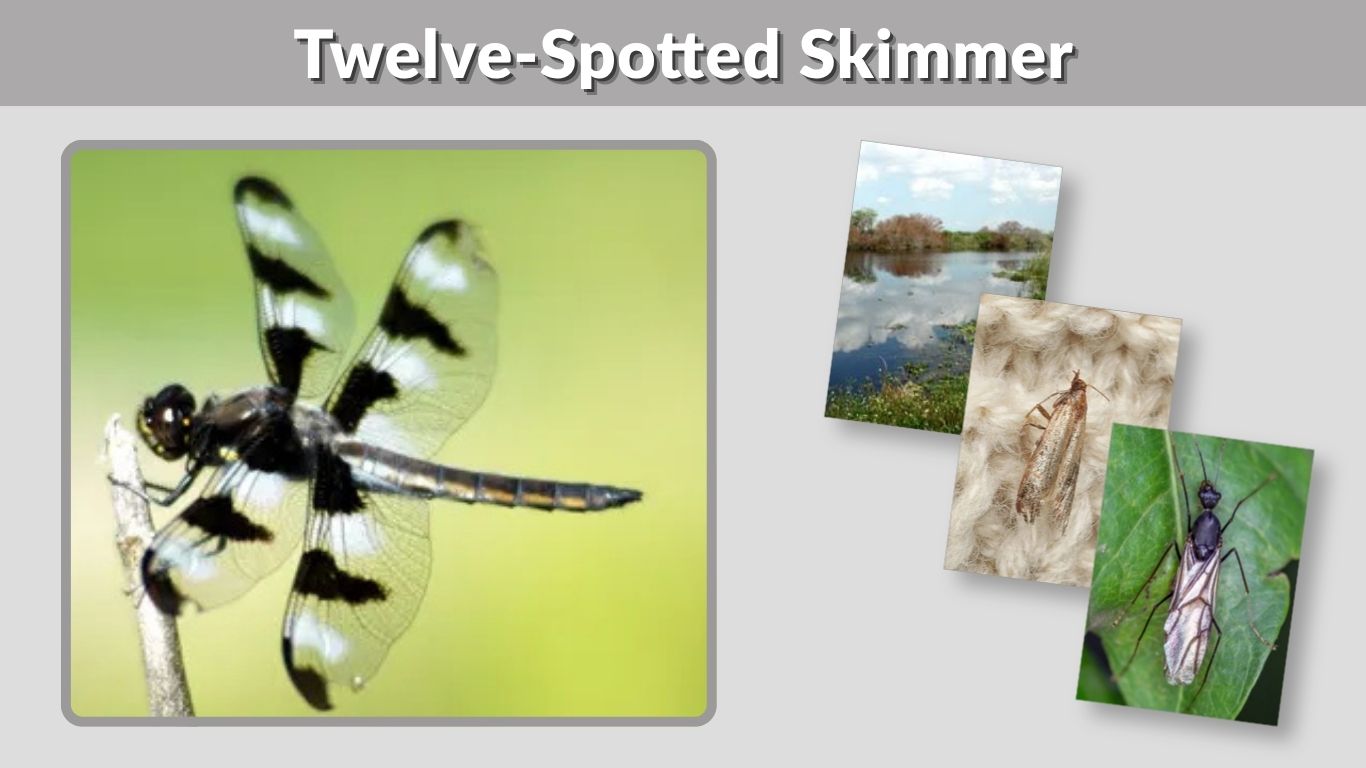
The Twelve-Spotted Skimmer (Libellula pulchella) is a large North American dragonfly recognized by the dark patches arranged across its transparent wings. Mature males are especially striking because white patches appear between the dark markings, while females retain a simpler brown-and-clear wing pattern. This active predator is commonly found around ponds, lakes, marshes, fields, and slow-moving waterways, where it catches mosquitoes, flies, midges, and other insects.
Twelve-Spotted Skimmer Overview
The Twelve-Spotted Skimmer belongs to the skimmer family Libellulidae and the order Odonata. Its scientific name, Libellula pulchella, is recognized as valid by both the U.S. Fish and Wildlife Service and the Integrated Taxonomic Information System.
| Feature | Details |
| Scientific name | Libellula pulchella |
| Family | Libellulidae |
| Order | Odonata |
| Adult length | Usually about 48–57 mm |
| Wing pattern | Three dark spots on each wing |
| Male color | Powdery blue or whitish abdomen |
| Female color | Brown with yellow abdominal stripes |
| Habitat | Ponds, lakes, marshes, ditches, and slow streams |
| Diet | Small flying insects |
| Native range | North America |
| Activity | Primarily daytime |
What Does a Twelve-Spotted Skimmer Look Like?
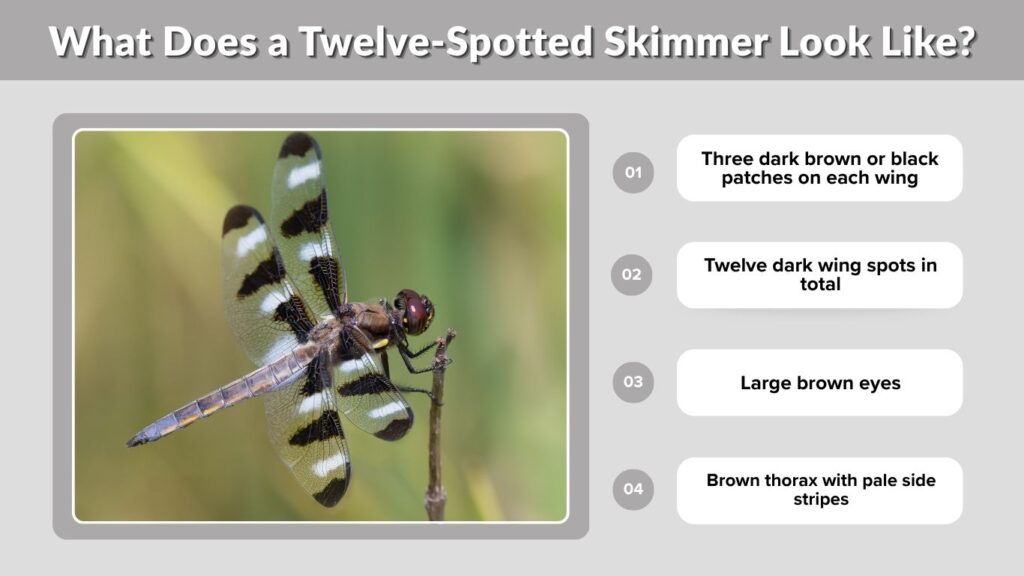
This dragonfly has a sturdy body, broad hindwings, large compound eyes, and four transparent wings marked with bold patches. Its body length is generally around 48–57 millimeters, or approximately two inches.
Identification Features
- Three dark brown or black patches on each wing
- Twelve dark wing spots in total
- Darkened wing tips
- Large brown eyes
- Brown thorax with pale side stripes
- Broad hindwings
- Strong legs used to capture flying prey
- Habit of resting on exposed twigs and stems
The dark markings occur near the wing bases, across the middle of the wings, and toward the tips. Counting three dark patches on each of four wings produces the twelve spots behind the species’ common name.
Male Twelve-Spotted Skimmer
A mature male is one of the most distinctive North American dragonflies. In addition to the twelve dark spots, he develops pale white patches between the dark markings. His abdomen gradually becomes covered with a powdery wax-like coating called pruinosity, giving it a pale blue, gray, or whitish appearance.
Young adult males initially resemble females. Their bodies are brown with yellow stripes, and the pale coating develops as they mature. Older males usually appear bluer and may lose some of the crispness of their body markings.
Why Is It Sometimes Called the Ten-Spotted Skimmer?
The species was formerly called the Ten-Spot or Ten-Spotted Skimmer. This older name referred to the male’s white wing patches rather than the twelve dark spots visible in both sexes.
Some observers counted the pale areas near the bases of the hindwings along with the white patches between the dark bands. However, these pale areas may be faint, missing, or worn away, making “Twelve-Spotted Skimmer” the more dependable common name.
Female Twelve-Spotted Skimmer
Females have the same twelve dark wing patches but lack the male’s obvious white spots. Their abdomens are brown with long yellow or cream-colored stripes running along the sides.
Female Identification
- Brown abdomen rather than powdery blue
- Two long yellow abdominal stripes
- Twelve dark wing patches
- Clear spaces between the dark markings
- Brown thorax with pale stripes
- Dark wing tips
- Broader abdomen than many males
Females may spend less time openly defending the water’s edge. They are often seen in nearby vegetation, meadows, fields, and woodland openings before returning to water for mating and egg-laying.
Twelve-Spotted Skimmer Size and Wingspan
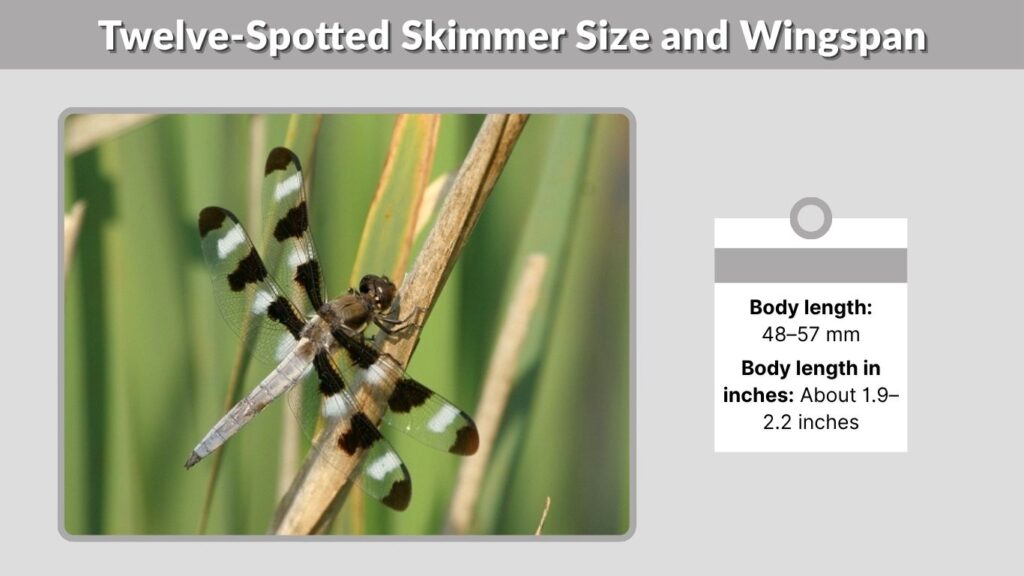
Adults generally measure approximately 48–57 millimeters long. Their broad wings and bold markings can make them look considerably larger when flying.
Published sources do not always provide a separate standardized wingspan measurement for this species. However, its overall dimensions place it among the larger and more conspicuous skimmer dragonflies in North America.
| Measurement | Approximate size |
| Body length | 48–57 mm |
| Body length in inches | About 1.9–2.2 inches |
| Relative size | Large skimmer dragonfly |
Twelve-Spotted Skimmer Range and Distribution
The Twelve-Spotted Skimmer has an exceptionally broad North American distribution. Records extend across the 48 contiguous United States, into extreme southern Canada, and southward into Mexico.
It can occur across eastern, central, and western regions, provided suitable freshwater breeding habitat is available. This wide distribution explains why it may be observed in very different environments, from prairie ponds and farm reservoirs to urban wetlands and desert water sources.
Twelve-Spotted Skimmers in Ontario
The species occurs in southern Canada, including Ontario. During the warmer months, adults may be found around ponds, marshes, lakeshores, ditches, and open fields near water.
In northern portions of its range, adults are primarily visible during summer. Cold winters normally survive in the aquatic immature stage rather than as flying adults.
Twelve-Spotted Skimmer Habitat
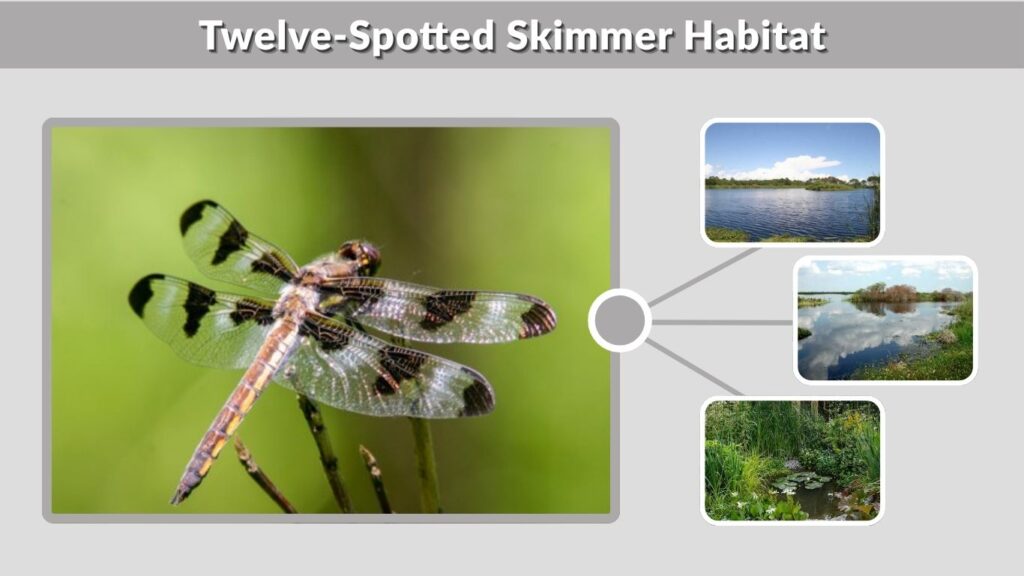
Twelve-Spotted Skimmers commonly breed in still or slow-moving freshwater. They prefer open, sunny habitats with vegetation around the shoreline.
Typical habitats include:
- Ponds
- Small lakes
- Marshes
- Wetlands
- Roadside ditches
- Farm reservoirs
- Bogs
- Slow-moving streams
- Seasonal pools
- Open fields near water
The species may also travel far from its breeding pond. Adults can appear over prairies, old fields, gardens, roadsides, and woodland clearings while hunting or dispersing.
What Do Twelve-Spotted Skimmers Eat?
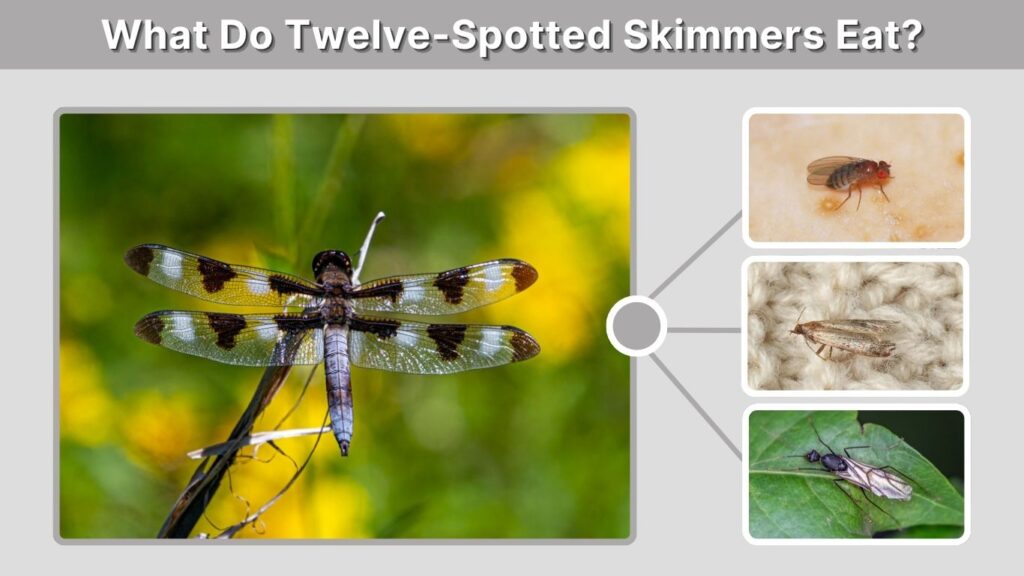
Adult Twelve-Spotted Skimmers are carnivorous aerial predators. They primarily eat small flying insects and capture prey using their long, bristled legs.
Their diet may include:
- Mosquitoes
- Midges
- Gnats
- Flies
- Small moths
- Winged ants
- Small bees and wasps
- Damselflies
- Smaller dragonflies
They do not eat leaves, flowers, fruit, or plant sap. A dragonfly resting on a flower or plant is usually using it as a hunting perch rather than feeding on it.
Hunting Behavior
The Twelve-Spotted Skimmer may patrol continuously or hunt from a favorite perch. A perched individual watches for movement, launches rapidly toward passing prey, captures it in flight, and often returns to the same branch or stem.
Its speed and maneuverability allow it to chase insects over open water, fields, and wetland vegetation.
Territorial Behavior
Males defend small territories near breeding water. A male may chase other males and even unrelated dragonfly species that enter his selected area.
After being disturbed, the dragonfly often flies away briefly and then returns to the same prominent perch. This predictable behavior makes it relatively easy to observe or photograph when approached slowly.
Territorial flights are not attacks on people. The male is responding to other dragonflies, searching for females, or hunting insects.
Twelve-Spotted Skimmer Life Cycle
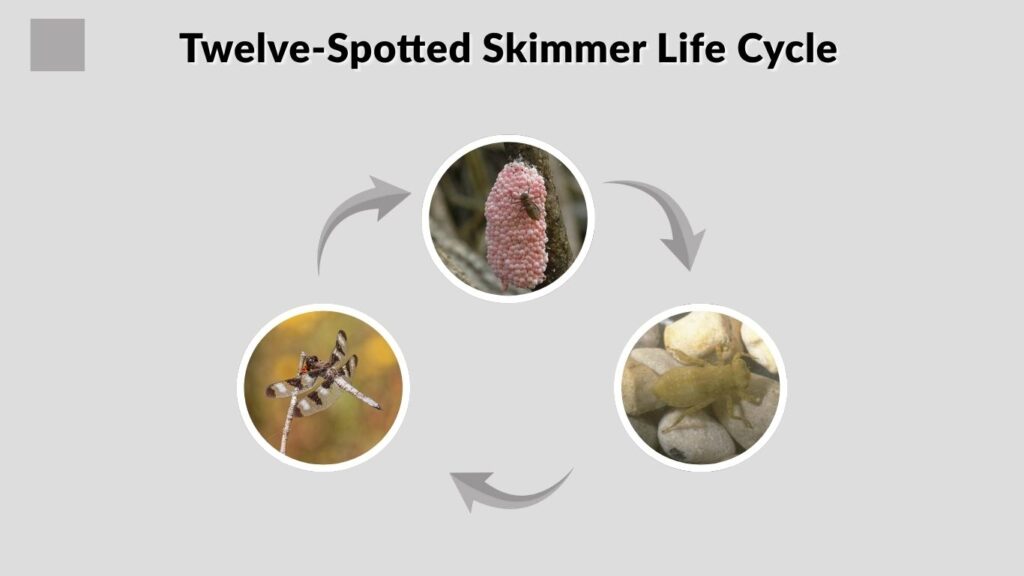
The species undergoes incomplete metamorphosis through three main stages: egg, aquatic nymph, and winged adult. It does not form a pupa or cocoon.
Eggs
After mating, a female flies low above the water and releases eggs by repeatedly touching the end of her abdomen to the surface. Eggs fall into shallow water or among aquatic vegetation. This dipping or striking behavior may be observed while the female remains in flight.
Aquatic Nymph
The eggs hatch into aquatic nymphs, also called larvae or naiads. Nymphs live underwater among sediment, submerged vegetation, and organic debris.
They are predators that may eat:
- Mosquito larvae
- Midge larvae
- Small aquatic insects
- Tiny crustaceans
- Worms
- Tadpoles
- Very small fish
Dragonfly nymphs capture prey with a specialized extendable lower mouthpart. Most of a dragonfly’s life is spent in this underwater stage, which can last several months or several years depending on the species and environmental conditions.
Adult Emergence
When fully developed, the nymph climbs out of the water onto a plant stem, rock, branch, or other support. Its outer skin splits, and the winged adult slowly pulls itself free.
The new adult is initially soft and pale. Its wings expand and harden, and its mature body colors develop over the following days. Newly emerged males resemble females before acquiring their powdery blue coating and contrasting white wing patches.
Twelve-Spotted Skimmer Lifespan
A species-specific lifespan for the Twelve-Spotted Skimmer is not consistently documented in public field guides. Like other temperate dragonflies, however, it spends most of its life underwater as a nymph, while the flying adult stage generally lasts only a few weeks to several months.
Adults are mainly seen during the warmer season. Regional flight periods vary, but records commonly extend from late spring through summer and into early fall. In the Minneapolis region, for example, the National Park Service records adults from June through September.
Twelve-Spotted Skimmer vs. Common Whitetail
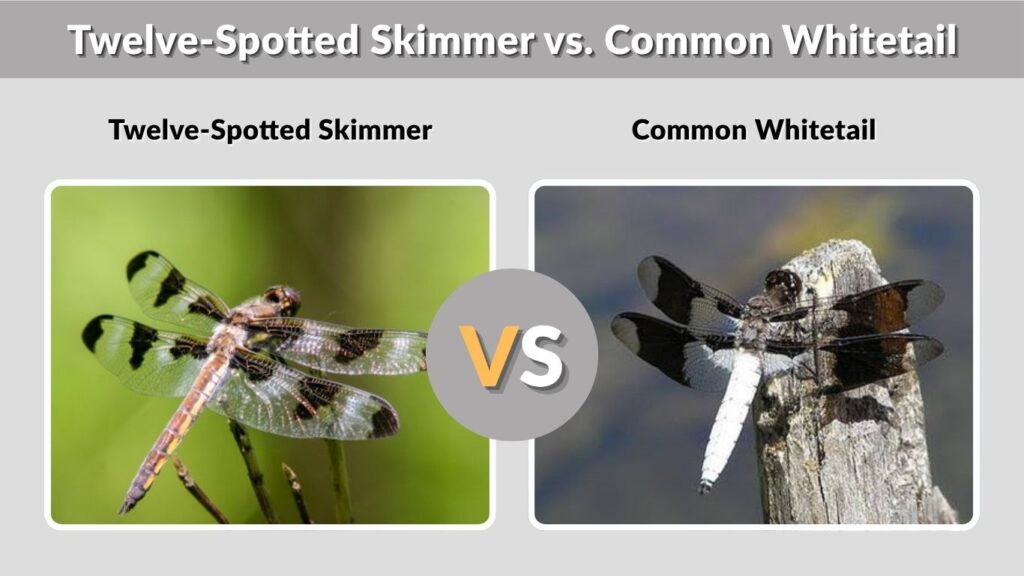
Female Twelve-Spotted Skimmers and female Common Whitetails can look similar because both have brown bodies and dark patches on the wings.
| Feature | Twelve-Spotted Skimmer | Common Whitetail |
| Dark wing patches | Three on each wing | Similar dark patches |
| Female abdomen | Gradually tapers | Tapers more abruptly |
| Side stripes | Relatively smooth | Often jagged or saw-toothed |
| Male wings | Dark and white patches | Broad dark wing bands |
| Perching | May perch relatively high | Often rests close to the ground |
The shape of the abdomen and the pattern of its yellow side stripes are especially useful for separating females.
Do Twelve-Spotted Skimmers Bite or Sting?
They cannot sting because they have no stinger. They do not drink blood, attack humans, or defend nests.
Like other large dragonflies, one may attempt to pinch with its chewing mouthparts when tightly held. Most encounters are harmless, and any risk can be avoided by observing the dragonfly without handling it.
FAQs
Why is it called a Twelve-Spotted Skimmer?
Both males and females have three dark spots on each of their four wings, producing twelve dark spots in total. Mature males also develop additional white wing patches.
How can you identify a male Twelve-Spotted Skimmer?
Mature males have twelve dark wing spots, white patches between them, and a powdery blue or whitish abdomen. Newly emerged males look browner and resemble females.
What does a female Twelve-Spotted Skimmer look like?
The female has twelve dark wing spots but no prominent white patches. Her abdomen is brown with long yellow stripes running along its sides.
Are Twelve-Spotted Skimmers Rare?
They are widespread and often common in suitable North American habitats. Their abundance varies locally according to water quality, wetland availability, climate, and seasonal conditions.
Do Twelve-Spotted Skimmers eat mosquitoes?
Yes. Adults may capture flying mosquitoes, while aquatic nymphs can eat mosquito larvae. They also consume many other small insects and do not specialize exclusively in mosquitoes.