
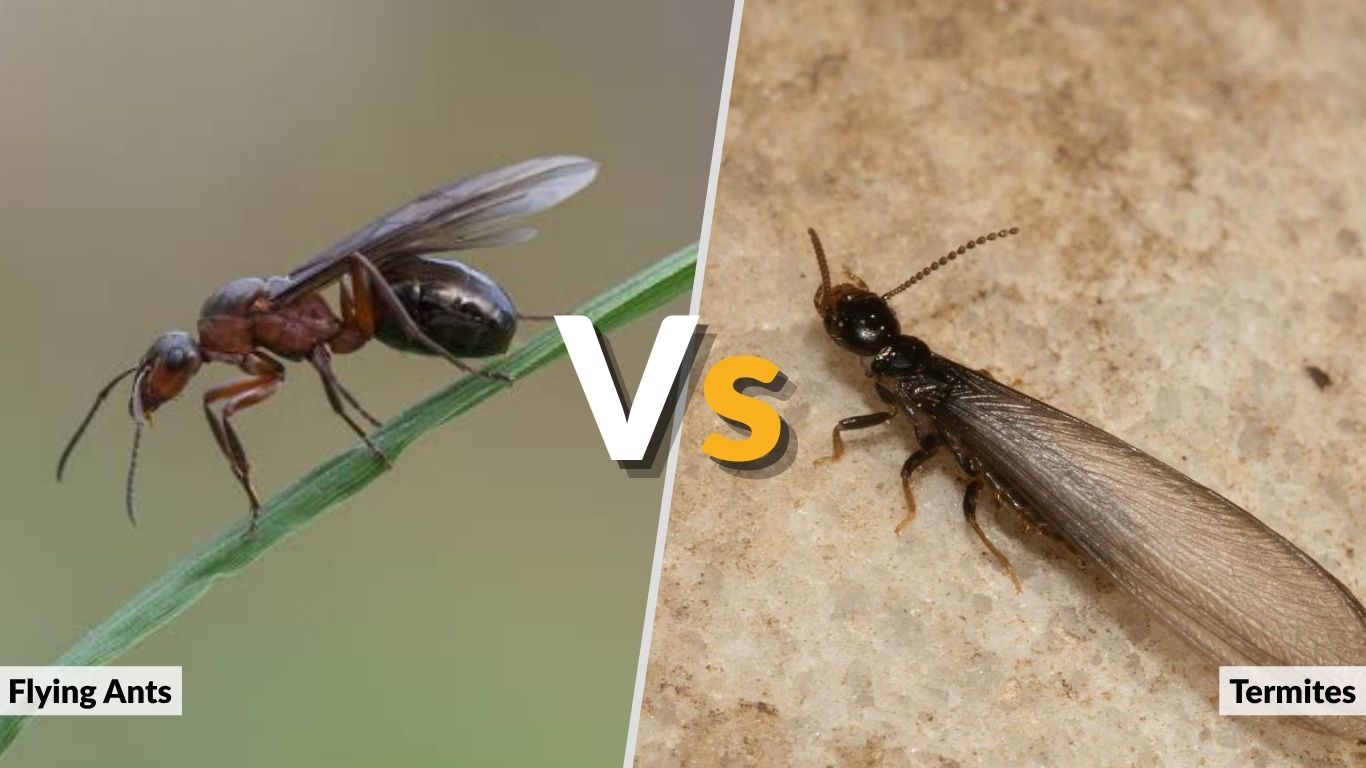
Flying ants and winged termites often appear suddenly in large groups, making them easy to confuse. However, their antennae, waists, wings, behavior, and potential impact on a home are noticeably different. Flying ants are reproductive members of an ant colony, while flying termites—called swarmers or alates—leave established colonies to reproduce. Correct identification is important because termites may indicate an active wood-destroying colony that requires prompt professional attention.
Flying Ants vs. Termites: Quick Comparison
At first glance, both insects have dark bodies, six legs, and two pairs of wings. A closer inspection usually reveals several reliable differences. Body shape, antenna form, and wing proportions are more useful for identification than color or size.
| Feature | Flying Ant | Winged Termite |
|---|---|---|
| Antennae | Bent or elbowed | Straight and bead-like |
| Waist | Narrow and pinched | Broad and nearly straight |
| Wings | Front pair larger than rear pair | Four wings of almost equal size |
| Wing length | Usually slightly longer than body | Often much longer than body |
| Common colors | Black, brown, reddish, or yellowish | Black, brown, tan, or pale |
| Body texture | Usually firm and clearly segmented | Softer and more uniform |
| Home risk | Depends on the ant species | Possible sign of termite infestation |
How to Identify Flying Ants
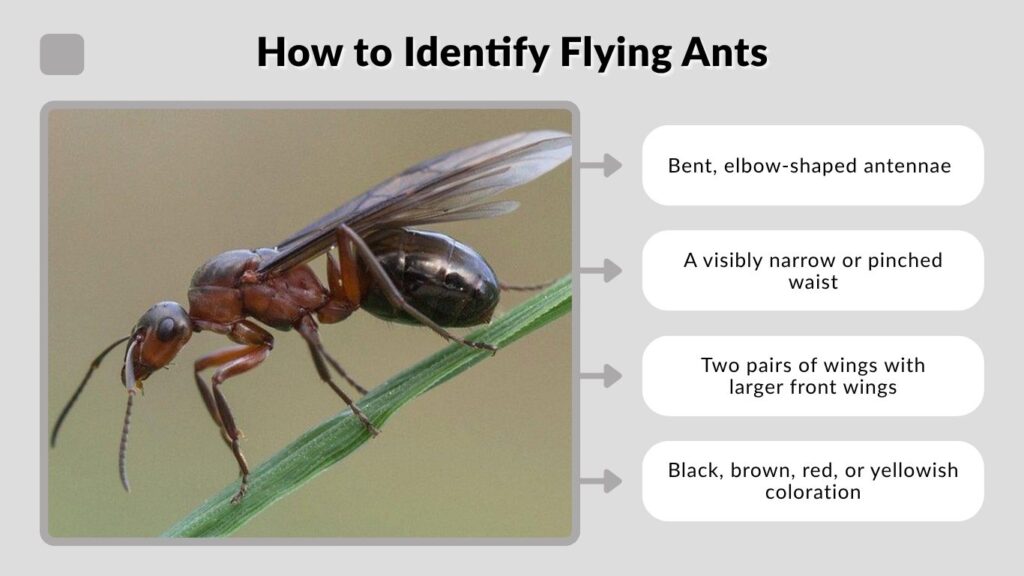
Flying ants are not a separate ant species. They are reproductive males and queens produced by an established colony. They develop wings temporarily so they can leave the nest, mate, and start new colonies.
Identification Features
Look for these characteristics when examining a flying ant:
- Bent, elbow-shaped antennae
- A visibly narrow or pinched waist
- Two pairs of wings with larger front wings
- A clearly divided head, thorax, and abdomen
- Black, brown, red, or yellowish coloration
- Harder-looking and more defined body segments
After mating, a female ant usually removes her wings and searches for a suitable nesting location. Males generally die shortly after the mating flight.
Flying Carpenter Ants
Carpenter ant swarmers are frequently mistaken for termites because they can be relatively large and may emerge from wooden structures. Unlike termites, carpenter ants do not eat wood. They excavate damaged or damp wood to create nesting galleries.
Carpenter ants still deserve attention because a colony inside the house may enlarge existing wood damage. Their presence can also point to moisture problems, roof leaks, plumbing leaks, or decaying timber.
How to Identify Winged Termites
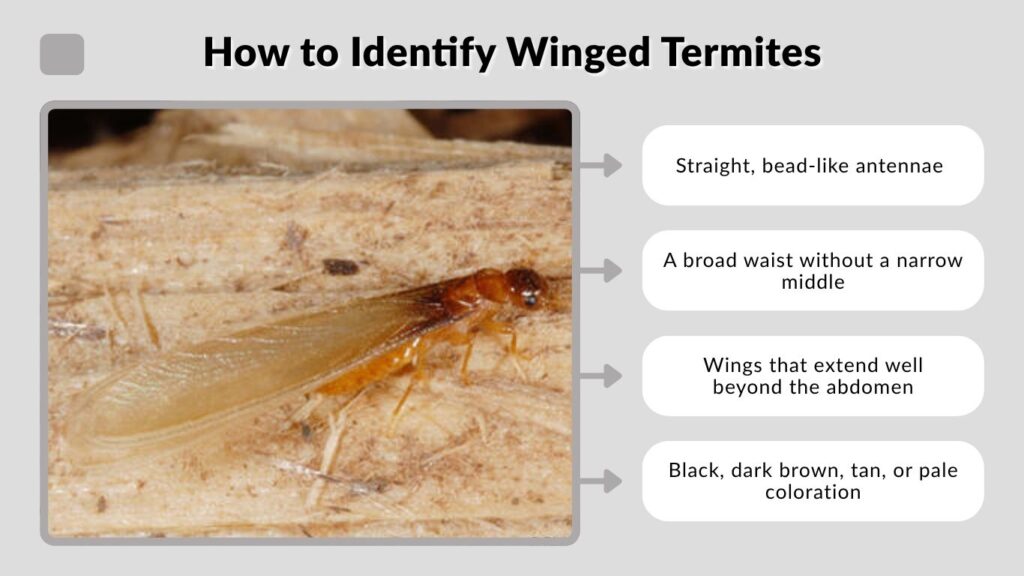
Winged termites are reproductive members of a mature termite colony. Their appearance indoors can be more concerning than the presence of a few outdoor swarmers, particularly when they emerge from walls, floors, windows, or wooden structures.
Identification Features
A termite swarmer commonly has:
- Straight, bead-like antennae
- A broad waist without a narrow middle
- Four wings that are approximately equal in size
- Wings that extend well beyond the abdomen
- A soft-looking, evenly shaped body
- Black, dark brown, tan, or pale coloration
Termite wings are delicate and detach easily. Finding piles of identical discarded wings around windowsills, doors, vents, or baseboards can therefore be an important warning sign.
Subterranean vs. Drywood Termite Swarmers
Subterranean termites live in the soil and travel between their colony and food through underground passages or mud tubes. Their swarmers often emerge during warm, humid conditions, particularly after rain.
Drywood termites live directly inside dry wooden materials and do not require contact with soil. In addition to swarmers and discarded wings, they may leave small piles of dry, pellet-like droppings called frass beneath infested wood.
Seven Differences Between Flying Ants and Termites
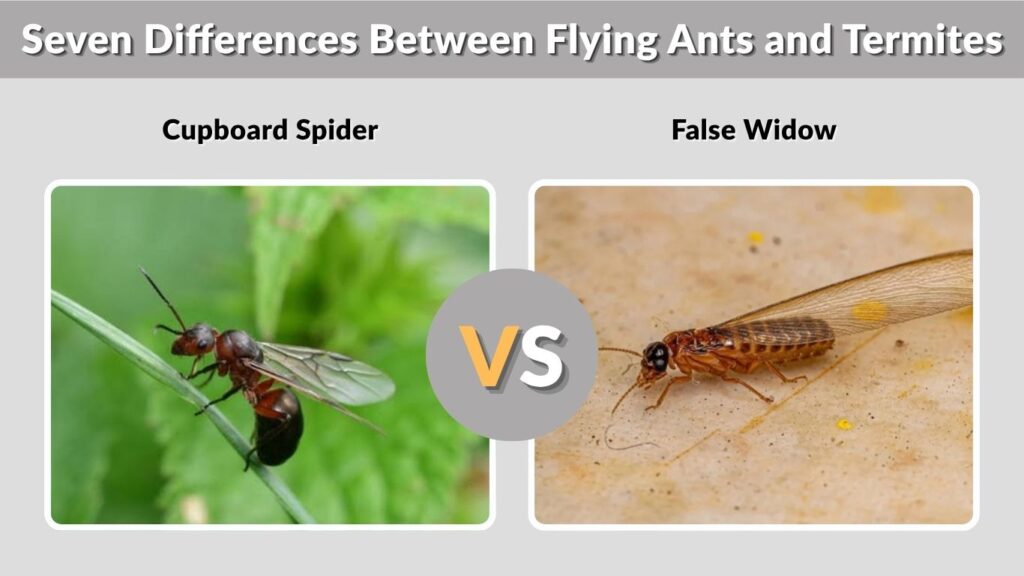
No single feature should be considered in isolation. Examining several body characteristics provides the most reliable identification.
1. Antennae
A flying ant’s antennae are distinctly bent, usually resembling an elbow. Termite antennae are straight or only slightly curved and appear to be made from a row of tiny beads.
2. Waist Shape
Flying ants have a narrow waist between the thorax and abdomen. Some species have one or two small nodes in this area. Termites have a broad waist, giving their bodies a straighter and more uniform appearance.
3. Wing Size
Both insects have four wings. A flying ant’s front wings are noticeably larger than its hind wings. All four termite wings are approximately equal in length and shape.
4. Wing Length
Termite wings are usually long and may extend far beyond the tip of the body. Flying ant wings can also extend beyond the body, but the difference between their front and rear pairs remains visible.
5. Lost Wings
Termites shed their fragile wings soon after landing. Numerous matching wings without bodies are therefore strongly associated with termite activity. Ant queens also remove their wings after mating, but large piles of ant wings inside a house are less common.
6. Body Shape
An ant has three clearly defined body sections and a constricted middle. A termite’s abdomen joins the thorax more broadly, creating a thicker, less sharply segmented profile.
7. Nesting and Wood Damage
Termites consume cellulose found in wood and other plant materials. Carpenter ants remove wood to build galleries but do not eat it. Many other flying ant species nest in soil, wall voids, pavement cracks, or decaying organic matter and cause no structural damage.
Do Color and Size Help With Identification?
Color and size provide supporting clues, but neither is completely reliable. Both groups contain many species, and their appearances overlap considerably.
| Appearance | What It May Indicate |
|---|---|
| Large black winged insect | Carpenter ant, but some termites are also dark |
| Small black flying insect | Various ant species or termite swarmers |
| Reddish winged insect | Often an ant, although color alone is inconclusive |
| Pale or tan winged insect | Possibly a termite, especially near infested wood |
| Four long, matching wings | Strong indication of a termite swarmer |
| Pinched waist and bent antennae | Strong indication of a flying ant |
There are no “baby flying ants” or “baby flying termites.” Immature ants and termites remain within their colonies and do not have functional wings. The flying insects are fully developed reproductive adults.
Why Are They Swarming Around the House?
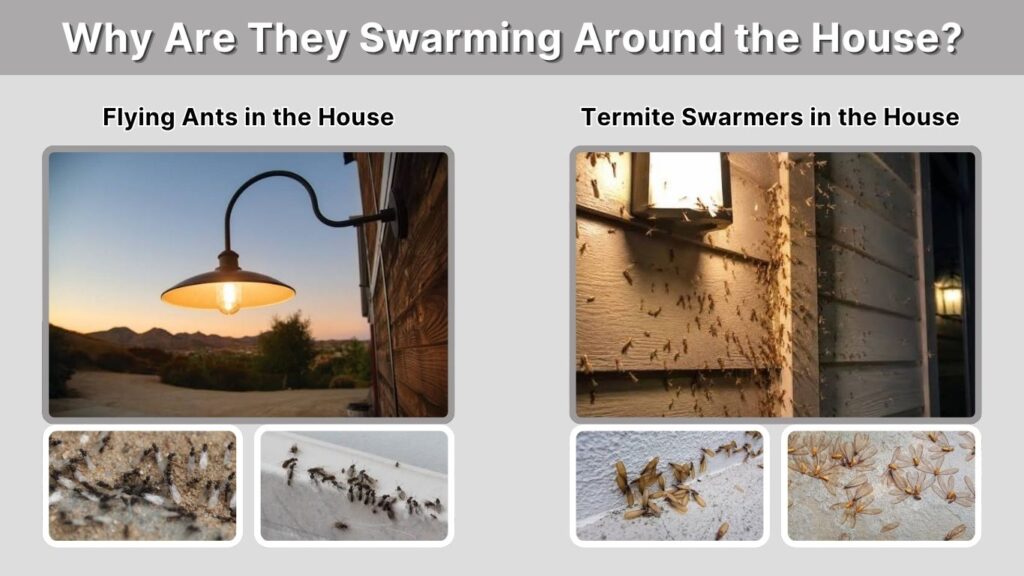
Swarming is a natural reproductive event. Mature colonies release winged males and females when temperature, humidity, wind, and seasonal conditions are favorable. Large numbers may emerge within a short period.
Flying Ants in the House
A few flying ants entering through an open window may have come from outdoors. Repeated indoor appearances, however, can indicate a nest in a wall void, attic, crawl space, or damaged wooden area.
Pay particular attention to large carpenter ants emerging near damp wood, plumbing, bathrooms, kitchens, window frames, or roof leaks.
Termite Swarmers in the House
Termites emerging indoors are more concerning. Swarmers near closed windows may be attracted to light after leaving a hidden colony within or beneath the building. They may also enter from an outdoor swarm, so their presence does not prove structural infestation by itself.
Warning signs include mud tubes, hollow-sounding wood, blistered surfaces, frass, damaged timber, and repeated piles of discarded wings.
What Should You Do After Finding Swarmers?
Collect several insects or wings in a sealed container or clear plastic bag. Clear photographs showing the antennae, waist, and wings can also help a pest professional identify them.
Avoid spraying or sweeping away everything before inspecting the area. Killing visible swarmers does not eliminate the hidden colony responsible for them.
For flying ants, locate food, moisture, and possible nesting sites. Seal entry gaps, repair leaks, remove damaged wood, store food properly, and use an appropriately labeled ant treatment if necessary.
If termites are suspected, arrange a professional inspection promptly. Effective treatment may involve soil barriers, baiting systems, localized wood treatments, or structural fumigation, depending on the termite species and extent of infestation.
FAQs
Are flying ants as dangerous as termites?
Most flying ants do not damage buildings. However, carpenter ants can excavate damp or weakened wood to create nests. Termites are generally a greater structural concern because their colonies consume cellulose and may damage wooden components continuously while remaining hidden.
Do flying termites mean a house is infested?
Not always. Outdoor termite swarmers can enter through open doors or windows. However, numerous swarmers emerging indoors, especially with closed windows, discarded wings, mud tubes, or damaged wood, may indicate a nearby or active colony and should be professionally inspected.
What time of year do flying ants and termites appear?
Timing depends on species and climate. Both commonly swarm during warm, humid weather. Subterranean termites frequently fly after rain, while many ant species swarm during summer. In heated buildings, an indoor colony may occasionally produce swarmers outside the usual season.
Can termites and flying ants be the same size?
Yes. Their sizes overlap, so size alone cannot provide a dependable identification. Examine the insects’ antennae, waists, and wings instead. Termites have straight antennae, broad waists, and equal-sized wings, whereas flying ants have bent antennae, narrow waists, and unequal wings.
Should I kill flying ants or termites immediately?
You can remove visible insects, but preserve a few samples first for identification. Killing swarmers will not eliminate their colony. If termites are possible, avoid disturbing suspected galleries or applying random sprays because this can complicate inspection and may scatter the infestation.