
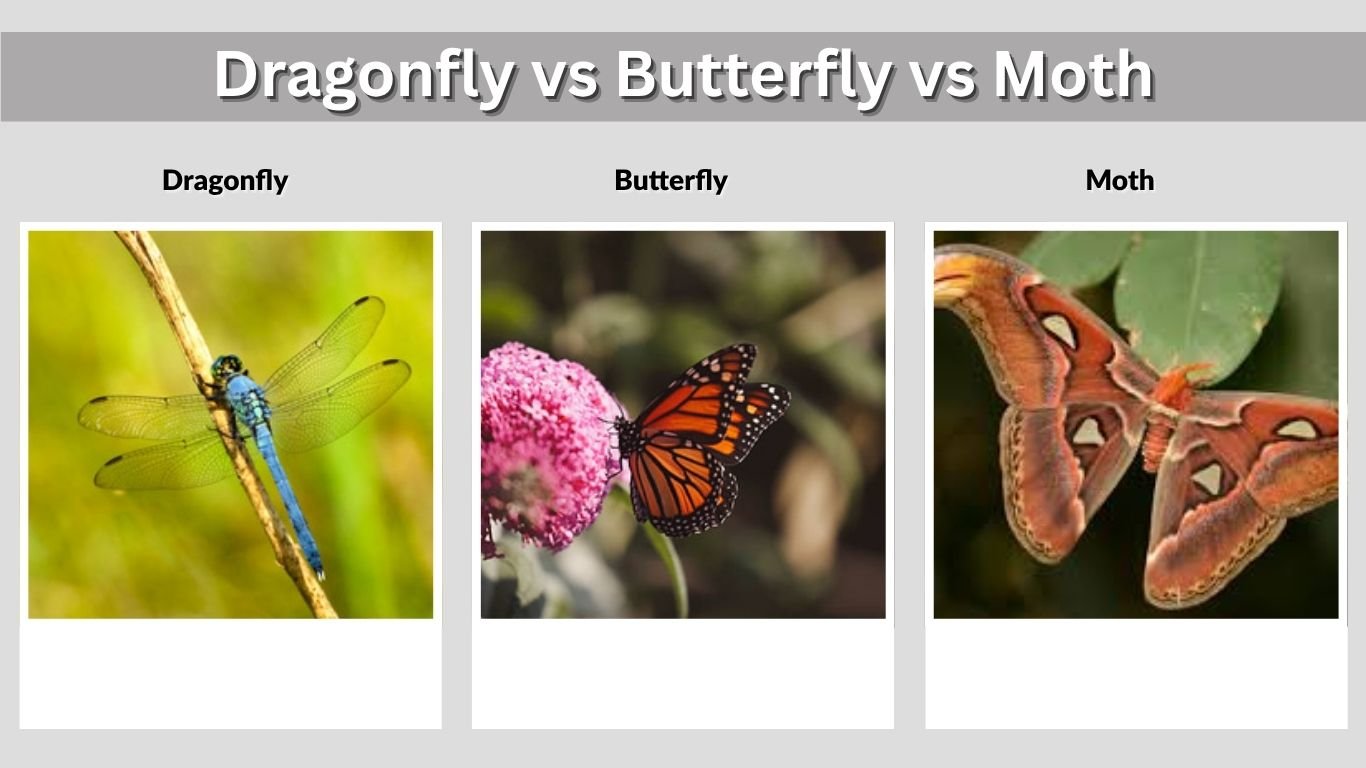
Dragonflies, butterflies, and moths are among the most commonly seen flying insects, yet many people confuse them due to their wings and ability to fly. While they may seem similar at first glance, they belong to different groups and have unique physical features, behaviors, and life cycles. Understanding these differences not only improves identification skills but also helps you appreciate their ecological roles.
This article compares dragonflies, butterflies, and moths in a structured way, starting with their basic definitions and key traits.
What Is a Dragonfly?

Dragonflies are fast-flying, predatory insects known for their agility and sharp vision. They belong to the order Odonata, which makes them very different from butterflies and moths.
Key Characteristics
- Long, slender body that helps with aerodynamic movement
- Large compound eyes that provide nearly 360-degree vision
- Two pairs of transparent, net-like wings
- Strong flying ability, including hovering and backward flight
Dragonflies are among the most efficient hunters in the insect world, often catching prey mid-air.
Habitat and Behavior
Dragonflies are commonly found near freshwater environments such as ponds, lakes, and rivers. This is because their early life stage (nymph) develops in water.
They are active during the daytime and spend much of their time flying, hunting insects like mosquitoes, flies, and even smaller dragonflies. Their presence often indicates a healthy aquatic ecosystem.
What Is a Butterfly?

Butterflies are colorful, delicate insects widely recognized for their beauty and role in pollination. They belong to the order Lepidoptera, the same group as moths.
Key Characteristics
- Brightly colored wings covered with tiny scales
- Slim body structure
- Club-shaped antennae
- Wings held upright when resting
Butterflies are often associated with flowers because of their feeding habits and vibrant appearance.
Habitat and Behavior
Butterflies are found in a wide range of habitats, including gardens, forests, grasslands, and even urban areas. They are primarily active during the day.
Their main source of food is nectar from flowers, which makes them important pollinators. While feeding, they transfer pollen from one plant to another, supporting plant reproduction.
What Is a Moth?

Moths are close relatives of butterflies but differ in appearance and behavior. They are also part of the Lepidoptera order but are generally less colorful and more active at night.
Key Characteristics
- Wings often dull-colored or camouflaged
- Thicker, fuzzier bodies compared to butterflies
- Feathered or thread-like antennae
- Wings held flat or tent-like when resting
Despite their less flashy appearance, moths are incredibly diverse and exist in far greater numbers than butterflies.
Habitat and Behavior
Moths can be found in almost every habitat on Earth, from forests to homes. Most species are nocturnal, meaning they are active at night.
They are famously attracted to light, a behavior known as positive phototaxis. Like butterflies, many moths feed on nectar, but they do so under the cover of darkness, making them important nighttime pollinators.
Major Differences Between Dragonfly, Butterfly, and Moth
Although all three are winged insects, their differences are quite distinct when examined closely. The table below summarizes the key distinctions.
| Feature | Dragonfly | Butterfly | Moth |
| Scientific Order | Odonata | Lepidoptera | Lepidoptera |
| Body Shape | Long and slender | Slim and smooth | Thick and fuzzy |
| Wings | Transparent, net-like | Bright, scaled wings | Dull or patterned, scaled wings |
| Antennae | Short and bristle-like | Club-shaped | Feathered or thread-like |
| Activity Time | Daytime | Daytime | Mostly nighttime |
| Flight Style | Fast, agile, hovering | Slow and fluttering | Steady or erratic |
| Resting Wings | Spread outward | Upright | Flat or tent-like |
Understanding the Key Differences
The differences between these insects are not just visual—they reflect how each species has adapted to its environment.
Dragonflies are built for speed and precision. Their streamlined bodies and powerful wings allow them to hunt effectively in mid-air. In contrast, butterflies prioritize visibility and attraction, using bright colors to communicate and deter predators. Moths, on the other hand, rely more on camouflage and nighttime activity to survive.
Another important distinction lies in their antennae. Butterfly antennae have a distinct club shape at the ends, which is a reliable way to identify them. Moths have more varied antennae, often feathery, which help them detect scents, especially during mating.
Activity Patterns and Behavior
One of the easiest ways to distinguish between these insects is by observing when they are active.
Dragonflies and butterflies are both diurnal, meaning they are active during the day. You will often see dragonflies darting around water or butterflies visiting flowers under sunlight.
Moths, however, are mostly nocturnal. They come out after sunset and are commonly seen around lights at night. This difference in activity reduces competition for food and helps each group occupy its own ecological niche.
Transition to Life Cycles
While their physical traits and behaviors are quite different, their life cycles also reveal important distinctions. Dragonflies undergo a unique transformation compared to butterflies and moths, which follow a complete metamorphosis process.
In the next section, we will explore how each of these insects develops from egg to adult and what makes their life cycles so unique.
Life Cycle Comparison

All three insects undergo transformation as they grow, but the process differs significantly between dragonflies and the Lepidoptera group (butterflies and moths).
Dragonfly Life Cycle
Dragonflies experience incomplete metamorphosis, meaning they do not have a pupal stage.
- Egg: Laid in or near water
- Nymph: Aquatic stage, lives underwater and hunts small organisms
- Adult: Emerges from water and develops wings
The nymph stage can last several months or even years, depending on the species. During this time, the dragonfly grows and molts multiple times before becoming an adult. Once fully developed, it climbs out of the water and transforms into a flying insect.
Butterfly Life Cycle
Butterflies go through complete metamorphosis, which includes four distinct stages.
- Egg: Usually laid on leaves
- Caterpillar (larva): Feeds actively on plants
- Pupa (chrysalis): Transformation stage
- Adult: Fully developed butterfly
The caterpillar stage is focused on growth and feeding, while the chrysalis stage is where the dramatic transformation into a butterfly occurs.
Moth Life Cycle
Moths also undergo complete metamorphosis, similar to butterflies.
- Egg: Laid on plants or surfaces
- Caterpillar: Often known as a larva, feeds on various materials
- Pupa (cocoon): Enclosed transformation stage
- Adult: Emerges as a moth
Unlike butterflies, many moths spin a cocoon for protection during the pupal stage. This difference is one of the easiest ways to distinguish their development processes.
Ecological Importance
Each of these insects plays a vital role in maintaining ecological balance.
Dragonflies
Dragonflies are natural pest controllers. They feed on mosquitoes and other small insects, helping reduce harmful insect populations. Their presence is also a strong indicator of clean, healthy water ecosystems.
Butterflies
Butterflies are important pollinators. As they move from flower to flower collecting nectar, they help plants reproduce. They are also considered indicators of environmental health, as their populations are sensitive to pollution and habitat loss.
Moths
Moths are often overlooked, but they are essential for nighttime pollination. Many plants rely on moths instead of daytime pollinators. In addition, moths serve as a key food source for birds, bats, and other wildlife.
Similarities Between Dragonfly, Butterfly, and Moth
Despite their differences, these insects share some important similarities:
- All are winged insects capable of flight
- All begin life as eggs and undergo transformation
- All contribute to ecosystem balance in different ways
These shared traits highlight their importance in nature, even though they belong to different biological groups.
How to Identify Them in Real Life
Identifying these insects becomes easier when you focus on a few observable features.
Visual Clues
- Check wing position when resting
- Observe body shape and thickness
- Look at antenna structure
Behavioral Clues
- Daytime activity usually indicates dragonfly or butterfly
- Nighttime activity strongly suggests a moth
- Fast, hovering flight is typical of dragonflies
By combining these clues, even beginners can quickly tell them apart in natural settings.
FAQs
What is the easiest way to tell a butterfly from a moth?
The simplest way is by looking at their antennae and activity time. Butterflies have club-shaped antennae and are active during the day, while moths usually have feathery or thread-like antennae and are mostly active at night.
Do dragonflies bite or harm humans?
Dragonflies are generally harmless to humans. They do not sting and rarely bite unless handled. Even if they do bite, it is mild and not dangerous, making them safe to observe in nature.
Why are moths attracted to light?
Moths use natural light sources like the moon for navigation. Artificial lights can confuse this system, causing them to fly toward bulbs and lamps. This behavior is known as positive phototaxis and is common in many nocturnal insects.