
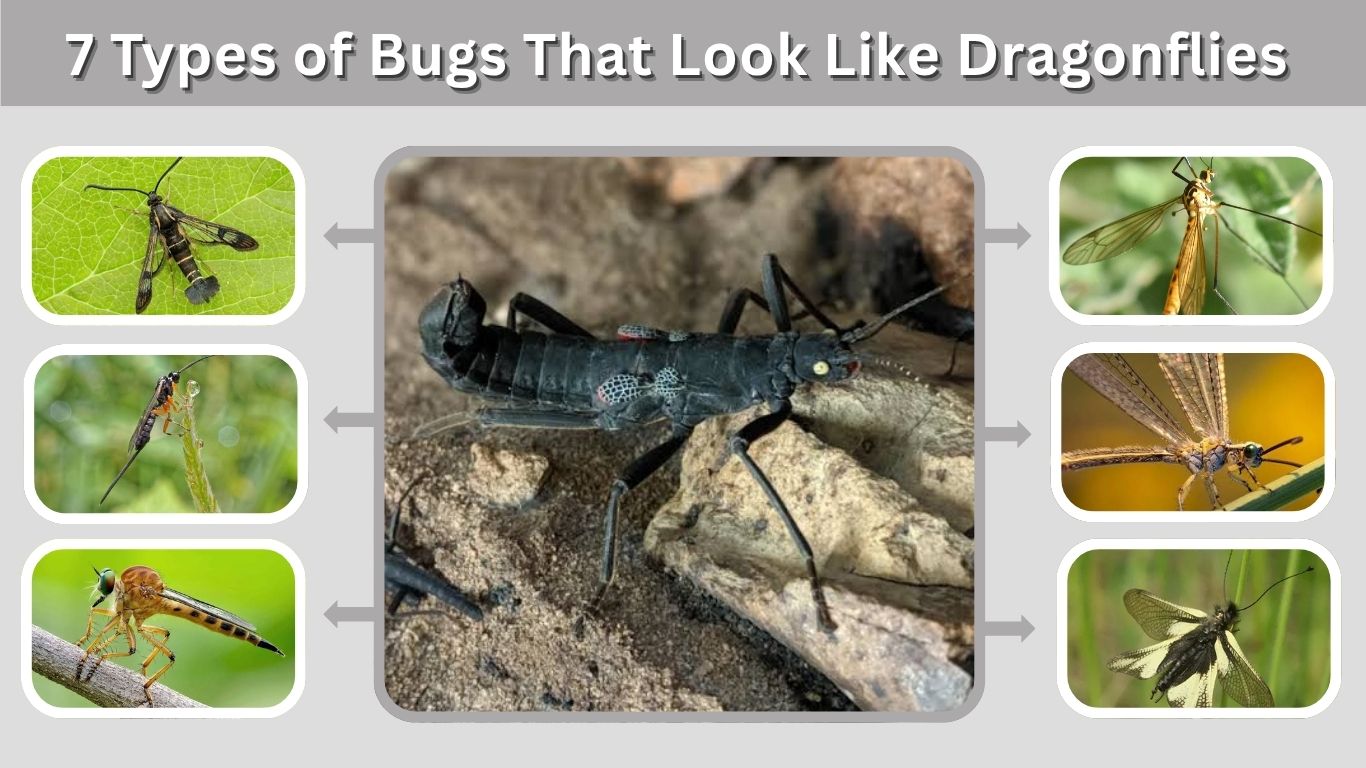
Several insects can easily be mistaken for dragonflies because they have long bodies, transparent wings, large eyes, or similar flying behavior. However, many of these dragonfly-looking bugs belong to completely different insect groups. Damselflies, owlflies, antlions, crane flies, robber flies, ichneumon wasps, and clearwing moths can all create confusion at first glance. Learning their key differences in wings, antennae, body shape, size, and behavior can help you quickly identify which insect you are actually seeing.
1. Damselfly
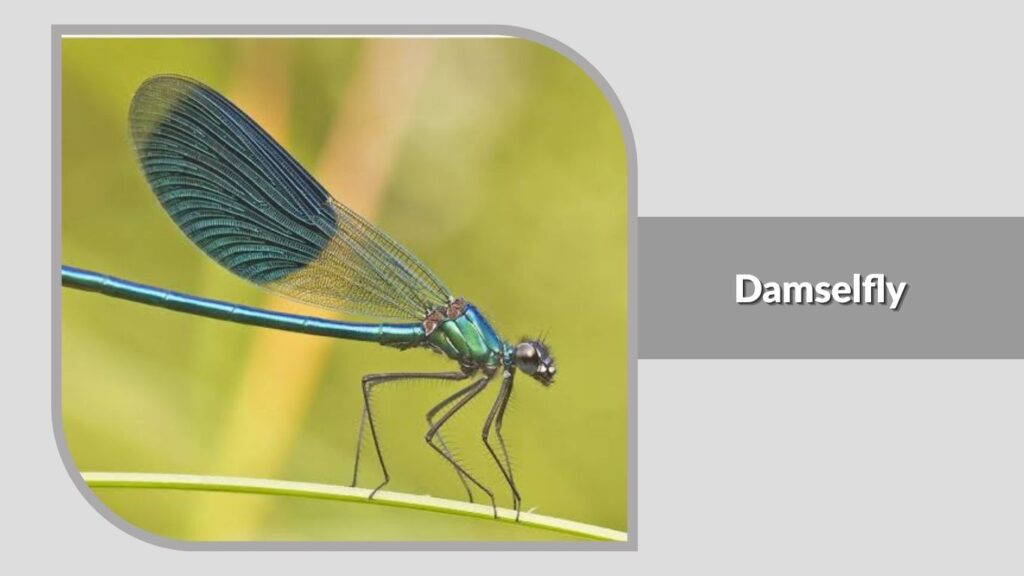
Damselflies are among the insects most commonly mistaken for dragonflies because they share long bodies, large eyes, and two pairs of transparent wings. Both belong to the order Odonata, but damselflies are generally slimmer and more delicate. Their resting posture, eye placement, and flight style are some of the easiest ways to distinguish them from true dragonflies.
Identification
- Long, slender abdomen
- Two pairs of transparent wings
- Large compound eyes positioned apart
- Thin and delicate body
- Six slender legs
- Usually smaller than most dragonflies
- Wings commonly held together above the body at rest
- Colors may include blue, green, black, red, or brown
Why Damselflies Look Like Dragonflies
Damselflies and dragonflies are close relatives, so their similar appearance is not surprising. Both have elongated bodies, large eyes, strong wings, and predatory behavior. However, dragonflies generally have broader, more powerful bodies and usually hold their wings spread horizontally while resting. Damselflies tend to appear much thinner and often fold their wings together over the abdomen.
Habitat and Behavior
Damselflies are usually found near ponds, lakes, streams, wetlands, and other freshwater habitats because their young develop underwater. Adults often perch on grasses and plants close to the water.
Their flight is typically lighter and less forceful than that of dragonflies. They frequently move short distances between plants while hunting small insects or searching for mates.
Diet and Life Cycle
Adult damselflies are predators that feed mainly on small flying insects such as mosquitoes, midges, gnats, and tiny flies. They capture prey using their legs while flying.
Females lay eggs in or near freshwater vegetation. The eggs hatch into aquatic nymphs that spend months or longer underwater feeding on small aquatic animals. When fully developed, the nymph climbs out of the water, sheds its final skin, and emerges as a winged adult.
2. Owlfly
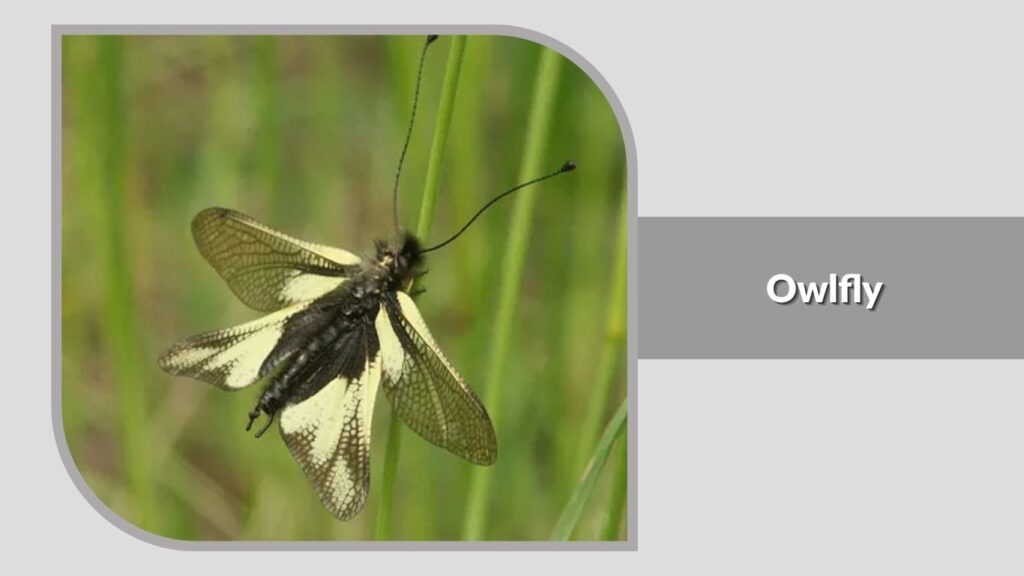
Owlflies are unusual flying insects that strongly resemble dragonflies because of their long bodies, large eyes, and transparent wings. Despite this similarity, they are more closely related to lacewings and antlions. Their long clubbed antennae are one of the easiest features to separate them from true dragonflies, which have very short antennae.
Identification
- Long, narrow body
- Two pairs of transparent wings
- Very large compound eyes
- Long, clubbed antennae
- Six slender legs
- Brown, yellow, black, or patterned body
- Often rests on stems or twigs
- Strong flying ability
Why Owlflies Look Like Dragonflies
Owlflies have elongated bodies and four large wings, giving them a dragonfly-like appearance when flying. Their prominent eyes also add to the resemblance.
The easiest difference is the antennae. Dragonfly antennae are extremely short, while owlfly antennae are long and clearly visible, often ending in small clubs. Owlflies may also hold their bodies differently while resting.
Habitat and Behavior
Owlflies are usually found in warm, open habitats such as grasslands, woodland edges, fields, and areas with plenty of flying insects.
Adults are active predators. Some species fly during the day, while others become more active around dusk or at night. They may perch on vegetation and suddenly launch into the air when prey passes nearby.
Diet and Life Cycle
Adult owlflies feed mainly on small flying insects. They capture prey in flight using their legs and powerful mouthparts.
Females lay eggs on stems or vegetation. The larvae are predatory and often remain hidden while waiting for small insects to approach. After completing several developmental stages, they pupate and later emerge as winged adults.
3. Antlion
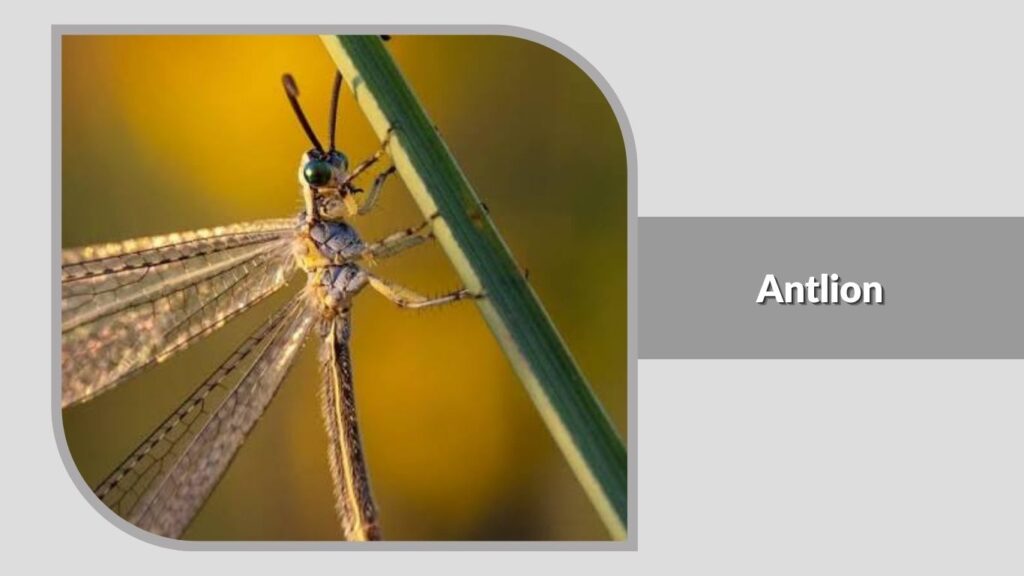
Adult antlions are sometimes mistaken for dragonflies because they have long bodies and two pairs of transparent, heavily veined wings. However, antlions are generally weaker fliers and have long antennae. Their larvae are famous for building funnel-shaped sand traps that capture ants and other small insects.
Identification
- Long, slender abdomen
- Four transparent wings
- Dense network of wing veins
- Long antennae
- Relatively small head
- Brown, gray, or yellowish coloration
- Wings usually folded over the body at rest
- Delicate, slow flight
Why Antlions Look Like Dragonflies
Adult antlions have an elongated body and four clear wings, creating a silhouette similar to a small dragonfly.
Dragonflies, however, have much larger eyes, shorter antennae, and more muscular bodies. Their flight is also faster and more controlled. Antlions often look more delicate and may flutter rather than rapidly dart through the air.
Habitat and Behavior
Adult antlions are commonly found around dry fields, sandy areas, woodland edges, gardens, and other places where their larvae can find suitable soil.
Many adults are most active during the evening or nighttime. They may be attracted to outdoor lights and are sometimes discovered resting on walls, windows, or vegetation.
Diet and Life Cycle
Adult antlions may feed on small insects, pollen, or nectar depending on the species. Their larvae are much more famous as predators.
Some antlion larvae dig cone-shaped pits in loose sand. When an ant or another small insect falls inside, the larva grabs it with large jaws. The larva later pupates in the soil before emerging as an adult.
4. Crane Fly
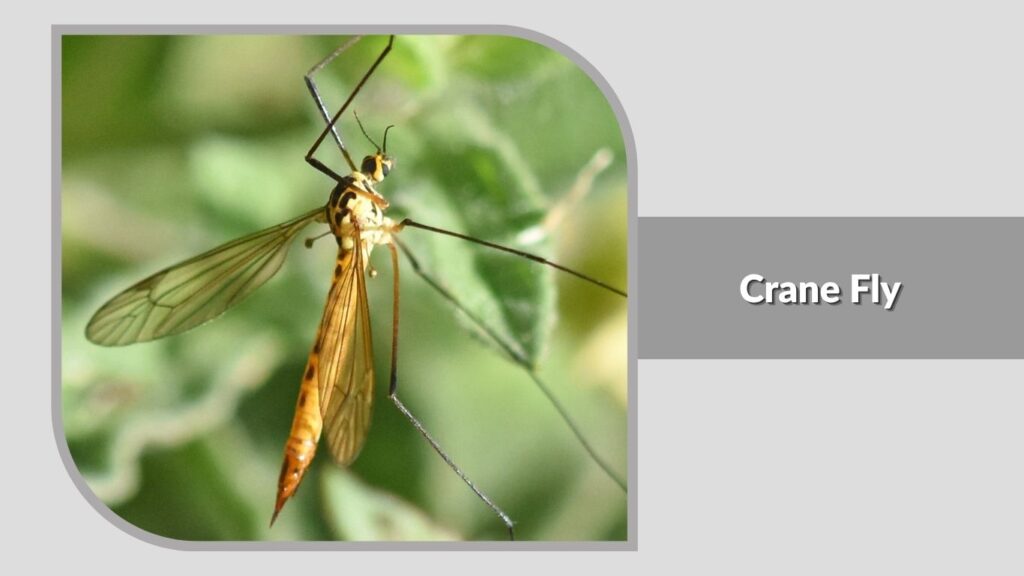
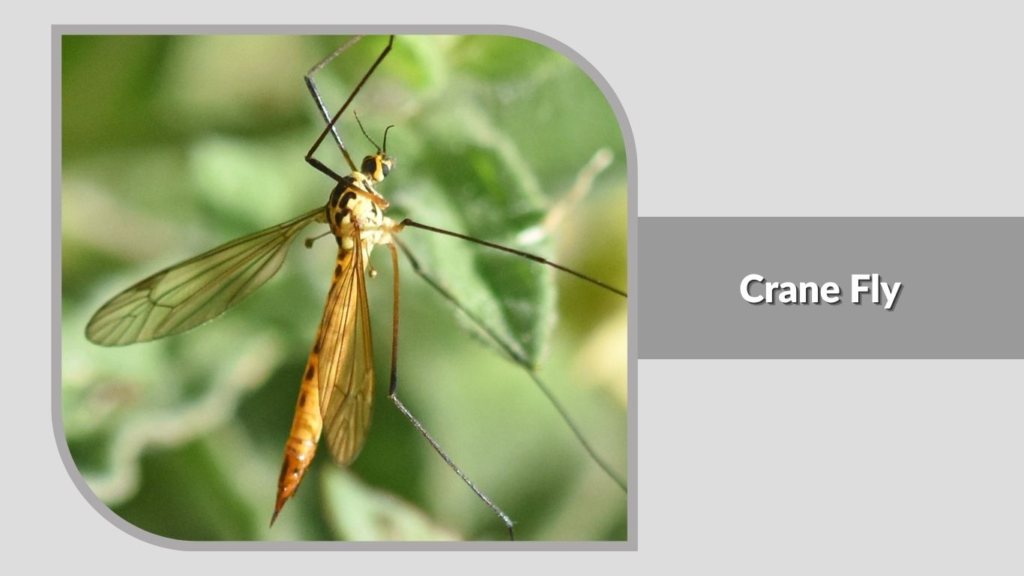
Crane flies are long-legged flying insects that can sometimes be confused with small dragonflies, especially when seen moving through gardens or near lights. Their extremely long legs and narrow bodies create a distinctive appearance. Unlike dragonflies, crane flies have only one functional pair of wings and are closely related to mosquitoes and other true flies.
Identification
- Very long, delicate legs
- Slender body
- One pair of functional wings
- Small head
- Long antennae
- Usually gray, brown, or yellowish
- Slow, awkward flight
- Often found around lights
Why Crane Flies Look Like Dragonflies
Crane flies can resemble dragonflies because both have long bodies and transparent wings. Their appearance while flying can be especially confusing from a distance.
The major difference is their legs. Crane flies have extremely long, dangling legs, while dragonfly legs are shorter and held closer to the body. Crane flies also have only two functional wings instead of four.
Habitat and Behavior
Crane flies occur in gardens, lawns, wetlands, forests, and other moist environments. Adults are frequently seen resting on walls or flying around outdoor lights.
Their flight is much slower and less controlled than a dragonfly’s. Crane flies often appear clumsy in the air and may repeatedly bump into windows or vegetation.
Diet and Life Cycle
Many adult crane flies eat little or nothing, while some feed on nectar or other plant fluids. They do not normally bite humans.
Females lay eggs in moist soil or water. The larvae, often called leatherjackets, usually feed on decaying vegetation, roots, or organic material. They eventually pupate and emerge as long-legged adults.
5. Robber Fly
Robber flies are powerful predatory insects that can resemble dragonflies because of their fast flight, elongated bodies, and hunting behavior. Some species are large enough to be mistaken for small dragonflies or wasps. However, robber flies belong to the order Diptera and therefore have only one functional pair of wings.
Identification
- Long or robust body
- One pair of functional wings
- Large compound eyes
- Strong legs
- Hairy face
- Short, pointed mouthparts
- Gray, brown, black, or yellow coloration
- Fast predatory flight
Why Robber Flies Look Like Dragonflies
Robber flies and dragonflies are both aerial predators, and both may sit on exposed perches before suddenly chasing prey.
Their large eyes and rapid flight create additional similarities. However, robber flies have only two wings and often have a noticeable beard-like patch of hairs on the face. Their bodies may also look stockier than those of most dragonflies.
Habitat and Behavior
Robber flies inhabit fields, meadows, gardens, woodland edges, and open sunny areas. Adults commonly perch on rocks, branches, fences, or leaves while watching for prey.
Once another insect passes nearby, the robber fly takes off quickly, captures it in the air, and usually returns to a perch to feed.
Diet and Life Cycle
Robber flies feed on other insects, including flies, beetles, grasshoppers, bees, wasps, and smaller flying prey.
They use piercing mouthparts to inject saliva into captured insects and consume the liquefied tissues. Their larvae usually develop in soil, wood, or decaying organic material and may also prey on other small organisms.
6. Ichneumon Wasp
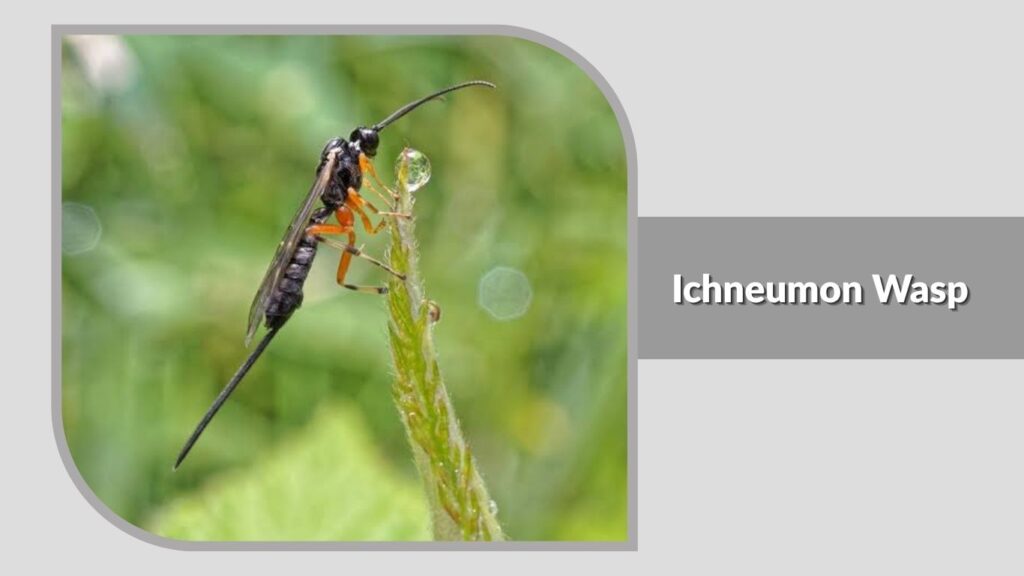
Ichneumon wasps are slender parasitoid wasps that are sometimes mistaken for dragonflies because of their elongated bodies, transparent wings, and long abdominal structures. Females of many species have an especially long ovipositor that can resemble a stinger, although it is primarily used to place eggs inside or near host insects.
Identification
- Long, narrow body
- Two pairs of transparent wings
- Noticeably long antennae
- Narrow wasp-like waist
- Six slender legs
- Black, orange, brown, or yellow coloration
- Females may have a long ovipositor
- Delicate but active flight
Why Ichneumon Wasps Look Like Dragonflies
Their long bodies and transparent wings can create a dragonfly-like outline, particularly while flying.
However, an ichneumon wasp has long antennae and a narrow waist, while dragonflies have extremely short antennae and no wasp-like waist. The long structure extending from some females is an ovipositor rather than a dragonfly-like abdominal feature.
Habitat and Behavior
Ichneumon wasps occur in gardens, forests, meadows, farms, and other habitats where suitable host insects are available.
Adults often search vegetation, tree bark, and plant stems for caterpillars or other insects in which to lay their eggs. Most species are not aggressive toward people.
Diet and Life Cycle
Adults may feed on nectar, honeydew, or other sugary substances. Females locate suitable insect hosts and deposit eggs on, near, or inside them.
The developing larva feeds on the host and eventually kills it. Because many host insects are agricultural or garden pests, ichneumon wasps can play an important role in natural biological control.
7. Clearwing Moth
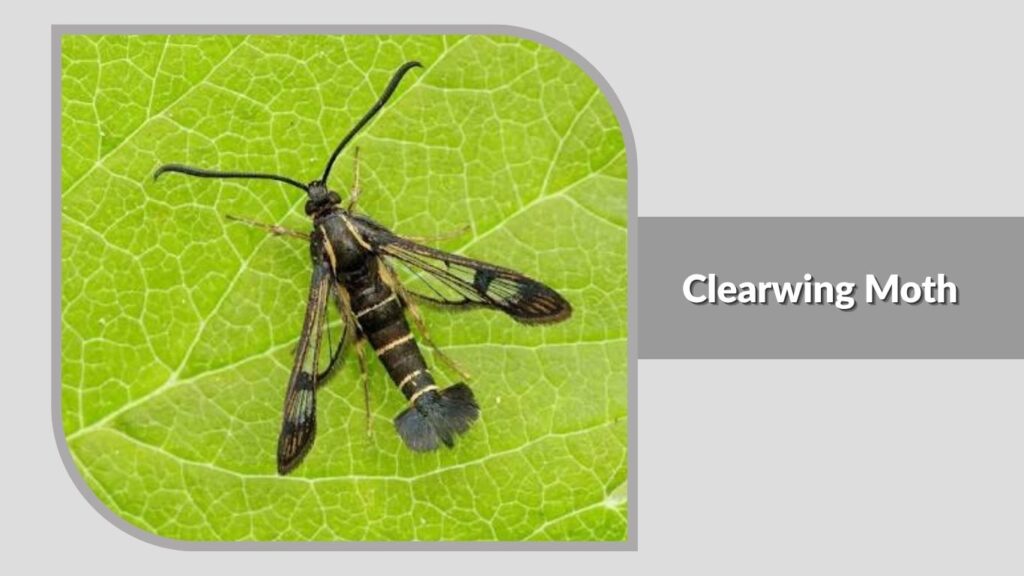
Clearwing moths are unusual moths with partly transparent wings and slender bodies. Some species resemble wasps, bees, or small dragonflies rather than typical fuzzy moths. Their narrow bodies and fast daytime flight make them especially easy to mistake for other flying insects when they are moving rapidly between flowers.
Identification
- Partly transparent wings
- Narrow, elongated body
- Long antennae
- Six legs
- Black, yellow, orange, or reddish markings
- Often resembles a wasp or bee
- Rapid daytime flight
- Scales concentrated around wing edges
Why Clearwing Moths Look Like Dragonflies
Their transparent wings and relatively long bodies can create a dragonfly-like appearance, particularly in larger species.
Unlike dragonflies, clearwing moths usually have obvious antennae and only portions of their wings are transparent. Their bodies often have colored bands that mimic bees or wasps, while dragonflies usually have more elongated abdomens and enormous compound eyes.
Habitat and Behavior
Clearwing moths can be found in gardens, woodland edges, orchards, meadows, and other places containing flowering plants and suitable larval host plants.
Many species are active during daylight. Their rapid flight and ability to hover near flowers may make them look more like bees or small dragonflies than ordinary moths.
Diet and Life Cycle
Adult clearwing moths often feed on flower nectar. Their larvae usually develop inside stems, trunks, roots, or branches of specific host plants.
After hatching, the caterpillar bores into plant tissue and feeds internally. It later pupates before emerging as a winged adult. Some species can become plant pests when larval feeding damages shrubs or trees.
FAQs
What bug is most commonly mistaken for a dragonfly?
Damselflies are among the insects most commonly mistaken for dragonflies. They have long bodies, large eyes, and four transparent wings. However, damselflies are usually slimmer, have more widely separated eyes, and often hold their wings together above the abdomen while resting.
What insect looks like a dragonfly with long antennae?
An owlfly or adult antlion may look like a dragonfly but has long, noticeable antennae. Dragonflies have extremely short antennae. Owlflies often have clubbed antennae and large eyes, while antlions usually have delicate bodies and heavily veined wings.
What bug looks like a dragonfly with a stinger?
An ichneumon wasp may resemble a dragonfly with a long stinger. In many females, the structure is actually an ovipositor used for laying eggs in or near host insects. Dragonflies themselves do not have stingers and are not venomous.
Are bugs that look like dragonflies dangerous?
Most dragonfly look-alikes, including damselflies, crane flies, owlflies, and clearwing moths, are harmless to people. Robber flies are predatory and should not be handled roughly, while ichneumon wasps generally avoid humans and use their ovipositors primarily for reproduction.
How can I tell a dragonfly from a look-alike?
Check the wings, eyes, antennae, and body shape. True dragonflies have four wings, very large compound eyes, extremely short antennae, and long abdomens. Most also hold their wings spread outward while resting and have stronger, more controlled flight than many similar-looking insects.