
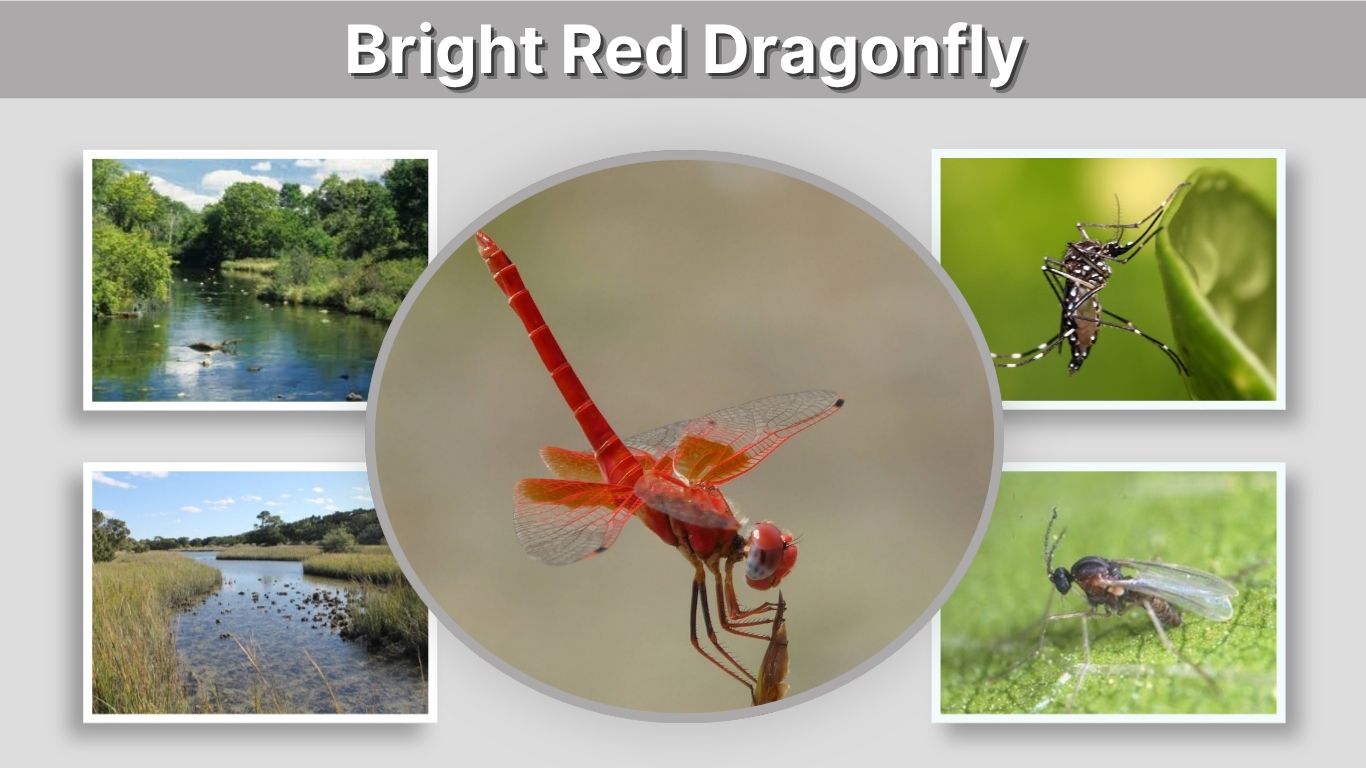
A bright red dragonfly is usually an adult male belonging to one of several colorful skimmer species. It is not the name of a single species. In California, the insect may be a Flame Skimmer; in Texas, it may be a Neon Skimmer; in Florida, it could be an introduced Scarlet Skimmer; and in Spain, a likely candidate is the Scarlet Darter. Accurate identification depends on location, body shape, wing coloration, and markings—not red color alone.
Bright Red Dragonfly Overview
Most vividly red dragonflies belong to the skimmer family, Libellulidae. Skimmers have broad hindwings, large compound eyes, long abdomens, and powerful chewing mouthparts. They often patrol ponds before returning repeatedly to an exposed twig, reed, or plant stem.
| Feature | Typical description |
| Insect group | Dragonfly |
| Common family | Libellulidae |
| Color | Scarlet, crimson, red-orange, or fiery orange |
| Brightest sex | Usually the mature male |
| Habitat | Ponds, lakes, wetlands, streams, and canals |
| Diet | Mosquitoes, flies, midges, moths, and other insects |
| Activity | Primarily daytime |
| Life cycle | Egg, aquatic nymph, and adult |
| Danger to people | Harmless unless roughly handled |
A dragonfly’s color can change with age. Newly emerged adults are usually pale and soft, while mature males often develop the strongest red coloration. Males and females of the same species may therefore look surprisingly different.
Which Dragonfly Is Bright Red?
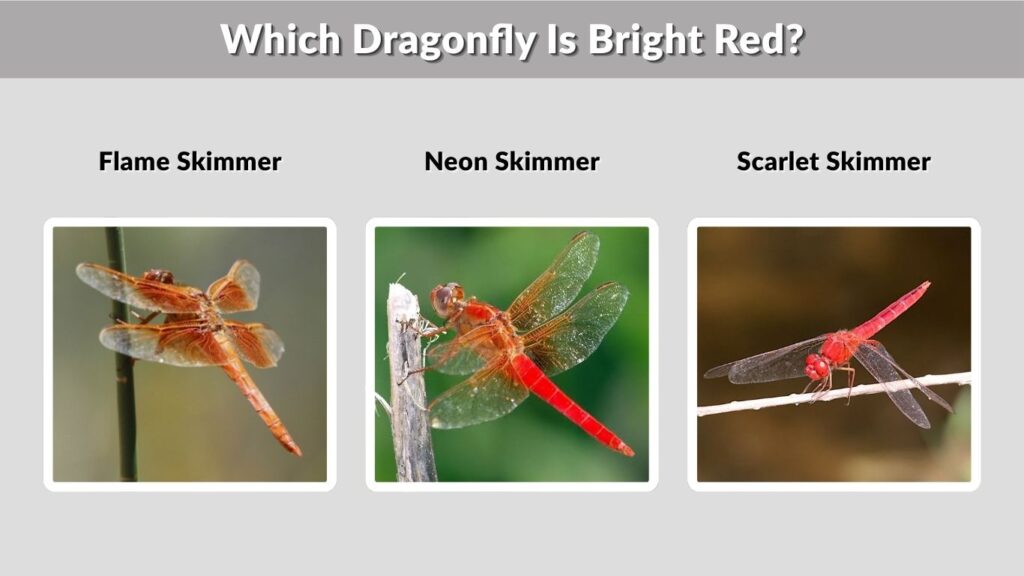
Several unrelated species may match the description. Location is one of the most useful first clues, but photographs showing the body and wings are normally needed for a confident identification.
Flame Skimmer
The Flame Skimmer, Libellula saturata, is one of the most recognizable red-orange dragonflies in western North America. Mature males have fiery orange-red bodies, red legs, and extensive amber-orange coloring through the wings. Females are generally paler and more golden-brown. Adults measure approximately 49–61 millimeters long.
This species is especially common in California and other western states. It often occurs around warm ponds, slow streams, hot springs, garden pools, and other sunny aquatic habitats.
Neon Skimmer
The Neon Skimmer, Libellula croceipennis, is a brilliant red species found in Texas and other parts of the southern and southwestern United States. Mature males usually have vivid crimson abdomens and red faces, while the thorax may appear darker or browner from the side.
Its wings generally have less amber coloration than those of the Flame Skimmer. On a Flame Skimmer, the orange wing coloring extends farther outward; on a Neon Skimmer, it is more concentrated near the wing bases.
Scarlet Skimmer
The Scarlet Skimmer, Crocothemis servilia, is native to parts of Asia but has established populations in Florida. Mature males are intensely red and commonly show a narrow black line running along the top of the abdomen. An amber patch may be visible at the base of each hindwing.
Females and young males are usually yellowish, brownish, or orange rather than solid scarlet. This difference means two dragonflies of the same species can appear completely different.
Scarlet Darter
The Scarlet Darter, also called the Broad Scarlet, is Crocothemis erythraea. It is widespread around the Mediterranean and is a likely identification for a bright red dragonfly seen in Spain. Mature males have red heads, bodies, legs, and leading wing veins. Females are usually yellow-brown.
The species favors shallow, still water, including pools, canals, drainage channels, and rice-growing areas. Adults typically measure about 33–44 millimeters long.
Bright Red Dragonflies by Location
Different red species overlap in some regions, so the following identifications should be treated as likely possibilities rather than guarantees.
| Location | Likely bright red species |
| California | Flame Skimmer or Neon Skimmer |
| Texas | Neon Skimmer or Flame Skimmer |
| Florida | Scarlet Skimmer and other red skimmers |
| Louisiana | Neon Skimmer or another Gulf Coast skimmer |
| Spain | Scarlet Darter |
| Western United States | Flame Skimmer |
| Southern United States | Neon Skimmer |
California is especially associated with the Flame Skimmer, which the University of California describes as a common western species with orange-red males and amber sections on the wings.
Texas supports numerous skimmer species, including the Neon Skimmer and Flame Skimmer. Because several red species can occur within the state, wing markings and body color should be examined together.
How to Identify a Bright Red Dragonfly
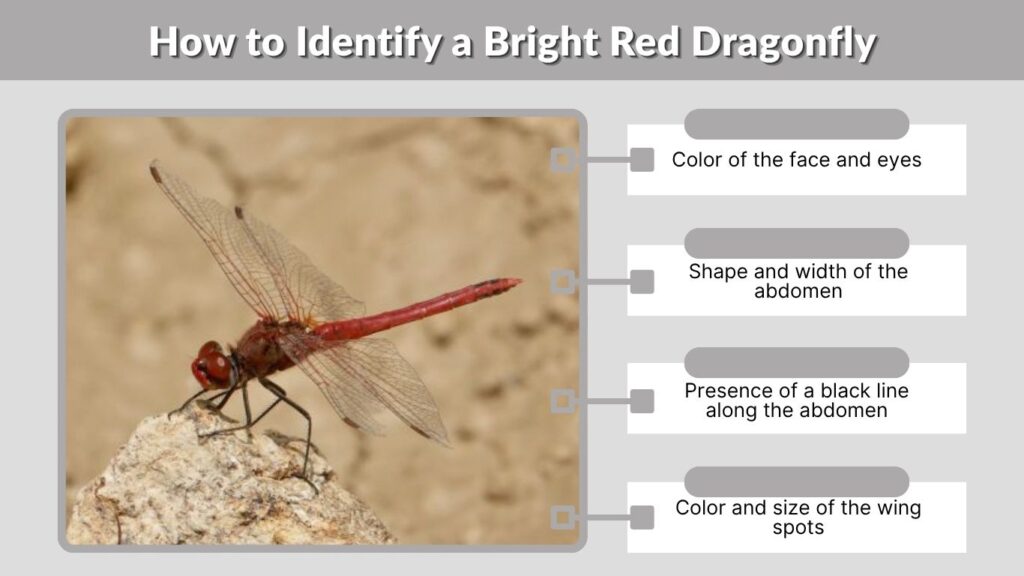
Color alone is not sufficient for identification. Sunlight, camera settings, age, sex, and viewing angle can make an orange dragonfly look scarlet or a brown individual look reddish.
Important Identification Features
- Exact geographic location
- Color of the face and eyes
- Shape and width of the abdomen
- Presence of a black line along the abdomen
- Amount of orange or amber coloring in the wings
- Color of the legs
- Color and size of the wing spots
- Whether the insect is male, female, or immature
A Flame Skimmer usually appears orange-red across nearly its entire body, with strong amber coloring extending through much of each wing. A male Neon Skimmer generally has a brighter crimson abdomen but less orange coverage on the wings.
Scarlet Skimmers and Scarlet Darters have broader, flatter abdomens than many Libellula skimmers. A sharp photograph from above and another from the side can greatly improve identification.
Habitat and Distribution
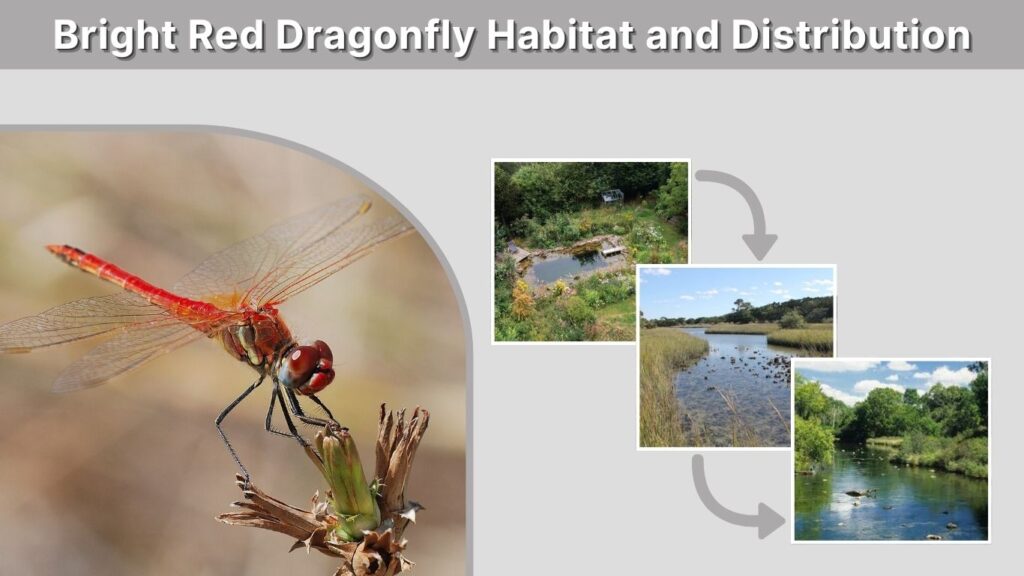
Bright red dragonflies are closely associated with freshwater because their immature stages are aquatic. Adults may travel into gardens, fields, woodland edges, and residential areas, but breeding normally takes place in or near water.
Common habitats include:
- Ponds and garden pools
- Lakeshores
- Marshes and wetlands
- Slow streams
- Irrigation canals
- Drainage channels
- Warm springs
- Water-treatment ponds
Flame Skimmers frequently use warm ponds, streams, and spring-fed environments. Scarlet Darters are commonly associated with shallow still water, while skimmers in Texas often patrol ponds and lakes before returning to familiar perches.
What Do Bright Red Dragonflies Eat?
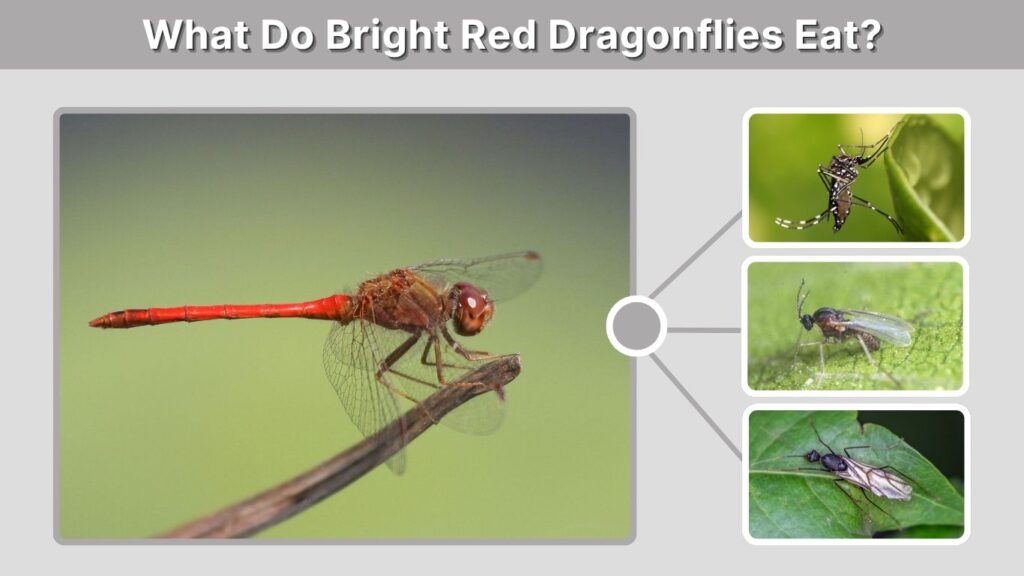
Bright red dragonflies are carnivores. Adults capture flying insects with their legs and chew them with strong mandibles.
Their prey commonly includes:
- Mosquitoes
- Midges
- Gnats
- Houseflies and other flies
- Moths
- Winged ants
- Bees
- Smaller dragonflies
Flame Skimmers have been observed catching moths, flies, bees, and other insects in flight. Dragonflies frequently return to the same perch to rest or consume captured prey.
They do not eat flowers, leaves, fruit, or plant sap. A red dragonfly resting on a flower is normally waiting for prey, warming itself, or using the plant as a lookout point.
Life Cycle
A bright red dragonfly begins life as an egg deposited in or near freshwater. After hatching, it becomes an aquatic nymph that lives among mud, vegetation, stones, and submerged debris.
Nymphs prey on mosquito larvae, aquatic flies, mayfly nymphs, freshwater crustaceans, tadpoles, and small fish. Depending on the species and climate, development underwater can take months or several years.
Once fully developed, the nymph climbs out of the water and sheds its outer skin. The winged adult emerges pale and soft. Its wings expand and harden, and its mature coloration develops over the following days.
Adults usually live for several weeks to a few months. During this period, they hunt, establish territories, mate, and lay eggs.
Do Bright Red Dragonflies Bite or Sting?
Bright red dragonflies cannot sting because they have no stinger. They also do not attack people, drink blood, or defend nests.
A large dragonfly may attempt to pinch with its mouthparts when someone catches and holds it. Most cannot break human skin, and any pinch is defensive rather than aggressive. Leaving the insect undisturbed eliminates nearly all risk.
Dragonflies are beneficial predators and should not be sprayed or killed simply because they are flying around a yard. Their presence often indicates nearby freshwater and an active population of small flying insects.
Bright Red Dragonfly Meaning
Seeing a bright red dragonfly has no scientifically proven supernatural meaning. Biologically, the insect is probably hunting, resting, searching for a mate, defending a territory, or moving between bodies of water.
In modern symbolic interpretations, dragonflies are often connected with change, adaptability, maturity, and resilience. Red may additionally be associated with energy, courage, passion, love, or remembrance. These meanings are personal or cultural interpretations rather than predictions or zoological facts.
A red dragonfly sighting does not scientifically predict death, misfortune, romance, or an upcoming life event. A person may still give the encounter a private meaning based on their own experiences and beliefs.
FAQs
Are all bright red dragonflies male?
Most intensely red individuals are mature males, but this is not an absolute rule. Females are generally yellow, brown, or orange, while newly emerged males may also look pale until their adult coloration develops.
What is the bright red dragonfly in California?
The Flame Skimmer is one of the most common possibilities. Mature males have orange-red bodies and strong amber coloring across their wings. Neon Skimmers may also occur in parts of California.
What is the bright red dragonfly in Texas?
A Neon Skimmer is a likely candidate. Mature males have vivid red abdomens and relatively limited amber coloring near the wing bases. Flame Skimmers and other red species also occur in Texas.
Are bright red dragonflies rare?
Some species are locally common, while others have restricted distributions. Flame Skimmers can be common in California, and Neon Skimmers may be regularly seen around suitable ponds and wetlands in Texas.
Why does a red dragonfly keep returning to the same spot?
Many dragonflies use favored hunting perches. They fly out to capture insects, patrol a territory, or chase rivals and then return to the same twig, stake, reed, or branch.