
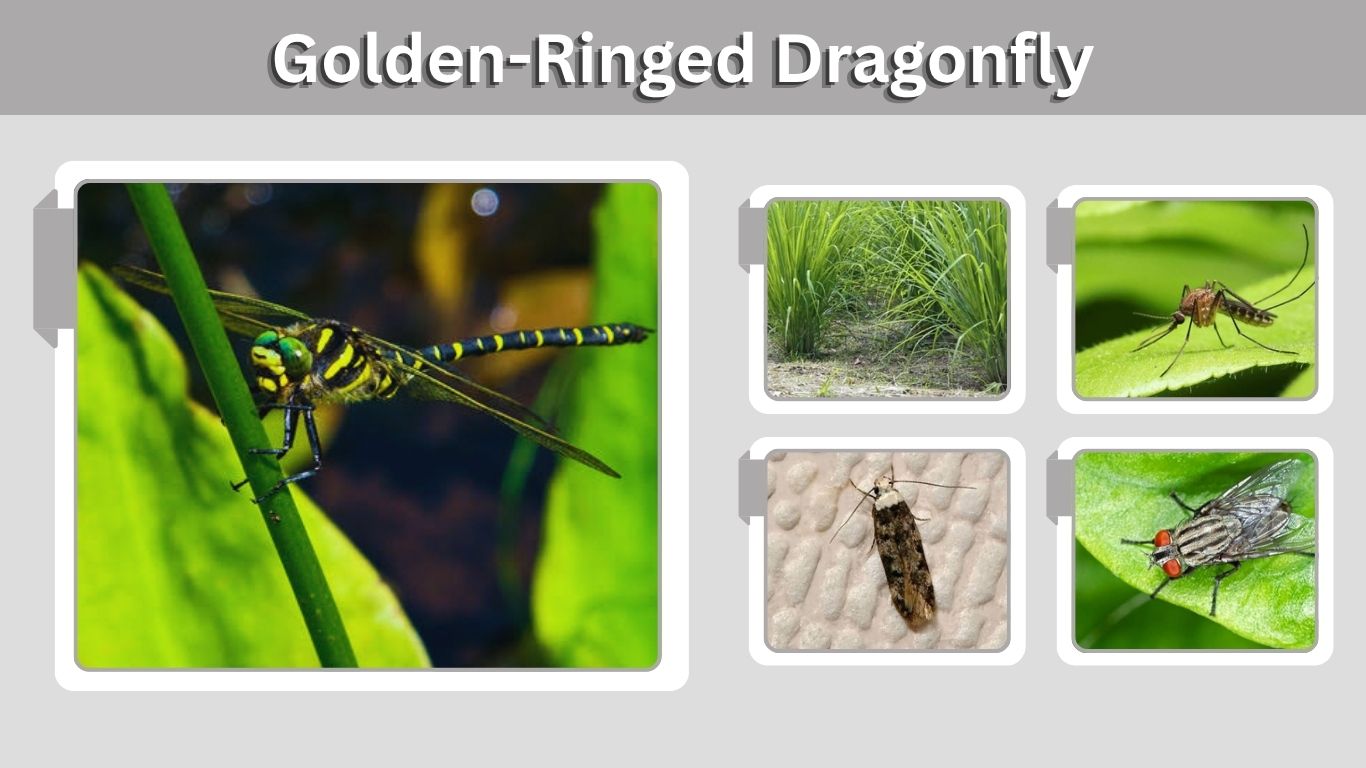
The golden-ringed dragonfly is a large and striking dragonfly recognized by its black body covered with bright yellow rings. Scientifically known as Cordulegaster boltonii, it is strongly associated with clean, flowing streams in parts of Europe. Its impressive size, powerful flight, and bold markings make it difficult to overlook when patrolling waterways. Despite its intimidating appearance, it is not dangerous to people. From its long aquatic larval stage to the differences between males and females, this dragonfly has a fascinating life history.
What Is a Golden-Ringed Dragonfly?
The golden-ringed dragonfly is a large species belonging to the family Cordulegastridae. Its common name comes from the contrasting yellow rings that run along its otherwise dark abdomen. Adults are powerful aerial predators, while their immature stages live underwater and hunt other aquatic animals before eventually emerging as winged dragonflies.
Golden-Ringed Dragonfly Identification
Typical identification features include:
- Long black abdomen with yellow rings
- Yellow markings along the thorax
- Large greenish compound eyes
- Four clear, strongly veined wings
- Long and relatively narrow body
- Six dark legs
- Strong, direct flight
- Females noticeably larger than males
The combination of large size and repeated yellow abdominal markings makes adults distinctive within much of their range.
Golden-Ringed Dragonfly Scientific Name
The scientific name of the golden-ringed dragonfly is Cordulegaster boltonii.
It belongs to the dragonfly family Cordulegastridae, commonly known as spiketails. Members of this group are often associated with streams and have elongated bodies suited to patrolling narrow freshwater habitats.
Gold-Ringed or Golden-Ringed Dragonfly?
“Golden-ringed dragonfly” is the standard common name, although people sometimes search for gold-ringed dragonfly or golden ring dragonfly.
These terms generally refer to the same distinctive black-and-yellow dragonfly rather than an insect that is genuinely metallic gold.
Golden-Ringed Dragonfly Size
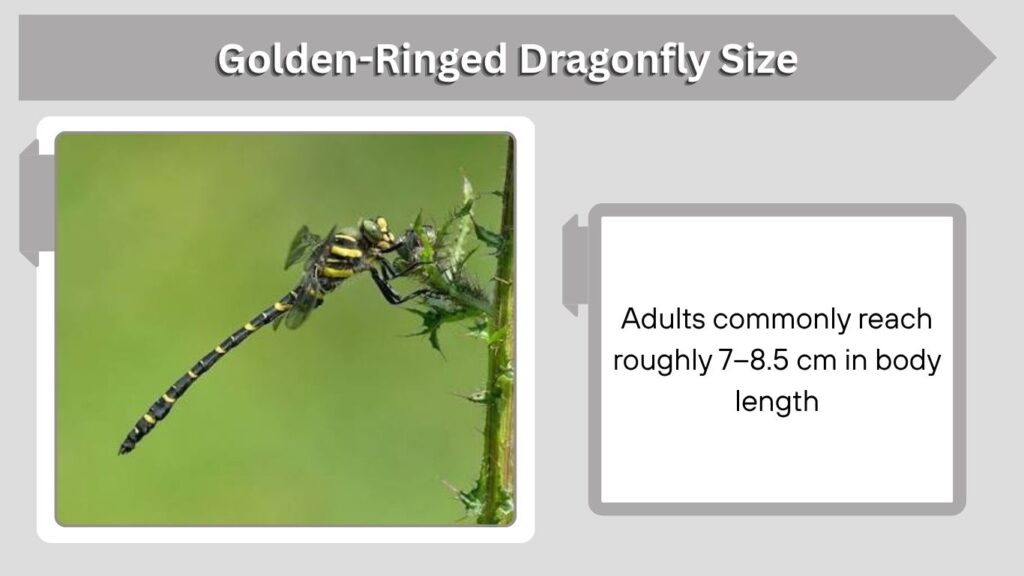
One of the most noticeable characteristics of this species is its size. The golden-ringed dragonfly is among the larger European dragonflies, with females particularly impressive. Its long abdomen contributes significantly to its overall length, while its large wings allow powerful and controlled flight above streams and nearby vegetation.
How Big Is a Golden-Ringed Dragonfly?
Adults commonly reach roughly 7–8.5 cm in body length, although size varies between individuals and sexes.
Females generally occupy the upper end of that range and can look particularly large because of their elongated abdomen. Their wingspan can approach about 10 cm, giving them an imposing appearance during flight.
Female Golden-Ringed Dragonfly
Females are generally larger and longer than males. Their most distinctive feature is a long ovipositor extending from the end of the abdomen.
This structure can resemble a stinger at first glance, but it is actually used to place eggs into suitable streambed material.
Male Golden-Ringed Dragonfly
Males are somewhat smaller and slimmer than females. They frequently patrol sections of streams while hunting prey and looking for females.
The end of the male abdomen possesses specialized appendages used during mating rather than the conspicuous egg-laying structure seen in females.
Golden-Ringed Dragonfly Habitat and Distribution
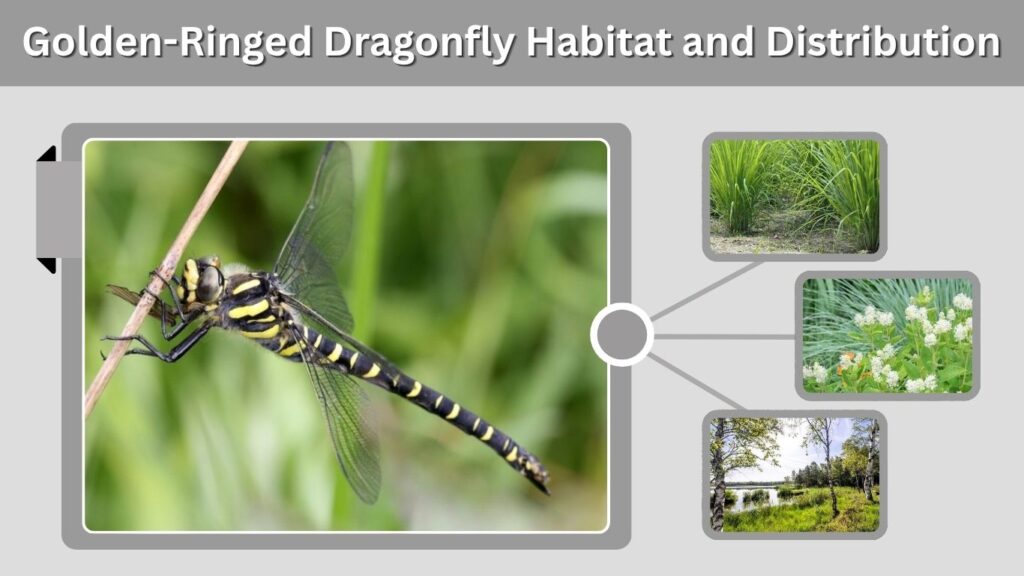
Golden-ringed dragonflies depend strongly on flowing freshwater. Clean streams surrounded by natural vegetation provide both suitable larval habitat and productive hunting areas for adults. While adults can travel away from water to feed, successful breeding requires appropriate aquatic conditions where larvae can remain for several years.
Golden-Ringed Dragonfly Habitat
Typical habitats include:
- Small clean streams
- Woodland streams
- Moorland waterways
- Heathland streams
- Rivers and narrow channels
- Areas with sandy or gravelly bottoms
- Streams surrounded by natural vegetation
Females need suitable streambed material for depositing eggs, while larvae remain concealed within the aquatic substrate.
Golden-Ringed Dragonfly Distribution
The species occurs across portions of Europe, with different subspecies and populations occupying suitable regions.
It is particularly familiar in parts of western Europe. Distribution is uneven because the dragonfly depends on streams with appropriate water quality, temperature, flow, and substrate.
Golden-Ringed Dragonfly in the UK
The golden-ringed dragonfly occurs in Britain and is especially associated with western and northern areas containing suitable streams.
It can be encountered in parts of England, Wales, and Scotland, particularly around heathland, moorland, and woodland waterways.
Golden-Ringed Dragonfly Life Cycle
The golden-ringed dragonfly undergoes incomplete metamorphosis. Its life begins as an egg before continuing through a long aquatic nymph stage and finally becoming a flying adult. Unlike butterflies, dragonflies do not form a pupa. Much of the golden-ringed dragonfly’s life is actually spent underwater rather than flying above streams.
Eggs and Hatching
Females deposit eggs into soft material along the streambed. They can appear to repeatedly jab the tip of their abdomen downward while laying.
The eggs eventually hatch into tiny aquatic nymphs that immediately begin living and feeding beneath the water.
Golden-Ringed Dragonfly Larvae
Larvae, also called nymphs, typically:
- Live on or within streambed sediment
- Remain underwater for several years
- Hunt aquatic invertebrates
- Use camouflage to ambush prey
- Molt repeatedly while growing
- Develop wing pads as maturity approaches
- Leave the water for their final molt
Their coloration helps them blend with sand, gravel, mud, and organic debris.
Becoming an Adult
When development is complete, a mature nymph climbs from the water onto vegetation, rocks, or another exposed surface.
The outer skin splits, and the adult gradually pulls itself free. Its wings expand and harden before it becomes capable of normal flight. The empty nymphal skin may remain attached after emergence.
What Do Golden-Ringed Dragonflies Eat?
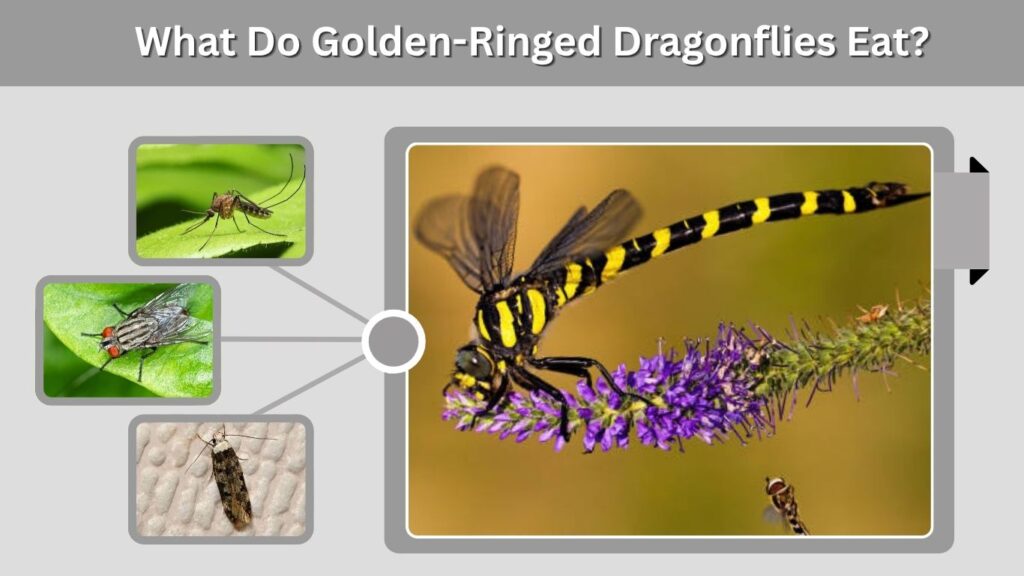
Both adults and larvae are predators. Adult golden-ringed dragonflies use excellent vision and powerful flight to catch insects in the air. Their aquatic larvae hunt underwater. As a result, this dragonfly functions as a predator during almost every active stage of its life.
Adult Diet
Adults may prey upon:
- Midges
- Mosquitoes
- Flies
- Small moths
- Damselflies
- Smaller dragonflies
- Other flying insects
They capture prey using their legs before consuming it with strong chewing mouthparts.
What Do the Larvae Eat?
Golden-ringed dragonfly larvae eat small aquatic animals that they can overpower.
They may take insect larvae, small crustaceans, and other aquatic invertebrates. Larger nymphs can tackle larger prey, but their normal diet consists primarily of suitably sized animals living within their freshwater habitat.
How They Hunt
Adults often patrol repeatedly along streams and surrounding areas. Their large compound eyes make them excellent at detecting moving prey.
Once a target is located, the dragonfly intercepts it in the air and captures it using its legs. Its speed and maneuverability make it a highly effective aerial predator.
Are Golden-Ringed Dragonflies Dangerous?
Their large bodies and fast flight can make golden-ringed dragonflies appear threatening, but they are not dangerous to people. They are interested in hunting insects rather than attacking humans. They also lack the venomous stinger found in bees and many wasps.
Do Golden-Ringed Dragonflies Sting?
Golden-ringed dragonflies do not sting.
The pointed structure at the end of a female’s abdomen is an ovipositor used for egg laying. Although it can look intimidating, it is not a venom-delivering stinger.
Golden-Ringed Dragonfly Bite
Dragonflies possess chewing mouthparts for capturing and consuming insect prey. A large dragonfly could potentially pinch if grabbed or handled roughly.
However, golden-ringed dragonflies do not seek out people to bite, and simply observing one outdoors presents essentially no danger.
Are They Aggressive?
They can be aggressive toward other insects and may chase rivals while patrolling breeding areas.
This territorial or predatory behavior does not translate into aggression toward humans. A dragonfly flying close to someone is usually hunting insects or moving through its normal territory.
Are Golden-Ringed Dragonflies Rare?
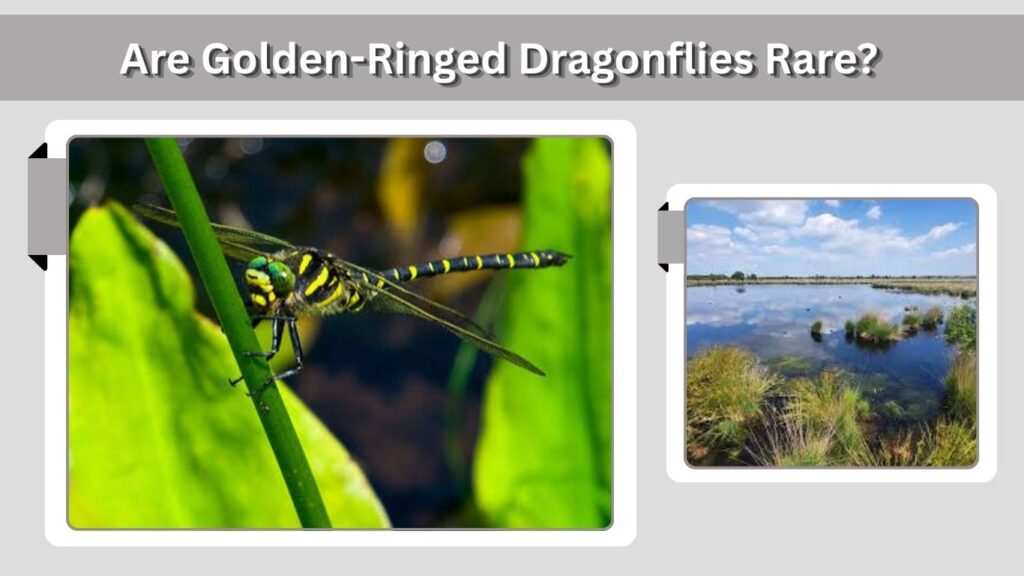
Whether the golden-ringed dragonfly seems rare depends strongly on location. In areas containing healthy populations and suitable streams, adults may be seen regularly during their flight season. Elsewhere, they may be absent because the necessary freshwater habitat does not occur.
Threats to Golden-Ringed Dragonflies
Potential problems include:
- Water pollution
- Destruction of stream habitats
- Altered water flow
- Excessive sediment disturbance
- Loss of surrounding vegetation
- Drought
- Decreasing water quality
Because the larvae spend years underwater, maintaining healthy streams is particularly important.
Golden-Ringed Dragonfly in America
Cordulegaster boltonii is a European species and is not a native dragonfly of North America.
North America does contain other members of the family Cordulegastridae. Some have similar black-and-yellow markings, which can cause observers to think they have found a European golden-ringed dragonfly.
Golden-Ringed Dragonfly vs Emperor Dragonfly
Both are among the more impressive dragonflies encountered in Europe, but their coloration and preferred habitats make them relatively easy to separate once their main characteristics are understood.
Appearance
The golden-ringed dragonfly is primarily black with repeated bright yellow bands.
The emperor dragonfly has a very different appearance. Adult males are especially recognizable for their predominantly blue abdomen combined with a green thorax and darker markings.
Habitat
Golden-ringed dragonflies are strongly associated with flowing streams and similar waterways.
Emperor dragonflies are more commonly associated with standing or slow-moving water, including ponds, lakes, canals, and other larger freshwater habitats.
Flight Behavior
Both species are strong and impressive fliers.
Golden-ringed dragonflies frequently patrol stretches of streams in a fairly linear manner, while emperor dragonflies may repeatedly patrol broader areas over ponds and lakes.
Interesting Golden-Ringed Dragonfly Facts
Several features make this species particularly fascinating:
- Its scientific name is Cordulegaster boltonii.
- It is one of Europe’s larger dragonflies.
- Females are larger than males.
- Its yellow rings contrast strongly with a black abdomen.
- It does not have a venomous sting.
- Females use a long ovipositor to lay eggs.
- Larvae live underwater for several years.
- Both larvae and adults are predators.
- Adults often patrol streams while hunting.
- Clean freshwater is essential for successful reproduction.
FAQs
How big is a golden-ringed dragonfly?
Golden-ringed dragonflies can reach roughly 7–8.5 cm in body length, with females generally larger than males. Their substantial wingspan and elongated abdomen can make them look even bigger while flying, placing them among the more impressive dragonflies encountered in Europe.
Where are golden-ringed dragonflies found?
Golden-ringed dragonflies occur in parts of Europe, particularly where suitable clean, flowing streams are available. They can be found in Britain and other regions of western Europe. Local distribution depends heavily on freshwater quality, stream structure, climate, and suitable breeding habitat.
How long does a golden-ringed dragonfly live?
Most of its life is spent underwater as a larva, a stage that can last several years. The winged adult stage is comparatively short and generally occupies only part of a warm season. Environmental conditions can influence development and survival.
Is the golden-ringed dragonfly dangerous?
No. Golden-ringed dragonflies are not considered dangerous to people. They do not have venomous stingers and do not deliberately attack humans. Although their strong mouthparts could potentially pinch if they were handled roughly, normal encounters with these dragonflies are harmless.
Are golden-ringed dragonflies found in North America?
The European golden-ringed dragonfly, Cordulegaster boltonii, is not native to North America. However, North America has related spiketail dragonflies belonging to the same family, and some can display similar dark bodies with yellow markings.