
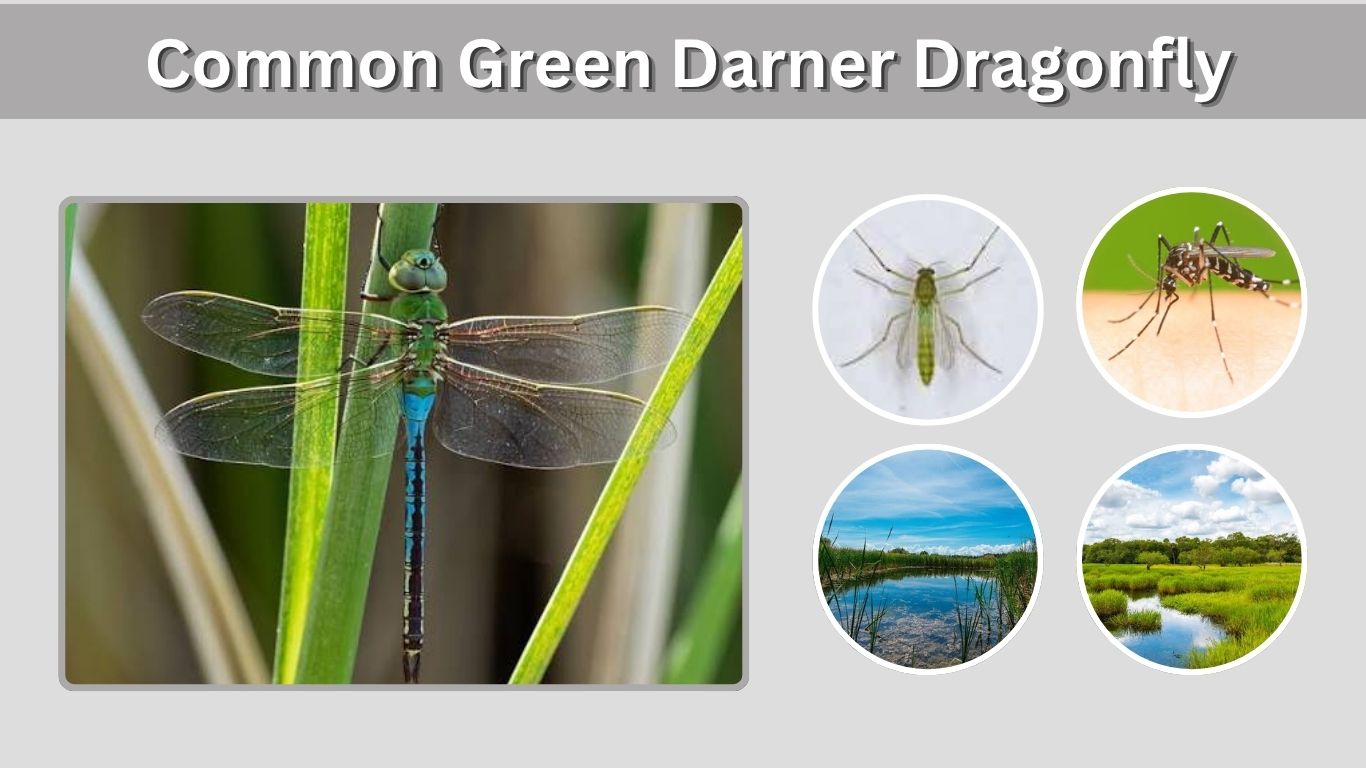
The Common Green Darner (Anax junius) is one of the largest and most recognizable dragonflies in North America. Named for its bright green thorax and long, needle-like abdomen, this powerful flier is often seen around ponds, marshes, lakes, and wetlands. Mature males usually have striking blue abdomens, while females are more often brown, purple, or greenish. Common Green Darners are also remarkable migrants, with some populations traveling hundreds or even thousands of miles between seasonal habitats.
What Is a Common Green Darner?
The Common Green Darner is a large dragonfly belonging to the darner family Aeshnidae.
Its scientific name is Anax junius.
The name “darner” comes from its long, slender abdomen, which resembles a large darning needle.
| Feature | Common Green Darner |
| Scientific name | Anax junius |
| Family | Aeshnidae |
| Order | Odonata |
| Adult length | About 2.7–3.1 inches |
| Main colors | Green, blue, brown or purple |
| Diet | Carnivorous |
| Habitat | Ponds, marshes, lakes, slow water |
| Activity | Mainly daytime |
| Migration | Some populations migrate |
Common Green Darner Identification
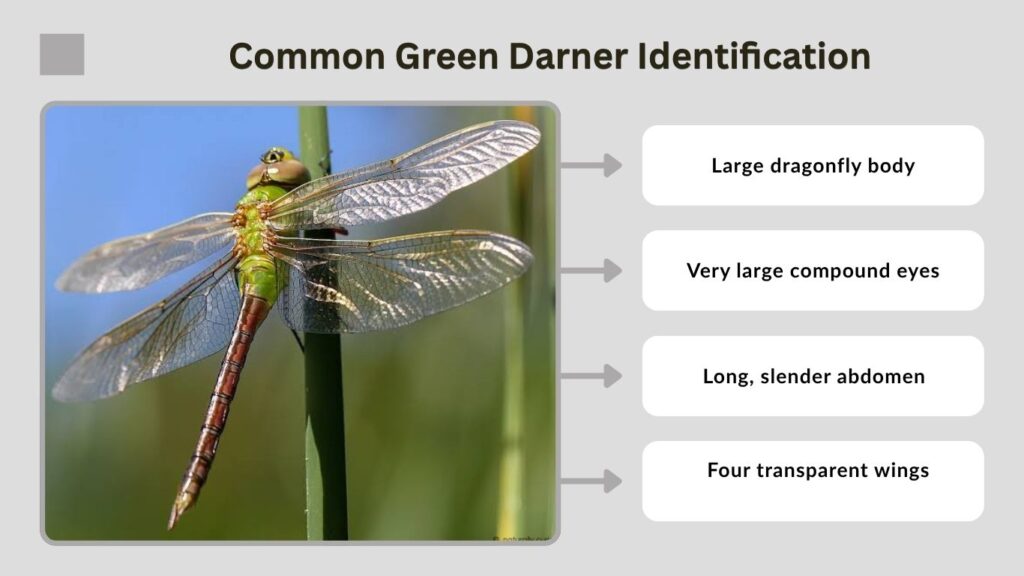
Common Green Darners are relatively easy to recognize once you know their main markings.
Identification Features
Look for:
- Large dragonfly body
- Bright, mostly unmarked green thorax
- Very large compound eyes
- Long, slender abdomen
- Four transparent wings
- Dark stripe along the top of the abdomen
- Distinctive black “bull’s-eye” marking on top of the forehead
- Strong, fast flight
Adults generally measure about 68–80 mm, or approximately 2.7–3.1 inches long.
The black bull’s-eye marking in front of the eyes is particularly useful for separating this species from some similar darners.
Male Common Green Darner
Mature males are especially colorful.
Their thorax is bright green, while much of the abdomen becomes brilliant blue with a dark purple or black stripe running along the center.
Mature Male Identification
A typical male has:
- Green face and thorax
- Large greenish eyes
- Bright blue abdominal sides
- Dark dorsal abdominal stripe
- Long dark terminal appendages
Interestingly, the blue abdomen may become darker or more purple when the insect is cool. This reversible color change can make the same male appear noticeably different under changing temperatures.
Female Common Green Darner
Female Common Green Darners share the bright green thorax but usually do not have the intensely blue abdomen of mature males.
Most females have an abdomen that is:
- Brown
- Rusty brown
- Gray-green
- Purple-brown
However, some females occur in a blue form and can resemble males.
Male vs. Female Common Green Darner
| Feature | Male | Female |
| Thorax | Bright green | Bright green |
| Abdomen | Usually bright blue | Usually brown, purple or green |
| Size | Large | Large |
| Bull’s-eye marking | Present | Present |
| Egg laying | No | Yes |
Color alone should therefore not always be used to determine sex.
Common Green Darner Head and Eyes
The head is dominated by two enormous compound eyes.
These eyes provide an exceptionally wide field of view and help the dragonfly detect moving insects while flying.
A useful identification feature is the black bull’s-eye-shaped mark located on top of the forehead in front of the eyes.
The eyes may appear greenish, gray-green, or brownish depending on the individual, age, sex, and lighting.
Like other dragonflies, Common Green Darners rely heavily on vision for hunting, navigating, defending territories, and locating mates.
Common Green Darner Habitat
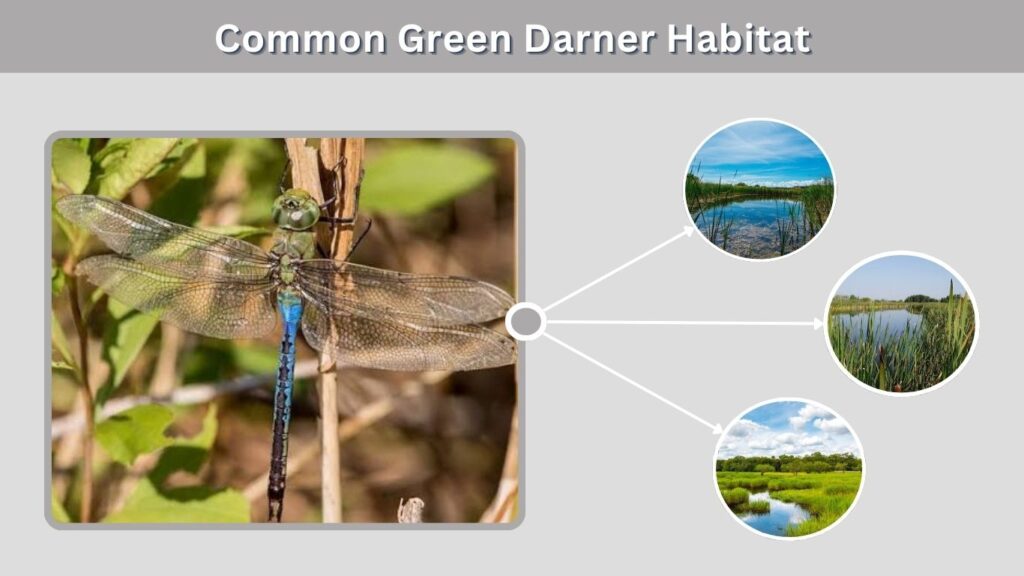
Common Green Darners are strongly associated with freshwater, although migrating adults may appear far away from water.
Their breeding habitats include:
- Ponds
- Marshes
- Lakes
- Wetlands
- Slow streams
- Shallow pools
- Slightly brackish waters
Nymphs generally occupy shallow aquatic environments, often remaining among vegetation near the shoreline. Adults may travel through forests, grasslands, beaches, deserts, and other habitats during migration.
Common Green Darner Range
The species occurs across nearly the entire United States and extends into southern Canada and Mexico.
It is also found in parts of Central America and the Caribbean, with populations or records from several other regions.
In Canada, Common Green Darners can be found in areas including Ontario and other southern provinces during the warmer months.
Common Green Darner in Ontario and Toronto
Migrating adults arrive in southern Canada during spring.
They can be found around Toronto and elsewhere in Ontario wherever suitable wetlands, ponds, marshes, lakeshores, and other freshwater habitats occur.
Northern adults become most noticeable from late spring through summer and fall.
Do Common Green Darners Migrate?
Yes. The Common Green Darner is one of North America’s best-known migratory dragonflies.
Not every individual migrates, but some populations undertake impressive seasonal journeys.
Large numbers begin moving south from Canada and the northern United States between approximately August and October.
Some individuals may travel more than 100 km in a day, while total seasonal journeys can extend thousands of kilometers.
Spring Migration
Migratory adults move north during spring and breed after reaching suitable freshwater habitats.
Fall Migration
Later generations move south during late summer and fall, sometimes forming noticeable dragonfly swarms.
They can use favorable winds, thermals, and updrafts to conserve energy while traveling.
What Do Common Green Darners Eat?
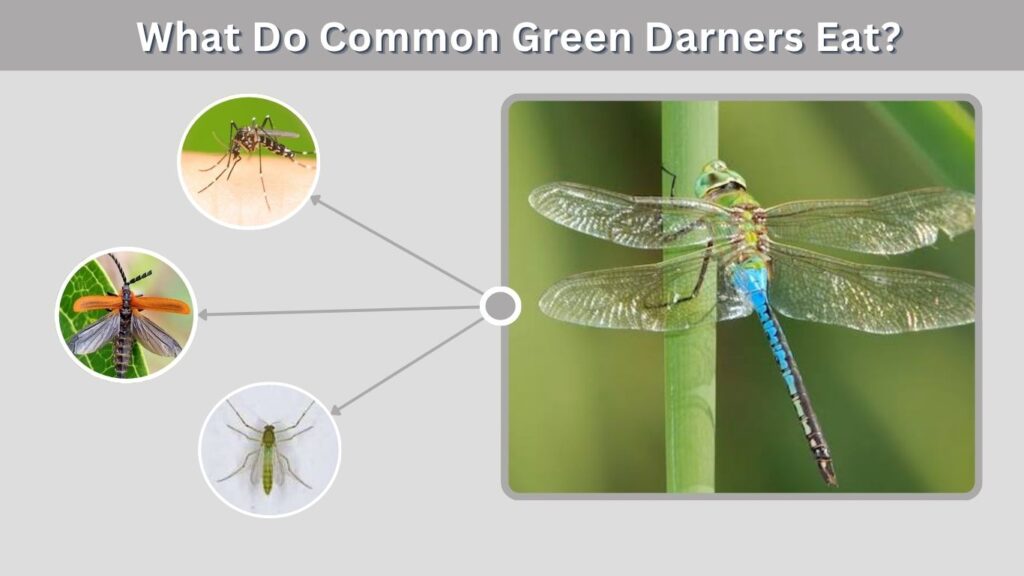
Both adults and aquatic nymphs are carnivorous predators.
Adult prey includes:
- Mosquitoes
- Midges
- Flies
- Flying ants
- Bees and wasps
- Small butterflies and moths
- Other dragonflies
They capture insects in flight using their legs like a basket.
What Do Green Darner Nymphs Eat?
Aquatic nymphs are powerful predators.
They may eat:
- Mosquito larvae
- Aquatic insects
- Small crustaceans
- Other dragonfly nymphs
- Tadpoles
- Very small fish
Their lower mouthpart can shoot forward rapidly to grab prey.
Common Green Darner Life Cycle
Common Green Darners undergo incomplete metamorphosis:
Egg → Aquatic Nymph → Adult
Eggs
One unusual feature of this species is that the male often remains attached to the female while she lays eggs.
The pair lands on floating or aquatic vegetation, and the female inserts eggs into plant material near or beneath the water surface.
Nymph
Eggs hatch into aquatic nymphs.
Nymphs molt repeatedly—typically through numerous immature stages—while feeding and growing underwater.
Development time varies between migratory and resident populations.
Adult
When ready to transform, the mature nymph climbs onto emergent vegetation.
Its outer skin splits, and the adult dragonfly pulls itself free.
The empty skin left behind is called an exuvia.
The newly emerged dragonfly is pale and soft before its wings and body harden.
Common Green Darner Mating
Mating begins when a male grasps a female behind the head using appendages at the end of his abdomen.
The female curves her abdomen forward, producing the typical dragonfly wheel position.
The pair may later remain connected in tandem while looking for a place to deposit eggs.
Common Green Darners are unusual among darners because tandem egg laying is characteristic of this species.
Common Green Darner vs. Emperor Dragonfly
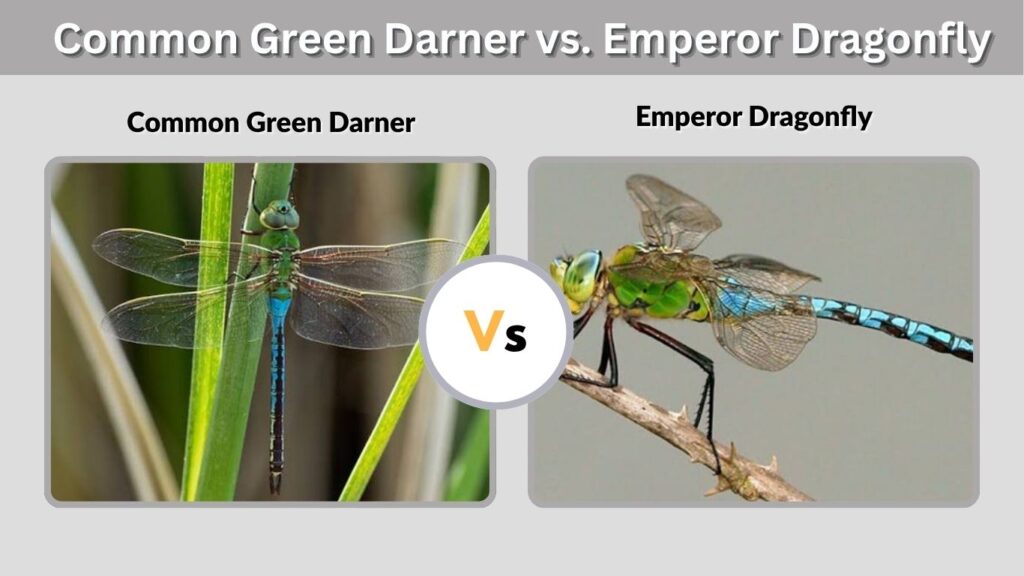
The Emperor Dragonfly (Anax imperator) is primarily an Old World species, while the Common Green Darner is widespread across North America.
| Feature | Common Green Darner | Emperor Dragonfly |
| Scientific name | Anax junius | Anax imperator |
| Main range | North America | Europe, Africa, western Asia |
| Thorax | Bright green | Green |
| Male abdomen | Blue with dark stripe | Bright blue with dark markings |
| Migration | Strong migrant | Some dispersal/migration |
| Family | Aeshnidae | Aeshnidae |
Both belong to the genus Anax and can look superficially similar.
Are Common Green Darners Dangerous?
No. Common Green Darners are harmless to people.
They:
- Do not sting
- Are not venomous
- Are not poisonous
- Do not attack humans
Like other dragonflies, they possess strong mouthparts for eating insect prey. A large individual held tightly might attempt a defensive nip, but normal encounters present essentially no danger.
Interesting Common Green Darner Facts
- Its scientific name is Anax junius.
- Adults can reach about 3 inches long.
- Both sexes have bright green thoraxes.
- Mature males usually have blue abdomens.
- Some females can also appear blue.
- A black bull’s-eye on the forehead helps identify the species.
- Some populations migrate thousands of kilometers.
- Adults catch insects while flying.
- Nymphs live entirely underwater.
- Both adults and nymphs eat mosquitoes.
- Males frequently remain attached to females during egg laying.
- Their blue coloration can become darker when their bodies cool.
FAQs
1. How big is a Common Green Darner dragonfly?
Adults generally measure approximately 68–80 mm, or about 2.7–3.1 inches long. Their long abdomen and broad wings make them one of the larger, more impressive dragonflies commonly encountered across North America.
2. How can you identify a Common Green Darner?
Look for a large dragonfly with a mostly unmarked green thorax and a distinctive black bull’s-eye marking on the forehead. Mature males generally have bright blue abdomens, while females usually have brown, purple, or greenish abdomens.
3. Where do Common Green Darners live?
They occur throughout most of the United States, southern Canada, Mexico, and parts of Central America. Breeding occurs primarily around ponds, lakes, marshes, wetlands, and slow-moving freshwater with aquatic vegetation.
4. Do Common Green Darners eat mosquitoes?
Yes. Adult Common Green Darners can catch mosquitoes and other small flying insects, while their aquatic nymphs may consume mosquito larvae. However, mosquitoes are only one part of a broad predatory diet.
5. Do Common Green Darners migrate?
Yes. Some populations undertake long-distance seasonal migrations. Adults move north in spring and later generations travel south during late summer and fall, with certain individuals covering hundreds or even thousands of kilometers during migration.