
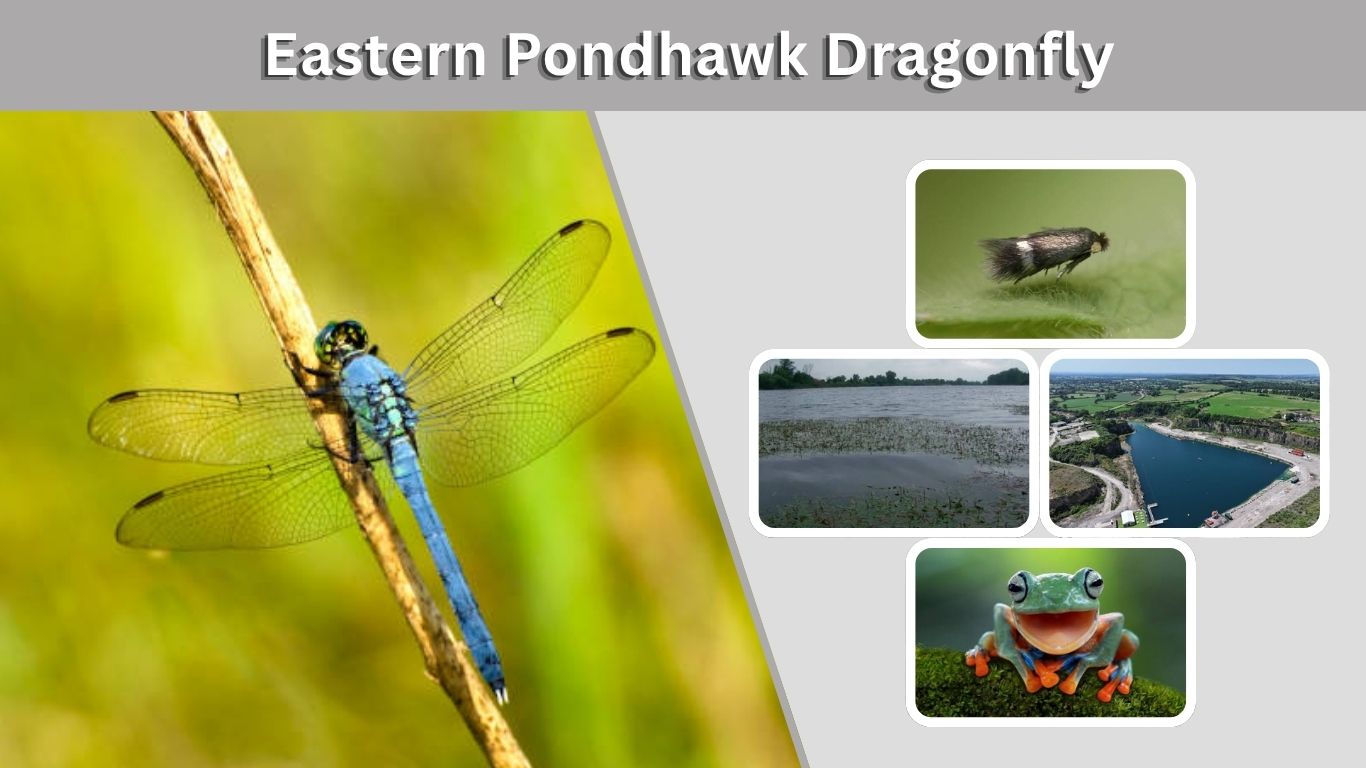
The eastern pondhawk is a powerful, brightly colored dragonfly commonly found around ponds, lakes, marshes, and slow waterways. Mature males are powder blue with a green face, while females and young males are vivid green with bold black abdominal markings. Its scientific name is Erythemis simplicicollis. Although harmless to people, this athletic predator catches flies, moths, damselflies, butterflies, and even other dragonflies.
Eastern Pondhawk Fact File
| Feature | Information |
| Scientific name | Erythemis simplicicollis |
| Other names | Common pondhawk, green clearwing, green jacket |
| Family | Libellulidae |
| Order | Odonata |
| Type | Dragonfly |
| Length | Approximately 1.5–1.8 inches |
| Male color | Powder blue with a green face |
| Female color | Bright green with black markings |
| Habitat | Ponds, lakes, marshes, swamps, and slow streams |
| Diet | Flying insects and aquatic invertebrates |
| Conservation rank | Globally secure |
The eastern pondhawk belongs to the skimmer family, Libellulidae. Its accepted scientific name is Erythemis simplicicollis, although older sources may use the former combination Lepthemis simplicicollis.
How to Identify an Eastern Pondhawk
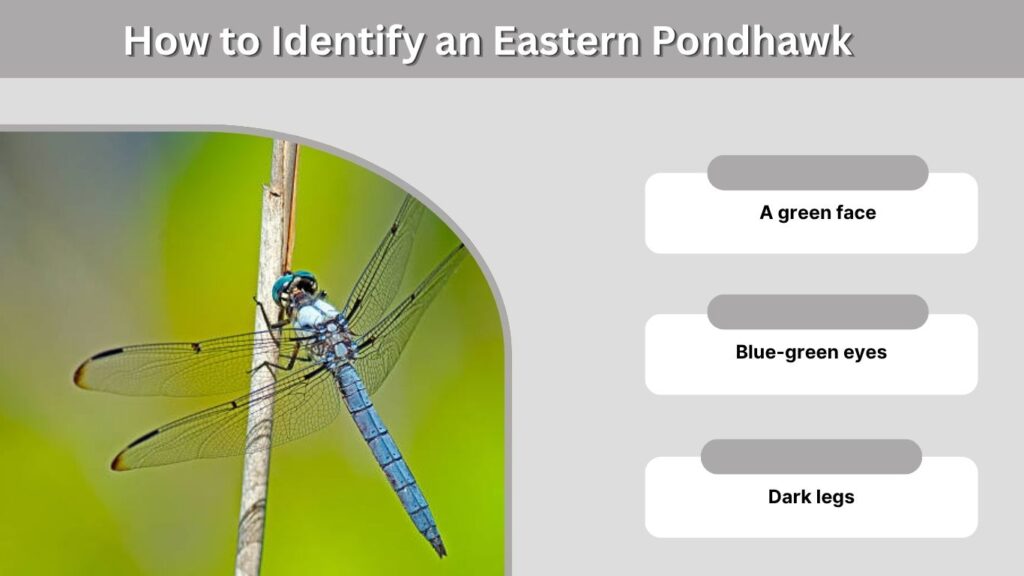
An eastern pondhawk is a medium-to-large dragonfly measuring approximately 38–45 millimeters long. It has clear wings, a robust body, strong black legs, large eyes, and a noticeably green face. Adults frequently perch horizontally on the ground, rocks, logs, broad leaves, or other flat surfaces.
Male Eastern Pondhawk
A mature male usually has:
- A powder-blue thorax and abdomen
- A green face
- Blue-green eyes
- Dark legs
- Clear, unmarked wings
- White appendages at the end of the abdomen
- Little or no visible striping on the thorax
The male does not begin life as a blue dragonfly. Young males closely resemble females, with green bodies and black markings. As a male matures, a waxy coating called pruinosity develops over the body, gradually changing its appearance from green to powder blue. The transformation normally begins near the abdominal tip and moves forward.
Female Eastern Pondhawk
Females remain predominantly bright green. Their abdomens contain a line of rectangular or square black markings, and the final abdominal segments are mostly dark.
A female can be identified by:
- A bright-green face and thorax
- Green abdominal segments
- Bold black rectangular spots
- Clear wings
- Dark legs
- A visible egg-laying structure near the abdominal tip
Female eastern pondhawks may appear larger and more heavily built than males. Their green-and-black pattern provides camouflage among waterside plants and floating vegetation.
Young Male Eastern Pondhawk
An immature male can easily be mistaken for a female because both are green. As it ages, blue pruinosity begins covering the abdomen while the thorax may remain green temporarily. A partly mature male may therefore display a blue abdomen, green thorax, and green face.
Eastern Pondhawk vs. Blue Dasher
Mature males of both species have blue bodies and often occupy the same wetland habitats. However, several physical details separate them.
| Feature | Eastern pondhawk | Blue dasher |
| Face | Green | White |
| Thorax | Plain blue or green | Dark with pale stripes |
| Abdomen tip | Pale or white appendages | Distinctly dark |
| Female color | Bright green and black | Yellow-and-black striped |
| Typical posture | Often flat on ground or leaves | Frequently on twig tips |
| General build | Larger and more robust | Usually smaller and slimmer |
The eastern pondhawk’s green face is one of the most dependable field marks. A male blue dasher normally has a white face, striped thorax, turquoise eyes, and a noticeably dark abdominal tip.
Eastern Pondhawk Habitat and Range
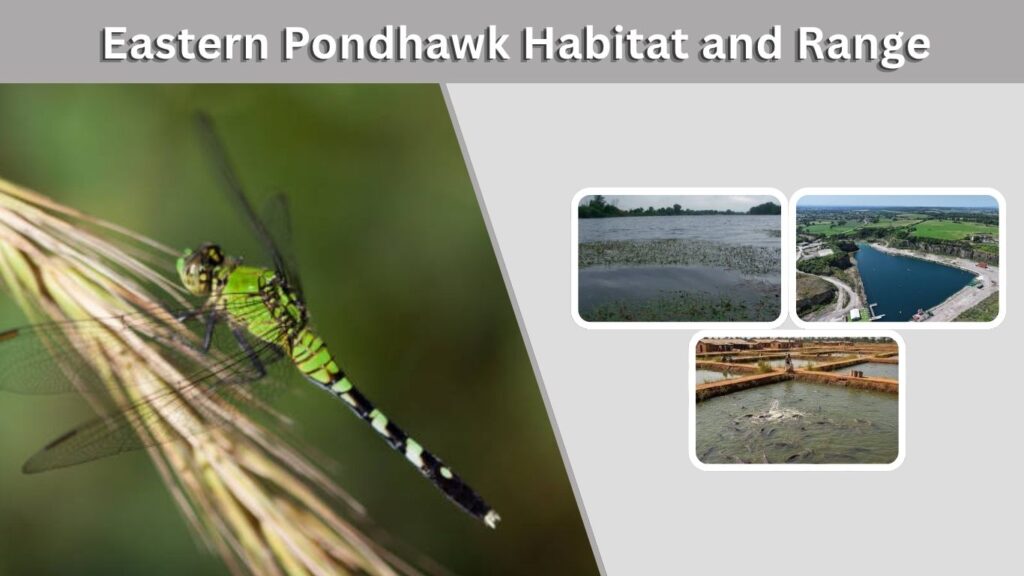
Eastern pondhawks are associated with standing or gently flowing freshwater. They are adaptable and may occupy both natural wetlands and human-made water bodies.
Common habitats include:
- Ponds
- Lakes
- Marshes
- Swamps
- Reservoirs
- Retention ponds
- Slow streams and rivers
- Wet ditches
- Vegetated shoreline pools
Aquatic vegetation provides shelter and hunting areas for nymphs, while floating leaves and open shorelines give adults suitable perches and breeding territories.
Eastern Pondhawk Range
The species is native to much of eastern and central North America. It occurs across the eastern two-thirds of the United States, parts of southern Canada, Mexico, Central America, and portions of the Caribbean. Its geographic presence includes Florida, Texas, Ohio, Missouri, New Jersey, and many surrounding regions.
The flight season changes with climate. Adults may be active throughout much of the year in warm areas such as Florida. In colder northern regions, they usually appear during late spring, summer, and early fall. In North Carolina, documented activity extends from late March or April through October, with occasional November records.
What Do Eastern Pondhawks Eat?
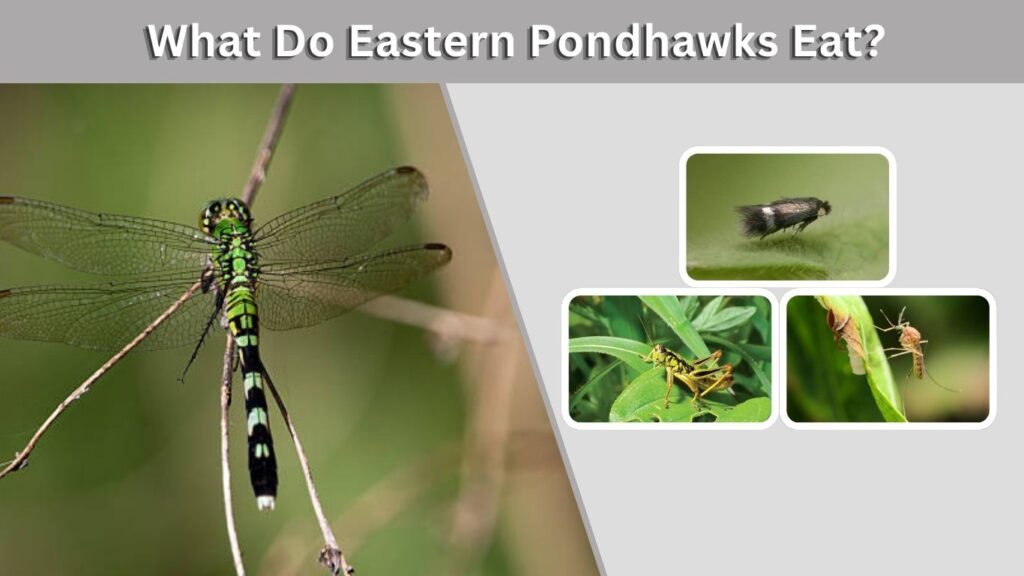
Eastern pondhawks are exceptionally aggressive insect predators. An adult commonly watches from a low perch, launches rapidly toward passing prey, captures it with its legs, and returns to a perch to eat.
Their prey can include:
- Mosquitoes
- Midges and flies
- Moths
- Small butterflies
- Bees and wasps
- Damselflies
- Grasshoppers
- Other dragonflies
- Smaller eastern pondhawks
Their long, spiny legs form a basket around prey during flight. Eastern pondhawks can capture insects close to their own size and may follow people or large animals because walking disturbs insects hidden in vegetation.
Eastern Pondhawk Nymph Diet
The immature stage lives underwater and is commonly called a nymph or naiad. Nymphs hide on the bottom or among submerged plants and capture aquatic prey with an extendable lower mouthpart.
Their diet may include:
- Mosquito larvae
- Aquatic fly larvae
- Small crustaceans
- Mayfly nymphs
- Other dragonfly and damselfly nymphs
- Tadpoles or very small fish when available
Both adults and nymphs contribute to wetland food webs by controlling populations of smaller animals.
Eastern Pondhawk Life Cycle
The eastern pondhawk undergoes incomplete metamorphosis with three main stages:
- Egg
- Aquatic nymph
- Winged adult
It does not pass through a caterpillar or pupal stage.
Mating and Reproduction
Males defend small territories around floating vegetation and may chase rival males through rapid aerial maneuvers. During mating, the male grasps the female behind her head, and the pair forms the characteristic wheel position seen in dragonflies.
After mating, the female flies low over shallow water and repeatedly touches the tip of her abdomen to the surface. This action releases eggs into water, algae, or submerged vegetation. A male may remain nearby and guard her against competing males while she lays eggs.
Nymph Development and Emergence
The eggs hatch into aquatic nymphs that feed and molt as they grow. When development is complete, a nymph climbs out of the water on a plant stem, rock, or other firm support.
The adult then splits the nymphal skin, pulls itself free, expands its wings, and waits for its body to harden. The empty skin left behind is called an exuvia. Newly emerged pondhawks are soft and pale before developing their mature green or blue coloration.
Eastern Pondhawk Predators
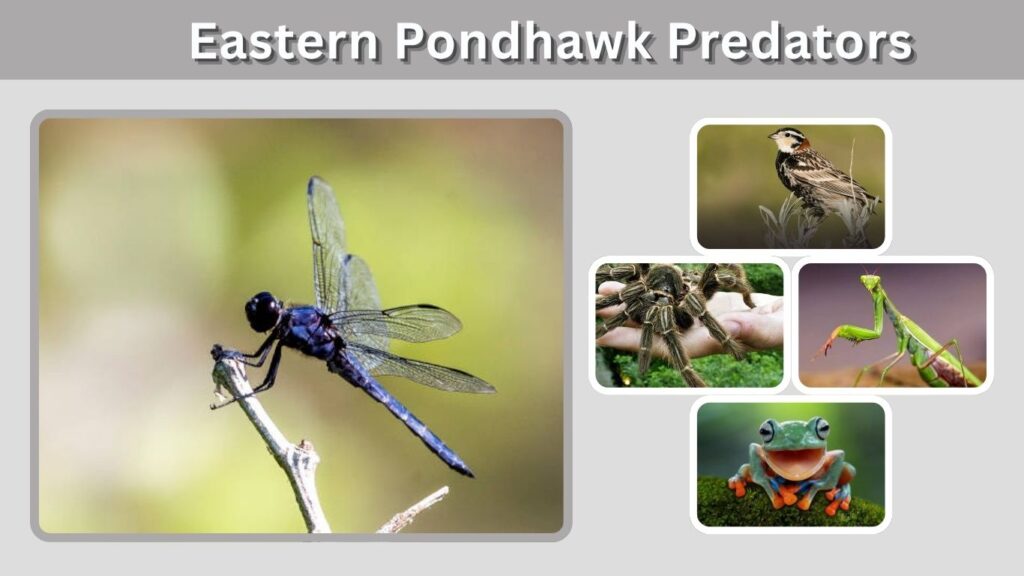
Despite being effective hunters, eastern pondhawks are eaten by many other animals. Aquatic nymphs may be captured by fish, frogs, larger aquatic insects, and other dragonfly nymphs.
Adult predators can include:
- Birds
- Frogs
- Spiders
- Praying mantises
- Robber flies
- Larger dragonflies
- Tiger beetle larvae
Ground-perching behavior may expose adults to predators hiding in soil or nearby vegetation. However, their speed, large eyes, and rapid takeoff provide strong defenses.
Are Eastern Pondhawks Dangerous?
Eastern pondhawks are not dangerous to humans. They have no stinger, are not venomous, and do not deliberately attack people. Their aggressive hunting behavior is directed toward other insects.
A dragonfly restrained in the hand may try to bite defensively, but eastern pondhawks normally fly away when approached. Observing one without handling it protects both the person and the dragonfly’s delicate wings and legs.
Eastern Pondhawk Conservation Status
The eastern pondhawk is widespread, adaptable, and globally ranked secure. It can reproduce in many permanent ponds, lakes, swamps, and artificial water bodies. Current records give the species a global NatureServe rank of G5, indicating that it is not considered at significant risk across its overall range.
Local populations still depend on freshwater habitat. Wetland drainage, pesticide contamination, shoreline clearing, and declining water quality can reduce suitable breeding and feeding areas.
FAQs
Is an eastern pondhawk a dragonfly or damselfly?
The eastern pondhawk is a dragonfly. It belongs to the suborder Anisoptera and the skimmer family Libellulidae. Unlike most damselflies, it has a relatively strong body, broad hindwings, and holds its wings open while resting.
Why are some eastern pondhawks green and others blue?
Females and young males are green with black abdominal markings. Males gradually develop powder-blue pruinosity as they mature. A young male may show both colors while changing from its juvenile green pattern to its adult blue appearance.
Where can I find eastern pondhawks?
Look around sunny ponds, lakes, marshes, swamps, retention basins, and slow streams. Adults frequently rest on paths, rocks, logs, broad leaves, low plants, or bare ground near water.
Do eastern pondhawks eat mosquitoes?
Yes. They capture mosquitoes and many other small flying insects. However, they are generalist predators rather than mosquito specialists and may also eat flies, moths, butterflies, damselflies, bees, and other dragonflies.
How can I distinguish an eastern pondhawk from a blue dasher?
Check the face and thorax. A mature male eastern pondhawk has a green face and a mostly unstriped blue body. A male blue dasher usually has a white face, striped thorax, turquoise eyes, and a dark abdominal tip.