
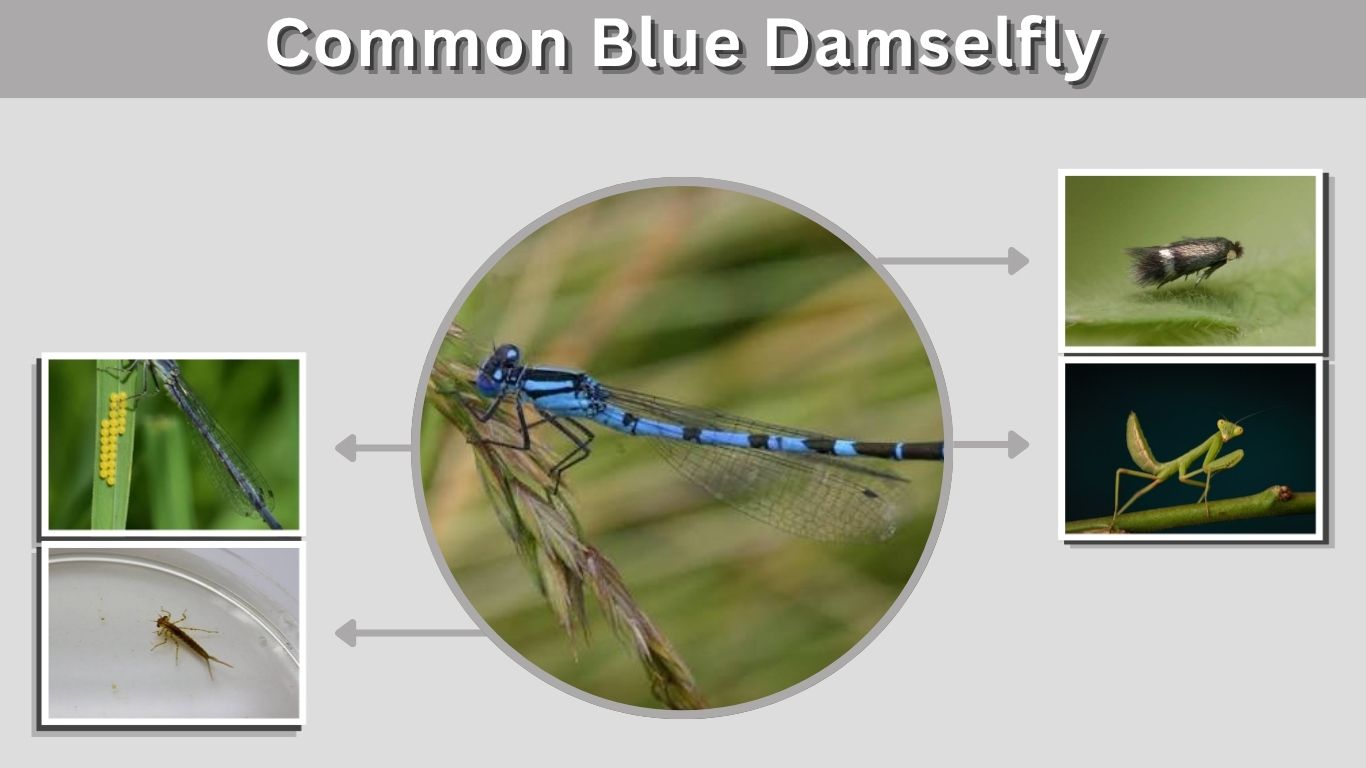
The common blue damselfly is a small, slender insect frequently seen around ponds, lakes, canals, and other freshwater habitats. Mature males are easily noticed because of their vivid blue-and-black bodies, while females may be blue or dull green. Its scientific name is Enallagma cyathigerum. Although similar to the azure damselfly, its thicker shoulder stripes and distinctive abdominal marking help confirm its identity.
Common Blue Damselfly Fact File
| Feature | Information |
| Scientific name | Enallagma cyathigerum |
| Class | Insecta |
| Order | Odonata |
| Suborder | Zygoptera |
| Family | Coenagrionidae |
| Average length | Approximately 32 mm |
| Main colors | Blue, black, or dull green |
| Habitat | Ponds, lakes, reservoirs, canals, and slow rivers |
| Adult diet | Small flying insects |
| Larval diet | Small aquatic animals |
| Conservation status | Least Concern |
The species belongs to the same insect order as dragonflies but is classified in the damselfly suborder Zygoptera. Its global and European conservation status is listed as Least Concern.
Common Blue Damselfly Identification
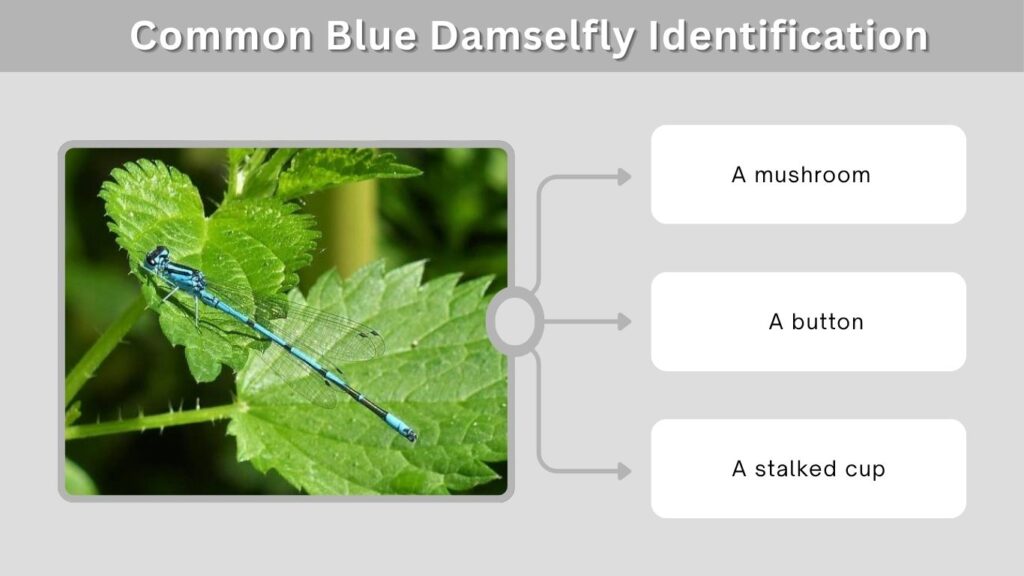
The common blue damselfly is approximately 32 millimeters long. It has a narrow abdomen, widely separated eyes, transparent wings, and two broad pale stripes running along the upper surface of its thorax.
Male Identification
A mature male has a bright blue body interrupted by black markings. The most useful identification feature is the black mark on the second abdominal segment, immediately behind the thorax.
This marking is commonly described as resembling:
- A mushroom
- A button
- A stalked cup
- A rounded spot with a short stem
Males also have thick blue antehumeral stripes along the top of the thorax. The combination of these broad stripes and the mushroom-shaped abdominal mark separates the species from many similar blue damselflies.
Female Common Blue Damselfly
Females are more variable than males. They are mainly black with either blue or dull-green areas. The marking on the second abdominal segment is normally shaped more like a thistle than the rounded mushroom mark found on males.
Additional dark markings along the female’s abdomen may resemble small rockets. Older females and blue-colored females can sometimes be mistaken for males when observed from a distance.
Newly emerged adults of both sexes are usually paler than fully mature individuals. Their colors become stronger as the body hardens following emergence from the water.
Common Blue vs. Azure Damselfly
The azure damselfly is the species most likely to be confused with the common blue damselfly. Both are approximately the same size and have blue-and-black males.
| Feature | Common blue damselfly | Azure damselfly |
| Scientific name | Enallagma cyathigerum | Coenagrion puella |
| Male abdominal mark | Mushroom or button shaped | Flat-bottomed U shape |
| Shoulder stripes | Broad and thick | Narrow and thin |
| Preferred habitat | Often larger, open waters | Frequently smaller ponds and margins |
| Open-water behavior | Commonly flies out over water | Often remains closer to vegetation |
Male azure damselflies have a U-shaped marking on their second abdominal segment and noticeably thinner shoulder stripes. The azure also possesses a short black line called the Coenagrion spur on the side of its thorax.
Females are more challenging to distinguish. Clear photographs of the thorax, pronotum, and abdominal markings may be required for a confident identification.
Where Do Common Blue Damselflies Live?
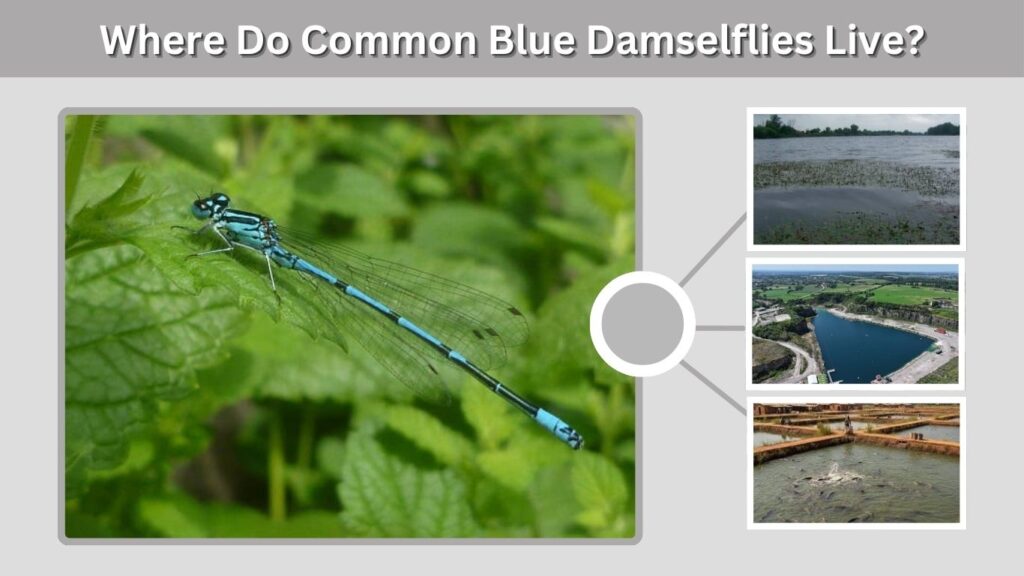
Common blue damselflies live around freshwater. They occur in many aquatic habitats but are particularly noticeable around larger bodies of standing water.
Suitable habitats include:
- Lakes and reservoirs
- Medium and large ponds
- Canals
- Gravel pits
- Marshes
- Slow-flowing rivers
- Well-vegetated wetland margins
Adults frequently fly low above open water, sometimes farther from shore than other blue damselflies. They also rest on reeds, grasses, rushes, and low vegetation surrounding breeding sites.
Aquatic vegetation is important because it provides hunting cover for larvae, egg-laying surfaces for females, and supports on which fully developed larvae can climb out of the water.
Common Blue Damselfly Range
Enallagma cyathigerum is an Old World species distributed across Europe and parts of northern Asia. It is widespread throughout Britain and is one of the country’s most frequently encountered damselflies.
Does It Live in North America?
Older books and records sometimes list Enallagma cyathigerum in North America, including Washington and Oregon. However, North American populations were separated taxonomically in 2005 and are now classified as the northern bluet, Enallagma annexum.
The true common blue damselfly, E. cyathigerum, is now considered Eurasian. Therefore, a similar-looking blue damselfly observed in the United States or Canada should not automatically be identified as a common blue damselfly.
What Do Common Blue Damselflies Eat?
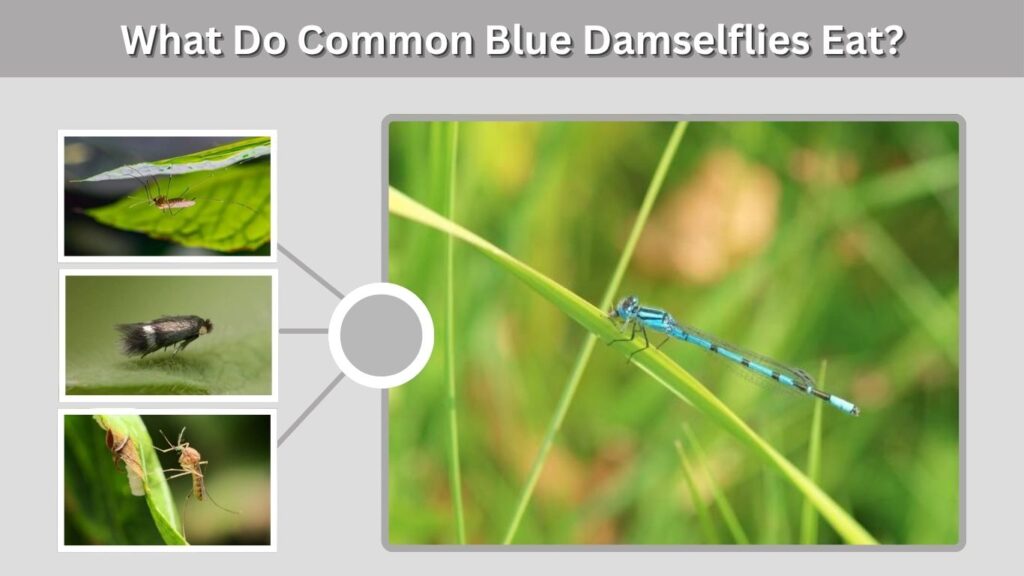
Adult common blue damselflies are predators that capture small insects in flight or pick them from nearby vegetation.
Their prey may include:
- Midges
- Mosquitoes
- Small flies
- Aphids
- Tiny moths
- Mayflies
- Other small insects
Adults often leave the breeding water for several days after emerging. During this period, they feed and mature before returning to ponds or lakes to reproduce.
What Do the Larvae Eat?
Common blue damselfly larvae live underwater and are also predators. They use an extendable lower mouthpart, called a labium, to seize prey.
Their food may include aquatic insect larvae, tiny crustaceans, worms, and other small freshwater animals. The larvae hide among submerged plants, where vegetation offers both hunting opportunities and protection from fish.
Common Blue Damselfly Life Cycle
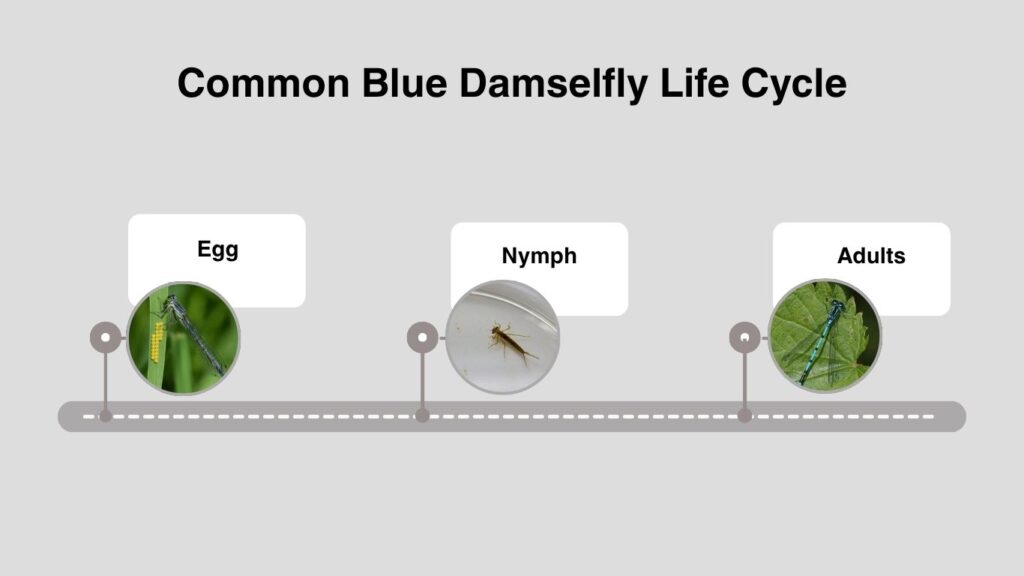
The common blue damselfly develops through three stages:
- Egg
- Aquatic larva or nymph
- Winged adult
It undergoes incomplete metamorphosis, meaning there is no caterpillar or pupal stage.
Mating and Egg Laying
During mating, the male holds the female behind her head with appendages at the end of his abdomen. The female curves her abdomen forward, producing the wheel-shaped position commonly associated with damselflies.
Following mating, the pair may remain connected in tandem. The female uses a blade-like ovipositor to insert eggs into aquatic plant tissue. She may descend partly or completely below the surface while laying eggs, sometimes with the male still attached.
Larval Development
The eggs hatch into aquatic larvae. Damselfly larvae have three leaf-like structures at the end of the abdomen called caudal lamellae, which function partly as external gills and assist with movement.
Common blue damselfly larvae can be identified by three thin horizontal bands across these structures, although the bands may be faint. They do not have the spotting on the back of the head seen in some similar species.
The larva molts repeatedly as it grows. Dragonflies and damselflies commonly spend one or two years in the aquatic stage, although development speed varies with water temperature, food, and climate.
Adult Emergence
Once fully developed, the larva climbs out of the water on a plant stem or another firm surface. The adult breaks out of the larval skin, expands its wings, and allows its body to harden.
The empty skin left attached to the vegetation is called an exuvia. Newly emerged adults are pale and vulnerable, but their coloration strengthens as they mature. Adult damselflies generally live for only a few weeks, much less time than they spend underwater as larvae.
Are Common Blue Damselflies Dangerous?
Common blue damselflies are harmless to people. They have no stinger, do not suck blood, and do not deliberately attack humans. Their small mouthparts are designed to capture tiny insects.
They may land on clothing or skin while resting, but this does not indicate aggressive behavior. Their presence is generally a welcome sign because they consume small flying insects and form part of the freshwater food web.
FAQs
What is the scientific name of the common blue damselfly?
Its scientific name is Enallagma cyathigerum. It belongs to the family Coenagrionidae within the insect order Odonata. The North American northern bluet was formerly included under the same scientific name but is now classified as Enallagma annexum.
How can you identify a male common blue damselfly?
Look for a slender blue-and-black body, thick blue shoulder stripes, and a black mushroom- or button-shaped mark on the second abdominal segment. This marking is located just behind the base of the wings.
What does a female common blue damselfly look like?
Females are mostly black with blue or dull-green coloration. They have a thistle-shaped marking near the base of the abdomen and a series of rocket-shaped dark markings farther along it.
Where do common blue damselflies lay their eggs?
Females insert their eggs into living or decaying aquatic plant material near or beneath the water’s surface. Some females submerge themselves while laying, and the male may remain attached in tandem.
What is the difference between a common blue and an azure damselfly?
The male common blue has broad shoulder stripes and a mushroom-shaped abdominal mark. The male azure has thin shoulder stripes, a U-shaped mark, and a short black Coenagrion spur on the side of its thorax.