
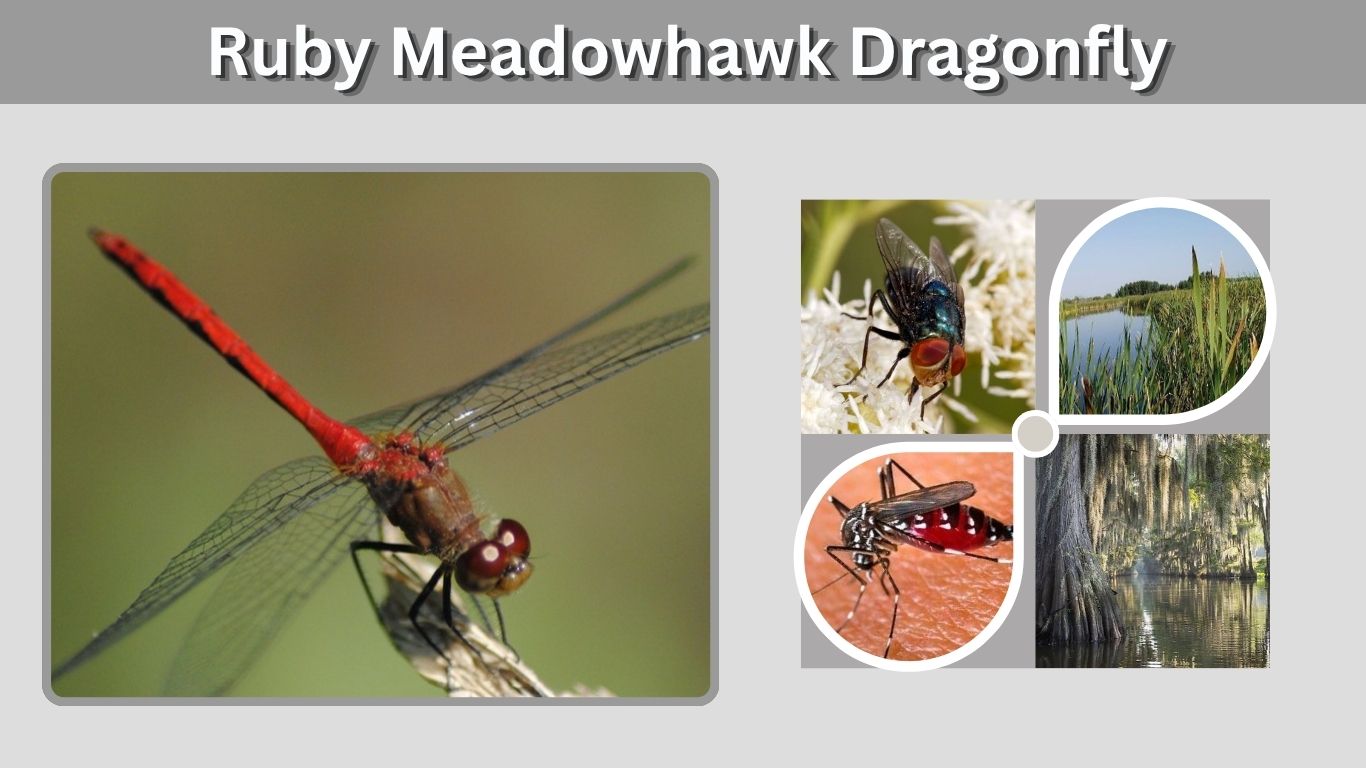
The ruby meadowhawk is a small red dragonfly commonly seen around ponds, marshes, lake edges, and sunny fields during summer and early fall. Scientifically known as Sympetrum rubicundulum, it belongs to the skimmer family and is recognized by its reddish abdomen, black legs, tan-to-brown face, and dark triangular markings. However, females and immature individuals closely resemble cherry-faced and white-faced meadowhawks, sometimes making identification difficult without detailed photographs.
What Is a Ruby Meadowhawk?
The ruby meadowhawk is a species of dragonfly in the family Libellulidae, commonly called the skimmers. Its accepted scientific name is Sympetrum rubicundulum. “Ruby-faced meadowhawk” is sometimes used informally or mistakenly, but ruby meadowhawk is the established common name.
Adults are compact, agile hunters that frequently perch on grasses, twigs, dried flower heads, and low shrubs. They repeatedly leave a perch to capture a flying insect and then return to the same or a nearby location.
| Feature | Ruby Meadowhawk |
| Scientific name | Sympetrum rubicundulum |
| Family | Libellulidae |
| Length | About 1.1–1.5 inches |
| Male color | Bright orange-red to ruby red |
| Female color | Yellow, tan, olive-brown, or reddish with age |
| Legs | Black |
| Face | Tan, yellowish, or brownish |
| Habitat | Ponds, marshes, lakeshores, and fields |
| Diet | Small flying insects |
Ruby Meadowhawk Identification
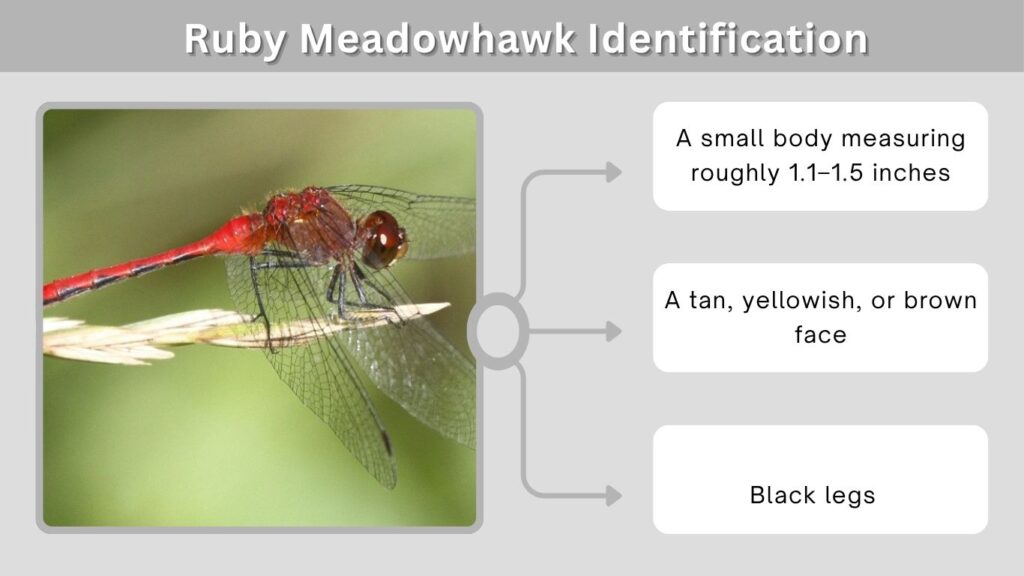
A mature male is easier to recognize than a female or juvenile. Even so, several meadowhawk species share nearly identical colors and markings.
Key Identification Features
Look for the following combination:
- A small body measuring roughly 1.1–1.5 inches
- Large eyes with bluish lower areas and reddish caps
- A tan, yellowish, or brown face
- Black legs
- Clear wings with dark veins
- A yellow-brown to reddish thorax
- Black triangular markings along the abdomen’s sides
- An orange-red or brilliant ruby abdomen in mature males
Illinois records describe adults as approximately 1.5 inches long, with clear wings, black legs, blue-toned eyes, and dark triangular abdominal markings. Ohio’s field guide gives a length of about 29–38 millimeters.
Male Ruby Meadowhawk
A mature male usually has a bright red or orange-red abdomen. Black triangular markings run along the lower sides, creating a broken dark stripe when viewed from the side.
The thorax is usually reddish brown or yellow-brown rather than uniformly brilliant red. The face remains tan or yellowish, which helps separate it from a mature cherry-faced meadowhawk with a deeper red face.
Female Ruby Meadowhawk
Females are generally stouter than males. Their abdomen may be yellow, golden brown, olive-brown, or dull reddish, with dark triangular markings along the sides.
A female also has a noticeable subgenital plate beneath the eighth abdominal segment. Its precise shape is one of the most dependable features for separating female ruby meadowhawks from nearly identical species. Illinois sources additionally describe a yellow mark underneath near the thorax’s base.
Juvenile Ruby Meadowhawk
Juveniles and newly emerged adults are not ruby red. They initially appear pale yellow, tan, orange, or greenish brown. Immature males gradually develop red coloring as they mature.
Their wings may look glossy immediately after emergence, while the body remains soft and lightly colored. Because juveniles lack the mature male’s red abdomen, they can be especially difficult to distinguish from female meadowhawks.
Male vs. Female Ruby Meadowhawk
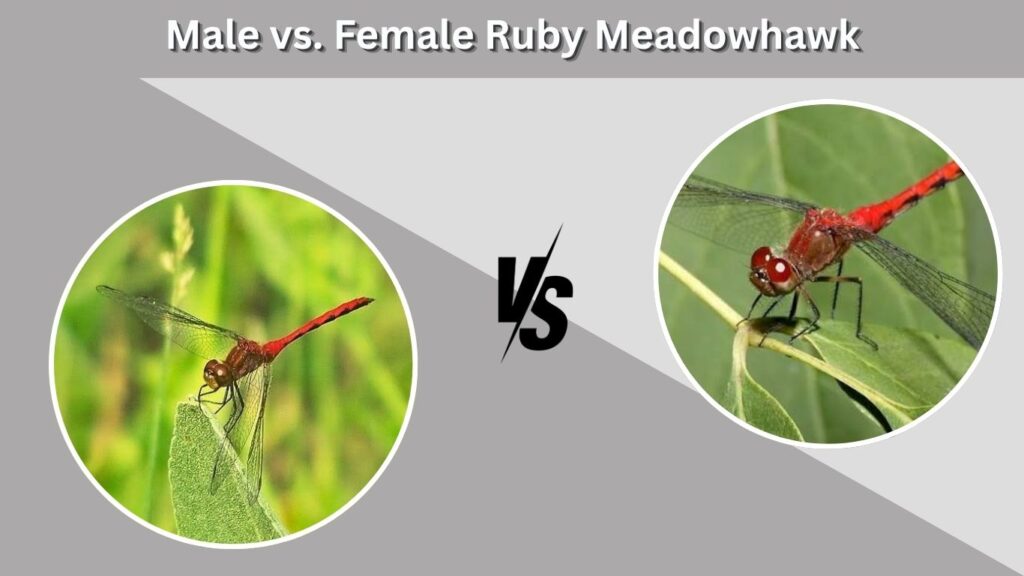
Male and female ruby meadowhawks share black legs, dark abdominal triangles, and similar wing shapes. Their body color and reproductive structures provide the best distinctions.
| Characteristic | Male | Female |
| Abdomen | Slender and bright red when mature | Broader; yellow, brown, or occasionally reddish |
| Thorax | Brownish red or yellow-brown | Usually yellow-brown or olive-brown |
| Reproductive feature | Hamules beneath the second abdominal segment | Subgenital plate beneath the eighth segment |
| Behavior near water | Frequently patrols or perches | Often visits primarily to mate and deposit eggs |
Photographs showing only the upper body may not reveal enough detail for a confident identification. Clear side and underside images are particularly helpful.
Why Genitalia Matter for Identification
The genital structures used by entomologists are small external features, not internal organs that require dissection. In males, experts examine the hamules beneath the front portion of the abdomen. In females, they examine the subgenital plate near the abdomen’s end.
North Carolina’s official odonate resource notes that ruby, cherry-faced, and white-faced meadowhawks can be unreliable to identify from one ordinary photograph. Close images of male hamules or the female subgenital plate may be needed for confirmation.
Ruby Meadowhawk Range and Habitat
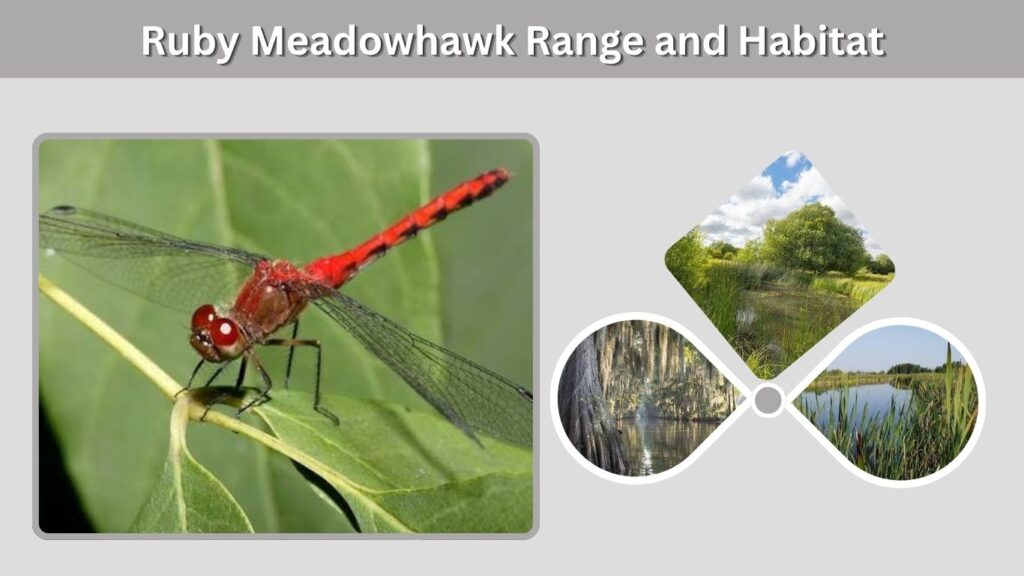
Ruby meadowhawks occur across a broad area of North America, especially in northern and central regions. Their abundance differs by location: they are considered common and native in Illinois, widespread in Ohio, and much more limited near the southern edge of their range.
Preferred Habitat
They are commonly associated with:
- Marshes
- Ponds
- Lakeshores
- Shallow wetlands
- Vegetated water margins
- Slow or quiet aquatic habitats
- Sunny meadows and fields near water
Adults often forage well away from their breeding habitat. A ruby meadowhawk seen in a dry field may therefore have developed in a pond or marsh some distance away.
Flight Season
The exact season depends on climate and location. In Illinois, adults are generally recorded from late June through early October. Ohio records extend from approximately late May through late October. They are often most noticeable during late summer, when mature males develop their strongest red coloring.
What Do Ruby Meadowhawks Eat?
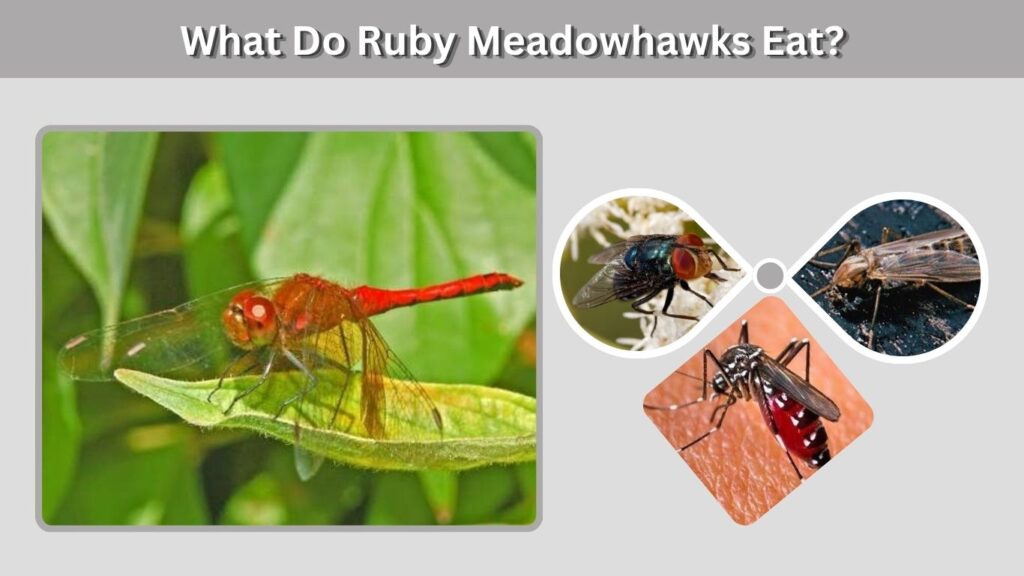
Ruby meadowhawks are predators during both their aquatic and flying stages.
Adult Diet
Adults capture small insects in the air, including:
- Mosquitoes
- Flies
- Midges
- Small moths
- Mayflies
- Flying ants
- Flying termites
They usually hunt from a perch. After detecting prey, the dragonfly launches into the air, catches the insect with its legs, and may eat it while flying or after returning to vegetation.
Larval Diet
The aquatic larvae, also called naiads or nymphs, are ambush predators. They consume mosquito larvae, aquatic fly larvae, mayfly nymphs, freshwater crustaceans, and other small aquatic animals. Larger individuals may occasionally capture tiny fish or tadpoles.
Life Cycle and Reproduction
Ruby meadowhawks develop through incomplete metamorphosis with three stages:
- Egg
- Aquatic nymph
- Winged adult
After mating, the male and female may remain connected in tandem. The male holds the female behind the head while she repeatedly dips the end of her abdomen against the water to release eggs. Females sometimes deposit eggs without an attached male.
The eggs hatch into aquatic nymphs that live among submerged plants, mud, and debris. After completing a series of molts, a mature nymph climbs from the water. Its adult body emerges from the old skin, and its wings expand and harden before it flies away.
Ruby Meadowhawk vs. Cherry-Faced Meadowhawk
The cherry-faced meadowhawk, Sympetrum internum, is one of the ruby meadowhawk’s most confusing lookalikes.
A mature cherry-faced male normally develops a stronger red face. However, face color varies with age and lighting, so it cannot always confirm identification. Both may have black legs, reddish abdomens, dark side triangles, and orange coloring near the wing bases.
Cherry-faced meadowhawks are generally more frequent later in the season in areas where both species occur. Examination of reproductive structures remains more dependable than color alone.
Ruby Meadowhawk vs. White-Faced Meadowhawk
A mature male white-faced meadowhawk has a conspicuous white face, making it relatively recognizable. The difficulty arises with females and young males, whose faces may be yellowish, brownish, or greenish.
Illinois officials note that ruby and white-faced meadowhawks may require in-hand examination for reliable separation. Photographs of immature individuals should therefore be labeled cautiously when diagnostic structures are not visible.
Are Ruby Meadowhawks Dangerous?
Ruby meadowhawks are harmless to people and pets. They have no stinger, are not venomous, and do not attack humans.
A dragonfly may move its mouthparts defensively when roughly restrained, but it cannot cause a medically significant bite. The safest practice is to observe and photograph it without handling, since its wings and legs can be damaged easily.
FAQs
Is a ruby meadowhawk a dragonfly?
Yes. The ruby meadowhawk is a small skimmer dragonfly in the family Libellulidae. Its scientific name is Sympetrum rubicundulum. Mature males are mostly red, while females and juveniles are usually yellow, brown, or olive-colored.
How can you identify a female ruby meadowhawk?
A female typically has a stout yellow-to-brown abdomen, black legs, a tan face, and black triangular markings along the sides. Reliable confirmation may require a close underside photograph showing the shape of her subgenital plate.
What does a juvenile ruby meadowhawk look like?
A juvenile is usually pale yellow, tan, orange-brown, or greenish rather than ruby red. Immature males gradually become red as they age, making early-stage individuals difficult to separate from females and related meadowhawks.
What is the difference between ruby and cherry-faced meadowhawks?
A mature cherry-faced male generally has a deeper red face, while the ruby meadowhawk’s face is typically tan or yellowish. Because coloration overlaps, specialists often examine male hamules or female subgenital plates for accurate identification.
What do ruby meadowhawks eat?
Adults eat mosquitoes, midges, flies, mayflies, small moths, and other flying insects. Their aquatic nymphs feed on insect larvae, small crustaceans, and occasionally tiny fish or tadpoles.