
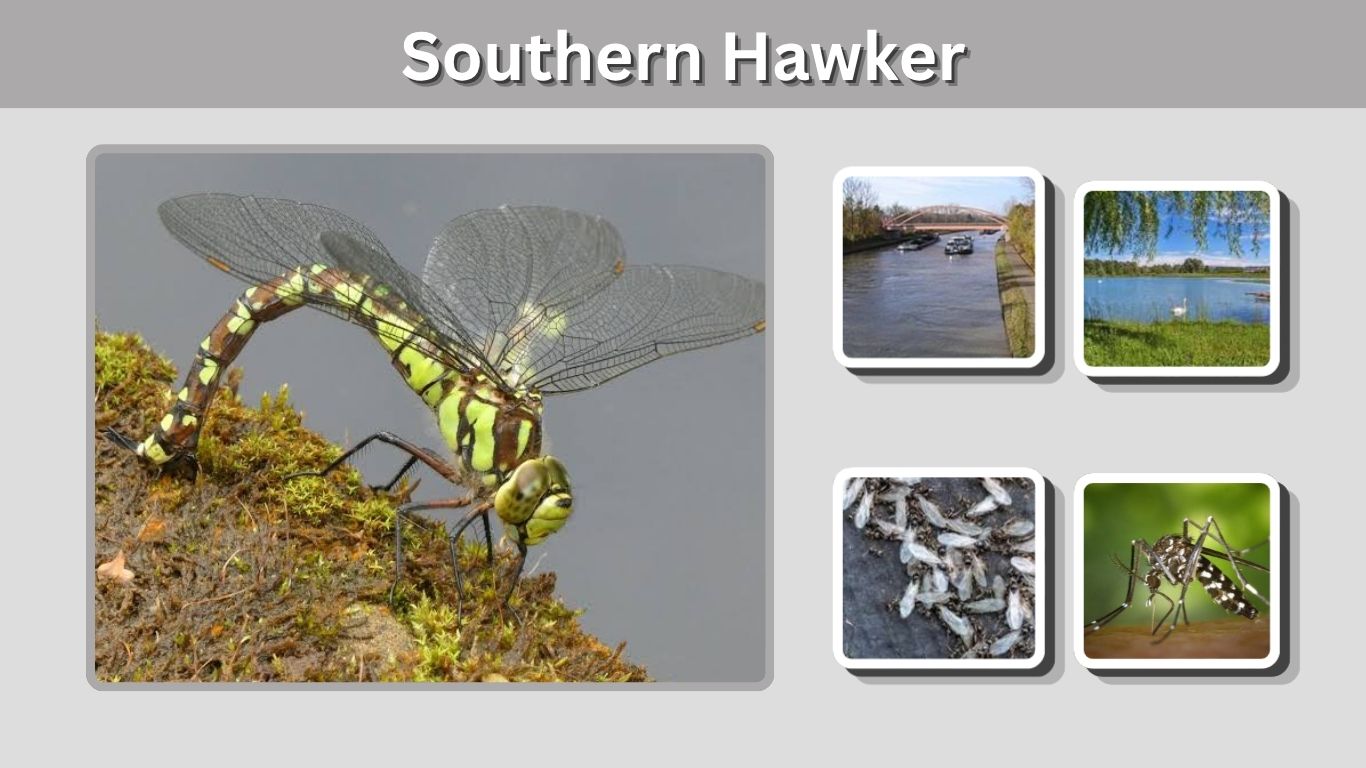
The southern hawker dragonfly is a large, fast-flying species recognized by its green markings, broad shoulder stripes, and inquisitive behavior. It frequently patrols ponds, canals, woodland paths, and gardens, sometimes hovering close to people as though inspecting them. Scientifically known as Aeshna cyanea, this powerful aerial predator catches insects in flight and spends its immature stage underwater. Despite its impressive size and strong jaws, the southern hawker is not dangerous to humans.
What Is a Southern Hawker Dragonfly?
The southern hawker belongs to the hawker or darner family, Aeshnidae. It is one of the larger European dragonflies and is particularly familiar in Britain, where it commonly visits small ponds and wooded landscapes.
| Classification | Details |
| Scientific name | Aeshna cyanea |
| Order | Odonata |
| Suborder | Anisoptera |
| Family | Aeshnidae |
| Common name | Southern hawker |
| Adult length | About 70 mm |
| Main colors | Black, green, blue, and brown |
| Active season in Britain | June to October |
Adults are strong, agile flyers capable of hovering, flying backward, and rapidly changing direction while pursuing prey.
Southern Hawker Dragonfly Identification
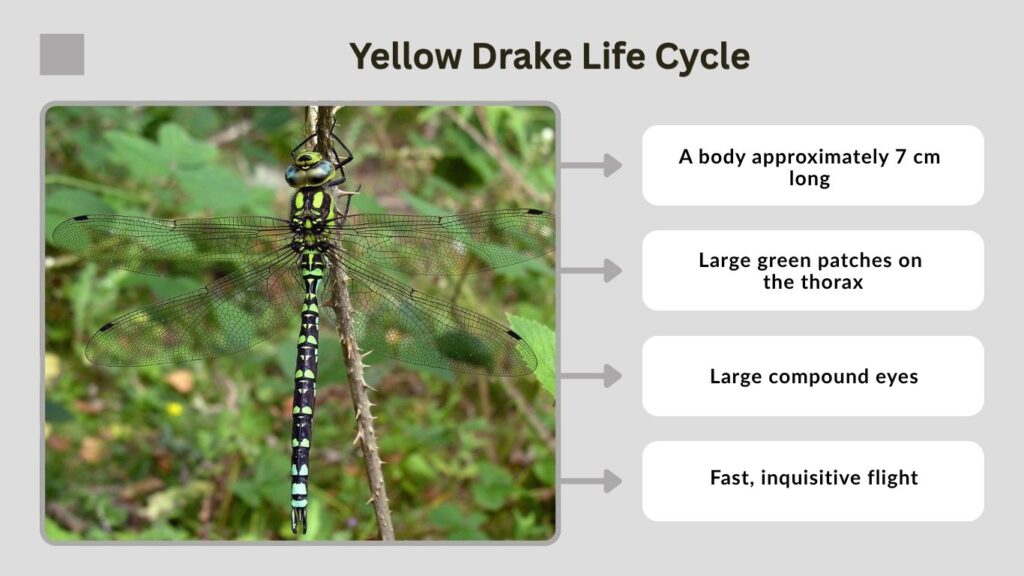
The southern hawker has a long, dark abdomen decorated with bright markings. Its large head is dominated by compound eyes, while its four transparent wings have dark veins and dark pterostigmata—the small colored marks near the outer wing edges.
Key Identification Features
Look for the following characteristics:
- A body approximately 7 cm long
- Broad, brightly colored shoulder stripes
- Large green patches on the thorax
- A dark abdomen covered with green or blue markings
- Colored bands near the tip of the abdomen
- Dark wing veins and wing spots
- A triangular marking on the second abdominal segment
- Large compound eyes
- Fast, inquisitive flight
The colored markings near the abdomen’s tip form broader bands rather than remaining as separate small spots. The prominent shoulder markings are sometimes described as “headlights” and are especially useful for identification.
Male vs. Female Southern Hawker
Male and female southern hawkers share the same large size and general body pattern, but their colors differ noticeably.
Male Southern Hawker
A mature male has a mostly dark body with bright green markings along much of the abdomen. The final abdominal segments display pale blue spots or bands. Males also have blue-green eyes and a relatively narrow abdomen.
Female Southern Hawker
Females are generally brown rather than black and have bright green or yellow-green markings. Their eyes are usually brownish, and the abdomen is slightly broader than the male’s. Females normally lack the male’s strong blue markings at the end of the abdomen.
| Feature | Male | Female |
| Main body color | Dark brown or black | Brown |
| Abdominal markings | Green with blue near the tip | Mostly green |
| Eyes | Blue-green | Brownish |
| Abdomen | Slender and distinctly waisted | Slightly broader |
| Behavior near water | Patrols territory | Visits water mainly to mate and lay eggs |
Southern Hawker Habitat
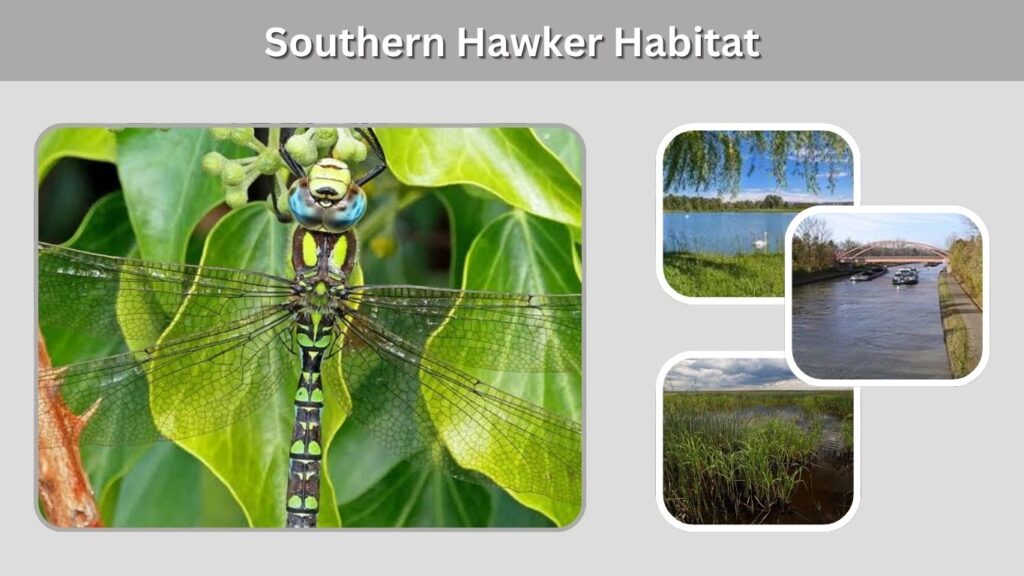
Southern hawkers breed in still or slowly moving freshwater. They favor well-vegetated, non-acidic water and readily use small garden ponds.
Suitable habitats include:
- Garden ponds
- Woodland ponds
- Small lakes
- Canals
- Slow-flowing streams
- Marshy pools
- Vegetated ditches
- Wetland margins
Adults frequently hunt far from water. They may be observed flying along woodland rides, hedgerows, country lanes, clearings, and gardens, sometimes continuing to hunt into the evening.
Southern Hawker Distribution
The southern hawker is widely distributed across central Europe, with a broader range extending from southern Scandinavia into North Africa and eastward into parts of Asia.
In the United Kingdom, it is widespread across England and Wales. Its Scottish range has expanded northward, although its distribution there remains more localized. It is especially associated with lowland ponds, gardens, canals, and woodland habitats.
What Do Southern Hawker Dragonflies Eat?
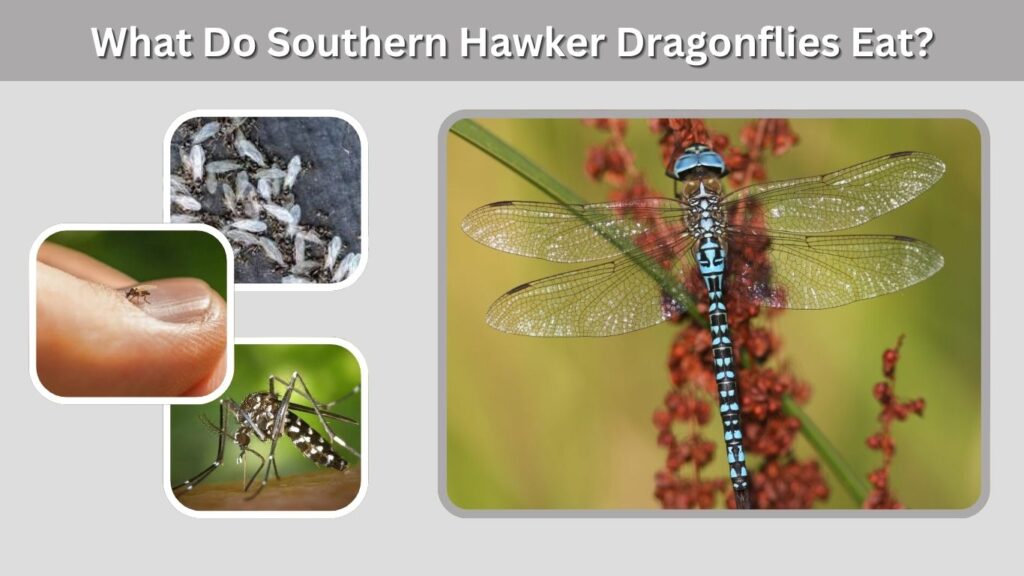
Southern hawkers are carnivorous throughout their lives. Adults hunt visually and catch flying insects using their legs, which form a basket beneath the body.
Adult Diet
Adult southern hawkers may eat:
- Mosquitoes
- Midges
- Gnats
- Flies
- Small moths
- Flying ants
- Other small dragonflies and damselflies
They patrol regular hunting routes and seize prey in midair. Small prey may be eaten during flight, while larger prey can be carried to vegetation. Their hunting behavior helps control populations of numerous flying insects.
Nymph Diet
Southern hawker nymphs are underwater predators. They use an extendable lower jaw to capture insect larvae, worms, small crustaceans, tadpoles, and occasionally newly hatched newts. The nymph may wait motionlessly among submerged vegetation before striking rapidly at passing prey.
Southern Hawker Nymph
The southern hawker’s aquatic juvenile stage is called a nymph or larva. It has a long, streamlined body and usually grows to approximately 38–48 mm before emergence.
Nymphs have six legs, developing wing pads, large eyes, and a hinged mouthpart called a labium. They remain underwater, where they hunt and molt repeatedly as they grow. Their greenish or brown coloration helps them blend into vegetation and pond debris.
Southern Hawker Life Cycle
The southern hawker undergoes incomplete metamorphosis and develops through three main stages: egg, nymph, and adult.
Oviposition and Eggs
After mating, the female lays eggs without the male remaining attached. She uses her ovipositor to insert eggs into soft materials near the water, including rotting vegetation, moss, mud, or decaying wood.
The female often bends her abdomen downward while ovipositing and may remain in one area for an extended period. Eggs deposited during summer or early autumn generally remain dormant through winter and hatch the following spring.
Aquatic Development
After hatching, the nymph lives underwater and passes through multiple molts. Development commonly lasts around two to three years, although temperature, food availability, and local conditions can affect the timing.
When fully developed, the nymph climbs out of the water onto a plant stem or another vertical surface. Its skin splits, allowing the adult dragonfly to emerge. The empty skin left behind is called an exuvia.
Adult Lifespan
Southern hawker adults may be observed in Britain from June through October, but this entire flight period represents successive individuals rather than the lifespan of one adult. The underwater nymph stage accounts for most of the insect’s total life, while the adult stage is mainly devoted to feeding, mating, and egg laying.
Southern Hawker Predators
Adult southern hawkers can be captured by birds, frogs, spiders, and larger dragonflies. Their excellent eyesight, speed, and ability to change direction help them escape many attacks.
Aquatic nymphs may be eaten by fish, newts, frogs, toads, water birds, larger aquatic insects, and other dragonfly nymphs. Young or newly emerged adults are particularly vulnerable because their bodies and wings require time to harden.
Does a Southern Hawker Dragonfly Bite?
Southern hawkers do not normally bite humans. They have no stinger, are not venomous, and do not feed on blood. Their jaws are designed for catching and chewing insect prey.
A dragonfly may attempt to bite when trapped or handled roughly, but such defensive contact is unlikely to cause serious injury. It does not actively chase people to attack them. Males sometimes approach and hover close to observers because the species is naturally inquisitive.
Southern Hawker vs. Southern Migrant Hawker
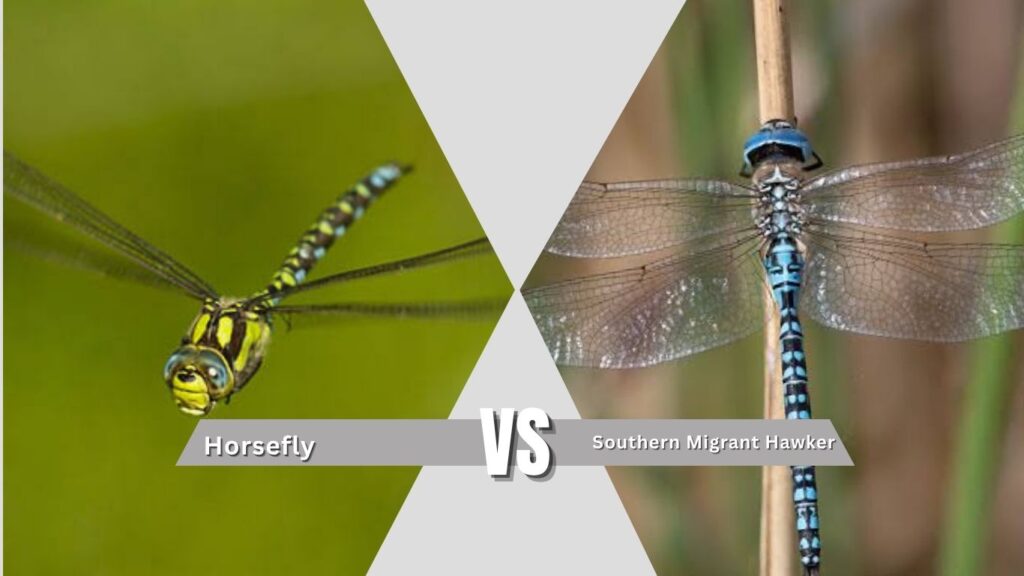
Despite their similar names, the southern hawker and southern migrant hawker are separate species.
| Feature | Southern Hawker | Southern Migrant Hawker |
| Scientific name | Aeshna cyanea | Aeshna affinis |
| Length | About 70 mm | About 60 mm |
| Male color | Green with blue near abdomen tip | Extensively bright blue |
| Thorax | Large colored stripes or patches | Mostly plain green or blue-green sides |
| UK status | Widespread in England and Wales | Localized recent colonist |
| Typical habitat | Ponds, lakes, canals, woodland | Shallow pools and reedy ditches |
Male southern migrant hawkers have bright blue eyes and much more extensive blue coloring. Southern hawkers are larger and show prominent shoulder stripes and green body markings.
FAQs
Are southern hawker dragonflies rare?
Southern hawkers are not considered rare across most of England and Wales. They are common around suitable ponds, canals, gardens, and woodland habitats. Their distribution is more localized in Scotland, although the species has gradually expanded northward.
Why do southern hawkers fly close to people?
They are naturally inquisitive and may approach moving objects within their territory. A male may hover near a person briefly before continuing its patrol. This is investigative behavior, not an attempt to attack or bite.
Do southern hawkers eat mosquitoes?
Yes. Adult southern hawkers catch mosquitoes, midges, flies, and other airborne insects. Their aquatic nymphs also consume insect larvae, including some mosquito larvae, making the species a beneficial freshwater predator.
How can you attract southern hawkers?
A wildlife-friendly garden pond with clean water, submerged plants, emergent stems, and vegetation around the edges may provide suitable breeding habitat. Avoid adding fish, which can consume dragonfly eggs and nymphs.
Where do female southern hawkers lay their eggs?
Females insert their eggs into damp or decaying material near water. Common sites include rotting vegetation, moss, soft mud, and decaying wood along the margins of ponds, canals, and other freshwater habitats.