
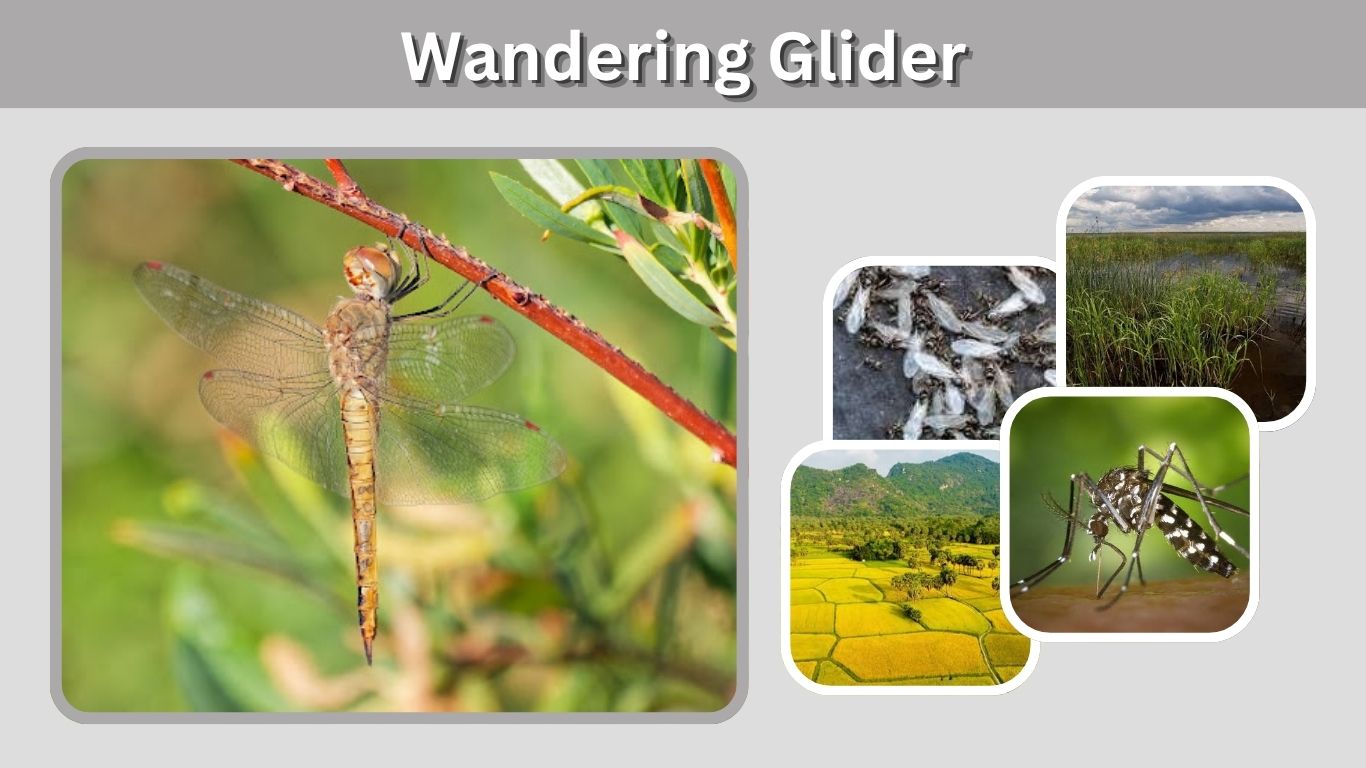
The wandering glider is an extraordinary dragonfly known for spending long periods in flight and migrating across continents and oceans. Its broad wings, lightweight body, and ability to use favorable winds allow it to travel farther than most insects. Also called the globe skimmer or globe wanderer, this golden-yellow dragonfly breeds rapidly in temporary rain pools and often appears in large groups after rainfall. Despite its impressive flying ability, it is harmless to humans and beneficial because it consumes mosquitoes and other small insects.
What Is a Wandering Glider?
The wandering glider’s scientific name is Pantala flavescens. It belongs to the skimmer family Libellulidae and is one of the most widely distributed dragonflies in the world. The species is also commonly called the globe skimmer because of its extensive movements across tropical and subtropical regions.
| Feature | Description |
| Scientific name | Pantala flavescens |
| Family | Libellulidae |
| Other names | Globe skimmer, globe wanderer |
| Main color | Yellow, golden brown, or orange |
| Diet | Small flying insects |
| Breeding habitat | Temporary pools, puddles, and wetlands |
| Main behavior | Long-distance migration and gliding |
| Danger to humans | Harmless |
Wandering Glider Identification
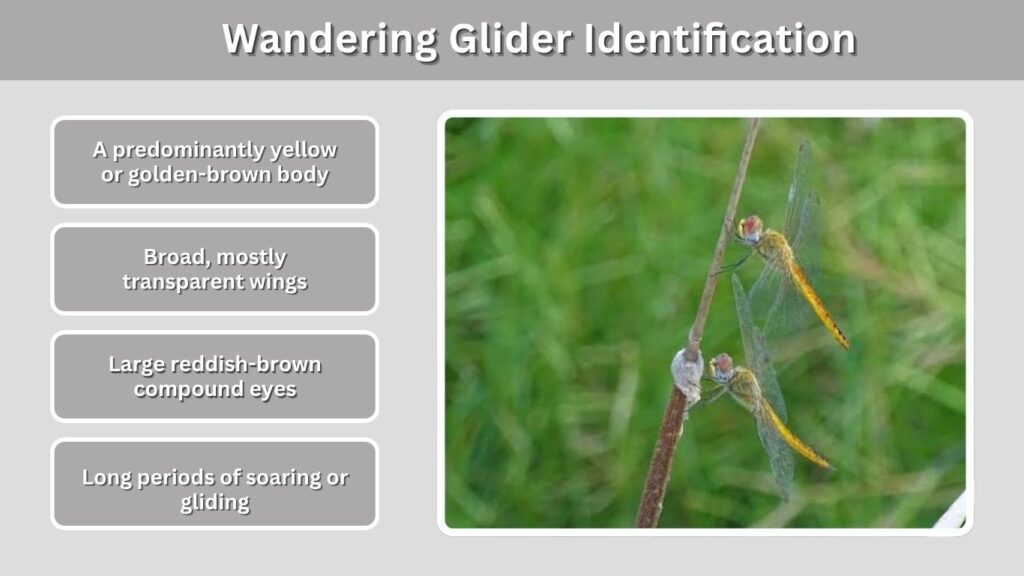
The wandering glider is usually golden yellow, orange-brown, or yellowish brown. It has a slender, tapering abdomen and broad wings that are well suited to extended gliding. A series of elongated dark markings runs along the upper center of the abdomen.
Key Identification Features
Look for the following characteristics:
- A predominantly yellow or golden-brown body
- A narrow abdomen that tapers toward the end
- Dark, diamond-shaped markings along the abdomen
- Broad, mostly transparent wings
- Small amber or brown marks near the wing tips
- Large reddish-brown compound eyes
- Long periods of soaring or gliding
- Frequent flight over open fields and temporary wetlands
The hindwings may show a small yellowish patch near their base, but the wandering glider lacks the large dark hindwing patches seen on the related Spot-winged Glider. Male and female wandering gliders look broadly similar, making sex identification difficult without a close view.
Male vs. Female Wandering Glider
Male and female wandering gliders have similar body shapes and colors. Both possess broad wings, reddish-brown eyes, yellowish abdomens, and dark central markings.
Male Wandering Glider
Males may appear brighter orange or reddish yellow, especially after reaching maturity. The abdomen is generally slender, and the reproductive appendages at its tip differ from those of the female.
Female Wandering Glider
Females are often slightly paler or more golden brown. They may have a marginally broader abdomen because they carry eggs. Measurements recorded in Bangladesh show little size difference between the sexes, with females having slightly longer wings in the reported specimens.
| Feature | Male | Female |
| General color | Yellow to orange-brown | Yellow to golden brown |
| Abdomen | Usually slimmer | May appear slightly broader |
| Wings | Broad and transparent | Broad and transparent |
| Behavior | Patrols and searches for mates | Searches for breeding water |
| Reliable identification | Reproductive structures | Reproductive structures |
Wandering Glider Habitat
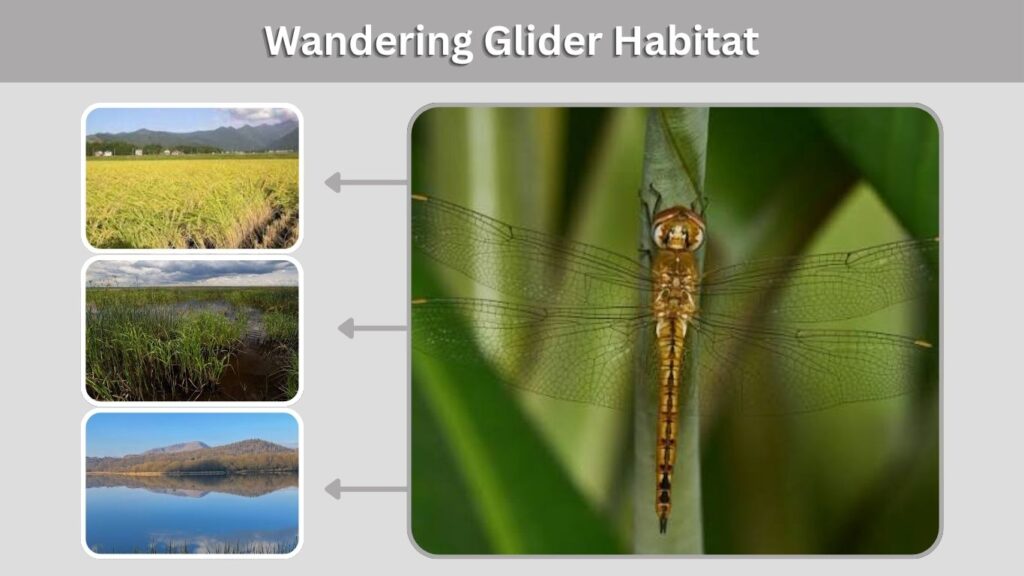
Wandering gliders use open environments such as grasslands, gardens, agricultural fields, urban areas, marshes, wetlands, and shallow rain-filled pools. Adults can travel far from water and are frequently observed flying over dry land.
Unlike dragonflies that require permanent lakes or streams, wandering gliders commonly breed in temporary water. Suitable sites include:
- Rain puddles
- Flooded fields
- Roadside pools
- Shallow marshes
- Rice fields
- Water-filled depressions
- Temporary construction-site pools
These habitats may contain fewer fish than permanent ponds, reducing predation on the developing nymphs. However, the water can disappear quickly, so rapid development is essential.
Wandering Glider Range
The wandering glider has an almost global distribution across warm regions. Its extensive range includes Africa, Asia, Australia, the Pacific islands, North and South America, and many oceanic islands. Genetic research indicates substantial movement and connectivity among populations separated by enormous distances.
In Singapore, the species is commonly seen over grasslands, urban parks, and gardens, sometimes forming swarms containing dozens or hundreds of individuals. In Bangladesh, it is recognized as a migratory dragonfly frequently observed flying over open fields and grasslands during the winter season.
Wandering Glider Migration
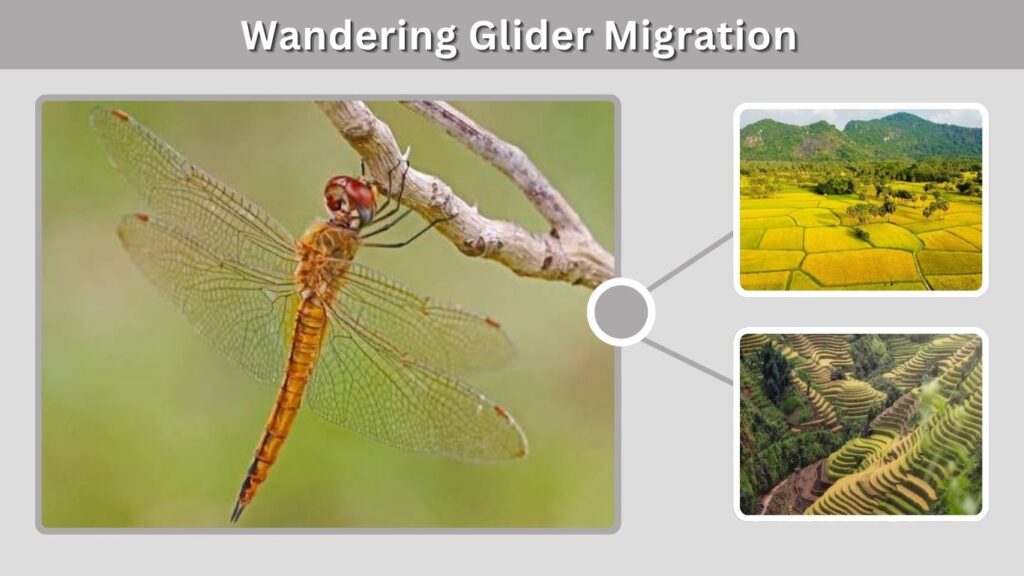
Migration is the wandering glider’s most remarkable behavior. Rather than remaining near one pond, populations follow seasonal rainfall and wind systems that lead them to temporary breeding pools.
Migration Across the Indian Ocean
Research suggests that wandering gliders participate in a multigenerational migration network between India and East Africa. Large numbers appear in the Maldives even though the islands lack suitable permanent freshwater for reproduction, indicating that many are passing through rather than breeding there.
The dragonflies may use monsoon winds and the movement of the Intertropical Convergence Zone to cross long stretches of ocean. Proposed routes include journeys from southern India toward the Maldives, Seychelles, and East Africa, with later generations participating in return movements.
Does It Migrate During the Day or Night?
Wandering gliders are primarily daytime flyers. They rely on sunlight for hunting and visual navigation, but migration timing can also be influenced by weather, wind direction, temperature, and rainfall. Some long water crossings may continue for extended periods when favorable tailwinds help carry the insects forward.
The complete migration is multigenerational. One individual does not necessarily finish the entire circular route; successive generations breed and continue the movement as seasonal conditions change. Studies suggest that the broader Afro-Asian migration system may cover more than 14,000 kilometres.
Why Is the Wandering Glider Such a Strong Flyer?
The wandering glider has broad wings and a relatively light body, creating a low wing-loading design that supports efficient soaring. Rather than constantly beating its wings, it can glide and use supportive winds to conserve energy.
Research comparing individuals from India and the Maldives found that successful migrants reaching the islands had wing characteristics associated with efficient long-distance flight, including broader wing bases and more slender overall wing shapes.
What Do Wandering Gliders Eat?
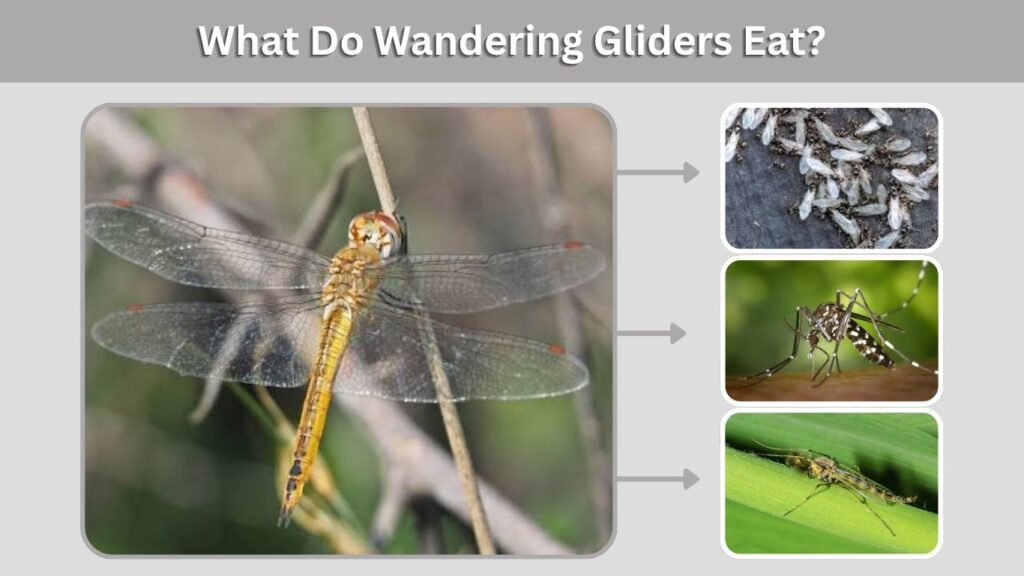
Adult wandering gliders are aerial predators. They catch small insects during flight using their legs and consume the prey while continuing to fly or after landing.
Their food may include:
- Mosquitoes
- Midges
- Gnats
- Small flies
- Flying ants
- Termites
- Other small airborne insects
The aquatic nymphs also hunt mosquito larvae, small crustaceans, and other aquatic organisms. Because both life stages consume insects, wandering gliders can contribute to the natural control of mosquito and pest populations.
Life Cycle and Lifespan
The wandering glider undergoes incomplete metamorphosis, progressing through the egg, aquatic nymph, and adult stages.
Eggs and Nymphs
Females deposit eggs in shallow temporary water, often following rainfall. The eggs hatch into aquatic nymphs that hunt small animals and molt repeatedly while growing.
Because their pools may dry quickly, wandering glider nymphs develop unusually fast. Research reports that larval development can sometimes be completed in approximately 38 to 65 days, allowing young dragonflies to emerge before the water disappears.
Adult Lifespan
The precise lifespan varies with climate, migration demands, food supply, and seasonal conditions. Adults generally survive long enough to migrate, mature, reproduce, and establish the next generation. In seasonal regions, populations may arrive during warmer months, increase through summer, and decline when cold weather begins.
Are Wandering Gliders Dangerous?
Wandering gliders are not dangerous to humans. They have no stinger, are not venomous, and do not feed on blood. Their strong jaws are used to capture small insects.
A dragonfly might attempt to bite if it is trapped or handled roughly, but it does not deliberately attack people. It is best to observe wandering gliders without grabbing their bodies or delicate wings.
Wandering Glider Meaning
Dragonflies are often associated symbolically with change, endurance, freedom, and adaptability. The wandering glider’s exceptional migration may also represent:
- Persistence through difficult journeys
- Adapting to changing circumstances
- Freedom and exploration
- Trusting the direction of change
- Strength despite a delicate appearance
These are cultural and personal interpretations rather than scientifically established meanings.
FAQs
Why is it called a wandering glider?
The name refers to its habit of wandering over enormous areas and spending long periods gliding through the air. Unlike dragonflies that remain close to a particular pond, this species follows rainfall, temporary pools, and favorable winds across regions and oceans.
Is the wandering glider the same as the globe skimmer?
Yes. Wandering glider, globe skimmer, and globe wanderer are common names for Pantala flavescens. The names emphasize its global distribution, powerful flight, and long-distance migratory behavior.
How far can a wandering glider migrate?
Proposed Indian Ocean routes include crossings of several thousand kilometres, while the entire multigenerational Afro-Asian migration network may exceed 14,000 kilometres. Wind assistance is essential during the longest ocean crossings.
Where do wandering gliders lay eggs?
Females usually lay eggs in shallow temporary water created by rainfall. Puddles, flooded fields, marshes, rice fields, and water-filled depressions can provide suitable breeding sites.
Are wandering gliders beneficial?
Yes. Adults catch mosquitoes, gnats, flies, and other small insects, while aquatic nymphs consume mosquito larvae and small aquatic animals. They are also part of the food web for birds, fish, frogs, and larger insects.