
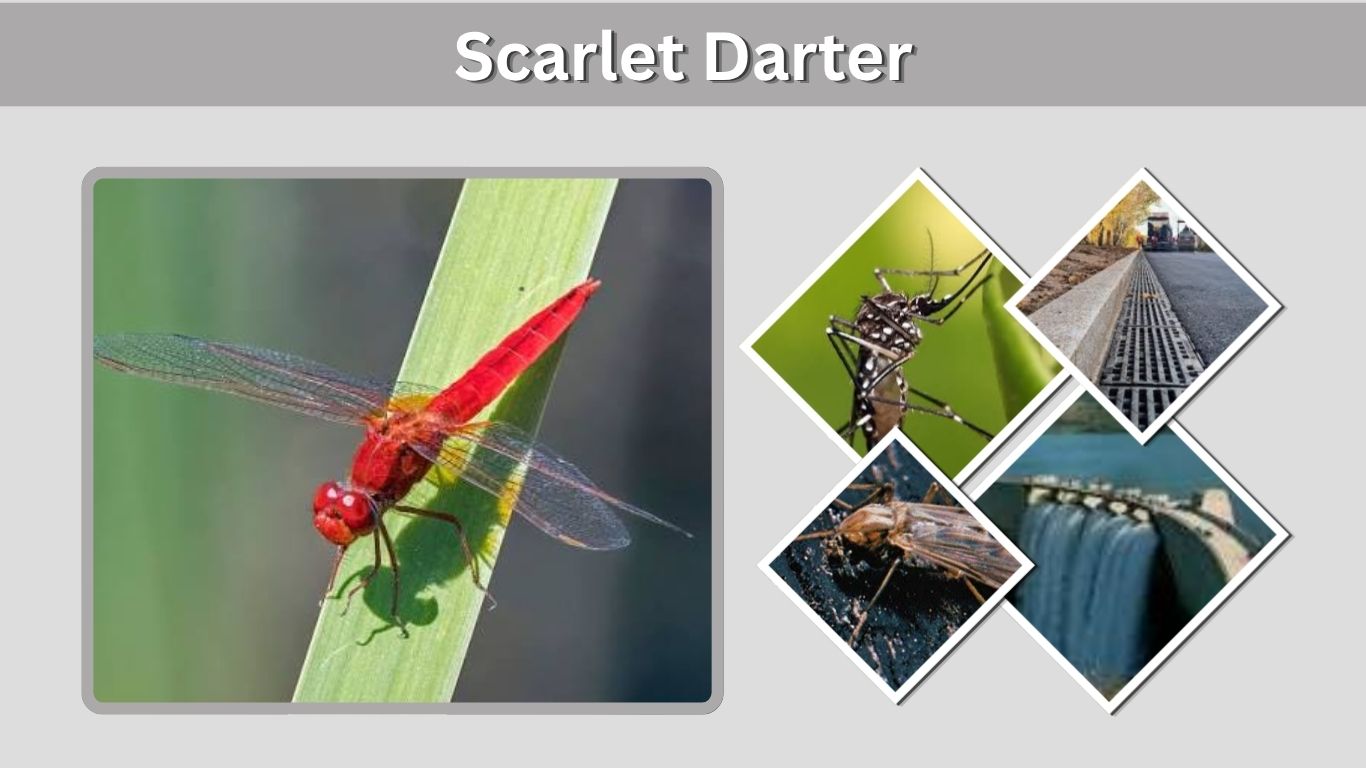
The scarlet darter is a striking dragonfly best known for the brilliant red coloration of mature males. Scientifically named Crocothemis erythraea, it is also called the broad scarlet or scarlet dragonfly. The species is widespread across Africa, southern Europe, the Middle East, and parts of western Asia. It favors warm, sunny wetlands and is gradually expanding farther north in Europe.
Scarlet Darter Quick Facts
The scarlet darter belongs to the skimmer family, Libellulidae. Although its intense color attracts the most attention, its broad, flattened abdomen is equally important for identification.
| Feature | Description |
| Scientific name | Crocothemis erythraea |
| Family | Libellulidae |
| Order | Odonata |
| Other names | Broad scarlet and scarlet dragonfly |
| Body length | Up to approximately 44 mm |
| Wingspan | Up to approximately 71 mm |
| Male color | Bright scarlet red |
| Female color | Yellow, golden-brown, or brown |
| Preferred habitat | Warm, shallow, still water |
| Adult diet | Small flying insects |
| Conservation status | Least Concern |
The species is considered adaptable, widespread, and globally of relatively low conservation concern. Its ability to use both natural and artificial water bodies has helped it occupy a broad geographic range.
How to Identify a Scarlet Darter
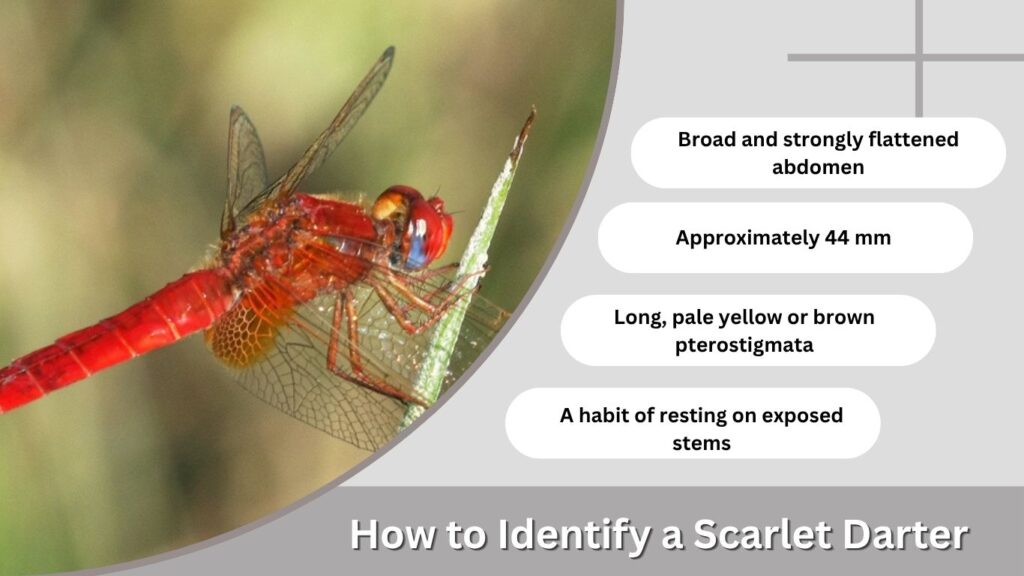
Scarlet darters are small to medium-sized dragonflies with robust bodies. Their abdomen is noticeably broad and flattened, giving them a heavier appearance than many true darters in the genus Sympetrum.
Key Identification Features
- Broad and strongly flattened abdomen
- Body length reaching approximately 44 mm
- Clear wings with colored patches near the hindwing bases
- Long, pale yellow or brown pterostigmata
- Pale blue or violet coloring on the lower rear portion of the eyes
- Legs that appear yellowish in females and reddish in mature males
- A habit of resting on exposed stems, twigs, rocks, or bare ground
The combination of a broad abdomen, amber hindwing patches, pale pterostigmata, and extensive body coloration helps separate this species from other red dragonflies.
Why Is It Called the Broad Scarlet?
“Broad scarlet” describes its two most noticeable characteristics. Mature males are intensely scarlet, while the abdomen is broader and flatter than that of many similar dragonflies. The name scarlet darter is commonly used in Britain, while broad scarlet is widely used in Africa and some field guides.
Male and Female Scarlet Darters
Scarlet darters display strong sexual dimorphism, meaning mature males and females can look noticeably different. Immature males initially resemble females before developing their characteristic red coloration.
Male Scarlet Darter
A mature male is almost entirely scarlet red. The face, eyes, thorax, abdomen, legs, and major veins along the front of the wings may all develop red coloring. Small amber or orange patches are visible at the bases of the hindwings.
The male’s abdomen is broadest near the base before gradually narrowing toward the tip. Unlike some red darters, it normally lacks prominent black markings along the upper surface of the abdomen.
Female Scarlet Darter
Females are usually yellow, ochre, or golden-brown. A noticeable pale stripe runs along the top of the thorax, while a thin dark line may extend along the abdomen. Older females can become considerably darker.
Their hindwing bases contain yellow or amber patches rather than the reddish patches seen in mature males. Females and newly emerged males can look similar, so close examination may be needed to determine the sex of an immature individual.
Scarlet Darter Habitat
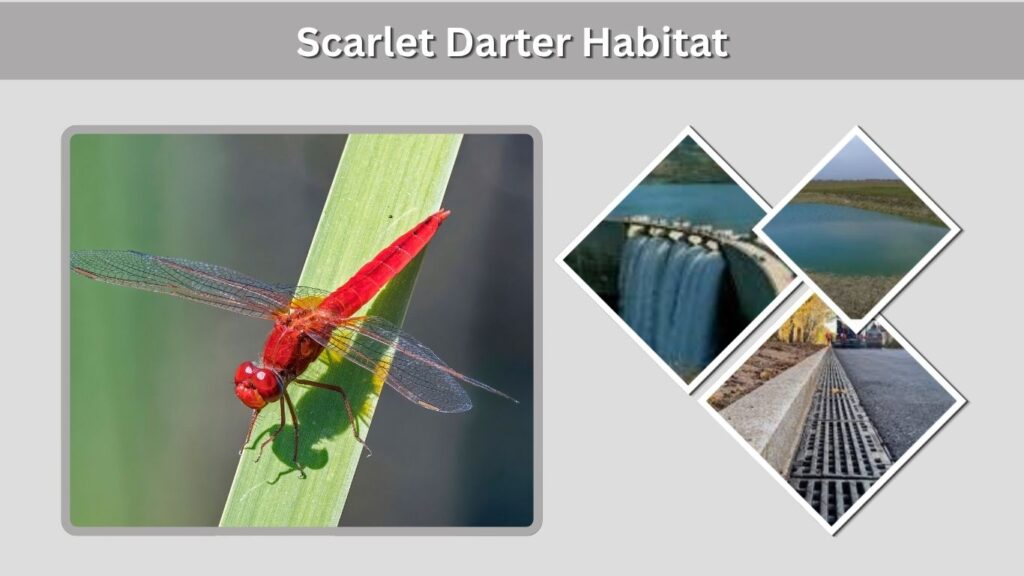
Scarlet darters prefer open, sunny locations containing warm water. They avoid heavily shaded habitats and are most abundant where there are exposed banks, low vegetation, and convenient perching sites.
Preferred Aquatic Habitats
The species may occur around:
- Shallow ponds
- Marshes and seasonal pools
- Lakes with grassy margins
- Rice paddies
- Drainage channels
- Reservoirs and dams
- Slow river sections
- Ornamental garden ponds
- Occasionally, neglected swimming pools
Still water is generally preferred, although scarlet darters can use slow-flowing streams, river backwaters, and sheltered channels. Their tolerance of artificial and temporary habitats contributes to their success in warm regions.
Distribution of the Scarlet Darter
The scarlet darter has an extensive range covering most of Africa, southern Europe, the Middle East, and parts of western Asia. It occurs from coastal lowlands to elevations of approximately 1,600 metres in some regions.
Scarlet Darters in Europe
The species was historically associated with Africa and Mediterranean Europe. However, it has expanded northward over recent decades and has established populations in countries including Germany, Belgium, and the Netherlands. Scientific research identifies it as a notable example of a dragonfly extending its European range as temperatures change.
Scarlet Darter in the UK
The first confirmed British scarlet darter was recorded in Cornwall in 1995. It remains a rare migrant, with most records occurring in southern England.
A significant event occurred in Dorset in 2024, when at least six males and one female were documented at the same site. Egg-laying was observed on several days. These were the first accepted British records involving multiple individuals and a confirmed female, although an established breeding population had not yet been conclusively demonstrated.
Scarlet Darter Diet and Hunting Behavior

Adult scarlet darters are aerial predators that feed on small flying insects. Their prey may include mosquitoes, midges, gnats, small flies, and other insects captured above vegetation or water.
How Scarlet Darters Hunt
A scarlet darter usually selects an exposed perch from which it can watch the surrounding area. When an insect passes, the dragonfly quickly launches into the air, captures its prey, and often returns to the same perch.
Males also use these elevated positions to watch for females and competing males. They can be highly territorial, repeatedly chasing other dragonflies away from favored sections of shoreline.
Scarlet darters do not sting and are not dangerous to people. Like other dragonflies, they provide useful natural insect control by consuming numerous small flying insects.
Mating and Reproduction
Mating begins when a male intercepts a receptive female and grasps her behind the head with appendages at the end of his abdomen. The pair forms the characteristic wheel-shaped mating position seen in dragonflies.
Egg-Laying Behavior
After mating, the female flies low over the water. She repeatedly touches the surface with the end of her abdomen, releasing eggs into shallow areas containing algae, submerged vegetation, or soft sediment.
Male scarlet darters may fly nearby during egg-laying without remaining physically attached to the female. This behavior can help prevent rival males from approaching her. Research on the species has examined this non-contact guarding and the way females distribute eggs within suitable water.
Scarlet Darter Larvae and Life Cycle
The eggs hatch into aquatic larvae, also called nymphs. These larvae live among submerged plants, bottom sediment, and organic debris, where they hunt small aquatic animals.
Scarlet darter larvae are compact predators equipped with an extendable lower jaw for capturing prey. Their food may include mosquito larvae, aquatic insects, tiny crustaceans, and other suitably sized organisms.
Development into an Adult
Larval development can be relatively rapid, particularly in warm or temporary water. One recent study recorded 11 larval stages and a total egg-to-late-larval development period of approximately 81–104 days under the conditions examined. Development time in nature varies with temperature, food, habitat stability, and region.
When fully developed, the larva climbs out of the water onto a stem or other support. Its skin splits, and the adult slowly emerges. The abandoned larval skin is known as an exuvia. The new adult remains nearby until its body and wings have hardened enough for flight.
Scarlet Darter vs Similar Dragonflies
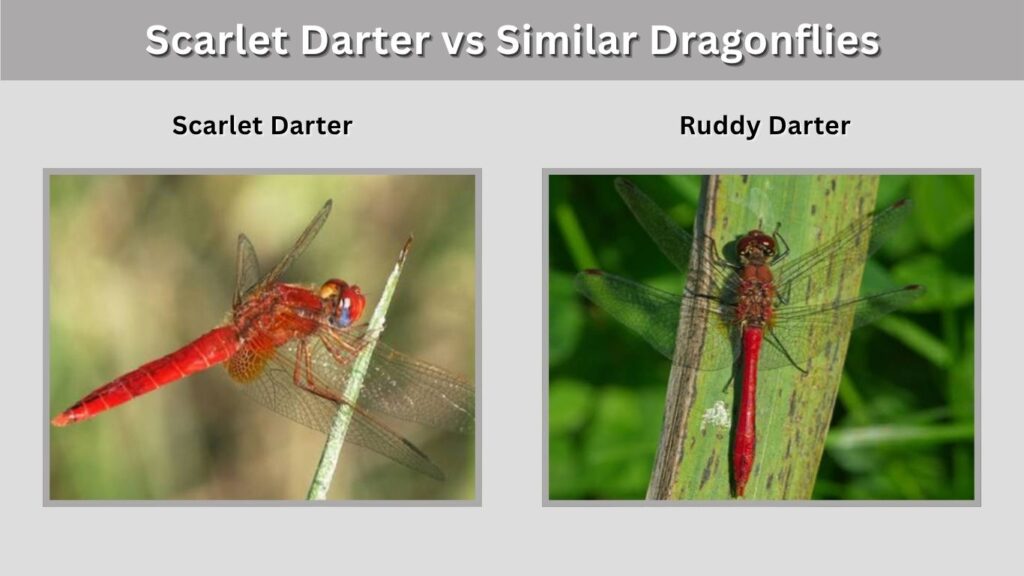
Several red dragonflies can be mistaken for a scarlet darter, particularly when viewed from a distance.
Scarlet Darter vs Ruddy Darter
The ruddy darter has a slimmer abdomen with a noticeable constriction near the front. Its legs are completely black, while the scarlet darter has a much broader abdomen and extensive red coloring on the mature male’s legs, face, and thorax.
Scarlet Darter vs Red-Veined Darter
The red-veined darter has a narrower body and generally shows blue-gray coloring on the lower eyes. Yellow markings may remain visible along the sides of the abdomen. The scarlet darter is broader and more uniformly red when mature.
Scarlet Darter vs Oriental Scarlet
The Oriental scarlet, Crocothemis servilia, is an Asian species that has been introduced to some other regions. It usually displays a strong dark line down the upper abdomen, whereas a mature male scarlet darter generally has a cleaner, more uniformly red back.
FAQs
Is a scarlet darter a dragonfly?
Yes. The scarlet darter is a true dragonfly in the family Libellulidae. Its scientific name is Crocothemis erythraea. It is also widely known as the broad scarlet or scarlet dragonfly.
Are scarlet darters rare?
They are widespread and common across much of Africa and parts of southern Europe and Asia. However, they remain rare migrants in Britain, where sightings have primarily occurred in southern England.
Do female scarlet darters turn red?
Most females remain yellowish or brown, but some can darken considerably with age. Rare male-colored females have also been documented, so body color should be considered together with reproductive structures when determining sex.
When are scarlet darters active?
The flight season depends on climate. Adults may be active for much of the year in warm tropical regions. In northern parts of their range, they are mainly observed during the warmer summer months.
Can scarlet darters bite people?
Scarlet darters are not aggressive toward humans and do not sting. A captured dragonfly might attempt to bite defensively, but it poses no meaningful danger when left undisturbed.