
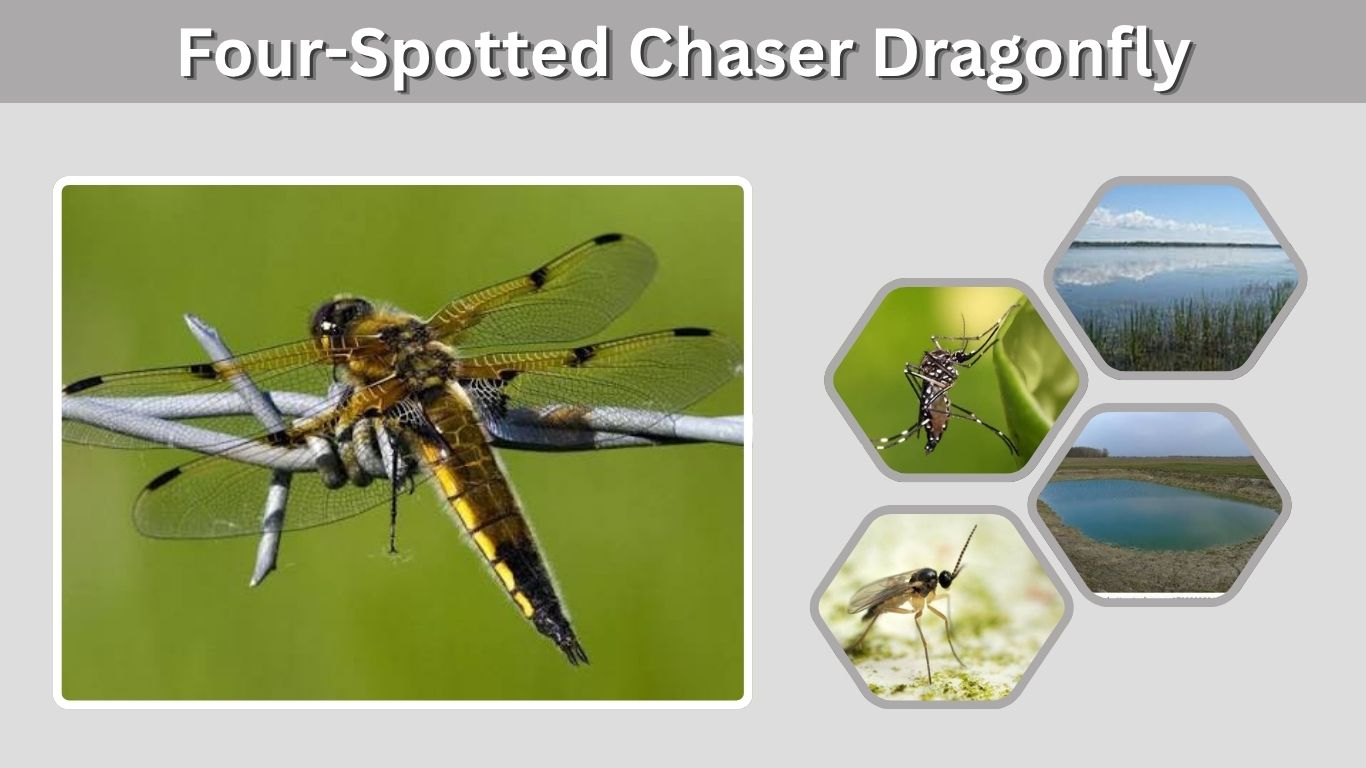
The four-spotted chaser dragonfly is a medium-sized, brown dragonfly recognized by the distinctive dark marking near the middle of each wing. Its scientific name is Libellula quadrimaculata. It is widespread across much of the Northern Hemisphere and is commonly seen around shallow ponds, lakes, bog pools, and wetlands. Both males and females look remarkably similar, making the species unusual among chaser dragonflies. This guide explains its size, identification, habitat, behavior, larvae, exuviae, male and female differences, and rare praenubila form.
Four-Spotted Chaser Quick Facts
The species is called the four-spotted chaser in Europe and the four-spotted skimmer in North America. Its name refers to the four additional dark spots positioned midway along the leading edges of its wings.
| Feature | Description |
| Scientific name | Libellula quadrimaculata |
| Family | Libellulidae |
| Order | Odonata |
| Adult length | Approximately 39–48 mm |
| Main color | Golden-brown to dark brown |
| Habitat | Ponds, lakes, bog pools and wetlands |
| UK flight season | Mainly late spring through summer |
| Diet | Small flying insects |
| Larval habitat | Underwater vegetation and debris |
| Similar species | Broad-bodied chaser and black-tailed skimmer |
The accepted scientific name is Libellula quadrimaculata Linnaeus, 1758. It belongs to the dragonfly family Libellulidae and the genus Libellula.
Four-Spotted Chaser Identification
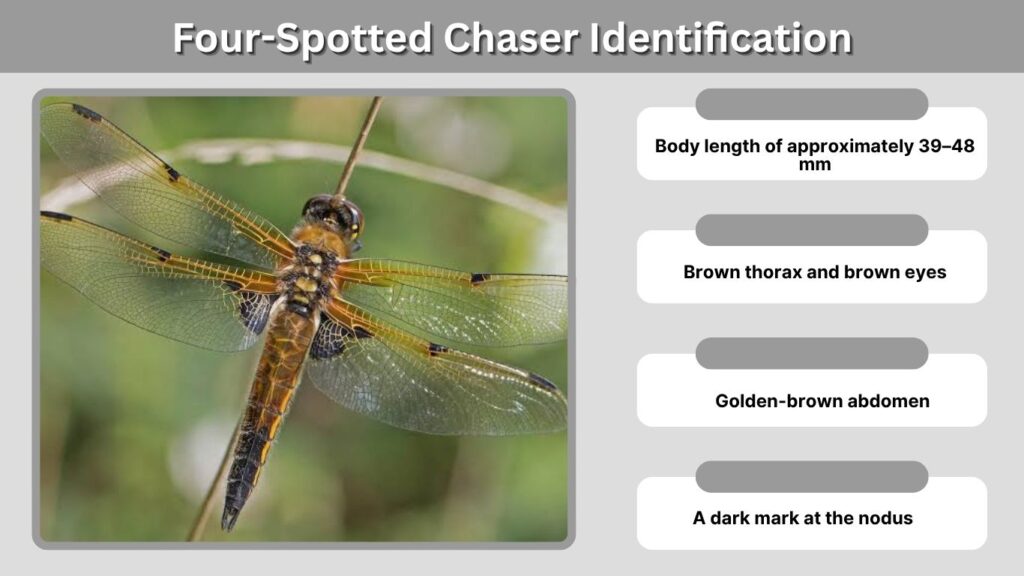
A four-spotted chaser has a strong, compact body and relatively broad wings. The abdomen begins golden or yellowish brown and gradually becomes darker toward the tip. Yellow markings may remain visible along the sides of several abdominal segments.
Key Identification Features
- Body length of approximately 39–48 mm
- Brown thorax and brown eyes
- Golden-brown abdomen that darkens toward the tip
- Yellow markings along the sides of the abdomen
- Amber or yellow coloring at the bases of the wings
- A dark mark at the nodus, or midpoint, of every wing
- Dark pterostigma near the outer edge of every wing
- Dark patches at the bases of the hindwings
The most dependable feature is the small dark mark halfway along the leading edge of each wing. Other chasers possess pterostigmata near their wingtips, but the four-spotted chaser also has these four additional central wing spots.
Why Does It Appear to Have More Than Four Spots?
The name can be confusing because the dragonfly appears to have eight or more dark markings. The “four spots” specifically refer to the additional marks at the nodus of its four wings. The dark pterostigmata near the wingtips are normal structures found in many dragonflies and are not counted in the common name.
Four-Spotted Chaser Male or Female
Male and female four-spotted chasers are unusually similar. Both have brown bodies, yellow side markings and the same characteristic wing spots. Unlike mature males of several related chaser species, male four-spotted chasers do not develop a bright blue abdomen.
Male Four-Spotted Chaser
A mature male generally becomes darker with age. The rear of the abdomen can appear nearly black, while the brown and yellow markings become less vivid. Males frequently occupy exposed perches beside water and repeatedly return to the same stem, reed or twig.
Territorial males launch rapid flights from their perches to catch prey, challenge rival dragonflies or investigate passing females. They may aggressively defend a small section of shoreline or open water.
Female Four-Spotted Chaser
Females typically retain a warmer golden-brown appearance, although color alone is not always dependable. Their abdomens may also be slightly broader, particularly when carrying eggs.
After mating, the female flies low over the water and releases eggs while touching or flicking the surface with the end of her abdomen. A male may remain nearby and guard her against other males.
How Can You Tell Them Apart?
Close inspection of the reproductive structures near the end or underside of the abdomen provides the most reliable distinction. From an ordinary photograph, however, sexing the dragonfly may be difficult. Color should be treated only as a supporting clue because age, lighting and individual variation can alter its appearance.
Four-Spotted Chaser Habitat and Distribution
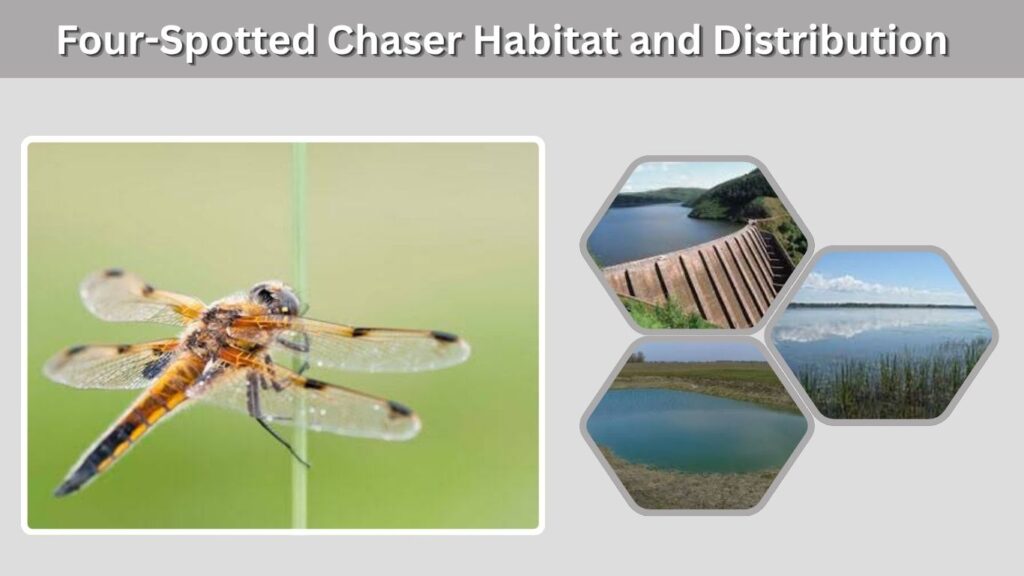
The four-spotted chaser has a broad circumpolar distribution. It occurs across parts of Europe, Asia and North America, where it is often called the four-spotted skimmer.
Four-Spotted Chaser in the UK
The species is common throughout most of Britain and has increased its occupied range since the 1990s. It is also widespread in Ireland, especially around sheltered lowland ponds and lakes. Populations can additionally occur in acidic bog pools and sheltered upland waters.
Adults are most likely to be found around:
- Shallow ponds
- Sheltered lakes
- Heathland pools
- Acidic bogs
- Marshes and wetlands
- Slow canals and drainage pools
- Grasslands near breeding water
Suitable breeding sites normally contain open water together with emergent plants. Reeds, rushes and other upright vegetation provide hunting perches and supports from which newly transformed adults can emerge.
Four-Spotted Chaser Diet and Hunting Behavior
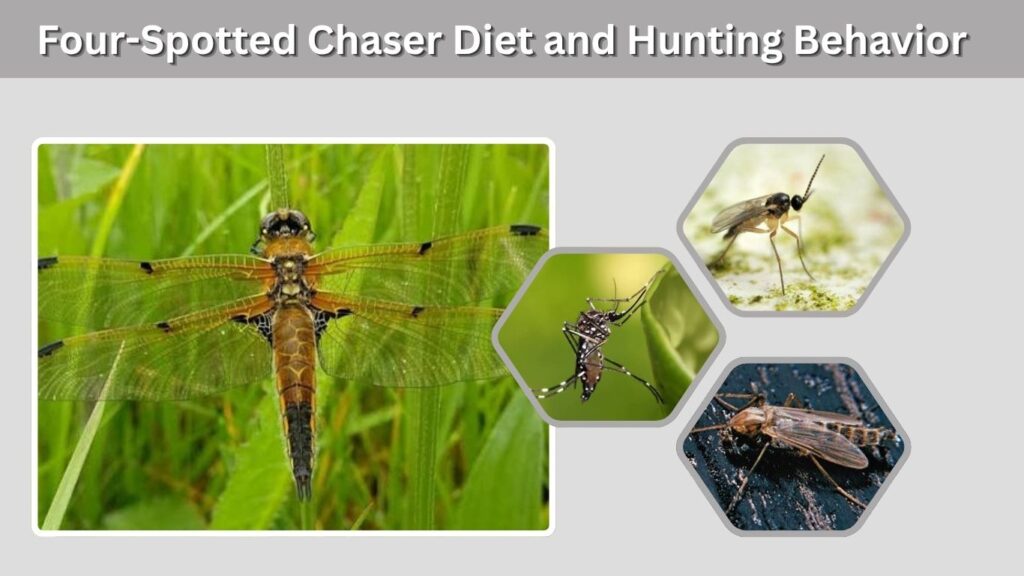
Adult four-spotted chasers are aerial predators. They capture mosquitoes, midges, gnats, flies and other small flying insects. Occasionally, a large individual may catch another small dragonfly.
The dragonfly often hunts from a prominent perch. It watches the surrounding air, suddenly darts outward to seize prey and then returns to the same or a nearby perch. This repeated “chasing” behavior helps explain the European common name.
Although territorial, four-spotted chasers are harmless to people. They do not sting, and they are not aggressive toward humans. Their presence can benefit wetland ecosystems because both adults and larvae consume numerous smaller organisms.
Four-Spotted Chaser Larvae
The immature aquatic stage is more accurately called a larva or nymph. It looks very different from the slender adult and spends its development underwater.
Larval Identification
Four-spotted chaser larvae have compact, squat bodies that may look somewhat spider-like. They possess a broad head, outward-facing eyes and strong legs for moving through vegetation and bottom debris. Mature larvae generally measure approximately 18–28 mm.
One useful identification feature is the absence of a dorsal spine on the ninth abdominal segment. However, distinguishing dragonfly larvae usually requires close examination and comparison with a specialist identification guide.
Larval Habitat and Diet
The larvae live among submerged plants, moss, decaying leaves and sediment in still or slowly moving water. They are ambush predators that feed on aquatic insect larvae, tiny crustaceans, worms and other small animals. Larger larvae may occasionally capture tadpoles.
Development normally takes around two to three years, although local temperature, food availability and water conditions can affect the timing.
Four-Spotted Chaser Exuvia
An exuvia is the empty larval skin left behind when the adult dragonfly emerges. Finding one attached to a reed or other waterside plant provides strong evidence that the species successfully bred at that location.
When development is complete, the mature larva moves into shallow water and begins breathing air. It then climbs an emergent plant, secures its legs and splits the skin along the back. The adult slowly pulls itself free, expands its wings and allows its new body to harden.
Four-spotted chaser exuviae are generally found on vegetation close to the water. They are squat and robust, with a broad head and relatively short abdomen. Because related chaser exuviae can look similar, features such as abdominal spines, body proportions and the shape of the mask should be examined carefully.
The Four-Spotted Chaser Praenubila Form
Praenubila is a distinctive color form rather than a separate species. Individuals displaying this variation have much larger and darker patches around the central wing spots. The markings may spread across a substantial portion of each wing, giving the dragonfly a dramatically different appearance.
Despite its unusually dark wings, a praenubila individual retains the same body shape, brown coloration and basic arrangement of diagnostic markings as a typical four-spotted chaser. The British Dragonfly Society describes this form as rare and notes that the central wing marks are greatly exaggerated.
Similar Dragonflies
The four-spotted chaser may be confused with female or immature broad-bodied chasers and black-tailed skimmers.
The broad-bodied chaser has a noticeably wider, flatter abdomen and large dark patches at the bases of all four wings. Mature males eventually become blue.
The black-tailed skimmer has a more slender body and lacks dark spots at the midpoint of the wings. Females and immature males usually show two dark longitudinal lines along a yellow abdomen.
Checking for the four dark nodal spots is therefore the quickest way to confirm a four-spotted chaser.
FAQs
Is the four-spotted chaser a butterfly?
No. It is a dragonfly belonging to the order Odonata and family Libellulidae. The phrase “four-spotted chaser butterfly” is a mistaken name. Dragonflies have large eyes, long abdomens and two pairs of independently controlled wings.
Is the four-spotted chaser rare in the UK?
It is not generally considered rare. The species is common across most of Britain, although its abundance varies according to habitat quality and region. Shallow, vegetated ponds and lakes provide some of the best places to find it.
When can four-spotted chasers be seen?
Adults are mainly active from late spring through summer. In Britain, sightings generally begin during May and continue into August, although weather and geographical location can cause the flight period to start earlier or finish later.
Do four-spotted chaser dragonflies bite?
They can use their mouthparts to defend themselves when roughly handled, but they do not normally bite people. They have no sting and pose no danger when observed around ponds, gardens or wetlands.
What is the four-spotted chaser’s scientific name?
Its scientific name is Libellula quadrimaculata. The species was formally described by Carl Linnaeus in 1758. In North America, it is commonly known as the four-spotted skimmer or four-spot pond skimmer.