
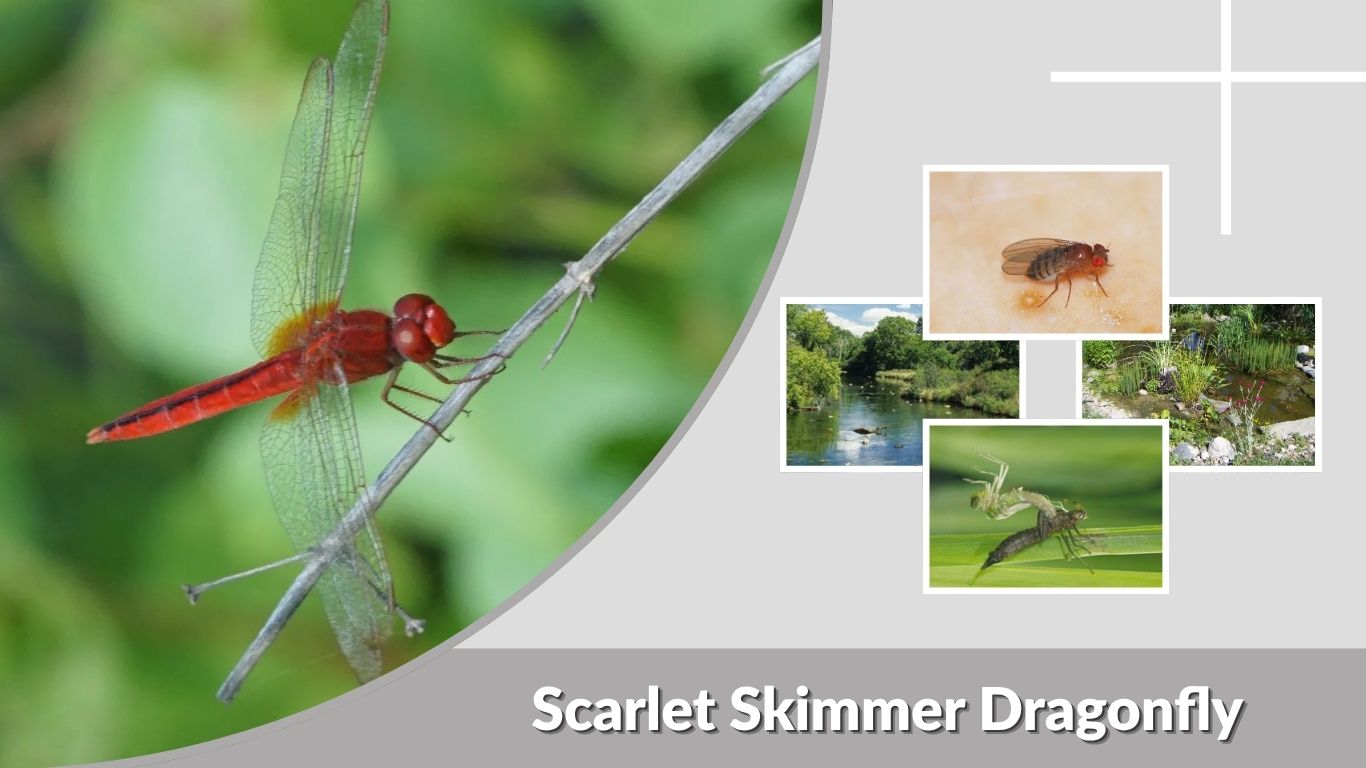
The Scarlet Skimmer (Crocothemis servilia) is a medium-sized dragonfly known for the brilliant red coloring of mature males. Females and immature males look very different, displaying yellowish-brown or light brown bodies instead of scarlet. Native across warm parts of Asia, the species is common in India and Singapore and has also become established in southern Florida. It favors sunny ponds, canals, marshes, and other open areas with still or slow-moving water.
Scarlet Skimmer Overview
The Scarlet Skimmer belongs to the order Odonata, suborder Anisoptera, and skimmer family Libellulidae. Its accepted scientific name is Crocothemis servilia, although it may also be called the Oriental Scarlet or Common Scarlet in parts of its native range.
| Feature | Description |
| Scientific name | Crocothemis servilia |
| Family | Libellulidae |
| Order | Odonata |
| Male color | Bright scarlet or crimson red |
| Female color | Yellowish-brown or light brown |
| Main habitat | Sunny ponds, canals, marshes, and grassy wetlands |
| Native range | Warm regions of Asia |
| Florida status | Introduced and established |
| Adult diet | Flying insects |
| Young stage | Aquatic nymph |
| Danger to humans | Harmless unless roughly handled |
What Does a Scarlet Skimmer Look Like?
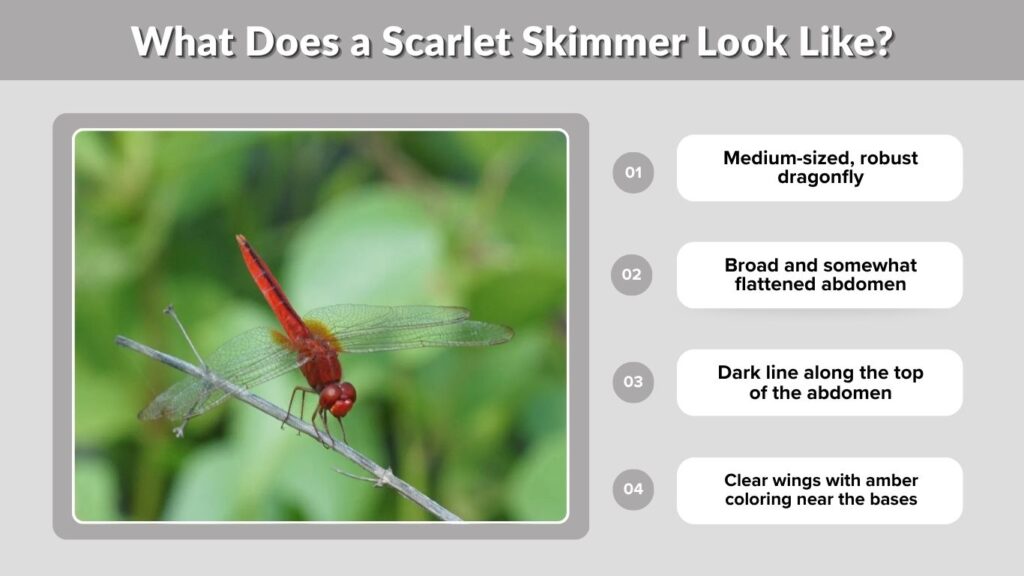
Scarlet Skimmers have broad hindwings, large compound eyes, a sturdy thorax, and a relatively wide abdomen. One of their most useful identification features is the dark line running lengthwise along the upper surface of the abdomen. A small amber or brownish-yellow patch is also present near the base of the hindwings.
Identification Features
- Medium-sized, robust dragonfly
- Broad and somewhat flattened abdomen
- Dark line along the top of the abdomen
- Clear wings with amber coloring near the bases
- Large compound eyes
- Strong legs adapted for catching flying prey
- Habit of resting on exposed plant tips near water
The dark abdominal line helps separate the Scarlet Skimmer from several other red dragonflies, including species whose abdomens appear almost completely red.
Male Scarlet Skimmer
A mature male is red from the face and eyes to the end of the abdomen. Its thorax, legs, and abdomen may appear scarlet, crimson, or orange-red depending on sunlight and age. The black line along the top of the abdomen normally remains visible despite the bright body color.
Males frequently rest on the tip of a reed or another emergent plant. From this elevated perch, they watch for prey, females, and competing males. A territorial individual may repeatedly fly out to chase another dragonfly before returning to the same perch.
Female Scarlet Skimmer
The female Scarlet Skimmer is usually light brown, golden-brown, yellowish, or olive-brown. Her wings are mostly clear, although an amber patch may be visible near the base of each hindwing. The dark dorsal line along the abdomen is normally more noticeable against her lighter body.
Female Scarlet Skimmers are sometimes misidentified because they do not match the bright-red appearance suggested by the species’ name. An immature male may also resemble a female before gradually developing its mature scarlet coloring.
Scarlet Skimmer Range and Distribution
The natural distribution of Crocothemis servilia extends from the Middle East through tropical and subtropical Asia to New Guinea. It occurs across countries such as India, Sri Lanka, China, Japan, Thailand, Malaysia, Indonesia, and Singapore, although its local abundance varies according to habitat.
Scarlet Skimmer in India
The Scarlet Skimmer is widely associated with warm, open freshwater habitats in India. It may be observed around village ponds, irrigation canals, rice fields, urban lakes, reservoirs, marshes, and temporary pools. Its ability to tolerate disturbed environments allows it to live close to farms, towns, and gardens.
India’s warm climate and extensive network of natural and artificial water bodies provide suitable breeding areas. Mature males are particularly easy to notice because they perch openly in bright sunlight.
Scarlet Skimmer in Singapore
In Singapore, the species is commonly called the Common Scarlet. The National Parks Board describes it as a common native dragonfly found in disturbed open habitats and grassy water bodies containing still water. It is also regularly recorded in parks and gardens.
Singapore’s official description emphasizes the bright-red male, light-brown female, and dark abdominal line shared by both sexes. Males are frequently seen guarding sunny territories from the tips of emergent plants.
Scarlet Skimmer in Florida
The Scarlet Skimmer is not native to Florida. An Asian population became established in southern Florida during the 1970s, representing one of the best-known successful introductions of a dragonfly to the continental United States. Early records linked its establishment with the highly disturbed aquatic habitats of southeastern Florida.
It is now encountered around canals, ponds, drainage systems, and urban wetlands in southern parts of the state. The species may have arrived as eggs or aquatic nymphs transported with aquarium plants, although the exact pathway has not been conclusively established.
Scarlet Skimmer Habitat
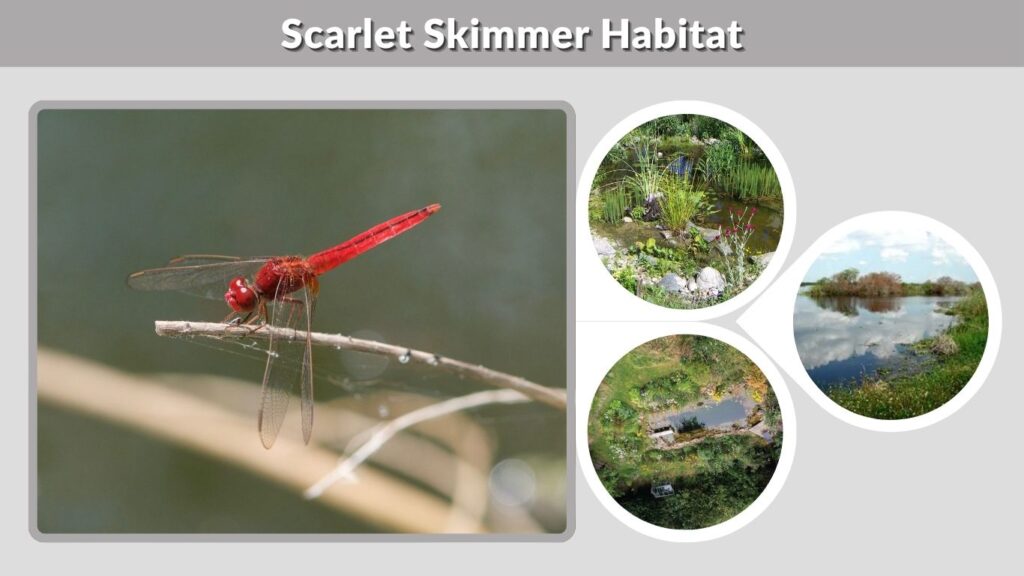
Scarlet Skimmers prefer warm, sunny, open environments rather than heavily shaded forest streams. They are particularly associated with grassy water bodies containing still or gently moving water.
Common habitats include:
- Ponds and small lakes
- Marshes and swamps
- Irrigation canals
- Drainage ditches
- Rice fields
- Reservoir edges
- Garden ponds
- Park wetlands
- Slow-moving streams
- Temporary rainwater pools
Aquatic plants provide places where females can lay eggs and where nymphs can hide from predators. Reeds and other vegetation rising above the water also offer adults suitable resting, hunting, and territorial perches.
What Do Scarlet Skimmers Eat?
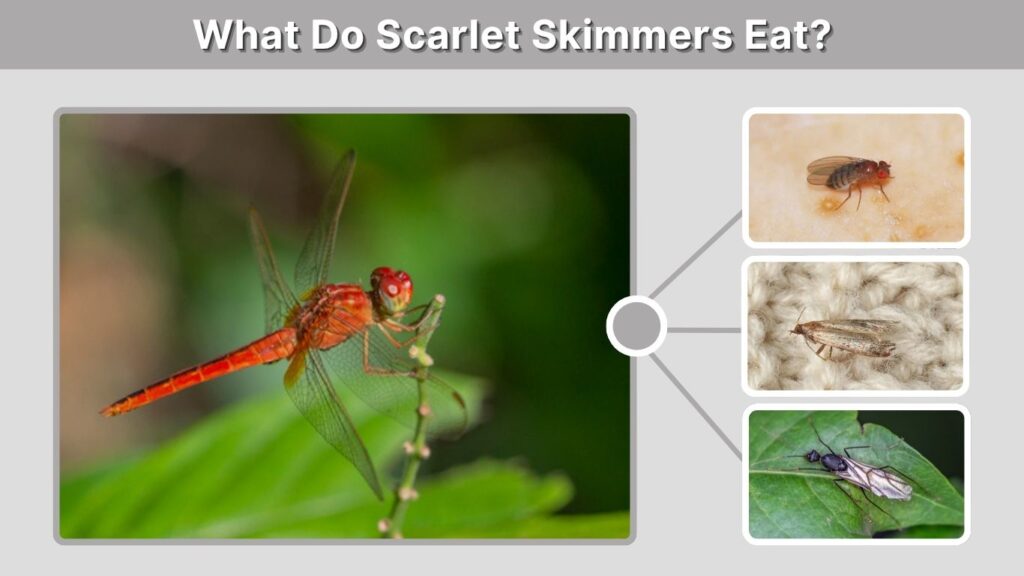
Adult Scarlet Skimmers are carnivorous aerial predators. Like other dragonflies, they use their bristled legs to form a basket around flying prey. The captured insect is transferred to the mouth and chewed with strong mandibles.
Their diet may include:
- Mosquitoes
- Midges and gnats
- Small flies
- Moths
- Winged ants
- Small bees and wasps
- Damselflies
- Smaller dragonflies
Scarlet Skimmers are generalist hunters rather than dedicated mosquito predators. They capture whichever appropriately sized, day-flying insects are abundant and within reach. Their presence can contribute to natural mosquito control, but they cannot eliminate an entire mosquito population.
What Do Scarlet Skimmer Nymphs Eat?
Young Scarlet Skimmers live underwater as nymphs, also called larvae or naiads. They prey on mosquito larvae, aquatic insects, worms, tiny crustaceans, tadpoles, and possibly very small fish when the nymph is large enough.
The nymph waits among mud, submerged plants, or bottom debris before rapidly extending a specialized hinged lower mouthpart to capture passing prey. Larger nymphs may also eat smaller dragonfly nymphs when food is limited.
Behavior and Territorial Activity
Scarlet Skimmers are sun-loving dragonflies and are most active during warm daylight hours. Males often occupy a small section of shoreline and repeatedly return to a favored reed, twig, or plant tip.
A male may chase rivals of its own species as well as other dragonflies entering its territory. These rapid flights are not attacks on nearby people. The dragonfly is defending access to breeding habitat or investigating another moving insect.
Females generally spend less time displaying over open water. They may remain in nearby vegetation and approach the breeding area when ready to mate or lay eggs.
Scarlet Skimmer Life Cycle
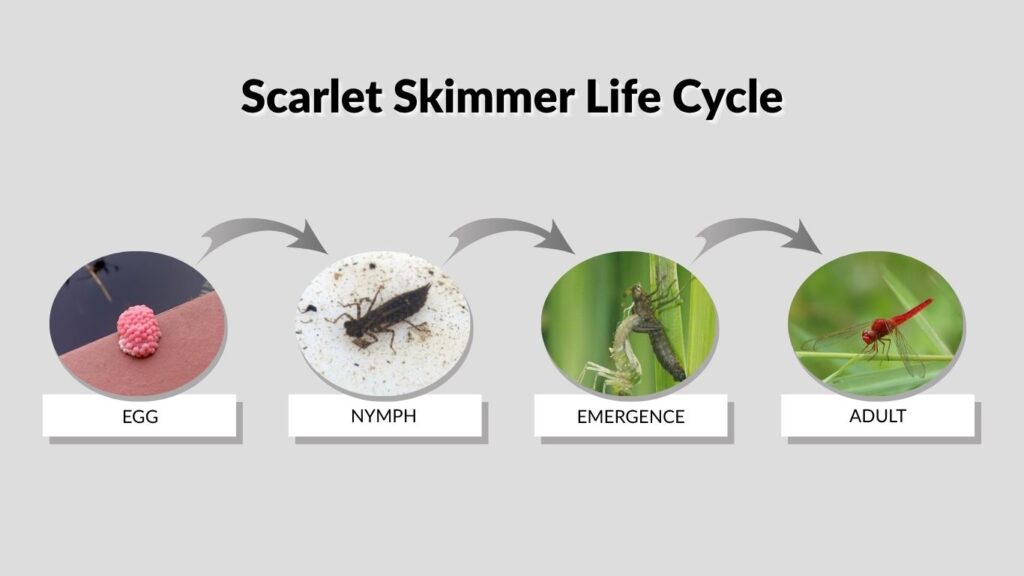
Scarlet Skimmers undergo incomplete metamorphosis through three primary stages: egg, aquatic nymph, and adult. They do not form a pupa or cocoon.
Egg Stage
After mating, the female deposits eggs in suitable freshwater. She may fly low over the surface and touch the tip of her abdomen to the water while releasing eggs. The male may remain nearby and guard her from competing males.
Aquatic Nymph Stage
The eggs hatch into nymphs that live underwater. This is normally the longest part of a dragonfly’s life. Dragonfly nymphs may remain aquatic for several months or several years, depending on species, temperature, habitat, and food availability.
Nymphs molt repeatedly while growing. When development is complete, the nymph climbs onto a plant stem, rock, wall, or other surface above the water.
Adult Emergence
The nymph’s outer skin splits, allowing the winged adult to pull itself free. The newly emerged dragonfly is initially soft and pale. Its wings gradually expand and harden, while its mature body color develops over the following days.
Most adult dragonflies live for only a few weeks, although survival varies with weather, predators, food, and species. During this short adult stage, they hunt, establish territories, mate, and reproduce.
Is the Scarlet Skimmer Invasive in Florida?
The Scarlet Skimmer is correctly described as introduced and established in Florida. It is also frequently called invasive because it has spread beyond its native Asian range. However, “invasive” may imply documented ecological damage, and publicly available sources provide clearer evidence of establishment and expansion than of major harm to native Florida wildlife.
It may compete with native dragonflies for food, perches, or breeding habitat, but the scale of these effects is not well established. Avoid releasing aquarium plants, water, or aquatic insects into natural wetlands because these materials can unintentionally transport non-native species.
Do Scarlet Skimmers Bite or Sting?
Scarlet Skimmers cannot sting because they have no stinger. They do not drink blood, attack people, or protect a nest.
A captured dragonfly may try to pinch with its chewing mouthparts, especially when squeezed or held near the head. Most such pinches are minor and can be avoided completely by observing the dragonfly without handling it.
Predators and Conservation
Scarlet Skimmer adults may be eaten by birds, frogs, spiders, fish, and larger dragonflies. Their aquatic nymphs are prey for fish, water birds, amphibians, and larger aquatic insects. Dragonfly larvae are important parts of freshwater food webs because they function as both predators and prey.
The species is common in Singapore and appears tolerant of human-modified habitats. Nevertheless, clean freshwater, aquatic vegetation, sunny shorelines, and reduced pesticide use support Scarlet Skimmers and other dragonflies.
FAQs
Is a Scarlet Skimmer rare?
It is common in many parts of its native Asian range, including Singapore, and is established in southern Florida. Local abundance depends on the availability of warm, open freshwater habitats.
How can you identify a male Scarlet Skimmer?
A mature male has a bright-red face, eyes, thorax, legs, and abdomen. Look for the narrow dark line running along the top of its abdomen and amber coloring at the hindwing bases.
What does a female Scarlet Skimmer look like?
Females are generally light brown, golden-brown, or yellowish rather than red. They have clear wings, amber patches near the hindwing bases, and a dark line extending along the upper abdomen.
Is the Scarlet Skimmer native to Florida?
No. It is native to Asia and was introduced to southern Florida, where it became established during the 1970s.
Do Scarlet Skimmers eat mosquitoes?
Yes. Adults may catch flying mosquitoes, while aquatic nymphs eat mosquito larvae. They also consume many other insects and should not be expected to control mosquitoes by themselves.