
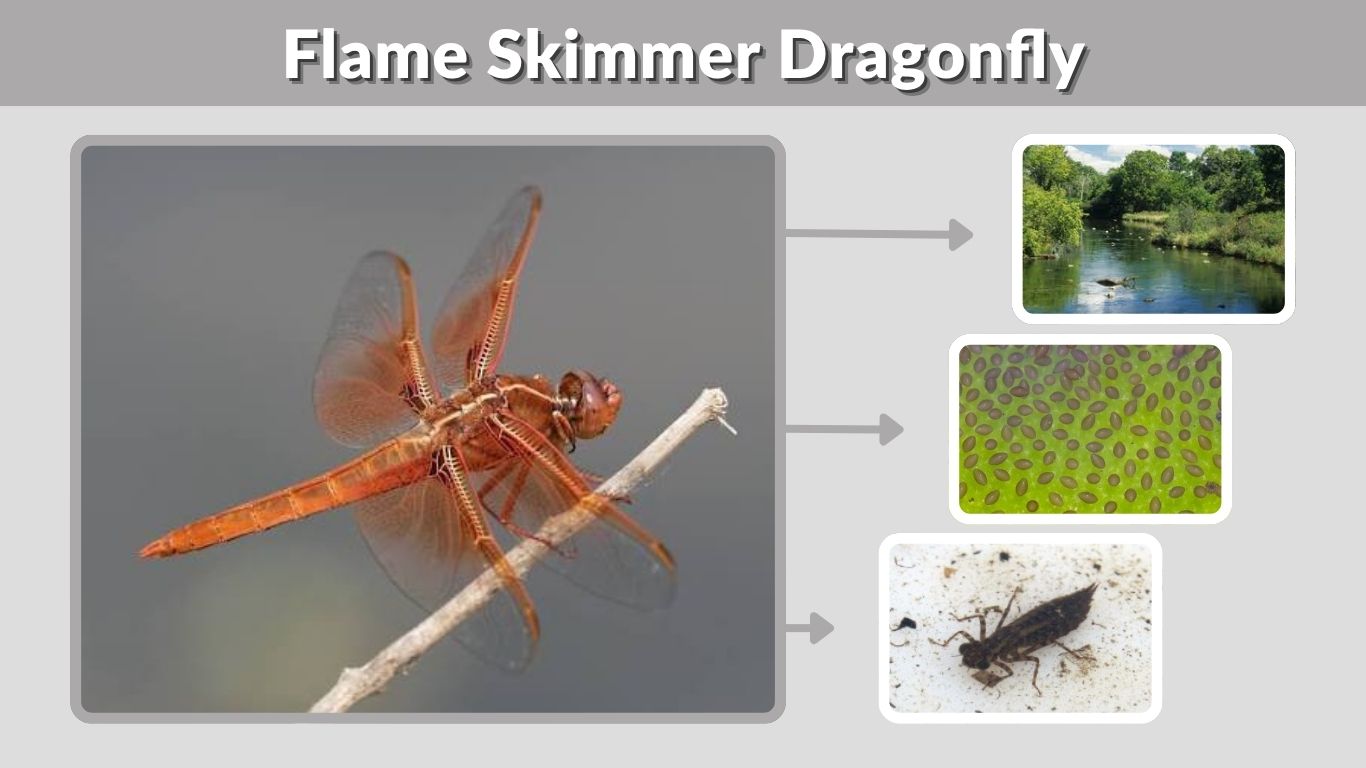
The Flame Skimmer (Libellula saturata) is a large orange-red dragonfly native to western North America. Mature males appear almost entirely fiery orange, including their bodies, legs, wing veins, and much of their wings. Females are usually paler, ranging from golden orange to tan. Flame Skimmers are commonly seen around sunny ponds, warm streams, springs, canals, and garden water features, where they hunt mosquitoes, flies, moths, and other insects.
Flame Skimmer Overview
The Flame Skimmer belongs to the skimmer family Libellulidae, one of the largest and most familiar dragonfly families. Its valid scientific name is Libellula saturata, and adults generally measure about 49–61 millimeters, or roughly 1.9–2.4 inches, in body length.
| Feature | Description |
| Scientific name | Libellula saturata |
| Family | Libellulidae |
| Adult length | Approximately 49–61 mm |
| Male color | Bright orange-red |
| Female color | Golden orange, yellow-brown, or tan |
| Native range | Western North America |
| Habitat | Warm ponds, streams, springs, and canals |
| Adult diet | Flying insects |
| Nymph diet | Aquatic insects and small vertebrates |
| Activity | Primarily daytime |
| Danger to humans | Harmless unless roughly handled |
What Does a Flame Skimmer Look Like?
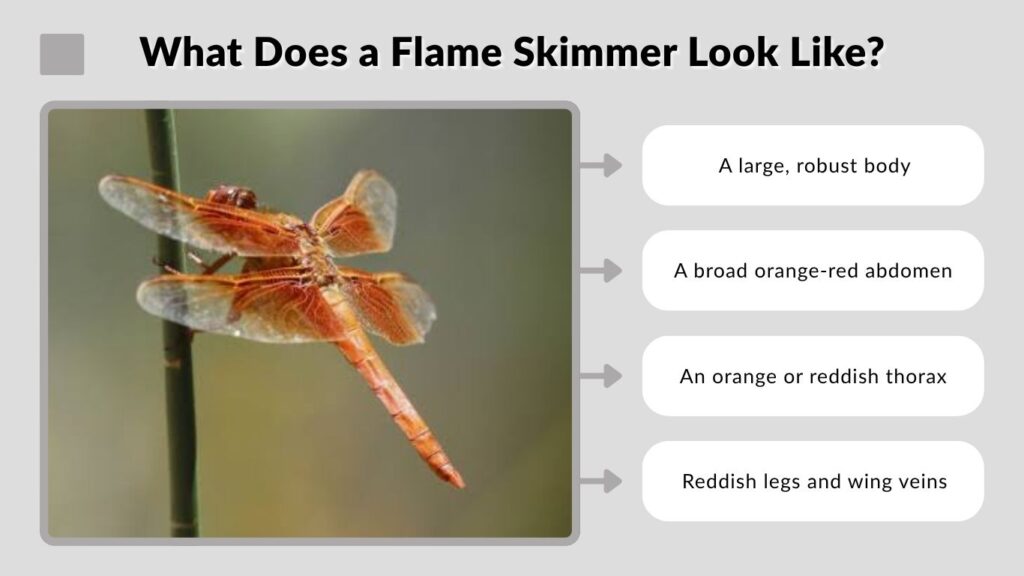
The Flame Skimmer is one of the easiest western dragonflies to notice because of its large body and intense coloration. Mature males can appear red from a distance, but close examination usually reveals a strong orange or flame-colored tone.
Identification Features
A Flame Skimmer can be recognized by:
- A large, robust body
- A broad orange-red abdomen
- An orange or reddish thorax
- Reddish legs and wing veins
- Extensive amber-orange coloring across the wings
- Broad hindwings typical of skimmer dragonflies
- A habit of returning repeatedly to exposed perches
Adult Flame Skimmers measure approximately 49–61 millimeters long. The extensive amber coloring in the wings is particularly useful for separating them from similar red dragonflies.
Male Flame Skimmer
A mature male is usually intensely orange-red. Its face, thorax, abdomen, legs, and many wing veins share the same fiery coloring. An amber wash extends through a large portion of each wing, creating the appearance that the entire insect is glowing in sunlight.
Males frequently perch on reeds, branches, stakes, and rocks overlooking water. From these positions, they fly out to catch prey, chase rivals, or investigate females before returning to the same perch.
Female Flame Skimmer
Female Flame Skimmers are normally lighter than mature males. Their bodies may appear golden orange, yellowish brown, or warm tan. Their wings retain some amber coloring, especially along the leading edges and near the bases, but the color is generally less intense.
Females can be mistaken for immature males because both may have softer orange-brown coloration. Mature males gradually develop the stronger red-orange appearance associated with the species.
Flame Skimmer Range
Flame Skimmers are native to western North America. Their U.S. range includes California, Arizona, Nevada, Oregon, Idaho, Utah, Colorado, New Mexico, Texas, Wyoming, and several nearby states. They also extend southward into Mexico.
Flame Skimmers in California
The Flame Skimmer is common in California and is one of the state’s most recognizable red-orange dragonflies. It can occur around natural wetlands as well as artificial ponds, irrigation channels, reservoirs, and backyard water features.
Flame Skimmers in Arizona and Texas
Arizona provides many suitable habitats, including desert springs, warm streams, and permanent ponds. Flame Skimmers also occur in Texas, although they may overlap there with the similar Neon Skimmer.
Because both species can look red or orange, photographs should clearly show the body and the amount of amber coloring in the wings before an identification is confirmed.
Flame Skimmers in Oregon
Oregon lies near the northern portion of the species’ western range. Flame Skimmers are more likely to appear in warm, sunny areas with permanent or slow-moving water than in cold, shaded mountain streams. NatureServe includes Oregon among the states where the species has been recorded.
Flame Skimmer Habitat
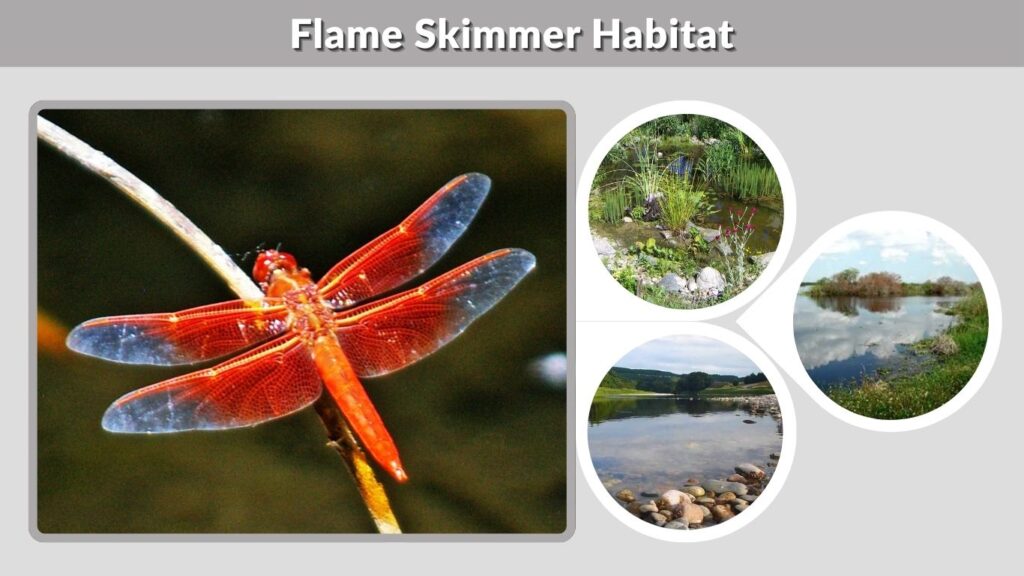
Flame Skimmers depend on freshwater because their immature stage develops underwater. Adults can travel away from breeding sites to hunt, but they are most frequently observed near warm aquatic habitats.
Common habitats include:
- Ponds and small lakes
- Warm, slow-moving streams
- Desert springs and oases
- Marshy pools
- Irrigation canals
- Drainage channels
- Reservoir edges
- Backyard and garden ponds
Their nymphs live in warm ponds and streams, often hiding in mud, sediment, vegetation, or submerged debris. Adults usually select sunny, open shorelines that provide hunting perches and room for aerial activity.
What Do Flame Skimmers Eat?
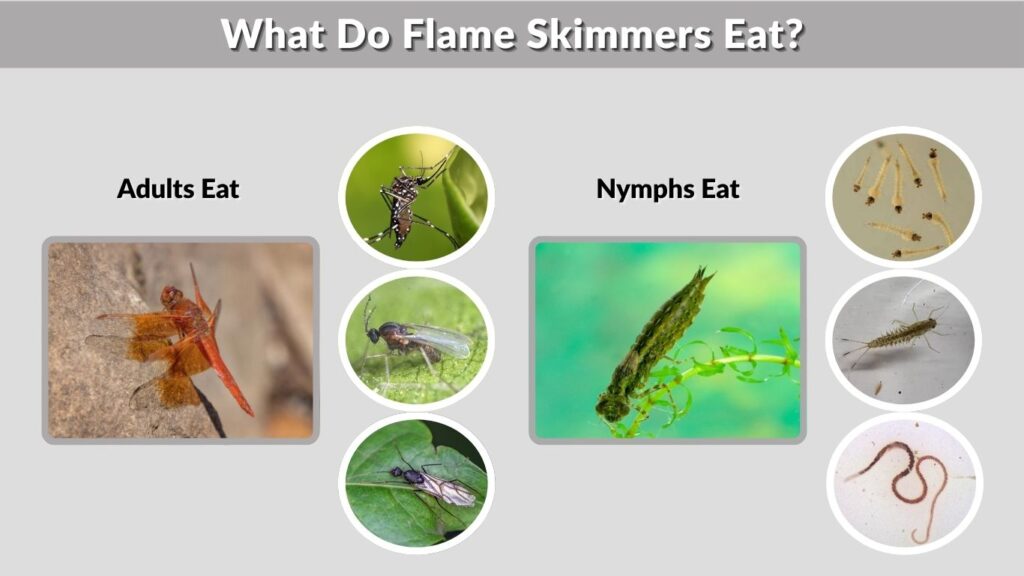
Flame Skimmers are carnivorous during both the aquatic nymph stage and the flying adult stage. They do not eat leaves, flowers, fruit, nectar, or other plant material.
Adult Diet
Adult Flame Skimmers hunt almost any flying insect they can catch, including:
- Mosquitoes
- Midges and gnats
- Flies
- Moths
- Winged ants
- Bees
- Small wasps
- Smaller dragonflies
They often hunt using a perch-and-pursue strategy. The dragonfly waits on a twig, reed, stake, or rock, launches when prey passes, captures the insect with its legs, and may return to a perch to eat it.
Flame Skimmer Nymph Diet
Aquatic Flame Skimmer nymphs eat:
- Mosquito larvae
- Aquatic fly larvae
- Mayfly nymphs
- Freshwater shrimp and other crustaceans
- Tadpoles
- Small fish
- Other aquatic insects
A nymph waits among sediment or vegetation before rapidly extending its hinged lower mouthpart to seize prey. Larger nymphs can capture much larger animals than newly hatched individuals.
Do Flame Skimmer Nymphs Eat Each Other?
Cannibalism is possible among predatory dragonfly nymphs, particularly when individuals differ in size, food is scarce, or they are confined together. A larger nymph may treat a smaller nymph as potential prey.
This is one reason dragonfly nymphs should not be crowded together in a small aquarium. Providing abundant structure and food may reduce encounters, but it cannot guarantee that cannibalism will not occur.
Flame Skimmer Life Cycle
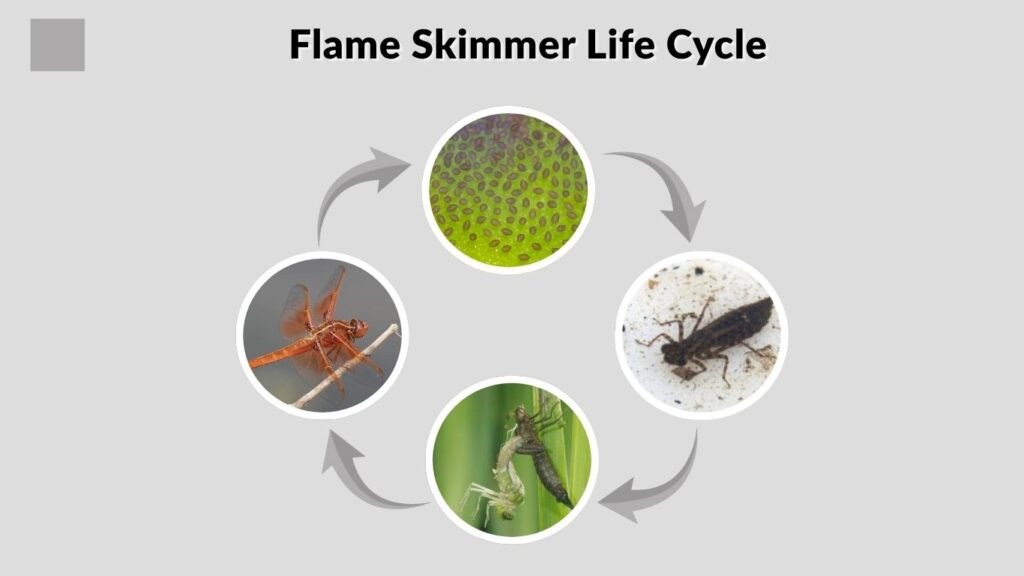
The Flame Skimmer undergoes incomplete metamorphosis, passing through egg, aquatic nymph, and adult stages. It does not form a pupa or cocoon.
Eggs
After mating, a female flies over suitable water and deposits eggs by touching or dipping the end of her abdomen onto the surface. Eggs may be released in several areas rather than concentrated in one place.
USA National Phenology Network guidance records Flame Skimmer females laying eggs directly on the water or around aquatic vegetation.
Aquatic Nymph
The eggs hatch into aquatic nymphs, also called larvae or naiads. The nymphs spend most of their development underwater, where they repeatedly molt and grow.
Flame Skimmer nymphs have compact, rounded bodies suited to living among mud and bottom debris. Idaho State University describes them as relatively large, stocky naiads that may reach approximately 28 millimeters long.
Emergence
When development is complete, the nymph stops feeding and climbs out of the water onto a rock, stem, log, or other support. Its outer skin splits, and the winged adult gradually pulls itself free.
The new dragonfly initially has a soft body and folded wings. The wings expand, while the body hardens and darkens. The empty nymphal skin left attached to the emergence surface is called an exuvia.
Adult Stage
Adults generally live for only a few weeks, although weather, predation, food, and individual condition influence survival. During this period, they feed, mature, defend territories, mate, and lay eggs.
Flame Skimmer Behavior and Adaptations
Flame Skimmers are fast, visually guided hunters. Their large compound eyes help them detect movement across a wide field of view, while four independently controlled wings allow rapid acceleration, hovering, sharp turns, and backward movement.
Perching Behavior
Males often choose prominent perches overlooking water. They repeatedly leave the perch to capture prey or chase other dragonflies and then return to the same location.
This predictable behavior makes Flame Skimmers relatively easy to observe and photograph. It also allows a male to monitor a breeding territory without remaining continuously in flight.
Territorial Behavior
Mature males may defend productive sections of shoreline against other males. Their flights can include rapid chases, circling, and brief aerial confrontations.
A territorial male is not attacking nearby people. It is normally responding to another dragonfly, searching for a mate, or catching an insect.
Neon Skimmer vs. Flame Skimmer
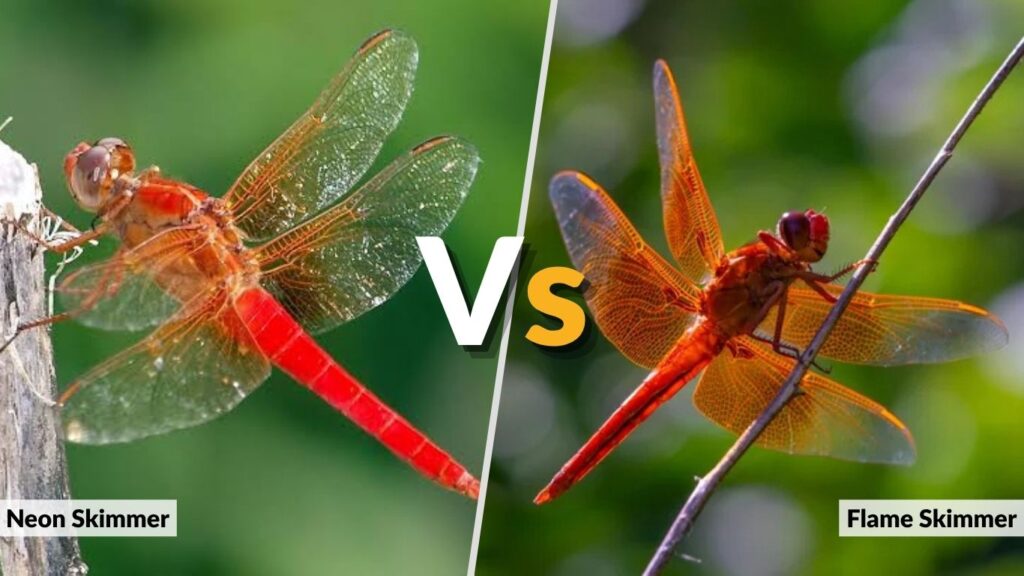
The Neon Skimmer and Flame Skimmer can appear similar, especially where their ranges overlap.
| Feature | Flame Skimmer | Neon Skimmer |
| Male body color | Orange-red | Brilliant crimson red |
| Amber wing coloring | Broad and extensive | More limited near the wing bases |
| Color past wing nodus | Often extends beyond it | Usually ends around or before it |
| General appearance | Fiery orange | Bright neon red |
| Scientific name | Libellula saturata | Libellula croceipennis |
On the Flame Skimmer, the amber coloring generally covers a larger portion of the wings and can extend beyond the nodus, the noticeable joint-like point along the leading wing edge. The Neon Skimmer’s amber wash is usually more restricted.
Predators
Adult Flame Skimmers may be eaten by birds, frogs, spiders, fish, and larger dragonflies. Nymphs are preyed upon by fish, aquatic birds, amphibians, larger aquatic insects, and other dragonfly nymphs.
Their speed and maneuverability help adults escape attacks, while nymphs rely on camouflage, bottom debris, and rapid jet-like movement through the water. Dragonfly larvae are an important food source for many fish and birds.
Do Flame Skimmers Bite or Sting?
Flame Skimmers cannot sting because they have no stinger. They do not attack people, drink blood, or defend nests.
A large individual may attempt to pinch with its chewing mouthparts when caught and tightly held. Such behavior is defensive, and most encounters do not break human skin. Leaving the dragonfly undisturbed removes nearly all risk.
Flame Skimmer Meaning and Symbolism
There is no scientific evidence that seeing a Flame Skimmer predicts a future event or carries a supernatural message. Biologically, the dragonfly is likely hunting, resting, defending a territory, searching for a mate, or moving between water sources.
In personal and spiritual interpretations, its bright orange-red color is sometimes associated with energy, confidence, courage, transformation, and vitality. These meanings are symbolic beliefs rather than facts about the dragonfly’s biology.
FAQs
Is the Flame Skimmer native to California?
Yes. The Flame Skimmer is native to western North America and is common in many parts of California. It lives around ponds, warm streams, springs, canals, reservoirs, and artificial water features.
How big is a Flame Skimmer?
Adults generally measure approximately 49–61 millimeters, or about 1.9–2.4 inches, from the head to the end of the abdomen. Females and males are similar in size, although their mature colors differ.
What is the difference between male and female Flame Skimmers?
Mature males are intensely orange-red with extensive amber coloring in their wings. Females are usually paler golden orange, yellow-brown, or tan, with less intense amber coloring.
Do Flame Skimmers eat mosquitoes?
Yes. Adults can catch flying mosquitoes, while aquatic nymphs eat mosquito larvae. However, Flame Skimmers also consume many other insects and should not be expected to eliminate an entire mosquito population.
Why does a Flame Skimmer return to the same perch?
It uses the perch as a hunting and observation point. The dragonfly launches to capture prey, chase rivals, or inspect potential mates and then returns to the same twig, stake, reed, or rock.