
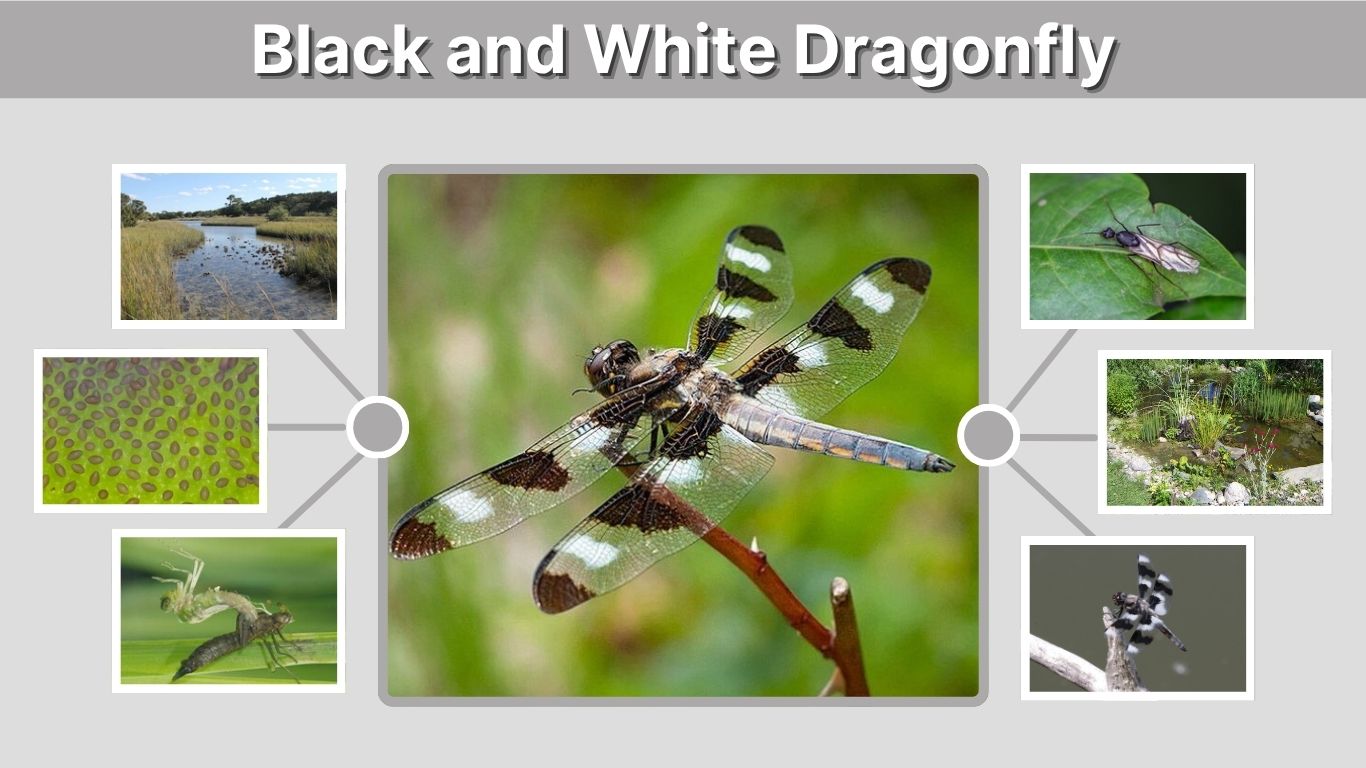
A black and white dragonfly is not one specific species. The description can refer to several dragonflies with dark bodies, pale abdominal markings, or bold black-and-white patches across their wings. Some of the best-known examples include the twelve-spotted skimmer, pied paddy skimmer, common whitetail, widow skimmer, and chalk-fronted corporal.
These striking insects are usually found around ponds, lakes, marshes, slow streams, and other freshwater habitats. Like all dragonflies, they are active predators that consume mosquitoes, flies, midges, and other small insects.
Black and White Dragonfly Overview
Black-and-white patterns may occur on a dragonfly’s wings, thorax, or abdomen. In some species, only mature males develop the contrasting pale coloration, while females and immature males look brown, yellow, or dark.
| Characteristic | General information |
| Common description | Black and white dragonfly |
| Scientific group | Anisoptera |
| Typical length | About 1.5–2.5 inches |
| Color | Black, white, gray, brown, or pale blue |
| Habitat | Ponds, lakes, marshes, and slow waterways |
| Adult diet | Small flying insects |
| Young stage | Aquatic nymph |
| Activity | Mainly during daylight |
| Dangerous to humans | No |
| Main identifying feature | Contrasting wings or body markings |
Accurate identification requires checking the wing pattern, abdomen, thorax, sex, location, and preferred habitat.
What Does a Black and White Dragonfly Look Like?
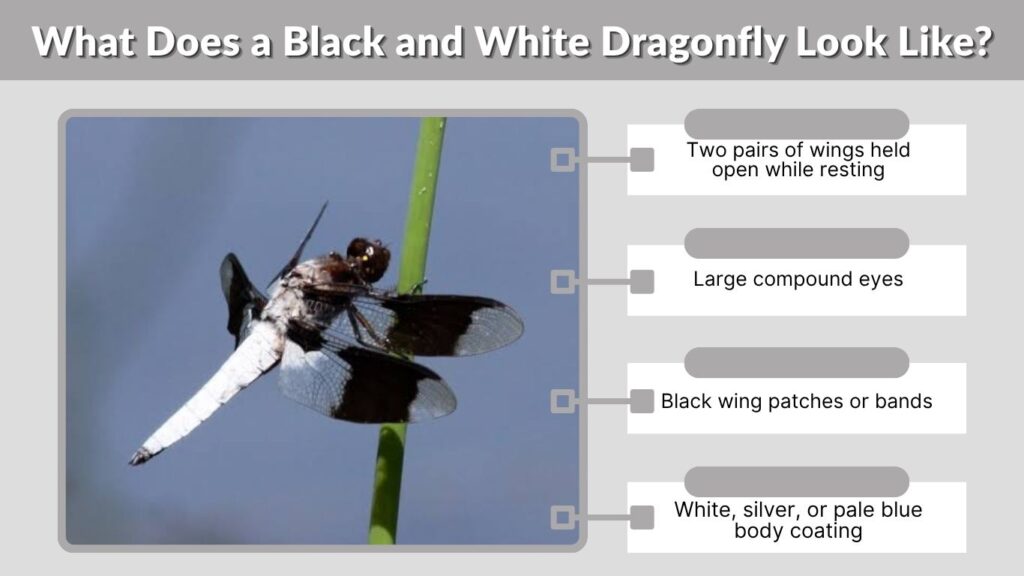
The appearance varies considerably between species. Some have transparent wings decorated with black and white spots, while others have clear wings and a powdery white abdomen.
Identification Features
- Two pairs of wings held open while resting
- Large compound eyes
- Long, segmented abdomen
- Black wing patches or bands
- White, silver, or pale blue body coating
- Dark legs adapted for catching prey
- Short, inconspicuous antennae
- Strong and highly controlled flight
- Habit of resting on exposed plants, rocks, or branches
The pale areas on mature males are sometimes caused by pruinescence, a waxy coating that gives the body a chalky white, gray, or blue appearance.
Common Types of Black and White Dragonflies
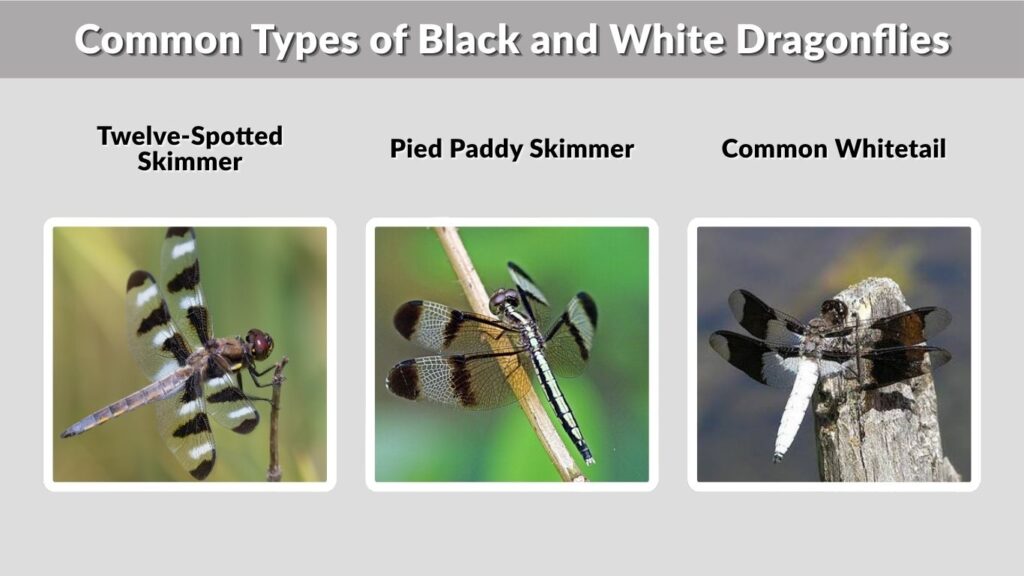
Several species may match this general description.
Twelve-Spotted Skimmer
The twelve-spotted skimmer, Libellula pulchella, is one of the most recognizable black-and-white dragonflies in North America. Mature males have three dark patches and two white patches on each wing, producing a striking spotted pattern visible from a considerable distance.
Females also have dark wing spots, but they generally lack the bright white areas. Their abdomens are usually brown with yellow stripes.
Pied Paddy Skimmer
The pied paddy skimmer, Neurothemis tullia, is found across parts of South and Southeast Asia, including Bangladesh and India. Mature males have broad black areas across the inner portions of their wings, followed by milky-white bands and transparent tips.
Their abdomens are dark and may develop a bluish-gray coating. Females are usually yellowish with brown or black markings and have less dramatic wings.
Common Whitetail
The common whitetail, Plathemis lydia, is widespread in North America. Mature males have a broad, powdery white abdomen with dark markings near the base and tip. Each wing also has a wide black band.
Females lack the white abdomen and instead have a brown body with yellow spots. Their wings contain several dark patches.
Widow Skimmer
The widow skimmer, Libellula luctuosa, has broad dark patches at the bases of all four wings. Mature males often develop white patches outside the dark areas, creating a bold black-and-white pattern.
Females generally have dark wing bases but lack the strong white markings. This species is commonly seen around ponds, lakes, and slow water.
Chalk-Fronted Corporal
The chalk-fronted corporal, Ladona julia, has mostly transparent wings rather than patterned ones. Mature males develop white or bluish-white coloring on the front of the thorax and the upper part of the abdomen.
The rest of the abdomen remains black, giving the dragonfly a sharply divided appearance. It is commonly associated with lakes, ponds, and boggy water in northern North America.
Black and White Dragonfly Size and Wingspan
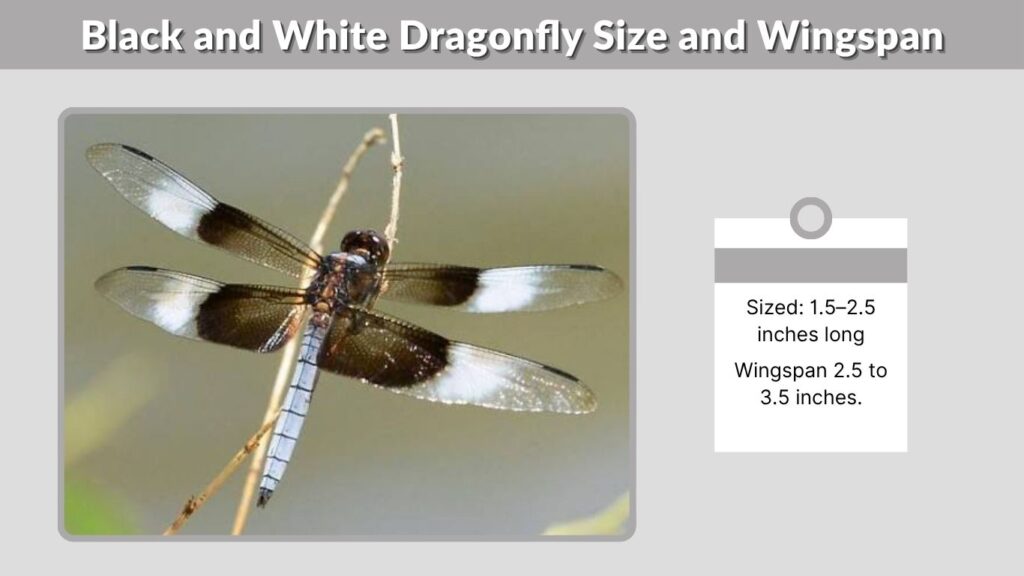
Most black-and-white dragonflies are medium-sized insects measuring approximately 1.5–2.5 inches long. Their wingspan may range from about 2.5 to 3.5 inches, depending on the species.
Twelve-spotted skimmers and common whitetails have broad bodies typical of the skimmer family. Pied paddy skimmers are usually more compact but appear larger when their boldly patterned wings are fully spread.
Males and females are often similar in size, although their coloration can be dramatically different.
Black and White Dragonfly Male vs Female Appearance
Sexual color differences are common among dragonflies. Mature males generally have the clearest black-and-white patterns because these markings may help with territorial displays and recognition.
| Feature | Mature male | Female |
| Body color | Black with white, gray, or blue coating | Usually brown, yellow, or dark |
| Wing pattern | May have black and white bands | Often dark spots without white bands |
| Behavior | Frequently territorial | Usually less territorial |
| Position near water | Often remains at breeding sites | May visit mainly to mate and lay eggs |
| Color change | Develops adult pattern with age | Usually retains brown or yellow pattern |
Immature males can resemble females before their white or bluish coating develops.
Black and White Dragonfly Habitat
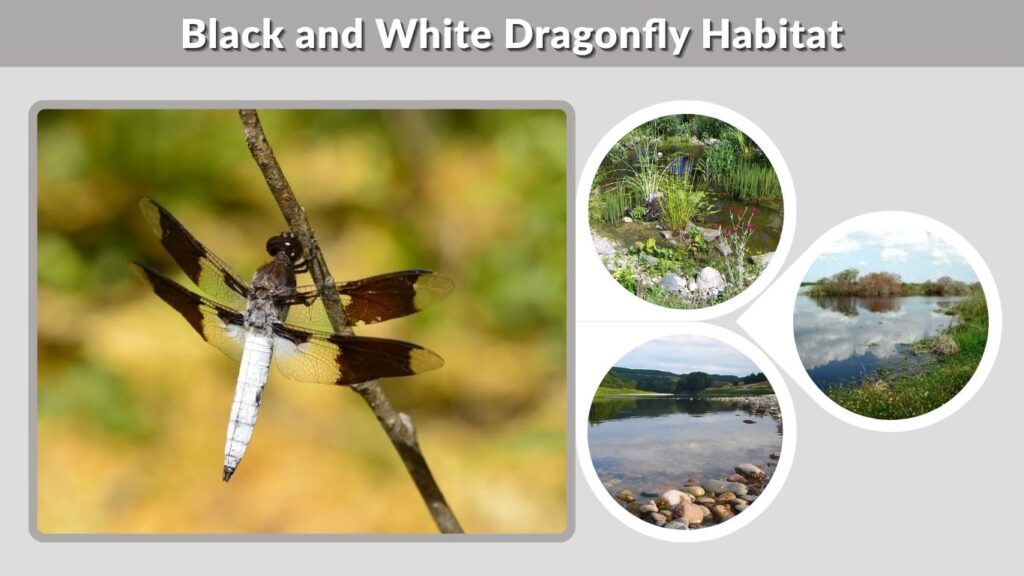
Black-and-white dragonflies depend on freshwater because their eggs and nymphs develop underwater. Adults may travel into nearby fields, gardens, woodland edges, and open areas to hunt.
Common Habitats
- Ponds
- Lakes
- Marshes
- Swamps
- Slow rivers
- Wetlands
- Reservoir edges
- Rice fields
- Vegetated ditches
- Gravel pits
Different species have different preferences. Pied paddy skimmers commonly inhabit ponds, marshes, canals, and rice-growing areas. Twelve-spotted skimmers favor open ponds, lakes, and slow waterways, while chalk-fronted corporals are frequently associated with northern lakes and boggy habitats.
Adults often choose sunny locations with exposed perches and plenty of flying insects.
Distribution
Black-and-white dragonflies occur in many parts of the world, but the species vary by region.
The twelve-spotted skimmer, common whitetail, widow skimmer, and chalk-fronted corporal are primarily North American species. The pied paddy skimmer occurs across South and Southeast Asia.
Therefore, location is one of the most helpful identification clues. A boldly patterned dragonfly found in Bangladesh is more likely to be a pied paddy skimmer than a twelve-spotted skimmer.
Black and White Dragonfly Diet and Hunting
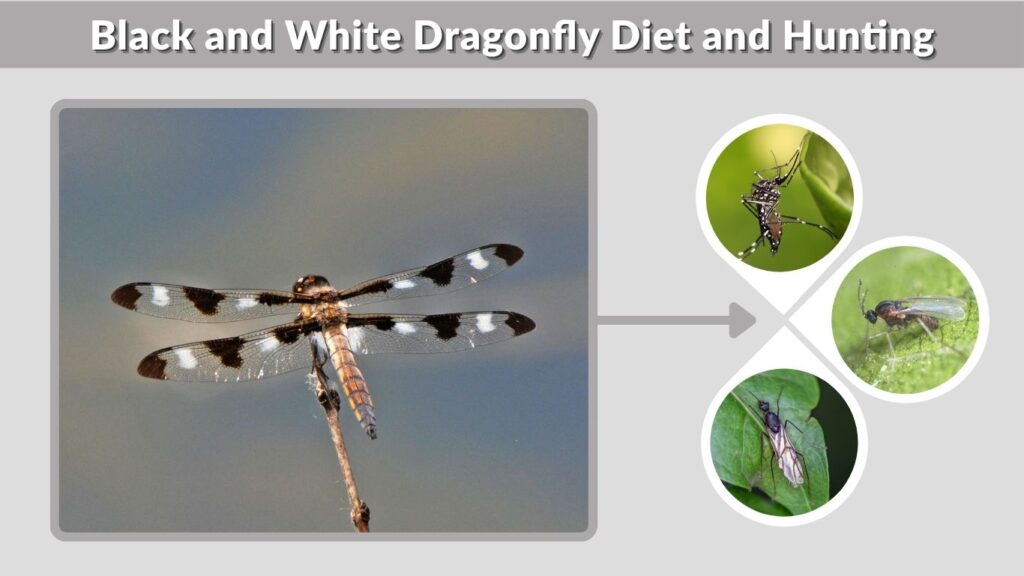
Black-and-white dragonflies are carnivorous throughout their lives. Adults capture insects in flight, while aquatic nymphs hunt underwater.
Adult Diet
Adults commonly eat:
- Mosquitoes
- Midges
- Gnats
- Houseflies
- Flying ants
- Small moths
- Mayflies
- Aphids
- Smaller dragonflies
Some species patrol repeatedly over the water. Others sit on an exposed perch and launch when prey flies nearby.
Their six spiny legs form a basket around captured insects. The prey is then brought toward the mouth and eaten, sometimes while the dragonfly remains in flight.
Nymph Diet
Dragonfly nymphs may consume aquatic insects, mosquito larvae, small crustaceans, tadpoles, other dragonfly nymphs, and occasionally tiny fish. They capture prey using a specialized extendable lower mouthpart called the labium.
Black and White Dragonfly Lifecycle
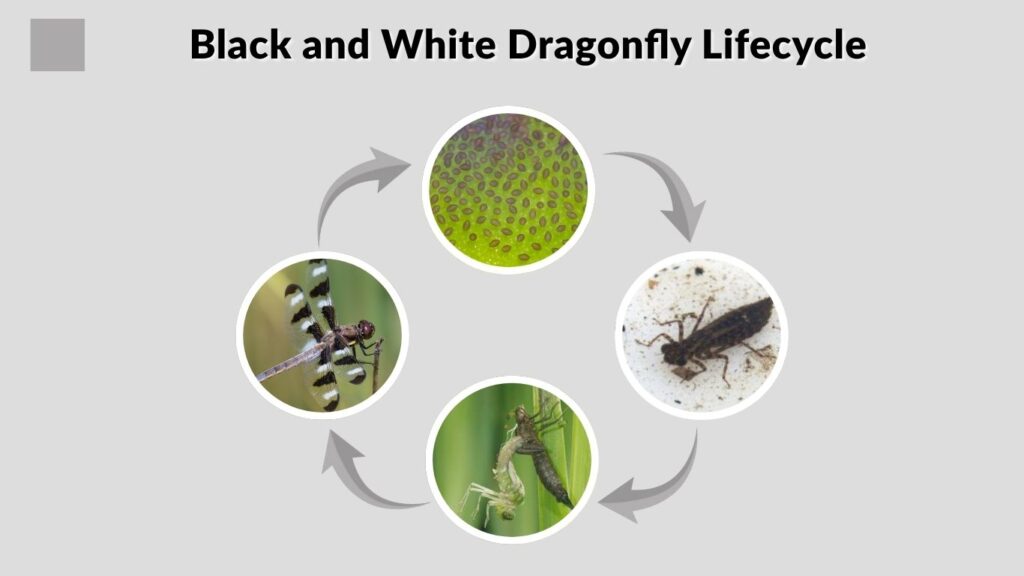
Black-and-white dragonflies undergo incomplete metamorphosis. They pass through three main stages: egg, aquatic nymph, and adult. They do not have a pupal stage.
Egg
After mating, the female lays eggs in water, wet mud, or aquatic vegetation. Depending on the species, she may touch the water repeatedly while flying or insert her eggs into plant tissue.
Aquatic Nymph
The eggs hatch into wingless nymphs that live underwater. This is usually the longest stage of the lifecycle.
Nymphs molt repeatedly as they grow. Development may take several months or multiple years, depending on the species, climate, food availability, and water temperature.
Emergence
A mature nymph climbs onto a plant stem, rock, log, or other surface above the water. Its outer skin splits, and the adult gradually pulls itself free.
The wings expand and harden over several hours. The empty nymph skin, known as an exuvia, often remains attached to the emergence site.
Adult
The adult initially appears pale and soft. Its final black-and-white pattern develops as the body hardens and matures.
Adults spend their time hunting, defending territories, mating, and laying eggs. Their winged stage generally lasts only a fraction of the complete lifespan.
Black and White Dragonfly Behavior
Male black-and-white dragonflies frequently defend sections of shoreline. They may chase rival males, patrol above the water, and repeatedly return to the same perch.
The contrasting wing markings can be highly visible during territorial flights. Some species briefly glide or hover, while others fly rapidly back and forth.
Females often remain farther from water except when mating or laying eggs. This is one reason colorful males are more frequently noticed and photographed.
Are Black and White Dragonflies Dangerous?
Black-and-white dragonflies are not dangerous to people. They have no stinger, produce no venom, and do not deliberately attack humans.
Their jaws are strong enough to crush small insects. A dragonfly may attempt a minor defensive nip when trapped or held incorrectly, but it cannot cause a serious injury.
Dragonflies are beneficial because they consume mosquitoes, flies, midges, and other insects. Their nymphs also form an important part of freshwater food webs.
Black and White Dragonfly vs Damselfly
Dragonflies and damselflies both belong to the order Odonata, but they have several visible differences.
| Feature | Dragonfly | Damselfly |
| Body | Usually thick and strong | Usually thin and delicate |
| Eyes | Large and often close together | Usually widely separated |
| Resting wings | Held open or downward | Commonly folded over the body |
| Flight | Fast and powerful | Slower and fluttering |
| Hindwings | Broader near the base | Similar in shape to forewings |
Some black-and-white damselflies exist, so checking the resting wing position and body shape can prevent misidentification.
FAQs
What is the black and white dragonfly called?
The name may refer to several species. Likely examples include the twelve-spotted skimmer, pied paddy skimmer, common whitetail, widow skimmer, and chalk-fronted corporal. Location and wing pattern are needed for an exact identification.
Which black and white dragonfly has spotted wings?
The mature male twelve-spotted skimmer has distinctive alternating dark and white patches across all four wings. Male widow skimmers also have dark and white wing sections, but their pattern is concentrated closer to the wing bases.
Are black and white dragonflies rare?
Some species are common within their natural ranges, while others have limited distributions. A dragonfly may appear rare simply because adults fly for a short season or females spend less time around easily observed breeding sites.
Do black and white dragonflies bite?
They do not normally bite people. A dragonfly may give a weak defensive nip when handled roughly, but it has no venom or sting and is not considered medically dangerous.
What does a black and white dragonfly eat?
Adults eat mosquitoes, midges, flies, moths, flying ants, and other airborne insects. Their aquatic nymphs consume mosquito larvae, aquatic insects, small crustaceans, tadpoles, and other small animals.