
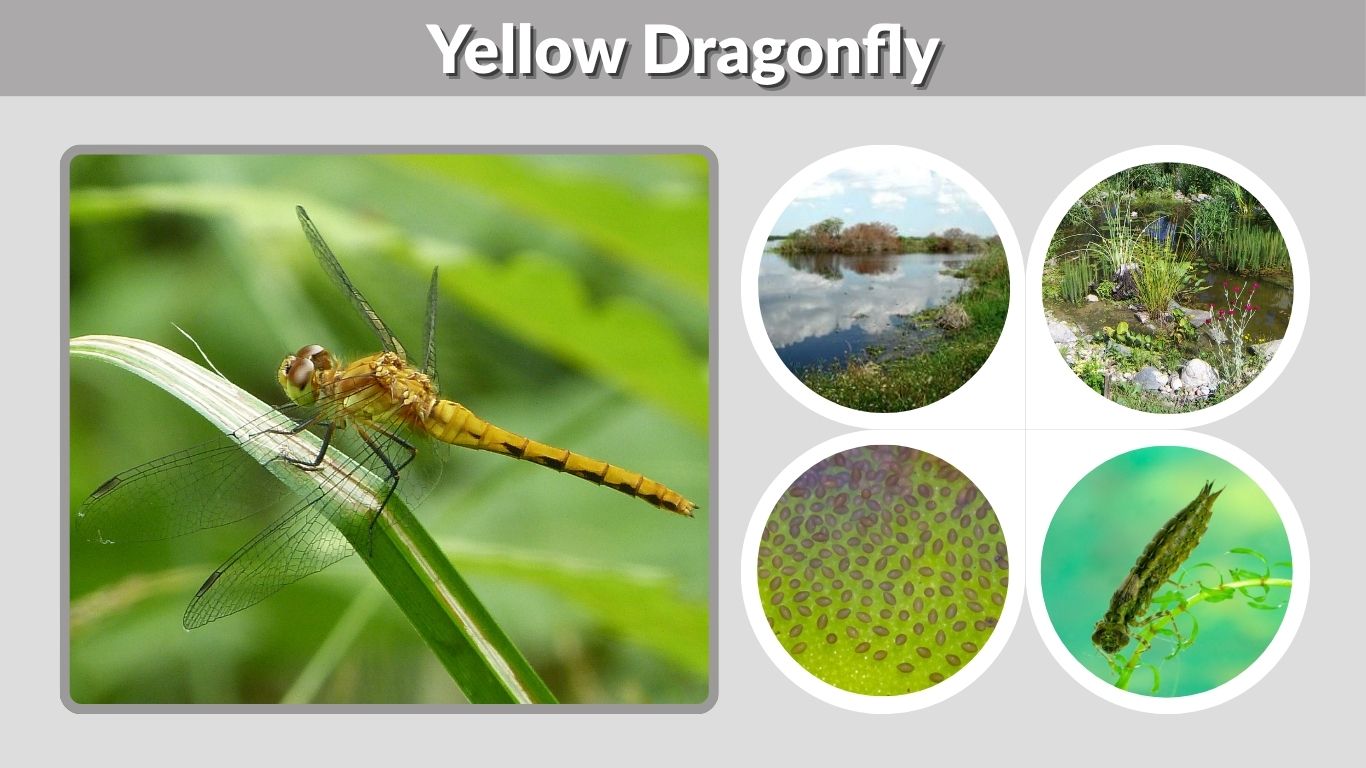
A yellow dragonfly is not one particular species. The name may describe any dragonfly with a yellow abdomen, yellow stripes, golden wings, or bright yellow markings. Many female and newly emerged dragonflies appear yellow before their colors darken as they mature.
Examples include the yellow-sided skimmer, yellow-winged darter, female ruddy darter, and several clubtails, meadowhawks, and pennants. Although their exact size and habitat vary, yellow dragonflies share the predatory behavior, aquatic juvenile stage, and impressive flying ability typical of dragonflies.
Yellow Dragonfly Overview
Dragonflies belong to the insect order Odonata and the group Anisoptera. They have large compound eyes, elongated bodies, six legs, and two pairs of independently controlled wings. Around 3,000 living dragonfly species are known worldwide.
| Characteristic | General information |
| Common description | Yellow dragonfly |
| Scientific classification | Anisoptera |
| Typical size | About 1–3 inches |
| Color | Yellow, gold, brown, black, or orange |
| Habitat | Ponds, lakes, marshes, streams, and wetlands |
| Adult diet | Mosquitoes, flies, midges, and other insects |
| Lifecycle | Egg, aquatic nymph, and adult |
| Activity | Mainly daytime |
| Dangerous to humans | No |
| Lifespan | Several months to multiple years, including the nymph stage |
What Does a Yellow Dragonfly Look Like?
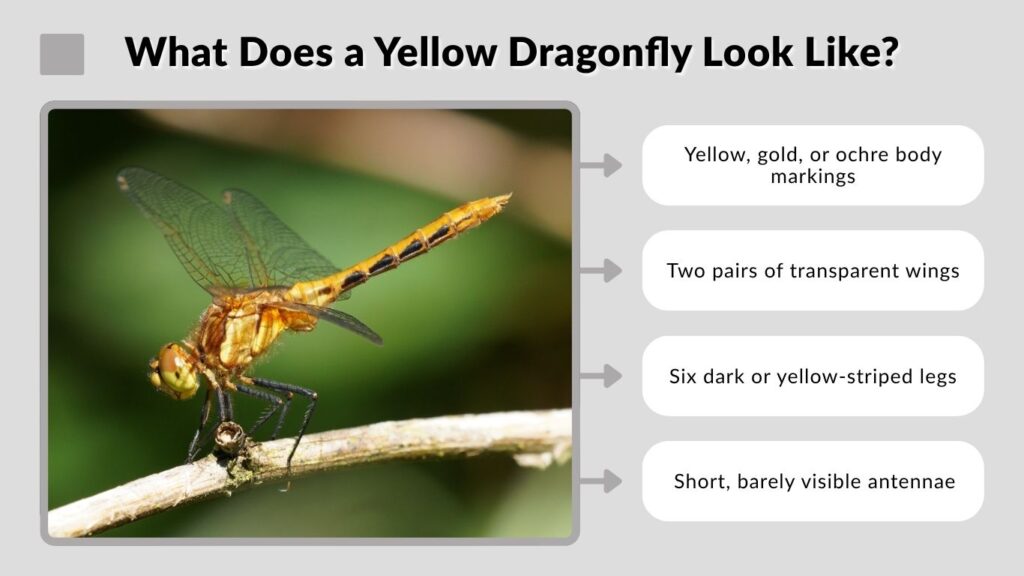
Yellow dragonflies vary considerably because the term covers numerous species, females, and immature adults. Their bodies may be almost entirely golden yellow or patterned with black, brown, orange, green, or pale stripes.
Their transparent wings can have yellow veins, amber patches, dark tips, or colored bases. Large compound eyes occupy most of the head and provide excellent vision for locating prey and avoiding predators.
Identification Features
- Long, narrow abdomen
- Yellow, gold, or ochre body markings
- Two pairs of transparent wings
- Large compound eyes
- Six dark or yellow-striped legs
- Short, barely visible antennae
- Dark wing spots called pterostigmata
- Strong, direct flight
- Habit of resting with the wings spread
Dragonflies hold their wings open while resting. Damselflies are generally slimmer and usually fold their wings over the abdomen.
How Big Is a Yellow Dragonfly?
Most dragonflies described as yellow measure approximately 1–3 inches long, although size depends entirely on the species.
Small yellow-patterned darters may measure around 1.2–1.5 inches. The female ruddy darter, for example, reaches approximately 34–36 mm and has an ochre-yellow abdomen with dark markings.
Larger hawkers and darners can approach 3 inches in body length and have wider wingspans. The brown hawker reaches roughly 73 mm and has yellow stripes on the sides of its thorax, although its overall appearance is predominantly brown.
Why Are Some Dragonflies Yellow?
Yellow coloration can indicate the species, sex, age, or maturity of a dragonfly.
Females and Immature Adults
Female dragonflies are frequently yellow, ochre, or brown, while mature males may become red, blue, black, or green. Immature males can initially resemble females and gradually develop their adult coloration.
For example, female and immature ruddy darters have yellowish bodies, whereas mature males become deep red. Female black darters are yellow-ochre with black markings, while mature males are mostly black.
Natural Species Coloration
Some species retain prominent yellow markings throughout adulthood. The yellow-sided skimmer, Libellula flavida, has striking yellow areas along its sides and abdomen. The yellow-winged darter has yellow-brown females and orange-red males, with yellow coloring at the wing bases.
Color alone is therefore not enough for accurate identification. The wing pattern, leg color, body shape, eye color, habitat, location, and season should also be examined.
Common Types of Yellow Dragonflies
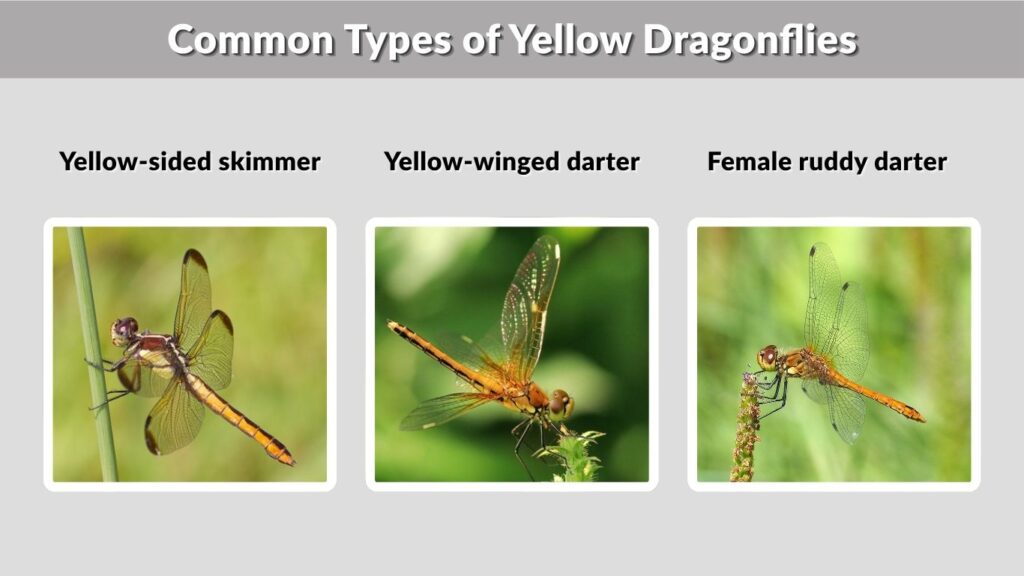
Several dragonflies may appear yellow during part or all of their adult lives.
| Dragonfly | Typical yellow features |
| Yellow-sided skimmer | Yellow sides and abdominal stripe |
| Yellow-winged darter | Yellow wing bases and yellow-brown female |
| Female ruddy darter | Ochre-yellow abdomen with black markings |
| Female black darter | Yellow-ochre body with dark markings |
| Common darter | Yellowish females and immature males |
| Golden-winged skimmer | Golden or amber-colored wings |
| Female meadowhawks | Yellow or brown abdomen with black markings |
| Some clubtails | Yellow-and-black striped body |
The exact species found in an area depends on geographic location and available freshwater habitat.
Yellow Dragonfly Habitat
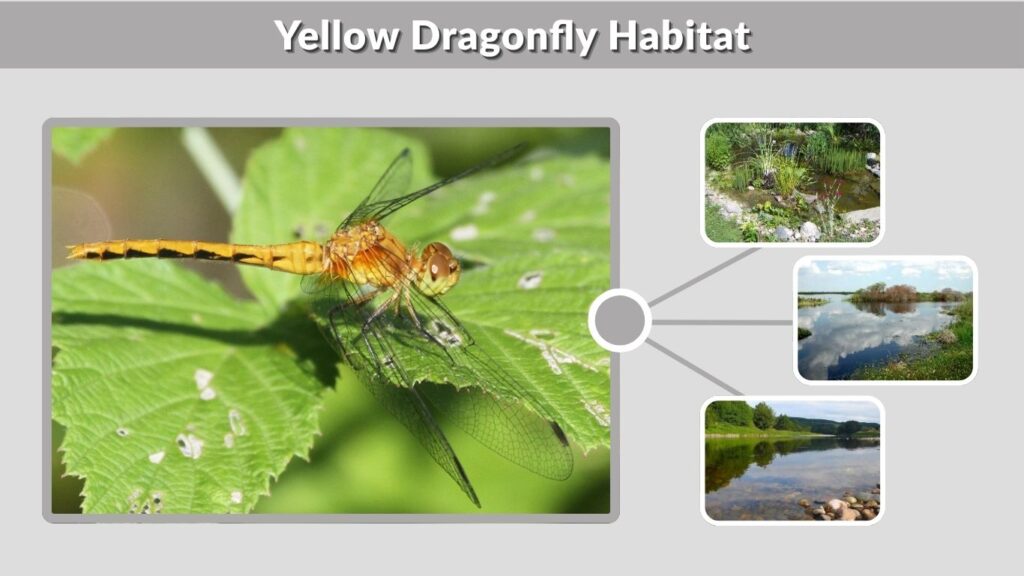
Yellow dragonflies live near freshwater because their eggs and nymphs develop in water. Adults may travel away from their breeding sites to hunt, rest, mature, or find mates.
Common Habitats
- Garden ponds
- Lakes and reservoirs
- Freshwater marshes
- Slow rivers and streams
- Temporary pools
- Wet meadows
- Swamps and bogs
- Drainage channels
- Rice fields
- Vegetated ditches
Some species prefer still water, while others require flowing streams or rivers. Dragonfly nymphs may hide in mud, sand, submerged plants, leaf litter, or beneath rocks.
Sunny areas with emergent vegetation are especially valuable. Plants provide resting places for adults and surfaces that mature nymphs can climb before transforming into winged dragonflies.
What Do Yellow Dragonflies Eat?
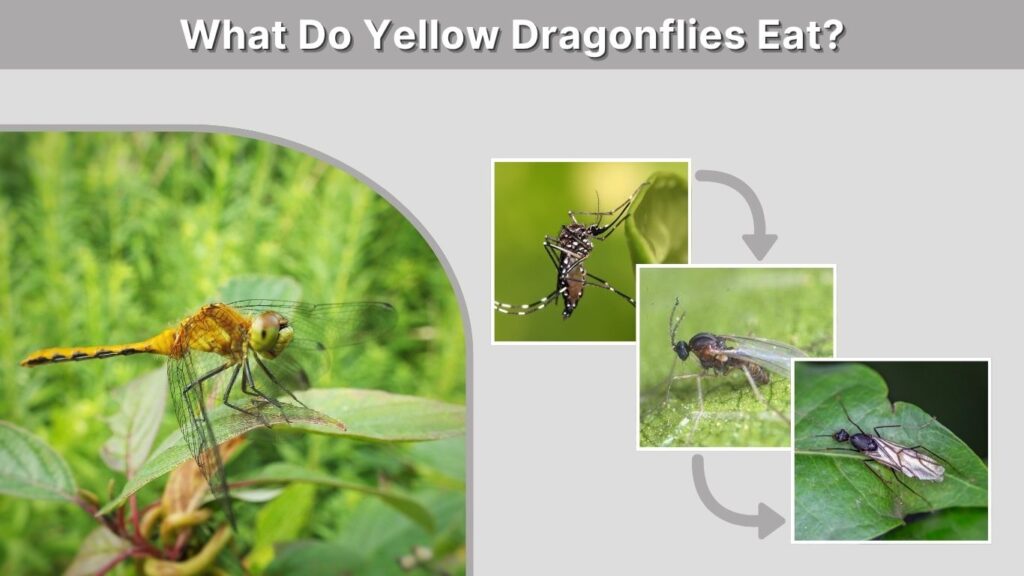
All dragonflies are predators during both their aquatic and adult stages. Adults hunt flying insects, while nymphs capture prey underwater.
Adult Diet
Adult yellow dragonflies commonly eat:
- Mosquitoes
- Midges
- Gnats
- Houseflies
- Horse flies
- Flying ants
- Small moths
- Aphids
- Mayflies
- Smaller dragonflies
They use their legs to form a basket beneath the body and capture prey in flight. Some species patrol continuously, while others wait on a perch before launching after passing insects.
Dragonflies can fly forward, backward, upward, and downward, as well as hover and change direction rapidly. This maneuverability makes them highly capable aerial hunters.
Nymph Diet
Aquatic dragonfly nymphs consume:
- Mosquito larvae
- Midge larvae
- Small aquatic insects
- Worms
- Tiny crustaceans
- Tadpoles
- Fish eggs
- Other dragonfly nymphs
- Very small fish
A nymph captures prey using an extendable lower mouthpart called a labium. It shoots this structure forward, grabs the animal, and pulls it back toward the mouth.
Yellow Dragonfly Lifecycle
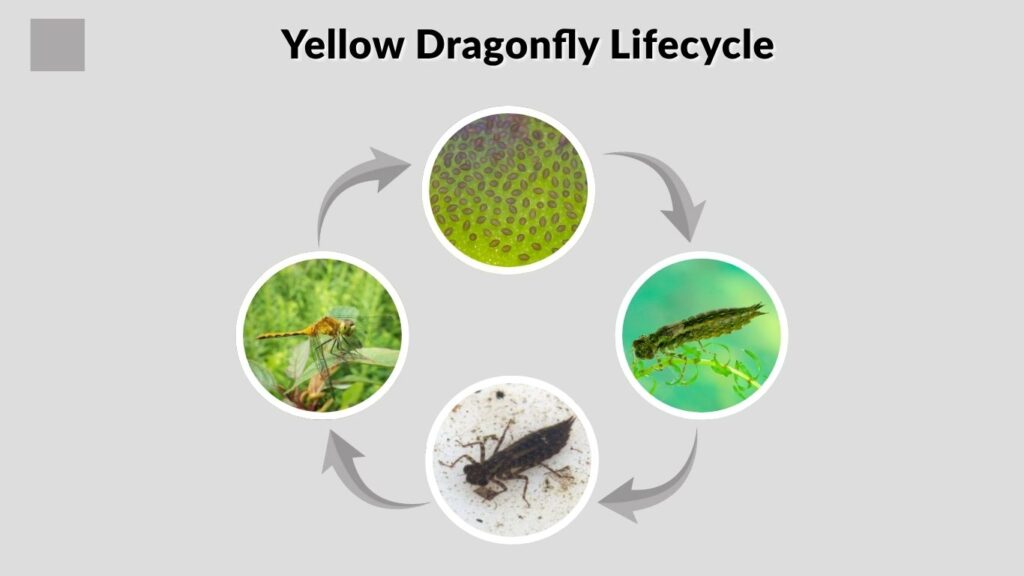
Dragonflies undergo incomplete metamorphosis. Their lifecycle contains three main stages: egg, aquatic nymph, and adult. They do not have a caterpillar or pupal stage.
1. Egg Stage
After mating, a female deposits eggs directly into water, onto wet surfaces, or inside aquatic plant tissue. Depending on the species, she may drop the eggs while flying or land and insert them into vegetation.
One female may lay hundreds of eggs in several batches. The eggs can hatch within weeks, remain dormant during unfavorable conditions, or survive until seasonal water returns.
2. Aquatic Nymph Stage
The egg hatches into a wingless aquatic nymph, sometimes called a naiad. This is usually the longest part of the dragonfly’s life.
Nymphs grow by molting repeatedly. Development can take several weeks in rapidly growing tropical species or several years in species living in colder environments. Some dragonfly nymph stages may last as long as seven years.
3. Emergence
When development is complete, the nymph climbs out of the water onto a plant stem, rock, log, or other support. Its skin splits, and the adult slowly pulls itself free.
The newly emerged dragonfly is soft, pale, and vulnerable. Its wings expand as fluid moves through their veins, and its body gradually hardens. An immature dragonfly may appear yellow even when its mature coloration will eventually be red, blue, or black.
4. Adult Stage
The adult begins feeding, developing mature colors, and searching for mates. Adults generally live for several weeks or months, depending on species, climate, predation, and food availability.
Their main purpose during this stage is to feed, reproduce, and lay eggs that begin the next generation.
Yellow Dragonfly Behavior
Yellow dragonflies are active during warm, sunny weather. They depend on external heat to power their flight muscles and may remain still during cool, cloudy, or rainy conditions.
Males commonly defend breeding territories near water. They patrol shorelines, chase rival males, and repeatedly return to favored perches.
Females may spend more time away from water, visiting breeding sites primarily to mate and lay eggs. This can make females more difficult to observe than territorial males.
Some species migrate over considerable distances. Others remain close to the pond, stream, or marsh where they emerged.
Are Yellow Dragonflies Dangerous?
Yellow dragonflies are not dangerous to humans. They have no stinger, do not produce venom, and do not deliberately attack people.
Their jaws can crush small insects, but they are not designed to feed on humans. A dragonfly trapped in someone’s hand might attempt a minor defensive nip, but it is unlikely to break the skin or require treatment.
Dragonflies are beneficial predators because they eat mosquitoes, flies, midges, and other insects. However, they do not remove enough mosquitoes by themselves to control a serious infestation.
Yellow Dragonfly Predators
Despite their speed, dragonflies are eaten by many animals.
Adult predators include:
- Birds
- Frogs
- Lizards
- Spiders
- Robber flies
- Larger dragonflies
- Fish that catch adults near the water
Aquatic nymphs may be eaten by fish, amphibians, water beetles, wading birds, and larger predatory insects. Adult dragonflies rely on rapid flight, excellent vision, and vegetation for protection.
How to Attract Yellow Dragonflies
A wildlife-friendly pond is the best way to attract dragonflies.
Create shallow and deeper sections, add native aquatic plants, and provide emergent stems where nymphs can climb out of the water. Flat rocks and upright sticks offer adults useful basking and resting places.
Avoid pesticides, which may kill dragonflies and their prey. A pond without ornamental fish is generally more suitable because fish can consume dragonfly eggs and nymphs.
Dragonflies may not arrive immediately, but a clean, sunny pond surrounded by natural vegetation can eventually support several species.
FAQs
Is a yellow dragonfly a separate species?
No. “Yellow dragonfly” is a descriptive name rather than one official species. It may refer to naturally yellow species, yellow females, or immature males whose bodies will change color as they mature.
What does seeing a yellow dragonfly mean?
Biologically, seeing one usually means suitable insect prey and freshwater habitat exist nearby. Cultural interpretations sometimes associate yellow dragonflies with happiness, energy, or change, but these meanings are symbolic rather than scientific.
Do yellow dragonflies bite or sting?
Yellow dragonflies cannot sting and do not normally bite humans. Their jaws are used to capture and consume small insects. Rough handling may cause a harmless defensive nip, so observing them without touching is best.
How long does a yellow dragonfly live?
The complete lifespan varies by species. The aquatic nymph stage may last several months or years, while the winged adult usually survives for several weeks or months. Climate, food, predators, and habitat conditions influence longevity.
Are yellow dragonflies good for gardens?
Yes. They consume mosquitoes, flies, gnats, midges, and other small insects. A garden pond with clean water and native vegetation can provide breeding habitat while supporting dragonflies and other beneficial wildlife.