
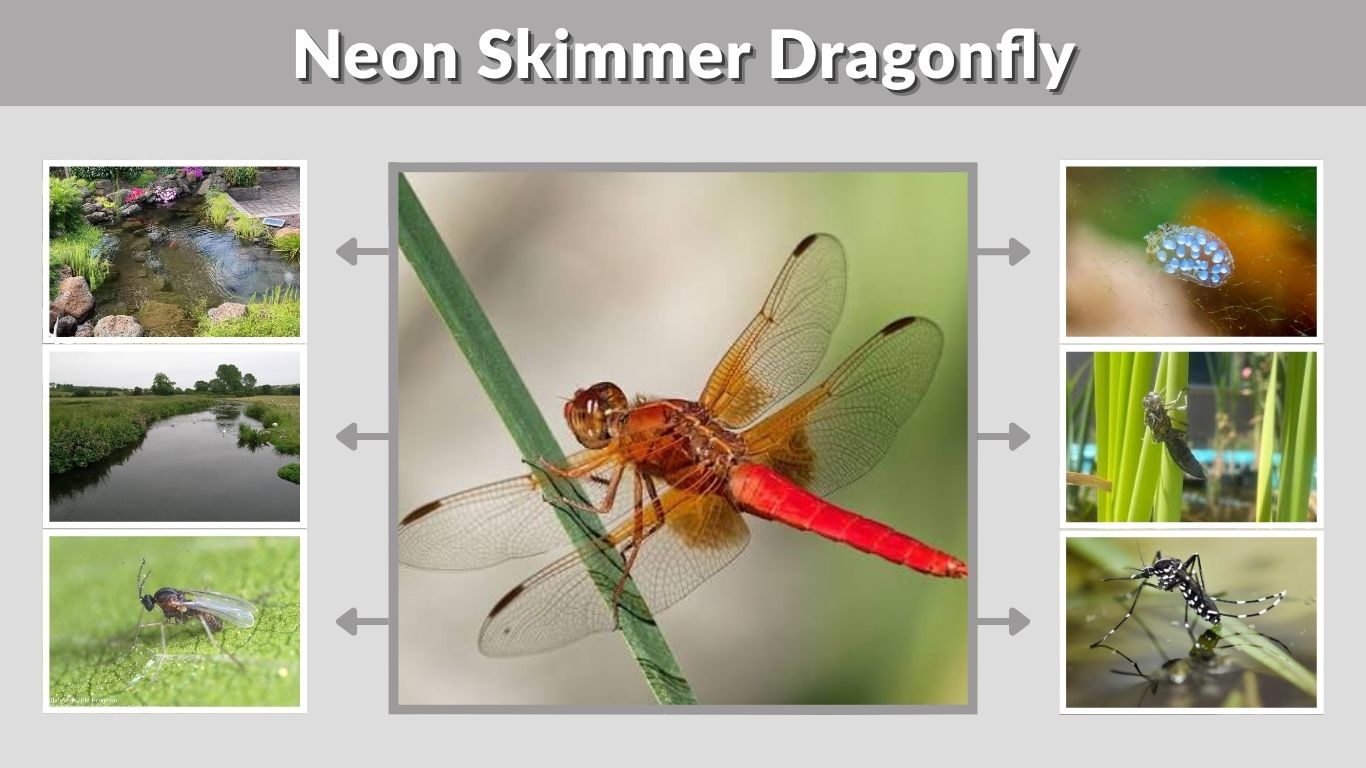
The neon skimmer dragonfly is a brilliantly colored insect commonly found around ponds, streams, canals, and other warm freshwater habitats. Mature males display a vivid red or reddish-pink body, while females usually have yellowish-brown coloration and dark markings. Scientifically known as Libellula croceipennis, this active aerial predator helps control mosquitoes, flies, and other small insects. Its bright appearance, territorial behavior, and habit of resting on exposed perches make it relatively easy to observe. Here is everything you need to know about the neon skimmer’s appearance, range, diet, behavior, life cycle, and ecological importance.
What Is a Neon Skimmer Dragonfly?
The neon skimmer is a medium-to-large dragonfly belonging to the family Libellulidae, commonly called the skimmers. This family includes numerous colorful species that frequently patrol open water and sunny wetlands.
Neon skimmers are strong and agile fliers. They spend much of the day hunting, defending territories, looking for mates, and resting on exposed vegetation. Although they may appear curious and occasionally fly close to people, they are not aggressive toward humans.
| Feature | Description |
|---|---|
| Scientific name | Libellula croceipennis |
| Family | Libellulidae |
| Average length | Approximately 2–2.4 inches |
| Male coloration | Bright red to reddish pink |
| Female coloration | Yellowish brown to reddish brown |
| Primary habitat | Ponds, streams, canals, and wetlands |
| Diet | Mosquitoes, flies, midges, and other insects |
| Activity period | Primarily during warm, sunny weather |
| Danger to humans | Harmless |
Meaning of the Name
The name “neon skimmer” refers to the brilliant coloration of the mature male and the insect’s fast, skimming flight over water. Under bright sunlight, a male’s red body can appear almost fluorescent.
The scientific name Libellula croceipennis also relates to its appearance. The species name is associated with the saffron or reddish coloring visible on the body and wings. However, color intensity can vary with age, sex, lighting, and geographic location.
Neon Skimmer Size
Adult neon skimmers usually measure approximately 2–2.4 inches in body length. Their broad wings produce a total wingspan that may approach 3 inches or slightly more.
Their relatively large size, robust abdomen, and powerful flight separate them from smaller damselflies. When resting, a neon skimmer holds its four wings open and away from the body. Damselflies are generally more slender and often fold their wings above the abdomen.
How to Identify a Neon Skimmer Dragonfly
Adult males and females look noticeably different. This difference in appearance, known as sexual dimorphism, sometimes causes observers to mistake them for separate species.
Color is helpful for identification, but it should not be the only feature considered. Body shape, wing markings, facial color, habitat, and geographic range are also important.
Male Neon Skimmer
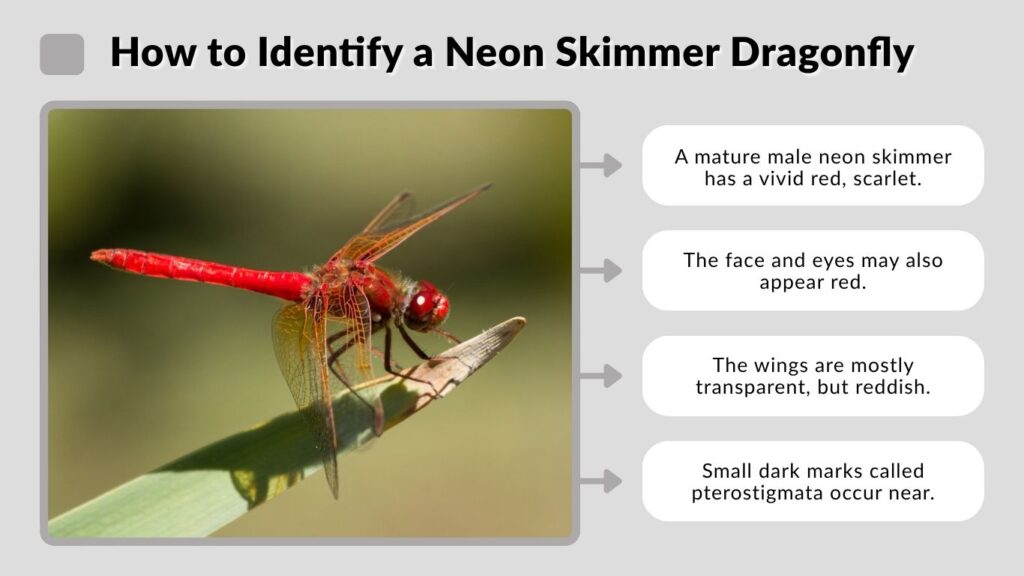
A mature male neon skimmer has a vivid red, scarlet, or reddish-pink body. The face and eyes may also appear red, creating an almost completely crimson appearance.
The wings are mostly transparent, but reddish or amber coloring may be visible near their bases. Small dark marks called pterostigmata occur near the outer leading edges of the wings. A male’s abdomen is broad and relatively flattened compared with those of some other red dragonflies.
Young males may initially resemble females. Their bright adult coloration develops gradually as they mature.
Female Neon Skimmer
Female neon skimmers usually have yellowish-brown, tan, or reddish-brown bodies. Dark lines or markings may run along the abdomen, giving females a more patterned appearance than mature males.
Their wings are mostly clear, although some amber shading can occur near the bases. Females may be less noticeable because their earthy colors blend more easily with dry vegetation, branches, and the edges of muddy ponds.
Immature individuals of both sexes may also show yellow-brown coloration, so close observation may be needed to distinguish a young male from a female.
Neon Skimmer vs. Flame Skimmer
The neon skimmer is sometimes confused with the flame skimmer because both can have striking red or orange bodies. The most noticeable difference usually appears in their wings.
A flame skimmer often has extensive orange or amber coloring across the wings, particularly from the bases toward the middle. A neon skimmer’s wings are generally clearer, with more limited coloration near the bases.
Geographic range and local habitat can help with identification. Because color changes under different lighting conditions, photographs taken from multiple angles are useful when comparing similar species.
Where Do Neon Skimmer Dragonflies Live?
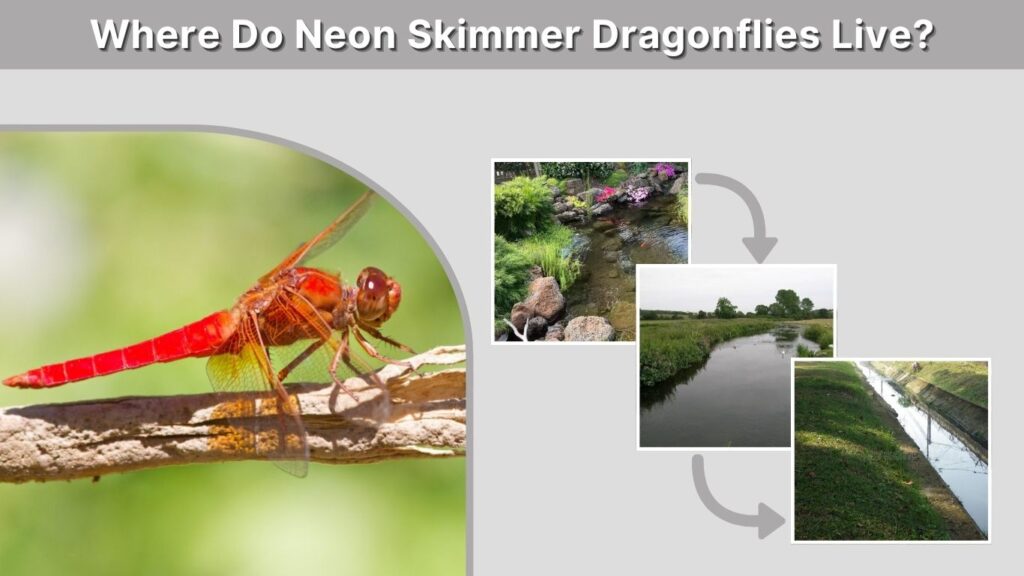
Neon skimmers are associated with warm regions of the Americas. In the United States, they are best known from southern and southwestern areas, particularly places with hot summers and reliable freshwater habitats. Their broader distribution extends south through Mexico and parts of Central America.
Within their range, they can occupy natural and human-made bodies of water. An open shoreline, abundant sunlight, suitable perches, and healthy insect populations make an area attractive to adults.
Preferred Habitat
Neon skimmers can be found near:
- Ponds and small lakes
- Slow-moving streams
- Canals and drainage channels
- Marshes and wetlands
- Irrigation ditches
- Reservoir edges
- Park ponds
- Shallow pools with aquatic vegetation
They often favor open, sunny environments instead of deeply shaded woodland pools. Warm temperatures support their flight muscles and increase the activity of the flying insects they hunt.
Perching Behavior
A neon skimmer frequently rests on the tip of a twig, reed, grass stem, fence, or other exposed object. From this perch, it watches for prey, intruding males, and potential mates.
The dragonfly may repeatedly leave its position, make a short hunting or territorial flight, and return to the same perch. This behavior provides photographers and wildlife watchers with several opportunities to observe it closely.
Dragonflies may also adjust the angle of their bodies in relation to the sun. This helps them control body temperature during changing weather conditions.
What Do Neon Skimmer Dragonflies Eat?
Neon skimmers are carnivorous throughout their lives. Both aquatic nymphs and flying adults hunt other animals, although the types of prey available to them are different.
Adults catch insects in the air using their legs. The legs form a basket-like structure beneath the body, allowing the dragonfly to grab prey while flying. It may eat a small insect without landing or carry larger prey to a perch.
Adult Diet
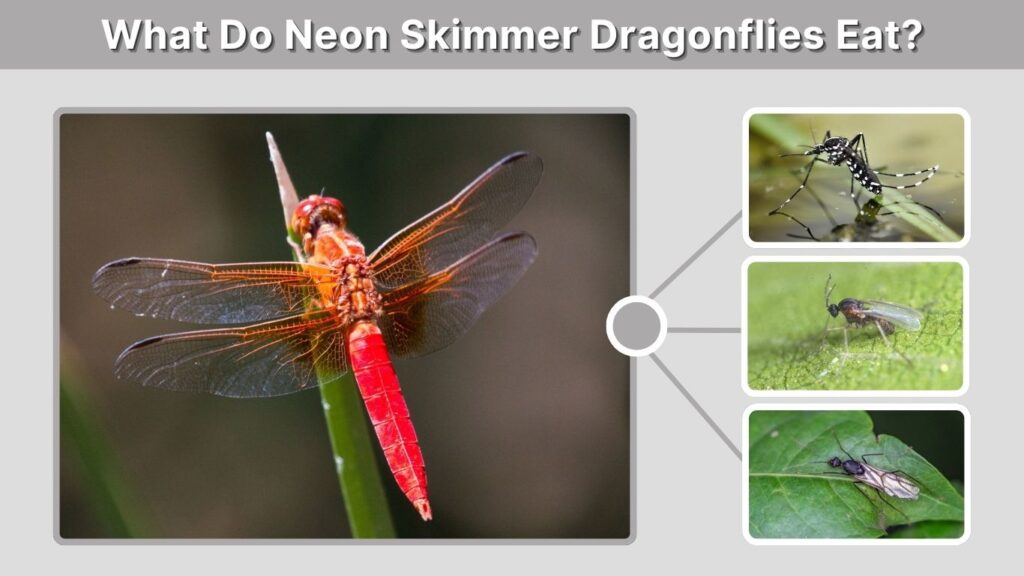
Adult neon skimmers may eat:
- Mosquitoes
- Midges
- Gnats
- Small flies
- Flying ants
- Small moths
- Termites
- Other small dragonflies
Their large compound eyes help them detect movement in several directions. Once prey is located, their speed and rapid turns make escape difficult.
Although they consume mosquitoes, neon skimmers do not eliminate mosquito populations by themselves. They are one part of a larger community of natural predators that helps regulate aquatic and flying insects.
Nymph Diet
Young dragonflies, called nymphs or naiads, live underwater. They are ambush predators that hide among vegetation, sediment, submerged roots, and plant debris.
Nymphs feed on mosquito larvae, aquatic insects, worms, tiny crustaceans, and other small water-dwelling animals. Larger nymphs may sometimes capture tadpoles or very small fish.
A specialized extendable mouthpart allows a nymph to seize prey quickly. This adaptation makes dragonfly nymphs effective predators long before they develop wings.
Neon Skimmer Behavior
Neon skimmers are most active during warm, clear, and sunny weather. They require heat to operate their flight muscles efficiently, so activity may decline during cool, cloudy, or rainy periods.
Males are especially conspicuous because they patrol open water and defend breeding territories. Females may spend more time away from the water when they are not mating or laying eggs.
Territorial Behavior
A male often claims a section of shoreline or open water. He flies back and forth across it while watching for rival males. When another dragonfly enters, the resident may chase it away through a series of fast turns.
These aerial confrontations usually end without serious injury. Their purpose is to control access to suitable egg-laying habitat and increase the male’s chances of mating.
The male commonly returns to a favorite perch after patrolling. His bright coloration may advertise his maturity and presence to other neon skimmers.
Flight and Hunting
Neon skimmers can accelerate rapidly, hover briefly, change direction, and intercept prey in midair. Their two pairs of wings can move with a degree of independence, providing excellent control.
They primarily rely on vision while hunting. Thousands of tiny visual units form each compound eye, giving the dragonfly a broad field of view and exceptional sensitivity to movement.
Neon Skimmer Life Cycle
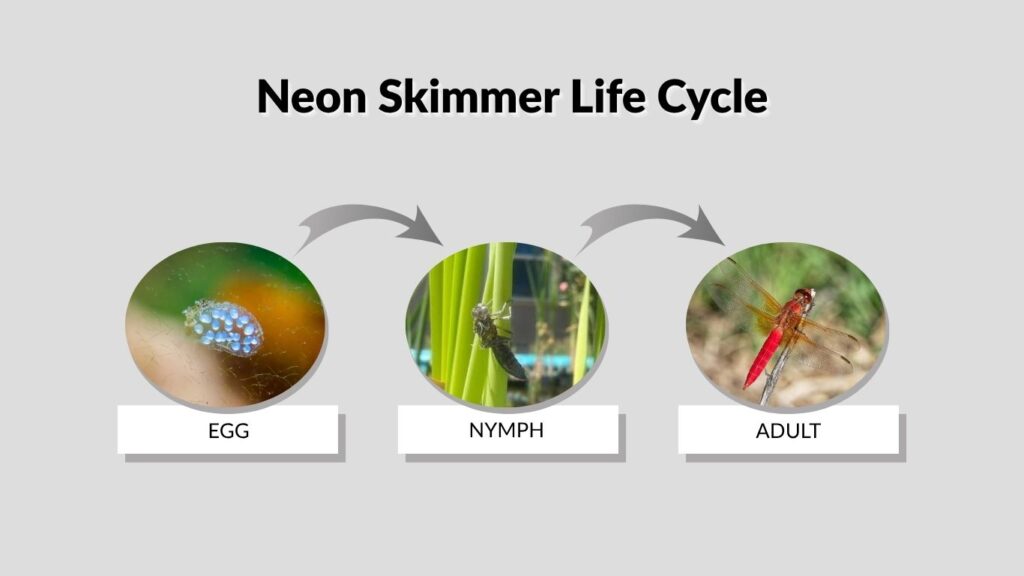
The neon skimmer undergoes incomplete metamorphosis. Its life cycle consists of three major stages: egg, aquatic nymph, and winged adult. There is no pupal stage like the one found in butterflies and beetles.
Much of the dragonfly’s life is spent underwater as a nymph. The familiar flying adult represents the reproductive and dispersal stage.
Mating and Egg-Laying
During mating, the male and female form a characteristic wheel-shaped position. After mating, the female lays her eggs in or near water.
She may touch the tip of her abdomen against the surface repeatedly, depositing eggs while in flight. The male may remain nearby, patrol the area, or guard her against competing males.
Suitable water is essential because the newly hatched nymphs are aquatic. Vegetation and shallow margins provide them with food, shelter, and protection from larger predators.
Aquatic Nymph Stage
After hatching, the nymph lives beneath the water and molts repeatedly as it grows. The exact development period depends on temperature, food availability, water conditions, and other environmental factors.
The nymph has no functional wings, but developing wing pads become visible as it approaches maturity. It breathes underwater and moves through submerged vegetation while hunting small animals.
Because nymphs need reasonably stable aquatic conditions, draining or contaminating their habitat can interrupt the species’ reproductive cycle.
Emergence as an Adult
When development is complete, the nymph climbs out of the water on a plant stem, rock, wall, or other support. Its outer skin splits, and the soft adult slowly pulls itself free.
The new dragonfly expands its wings and abdomen before its body hardens. An empty nymph skin, called an exuvia, remains attached to the emergence surface.
The adult is initially pale and vulnerable. Its colors deepen over the following days as it matures and begins hunting actively.
Are Neon Skimmer Dragonflies Dangerous?
Neon skimmer dragonflies are harmless to people. They do not possess a stinger and do not attack humans. Their mouthparts are designed to capture and consume relatively small insects.
A dragonfly might attempt to bite if it is trapped or handled roughly, but such incidents are uncommon and generally cause little harm. Allowing the insect to remain free is safest for both the dragonfly and the observer.
Neon skimmers are also not poisonous. People can enjoy watching or photographing them without worrying about venom, toxic secretions, or aggressive swarms.
Importance of Neon Skimmers
Neon skimmers play several valuable roles in wetland ecosystems. As both predators and prey, they connect aquatic and terrestrial food webs.
Nymphs help regulate populations of mosquito larvae and other aquatic organisms. Adults consume numerous flying insects, while birds, frogs, fish, lizards, and larger insects may feed on the dragonflies themselves.
Their presence can also offer clues about local habitat. However, finding neon skimmers alone does not prove that water is completely unpolluted, because different dragonfly species tolerate different environmental conditions.
Attracting Neon Skimmers to a Yard
A sunny wildlife pond can encourage neon skimmers and other dragonflies to visit. The pond should include different depths, open water, native aquatic plants, and upright stems that nymphs can use during emergence.
Avoid routinely spraying broad-spectrum insecticides around the pond. These chemicals may kill dragonflies, reduce their prey, or enter the water. Rocks, reeds, and nearby shrubs can provide resting, hunting, and emergence sites.
Fish may eat large numbers of dragonfly eggs and nymphs. A fish-free section or shallow planted area can provide safer habitat for developing dragonflies.
FAQs
How big is a neon skimmer dragonfly?
An adult neon skimmer is generally around 2–2.4 inches long, with a wingspan that may approach or exceed 3 inches. Its strong body and broad wings make it noticeably larger than most damselflies, although it is not among the world’s largest dragonflies.
Why is the neon skimmer bright red?
The brilliant red coloration is primarily a characteristic of mature males. Young males begin with duller colors that intensify as they age. Females remain yellowish brown or reddish brown, allowing observers to distinguish the sexes once the dragonflies reach maturity.
Do neon skimmer dragonflies bite or sting?
Neon skimmers cannot sting and do not normally bite people. A dragonfly handled roughly may use its mouthparts defensively, but it is unlikely to break human skin. These insects prefer escaping and should be observed without being captured or handled.
Are neon skimmers beneficial?
Yes. Adult neon skimmers eat mosquitoes, midges, flies, and other flying insects. Their aquatic nymphs also prey on mosquito larvae and small aquatic animals. They contribute to natural population control while providing food for birds, fish, frogs, and other wildlife.
How can you distinguish a male from a female?
A mature male usually has a brilliant red or reddish-pink body, including reddish eyes and facial features. The female is typically yellowish brown or reddish brown with darker abdominal markings. Immature males may resemble females until their brighter adult coloration develops.