
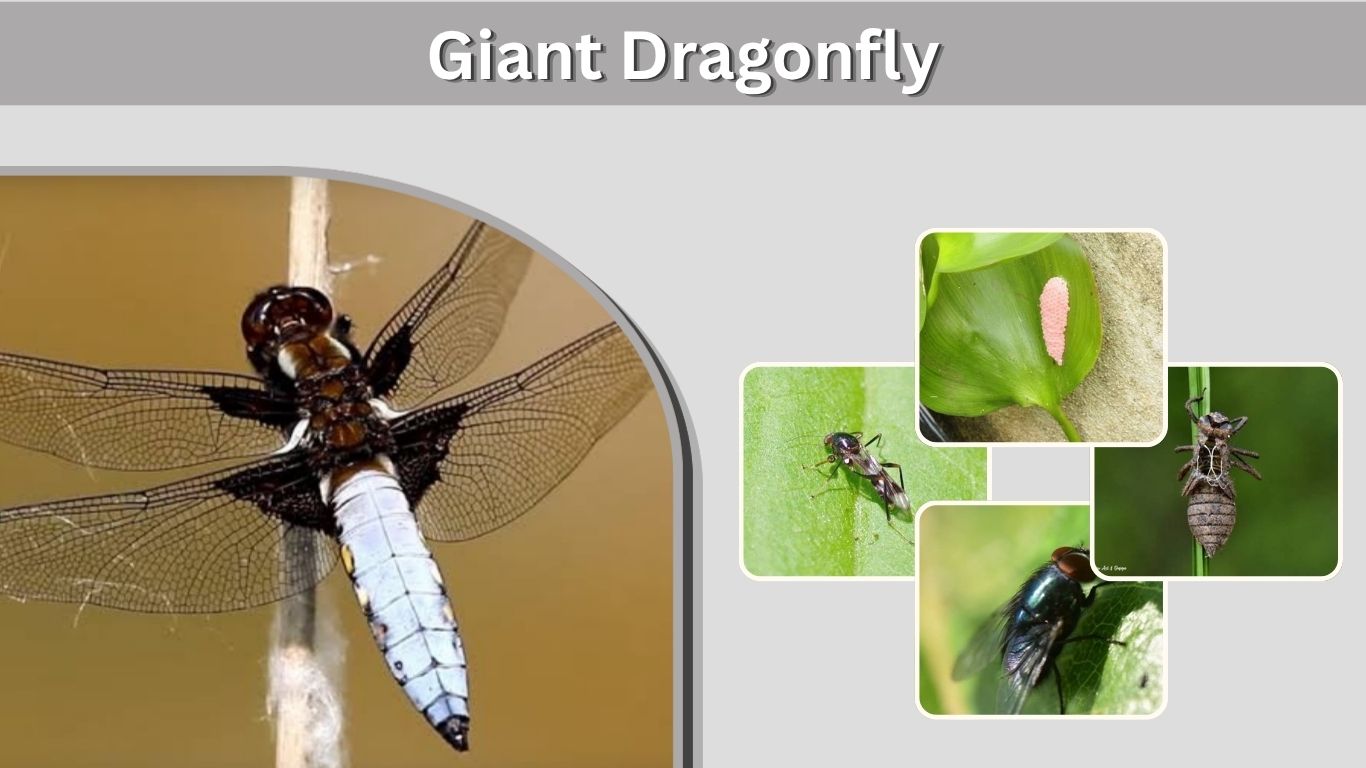
Giant dragonflies are some of the most impressive flying insects, with long bodies, powerful wings, huge eyes, and exceptional aerial hunting skills. The term can describe several unusually large modern species, including the giant darner and giant petaltail, as well as extinct dragonfly-like insects such as Meganeura. Some prehistoric relatives reached wingspans far beyond anything alive today. From enormous fossils to modern species found in North America, Australia, and Asia, giant dragonflies reveal an extraordinary story of insect evolution and adaptation.
What Is a Giant Dragonfly?
“Giant dragonfly” is not the scientific name of one single species. The term is commonly used for particularly large members of the dragonfly group and is also informally applied to extinct dragonfly-like insects. Modern dragonflies belong to the order Odonata, while famous prehistoric giants such as Meganeura belonged to an extinct dragonfly-like lineage called Meganisoptera.
Giant Dragonfly Identification
Large modern dragonflies typically have:
- Long, slender or robust abdomens
- Two pairs of transparent wings
- Very large compound eyes
- Six strong legs
- Powerful flight muscles
- Green, blue, black, brown, or yellow markings
- Rapid and highly maneuverable flight
- A habit of hunting other insects in the air
The exact appearance depends on the species. Giant darners, petaltails, and giant hawkers can look noticeably different from one another.
How Big Can a Giant Dragonfly Get?
Living dragonflies can reach impressive dimensions, although none approaches the enormous wingspans of prehistoric griffinflies. The Australian giant petaltail, Petalura ingentissima, can reach roughly 16 cm across the wings, while some Asian giant hawkers are similarly enormous.
By comparison, extinct dragonfly-like insects could exceed 60 cm in wingspan. This makes the difference between modern and prehistoric forms dramatic.
Giant Darner Dragonfly
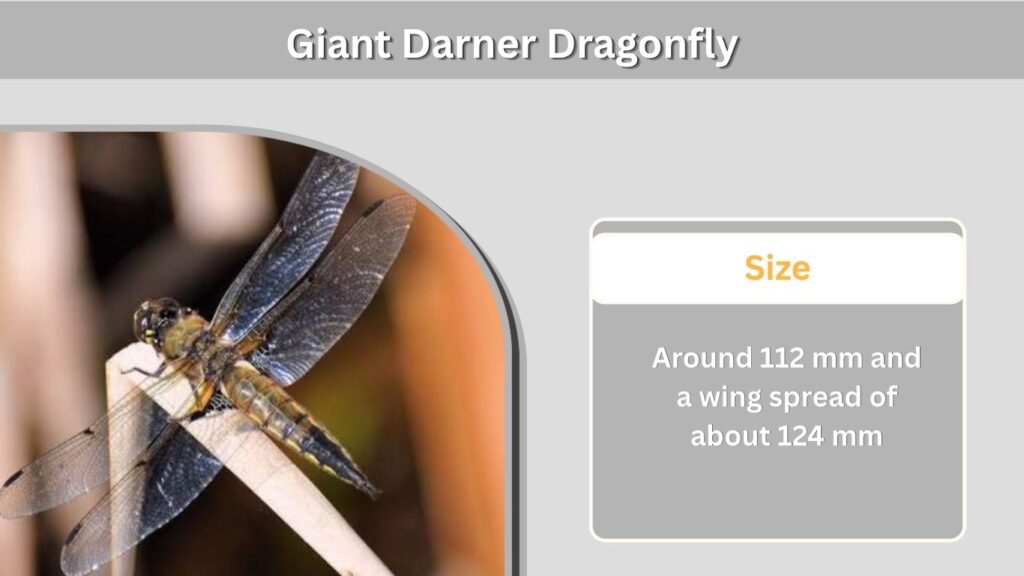
The giant darner, Anax walsinghami, is one of the best-known large dragonflies of North America. It belongs to the darner family Aeshnidae and is especially associated with the southwestern United States and areas farther south into Mexico. Odonata Central lists its range from parts of the western and southern United States southward into Mexico.
Giant Darner Size
The giant darner is regarded as the largest dragonfly in the continental United States. Historical measurements give exceptionally large individuals a total length of around 112 mm and a wing spread of about 124 mm.
Its size becomes especially noticeable when it patrols slowly around streams or flies close to an observer.
What Does a Giant Darner Look Like?
Giant darners are recognizable by their combination of:
- Very long abdomen
- Greenish thorax
- Blue markings in males
- Large greenish eyes
- Transparent wings
- Strong, steady flight
- Large overall body size
Like other darners, they are active aerial predators and spend considerable time flying rather than sitting exposed on vegetation.
Giant Darner Range
The species occurs mainly in southwestern North America and extends south into Mexico. Records include California, Arizona, Texas, and other parts of its southwestern range.
This means that a very large dragonfly observed in the eastern United States is not automatically a giant darner.
Giant Petaltail Dragonfly
The name giant petaltail is most strongly associated with Petalura ingentissima, a remarkable Australian dragonfly. It belongs to Petaluridae, an ancient family of living dragonflies whose members have unusual larval habitats. The species occurs in Queensland, Australia.
Giant Petaltail Size
The female giant petaltail can reach approximately:
- Body length: about 12.5 cm
- Wingspan: around 15.8–16.2 cm
- Build: large and heavily constructed
- Color: primarily dark with yellow markings
These dimensions place it among the largest living true dragonflies.
Giant Petaltail Larvae
Petaltail larvae are especially interesting because some species occupy wet burrows and seepage habitats rather than living fully exposed in open water.
The giant petaltail’s immature stage can remain associated with saturated soils and burrows near wet habitats before emerging as a large flying adult.
Giant Hawker Dragonfly
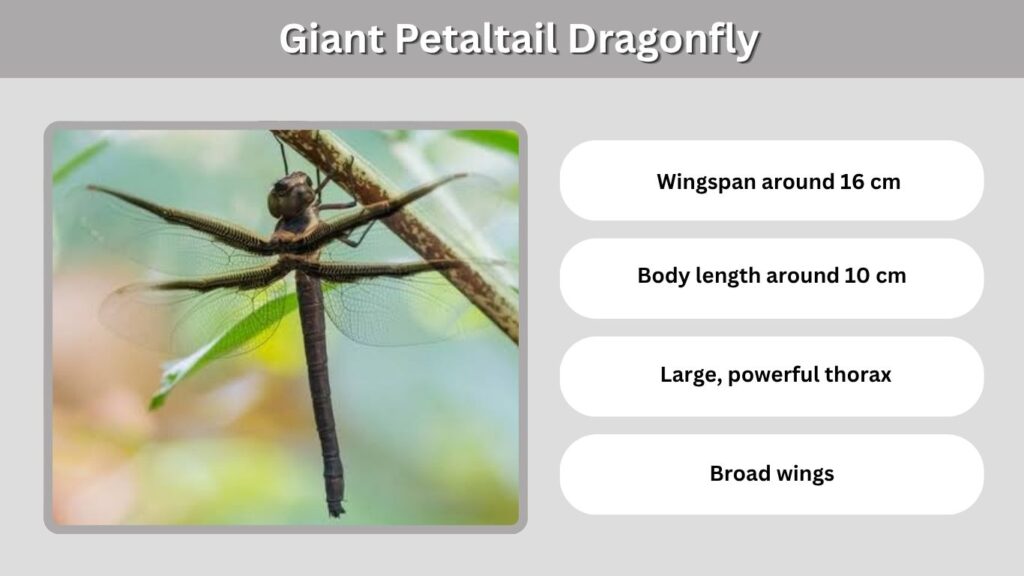
Another contender among the world’s biggest dragonflies is the giant hawker or gigantic riverhawker, Tetracanthagyna plagiata. This large species occurs in parts of Southeast Asia, including the Sundaland region. Females are particularly impressive because they are considerably larger and heavier than most familiar dragonflies.
How Large Is a Giant Hawker?
Reported maximum measurements reach approximately:
- Wingspan around 16 cm
- Body length around 10 cm
- Large, powerful thorax
- Broad wings
- Heavy overall build
Depending on whether size is judged by wingspan, body length, mass, or wing area, different species can be described as the “largest” living dragonfly.
Where Does the Giant Hawker Live?
The giant hawker occurs in tropical Southeast Asia, including areas of Malaysia, Singapore, Sumatra, Borneo, and neighboring regions.
Its larvae develop in forest-stream environments, while adults are powerful fliers that may be particularly active during lower-light periods.
Giant Prehistoric Dragonflies
Some of the most famous “giant dragonflies” never lived alongside humans. During the late Paleozoic Era, enormous predatory insects resembling modern dragonflies flew through ancient ecosystems. They are commonly called giant dragonflies, although scientifically they belonged to extinct griffinfly groups rather than to the true modern dragonflies.
Meganeura Giant Dragonfly
Meganeura monyi lived during the Late Carboniferous roughly 300 million years ago.
It had:
- A dragonfly-like body
- Extremely large wings
- Strong predatory legs
- Spines useful for trapping prey
- Large chewing mouthparts
- A wingspan dramatically greater than modern dragonflies
The Natural History Museum describes Meganeura as a giant early dragonfly-like predator that probably fed primarily on other insects.
How Big Was Meganeura?
Reconstructions of Meganeura monyi indicate a wingspan around 65 cm, making it one of the largest flying insects known from the fossil record.
That is roughly four times the wingspan of the biggest living true dragonflies.
Although popular illustrations sometimes exaggerate its size, even realistic estimates make it enormous compared with insects flying today.
Was Meganeura the Largest Insect Ever?
Meganeura is famous, but another closely related prehistoric insect may have been even larger.
Meganeuropsis permiana lived later, during the Early Permian, and is among the largest flying insects known from fossils. Reconstructions place its wingspan at roughly 70 cm.
Meganeuropsis vs. Meganeura
The main comparison is:
- Meganeura monyi – Late Carboniferous
- Meganeuropsis permiana – Early Permian
- Both were dragonfly-like griffinflies
- Both were large aerial predators
- Meganeuropsis appears to have reached the greater maximum wingspan
Neither was technically a modern true dragonfly, despite being commonly described that way in popular discussions.
Why Were Prehistoric Dragonflies So Giant?
Scientists have proposed several explanations for the extraordinary size of late Paleozoic insects. One important factor is that atmospheric oxygen concentrations were substantially different during portions of the Carboniferous and Permian. Because insects deliver oxygen through a tracheal respiratory system rather than lungs, atmospheric conditions can influence limits on body size.
High Oxygen May Have Helped
Higher oxygen availability may have made it easier for very large insects to supply tissues with enough oxygen.
However, giant insect evolution was probably influenced by more than one factor, including:
- Atmospheric oxygen
- Climate
- Available prey
- Predator competition
- Evolutionary history
- Flight mechanics
The exact reasons for extreme insect gigantism remain a subject of scientific investigation rather than having one simple explanation.
Giant Dragonfly Life Cycle
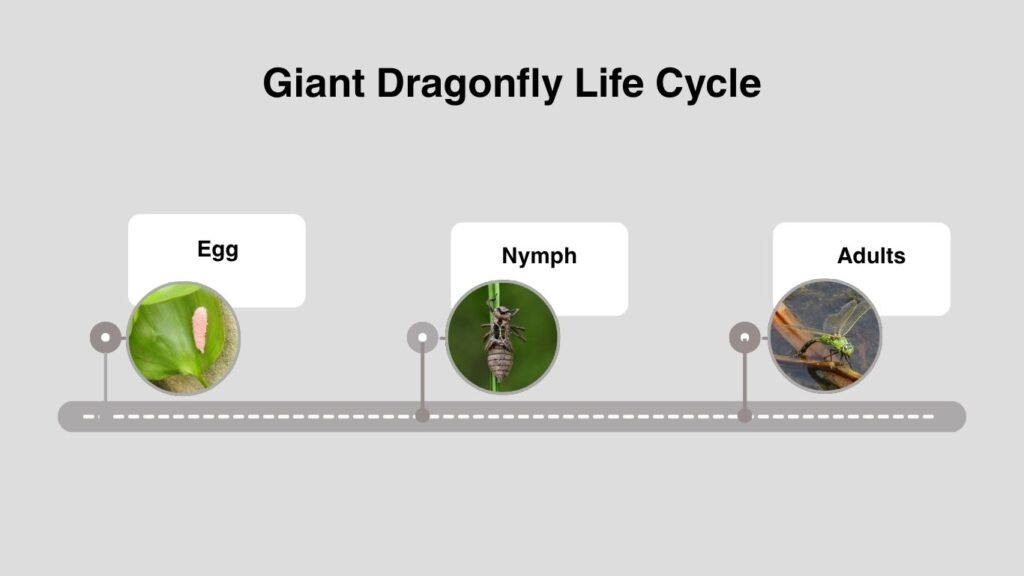
Modern giant dragonflies follow the same basic incomplete-metamorphosis pattern as other dragonflies. They begin life in aquatic or extremely wet environments, spend their immature stage as predatory nymphs, and eventually emerge from the water or wet substrate to become winged adults.
Egg to Adult
The basic life cycle is:
- Egg – deposited in or near suitable wet habitat.
- Nymph – lives in water or saturated habitat and hunts prey.
- Molting stages – the nymph grows through repeated molts.
- Emergence – the mature nymph climbs onto vegetation or another surface.
- Adult – the winged dragonfly emerges and begins its aerial life.
There is no pupal stage as there is in butterflies and beetles.
Giant Dragonfly Larvae
Large dragonfly nymphs are formidable aquatic predators.
Depending on the species and size, prey may include:
- Mosquito larvae
- Aquatic insects
- Small crustaceans
- Tadpoles
- Small fish
- Other dragonfly nymphs
Their extendable lower mouthpart allows them to seize prey extremely quickly.
What Do Giant Dragonflies Eat?
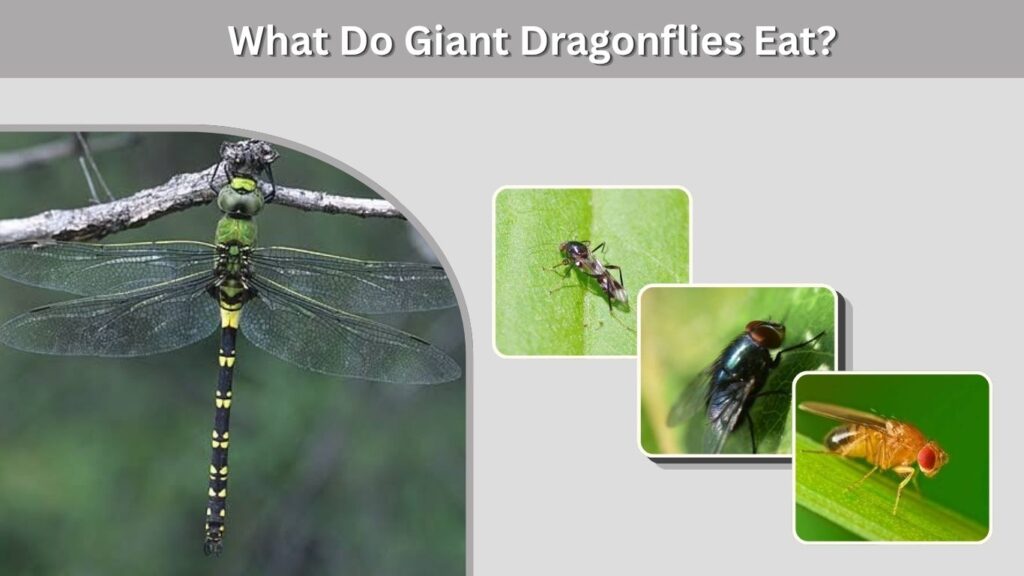
Adult giant dragonflies are carnivorous aerial hunters. Their excellent eyesight, powerful wings, and basket-like arrangement of the legs allow them to intercept insects while flying.
Common Prey
Their diet may include:
- Mosquitoes
- Midges
- Flies
- Moths
- Flying ants
- Small bees and wasps
- Smaller dragonflies
- Other flying insects
Large species can tackle somewhat larger prey than small dragonflies, but they remain primarily insect predators.
Are Giant Dragonflies Dangerous?
Despite their intimidating size, modern giant dragonflies are not dangerous predators of humans. They do not sting and have no venom apparatus. Their jaws are designed for capturing insects rather than attacking people.
Do Giant Dragonflies Bite?
A large dragonfly may attempt to bite defensively if someone catches it and holds it in a hand.
However, giant dragonflies:
- Do not hunt humans
- Do not suck blood
- Do not sting
- Do not deliberately chase people
- Usually fly away when disturbed
The easiest way to avoid a defensive nip is simply to observe them without grabbing them.
Giant Dragonflies in Australia and the United States
Different regions have their own exceptionally large species. Australia is particularly notable for petaltails, while the continental United States is home to the giant darner.
Giant Dragonfly in Australia
Australia is home to several impressive petaltail dragonflies, including Petalura ingentissima. Queensland is especially important for this species.
Australia also has Petalura gigantea, whose common name is simply the giant dragonfly.
Giant Dragonfly in the United States
The giant darner, Anax walsinghami, is generally recognized as the largest dragonfly of the continental United States and occurs primarily in the Southwest.
Other large darners and petaltails occur elsewhere in North America, so identification should consider location, size, coloration, and wing pattern together.
FAQs
What Is the Biggest Dragonfly Alive Today?
There is no completely simple answer because “biggest” may refer to wingspan, body length, mass, or wing area. The giant petaltail Petalura ingentissima and giant hawker Tetracanthagyna plagiata are among the largest living true dragonflies.
How Big Was the Giant Prehistoric Dragonfly?
The largest prehistoric dragonfly-like insects had wingspans around 65–70 cm. Meganeura monyi was enormous, while Meganeuropsis permiana may have reached approximately 71 cm across its wings. They were griffinflies rather than true modern dragonflies.
Are Giant Dragonflies Extinct?
Prehistoric giants such as Meganeura and Meganeuropsis are extinct. However, many large modern dragonflies remain alive today, including the giant darner in North America, giant petaltail in Australia, and giant hawker in Southeast Asia.
Can a Giant Dragonfly Hurt a Human?
Giant dragonflies are not considered dangerous to people. They cannot sting and normally avoid humans. A captured individual could potentially use its jaws defensively, so handling large dragonflies unnecessarily is best avoided.
Did Giant Dragonflies Live With Dinosaurs?
The famous Meganeura lived roughly 300 million years ago during the Carboniferous, long before dinosaurs appeared. Meganeuropsis lived during the Permian, also before the age of dinosaurs. Calling them “dinosaur dragonflies” is therefore misleading.