
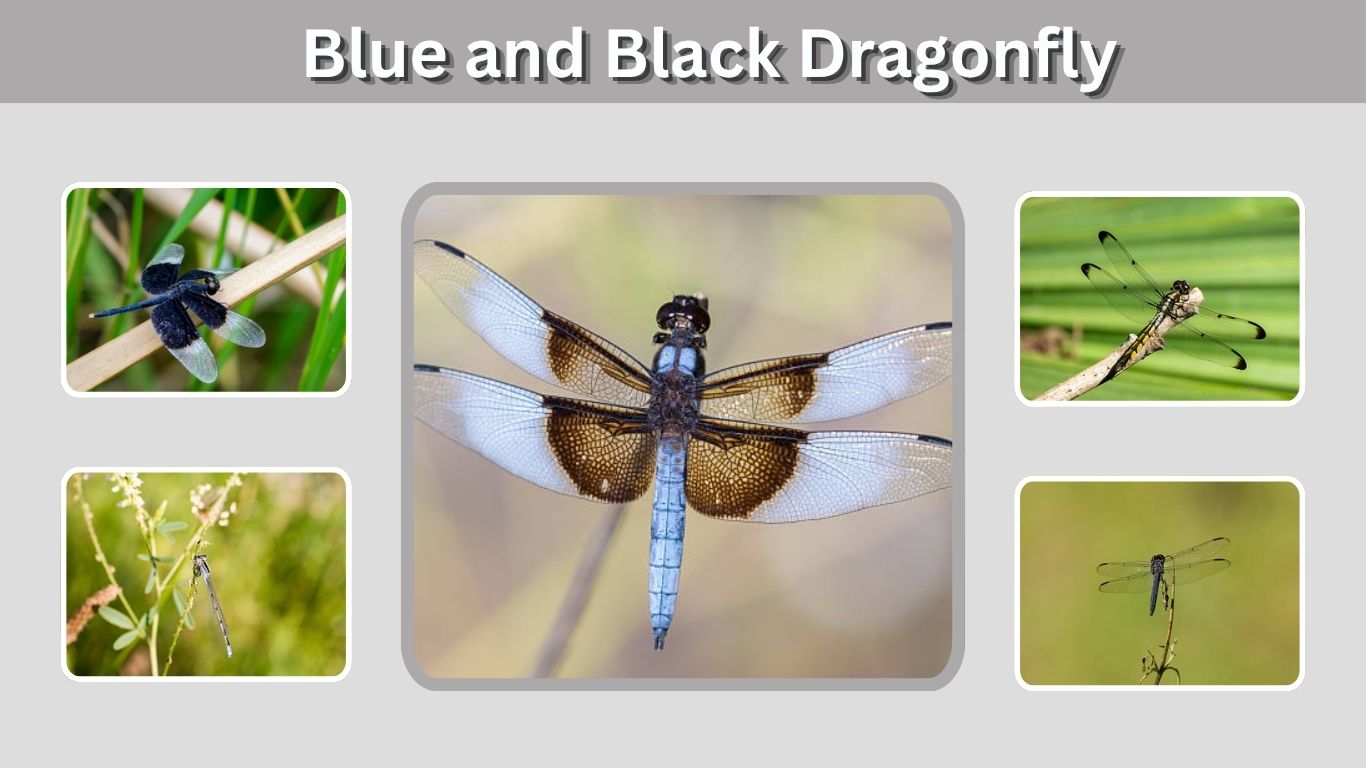
A blue and black dragonfly can belong to several different species rather than one specific insect. Some have bright blue bodies with black heads or abdomen tips, while others display dark patches or bands across their wings. Common possibilities include the Blue Corporal, Slaty Skimmer, Blue Dasher, Common Whitetail, and Widow Skimmer. A metallic blue insect with completely black wings may actually be an Ebony Jewelwing damselfly, which is frequently mistaken for a dragonfly.
Body shape, wing markings, location, and sex are therefore important when identifying a blue-and-black dragonfly.
What Is a Blue and Black Dragonfly?
Blue and black coloration occurs in numerous dragonflies, particularly mature males. In some species, males develop a powdery blue coating as they age, while females remain brown or yellow.
Because color can change with age and sex, two members of the same species may look completely different.
How to Identify a Blue and Black Dragonfly
Check these characteristics:
- Bright, dark, or powder-blue abdomen
- Black head or eyes
- Black stripes along the abdomen
- Dark patches at the wing bases
- Black bands across otherwise transparent wings
- Four wings held outward while resting
- Large eyes that meet or nearly meet
- Long abdomen
- Strong, direct flight
Pay particular attention to the wings. The location of black patches is often more useful for identification than body color alone.
Common Blue and Black Dragonfly Species
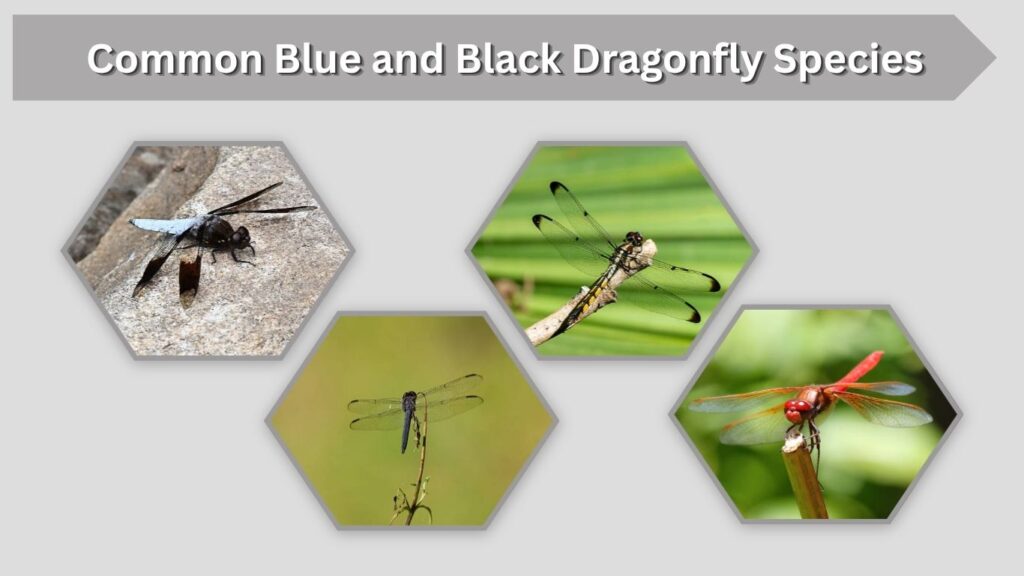
Several North American species fit descriptions such as blue black dragonfly, “blue dragonfly with black wings,” or “black dragonfly with blue tail.”
| Species | Blue Features | Black Features |
| Blue Corporal | Dark blue male body | Black head and dark wing bases |
| Slaty Skimmer | Slate-blue male body | Black head and eyes |
| Blue Dasher | Powder-blue male abdomen | Black abdomen tip |
| Common Whitetail | Bluish-white abdomen | Broad black wing bands |
| Widow Skimmer | Pale bluish mature male body | Large dark wing patches |
| Ebony Jewelwing* | Metallic blue-green body | Almost entirely black wings |
*The Ebony Jewelwing is a damselfly rather than a true dragonfly.
Blue Corporal
The Blue Corporal (Ladona deplanata) is one of the best matches for a dark blue and black dragonfly.
Mature males have a relatively dark blue body, black head, and dark markings around the bases of the wings. Females and young males look considerably browner.
What Does a Blue Corporal Look Like?
A mature male typically shows:
- Dark blue abdomen
- Blue thorax
- Black head
- Dark patches at wing bases
- Transparent outer portions of wings
- Compact skimmer-like build
Because of these markings, it may appear almost navy blue and black when viewed from a distance.
Slaty Skimmer
The Slaty Skimmer (Libellula incesta) is another excellent candidate for a dark blue dragonfly with a black head.
Older males are almost entirely slate blue except for their black head and eyes. They reach about 2 inches in body length and are usually associated with ponds and other still-water habitats near woodland.
Young males and females look brown rather than blue, making mature males much easier to recognize.
Blue Dasher
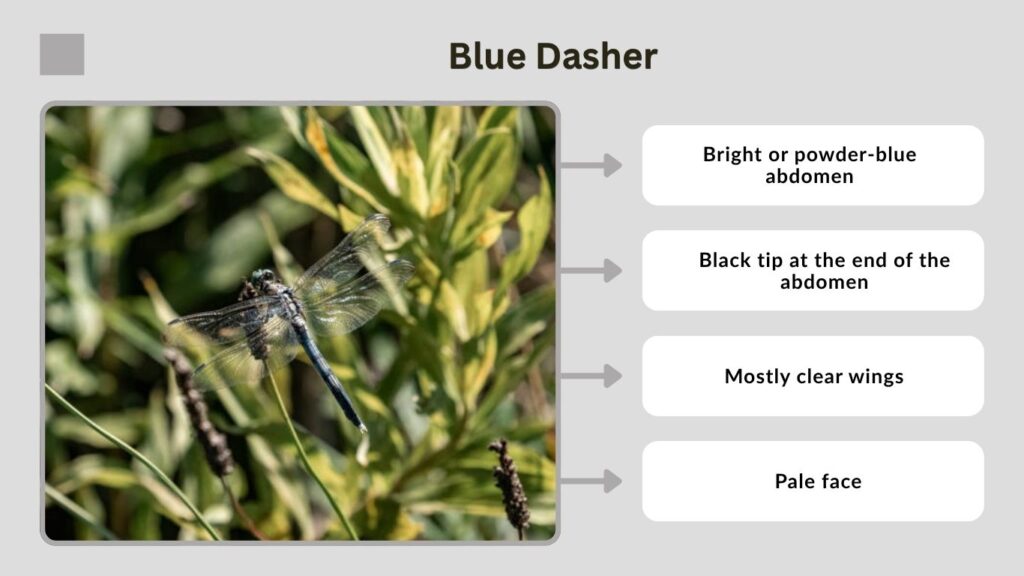
The Blue Dasher (Pachydiplax longipennis) is one of the most familiar blue dragonflies in North America.
Mature males develop a blue abdomen but retain a distinctly black abdomen tip. They also have a white face and black-and-yellow markings on the thorax.
Blue Dragonfly With a Black Tail
If the dragonfly has:
- Bright or powder-blue abdomen
- Black tip at the end of the abdomen
- Mostly clear wings
- Pale face
- Turquoise-looking eyes
a male Blue Dasher is a strong possibility.
It is a better match for “blue dragonfly with black tail” than species with heavily patterned wings.
Blue Dragonfly With Black Wings
A light blue dragonfly with obvious black wings or large black wing bands requires closer inspection.
Several species can create this appearance.
Common Whitetail
Male Common Whitetails (Plathemis lydia) develop a broad, chalky bluish-white abdomen and have a large dark band across each wing.
From a distance, the abdomen can look light blue rather than white.
This makes the Common Whitetail one of the better matches for descriptions such as:
- Light blue dragonfly with black wings
- Blue dragonfly with black striped wings
- Dragonfly with blue body and black wings
- Blue dragonfly with black banded wings
The bold wing bands distinguish it from a Blue Dasher or Slaty Skimmer.
Widow Skimmer
The Widow Skimmer (Libellula luctuosa) is another dragonfly with dramatic dark wing markings.
Its wings have broad dark areas near their bases. Mature males also develop prominent white areas beside the dark patches.
The body of an adult male may appear pale or bluish because of its powdery coating.
Therefore, a black and blue Widow Skimmer dragonfly may look like a pale blue insect with alternating dark and light wing sections.
Is a Blue Dragonfly With Completely Black Wings a Dragonfly?
Not always.
One of the most important blue-and-black look-alikes is the Ebony Jewelwing (Calopteryx maculata).
Ebony Jewelwing Damselfly
Adult male Ebony Jewelwings have brilliantly metallic blue-green bodies combined with almost completely black wings.
They are exceptionally striking and are frequently described informally as black-winged blue dragonflies.
However, they are actually damselflies.
They usually occur around wooded streams and small rivers and have a fluttering style of flight rather than the powerful flight typical of many dragonflies.
Dragonfly vs Damselfly
A few features can help:
| Feature | Dragonfly | Damselfly |
| Body | Usually robust | Usually slender |
| Eyes | Often touch or nearly touch | Widely separated |
| Resting wings | Usually spread outward | Often held together |
| Flight | Strong and direct | Often lighter or fluttering |
If your insect has a metallic blue-green body and solid black wings, especially near a shaded woodland stream, consider an Ebony Jewelwing before assuming it is a dragonfly.
Blue and Black Striped Dragonfly
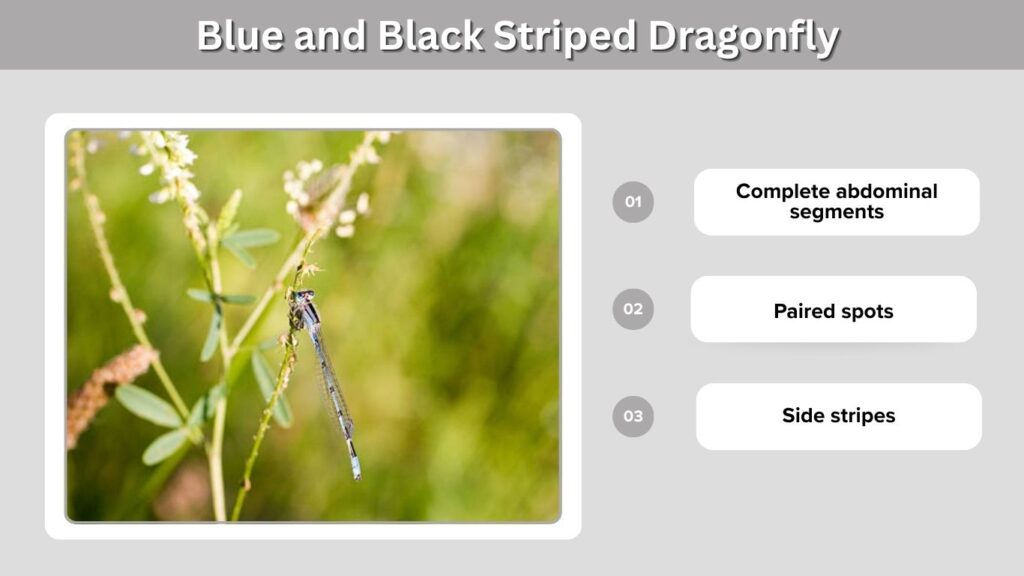
Some blue dragonflies have black markings directly on the abdomen rather than on the wings.
Darners are particularly likely to show combinations of dark backgrounds with blue markings.
In the UK, for example, the male Emperor Dragonfly has a sky-blue abdomen with a dark central line.
Other dragonfly species may have blue spots or stripes separated by extensive black areas, creating an overall blue-and-black pattern.
When identifying them, look at whether the blue appears as:
- Complete abdominal segments
- Paired spots
- Side stripes
- A continuous stripe
- A blue tail tip
These patterns can be more diagnostic than the general color description.
Blue and Black Dragonflies in the UK
A blue-and-black insect in the UK may be different from one found in North America.
Black-Tailed Skimmer
Male Black-tailed Skimmers (Orthetrum cancellatum) have a blue abdomen that becomes dark toward the end, with the final abdominal segments appearing black. They also have green eyes and largely clear wings.
This makes them an excellent match for a UK sighting described as a “blue dragonfly with a black tail.”
Scarce Chaser
Mature male Scarce Chasers also develop a blue body with a black abdominal tip. Their wings have darker bases, and blackish markings may occur near the tips.
Location is therefore essential when trying to identify an unknown blue-and-black dragonfly.
Why Do Some Dragonflies Turn Blue?
The blue appearance of many mature male dragonflies is associated with changes that occur after emergence.
Newly emerged adults may look pale, yellowish, brown, or otherwise very different. As they mature, their adult coloration becomes stronger. Some species become darker again as they age.
This explains why a species normally described as blue may not look blue throughout its entire adult life.
Black and Blue Dragonfly Spiritual Meaning
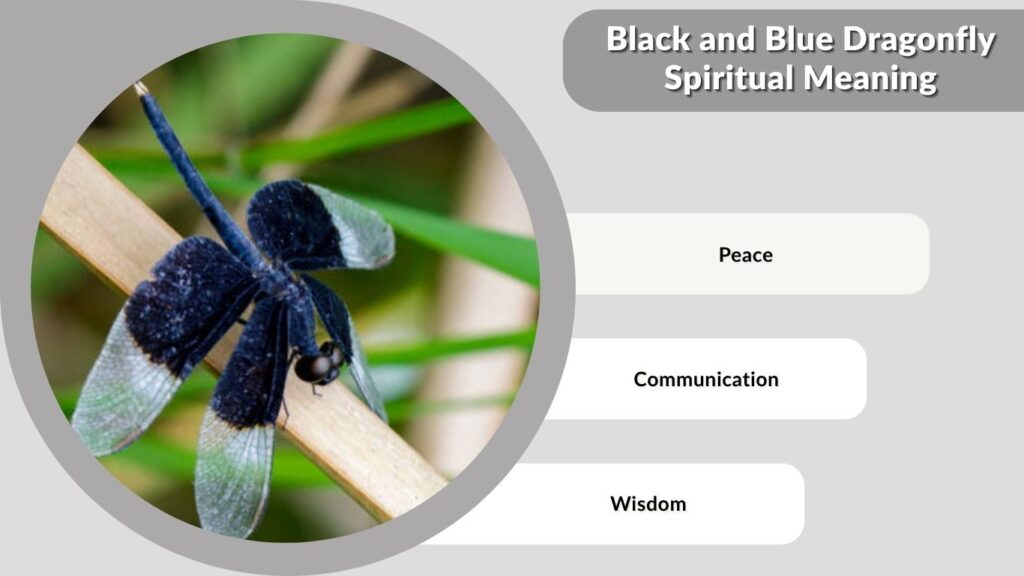
The spiritual meaning of a black and blue dragonfly is symbolic rather than scientific.
Dragonflies are frequently associated in modern symbolism with transformation and change because they spend their immature lives underwater before becoming flying adults.
Blue is commonly interpreted as representing:
- Peace
- Communication
- Clarity
- Wisdom
- Emotional balance
Black may symbolically represent:
- Mystery
- Strength
- Transition
- Protection
- The unknown
Together, a blue-and-black dragonfly may be personally interpreted as representing transformation combined with inner strength, calmness, or moving through an uncertain period.
There is no universal or scientifically established spiritual meaning.
FAQs
What species is a blue and black dragonfly?
There is no single species. Blue Corporals, Slaty Skimmers, Blue Dashers, Common Whitetails, Widow Skimmers, and several darners can show combinations of blue and black. Wing pattern, abdomen markings, size, and location are needed for a more precise identification.
What dragonfly has a blue body and black wings?
A Common Whitetail can appear bluish with broad black wing bands, while Widow Skimmers have large dark wing patches. If the wings are almost completely black and the body is metallic blue-green, the insect may actually be an Ebony Jewelwing damselfly.
What is a blue dragonfly with a black tail?
A male Blue Dasher is one possibility in North America because it has a powder-blue abdomen ending in a black tip. In the UK, a male Black-tailed Skimmer is another strong possibility.
Are black and blue dragonflies rare?
Not necessarily. Some species showing blue and black coloration can be locally common. Rarity depends on the particular species, geographic area, season, and habitat rather than the colors themselves.
What does seeing a black and blue dragonfly mean?
Scientifically, seeing one has no special hidden meaning. In personal or spiritual symbolism, blue-and-black dragonflies may represent transformation, strength, calmness, emotional growth, or transition. These interpretations vary between individuals and traditions.