
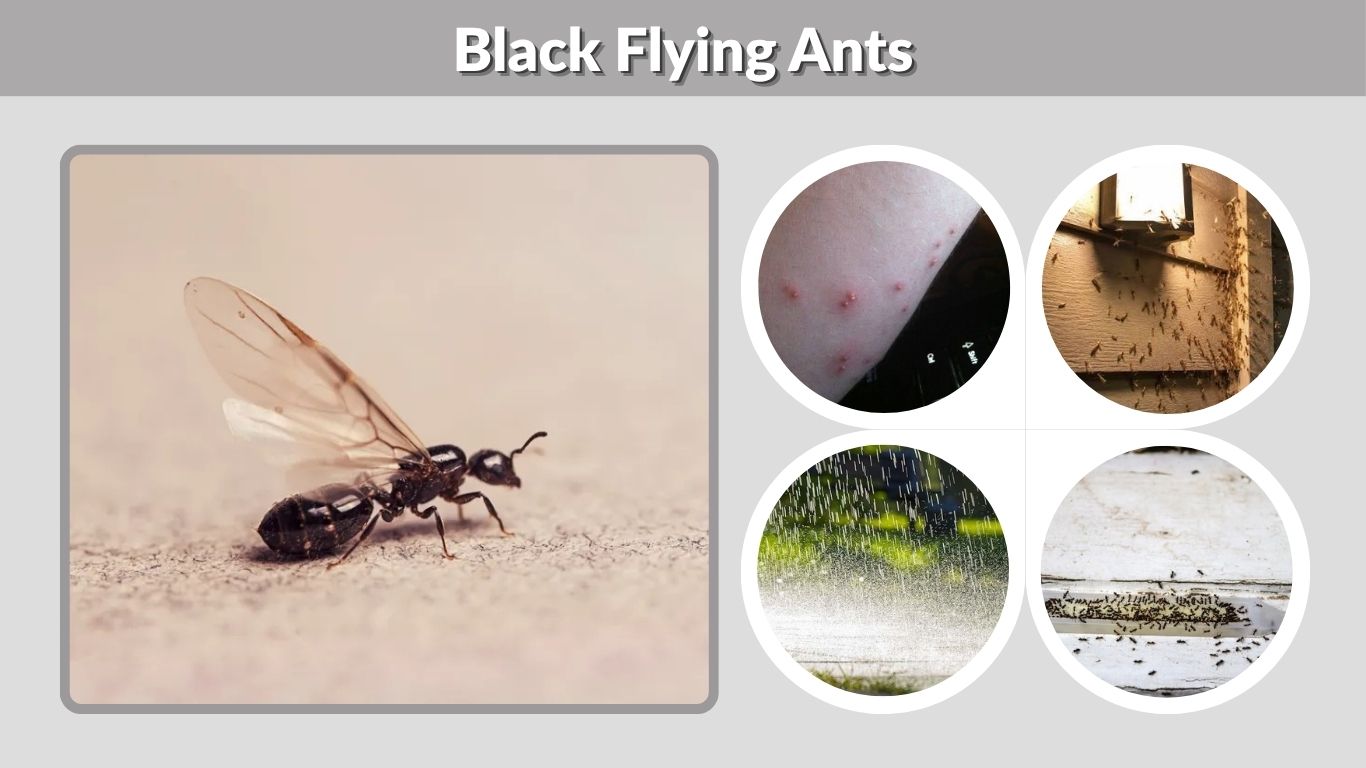
Black flying ants often appear suddenly around homes, gardens, pools, windows, and outdoor lights. These insects are not a distinct ant species. They are reproductive males and queens from established colonies. Their temporary wings allow them to participate in mating flights and establish new nests. Large black flying ants are frequently carpenter ants, while smaller ones may be pavement ants, little black ants, or black garden ants. Identifying them correctly is important because winged termites can look remarkably similar.
What Are Black Flying Ants?
Black flying ants are reproductive adults, also called alates. Most ants in a colony are wingless workers, but a mature colony periodically produces winged males and females.
During favorable weather, the reproductive ants leave their nest together. Males and queens mate during or shortly after this flight. The males generally die soon afterward, while fertilized queens land, remove their wings, and search for protected nesting locations.
Common ants that may produce black or dark-colored flying adults include:
- Carpenter ants
- Black garden ants
- Pavement ants
- Little black ants
- Field ants
- Acrobat ants
- Odorous house ants
Color alone cannot identify the species because many unrelated ants have black or dark brown reproductive forms.
What Do Black Flying Ants Look Like?
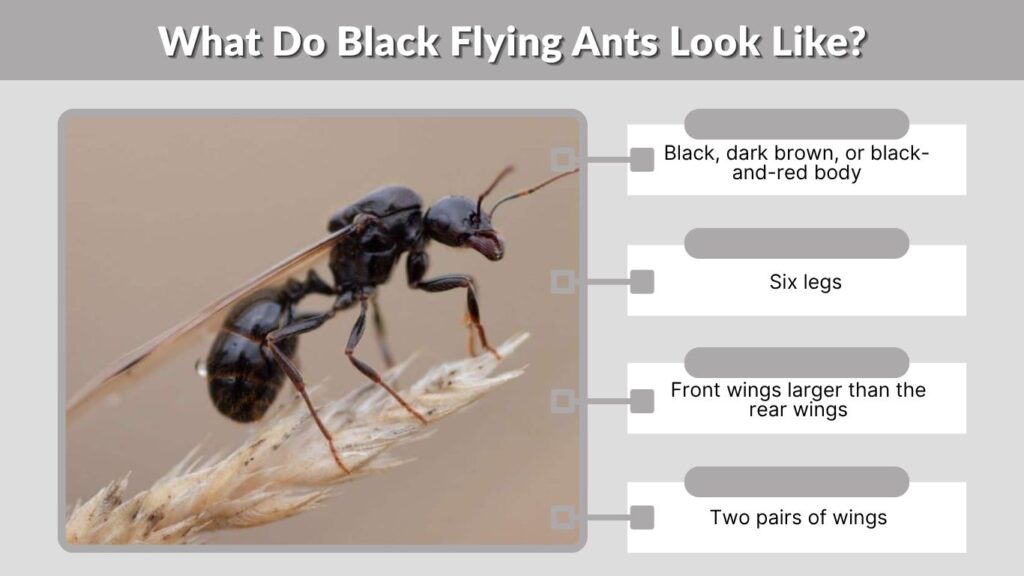
Black flying ants vary from tiny insects measuring less than ⅛ inch to large queens approaching ¾ inch. However, they share several basic ant characteristics.
Identification Features
- Black, dark brown, or black-and-red body
- Six legs
- Bent or elbowed antennae
- Clearly pinched waist
- Two pairs of wings
- Front wings larger than the rear wings
- Three defined body sections
- Robust thorax containing flight muscles
Their wings may look clear, smoky, white, gray, or nearly black depending on lighting, pigmentation, and species. An ant with black wings is not necessarily a special species.
A winged insect with black-and-yellow markings, an unusually slender waist, or long dangling legs may be a wasp rather than an ant. Avoid handling unidentified insects directly.
Large vs. Small Black Flying Ants
Size can narrow down the possibilities, but it does not provide a certain identification. Winged queens are also much larger than workers of the same species.
| Appearance | Possible Identification | Typical Location |
|---|---|---|
| Large black flying ant | Carpenter ant queen or field ant | Damp wood, trees, lawns, or walls |
| Big black-and-red flying ant | Carpenter ant or field ant | Wooded areas, lawns, or structures |
| Small dark flying ant | Pavement or odorous house ant | Foundations, walls, or concrete |
| Tiny shiny black flying ant | Little black ant | Gardens, wall voids, or wood |
| Black flying insect with equal wings | Possible termite | Wood, soil, or foundations |
| Black ant-like insect with a stinger | Ant or wasp | Varies by species |
Large Black Flying Ants
Large black flying ants are commonly carpenter ant reproductives. Carpenter ants have a smoothly rounded thorax, elbowed antennae, a narrow waist, and a single waist node.
These ants do not eat wood. Instead, workers excavate galleries in damp or weakened wood to create nesting space. Repeatedly finding large black flying ants indoors can therefore indicate a carpenter ant colony in a wall, roof, window frame, or another moisture-damaged area.
Small Black Flying Ants
Small or tiny flying black ants may be pavement ants, little black ants, or odorous house ants. They generally do not damage structural wood, but they can establish colonies inside walls and become persistent food pests.
Because several species look similar, examine their nesting location, body structure, trails, and odor rather than relying only on size.
Why Are Black Flying Ants Appearing?
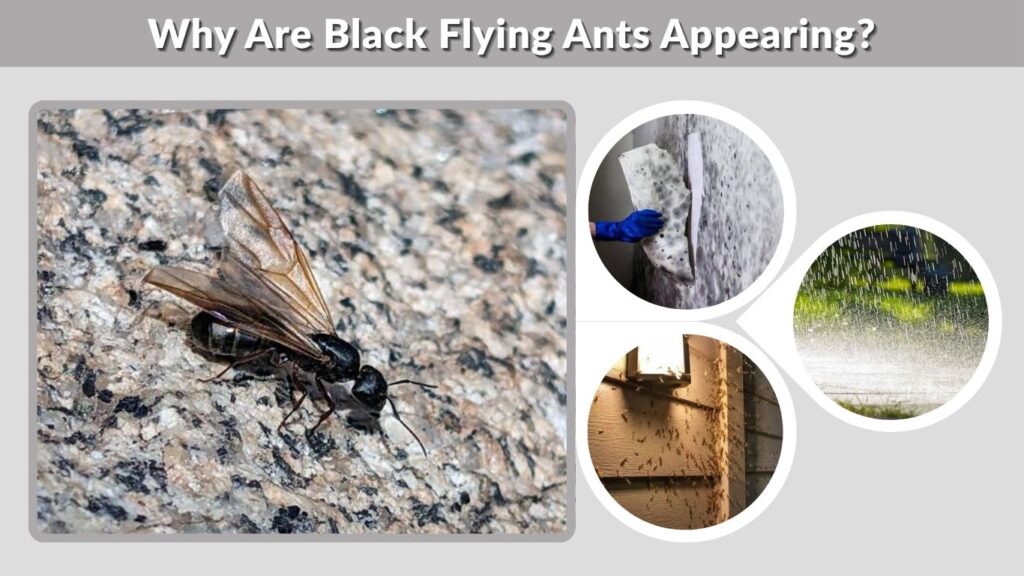
Flying ants emerge when environmental conditions are favorable for mating and starting new colonies. Numerous ants may fly on the same day, creating an apparently sudden invasion.
Common triggers include:
- Warm spring or summer temperatures
- High humidity
- Recent rainfall
- Calm wind
- A mature colony nearby
- Artificial lights at night
Rain softens the soil, making it easier for fertilized queens to create nesting chambers. Humid air also helps prevent the flying ants from drying out.
Black flying ants around a pool may be attracted to reflected light or may simply land on the water during a mating flight. A temporary group in a pool does not necessarily mean a colony is inside it.
Black Flying Ants in the House
A few black flying ants may enter through an open door, window, roof gap, damaged screen, or utility opening. This is particularly common when outdoor swarmers are attracted to indoor lights.
However, repeated swarms inside a house can indicate a mature colony in:
- Wall or ceiling voids
- Window and door frames
- Attics or crawl spaces
- Spaces beneath flooring
- Foundation cracks
- Damp structural wood
- Areas around leaking pipes
- Wood affected by roof or gutter leaks
Pay attention to where the ants first appear. Swarmers consistently emerging from a baseboard, light fixture, vent, or wooden surface suggest that a nest may be concealed nearby.
Black Flying Ants vs. Termites
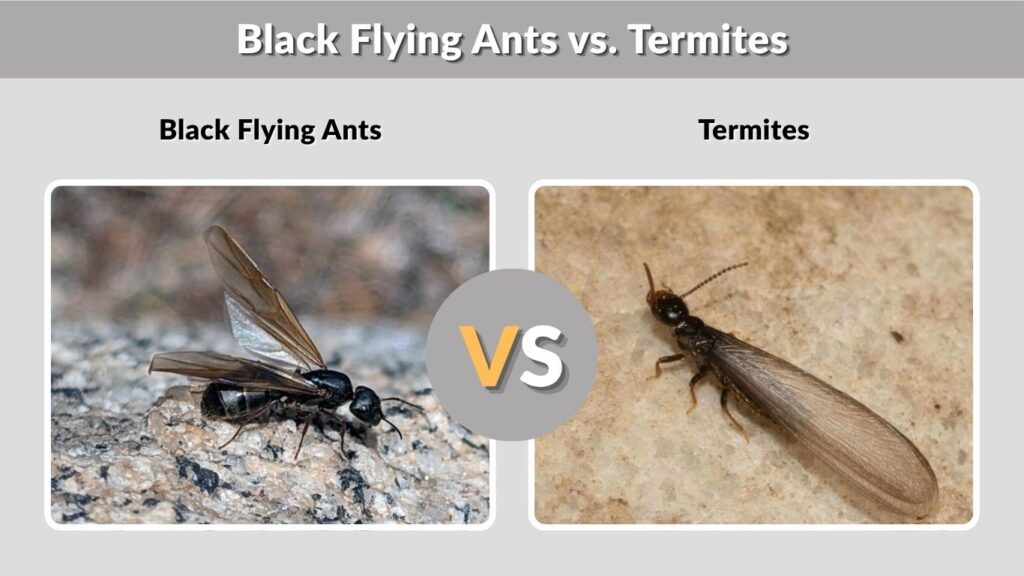
Dark termite swarmers are frequently mistaken for black flying ants. Termites can remain hidden while damaging structural wood, so identification should be completed before treatment begins.
| Feature | Black Flying Ant | Winged Termite |
|---|---|---|
| Antennae | Bent or elbowed | Straight and bead-like |
| Waist | Narrow and pinched | Broad and straight |
| Wings | Front wings larger | Four nearly equal wings |
| Body shape | Clearly segmented | More uniform |
| Wing strength | Relatively strong | Fragile and easily detached |
| Wood damage | Mainly carpenter ants excavate wood | Workers consume cellulose |
Piles of matching discarded wings around windows, doors, baseboards, or wooden surfaces can indicate termite activity. Preserve several insects or wings for identification instead of immediately discarding everything.
Do Black Flying Ants Bite or Sting?
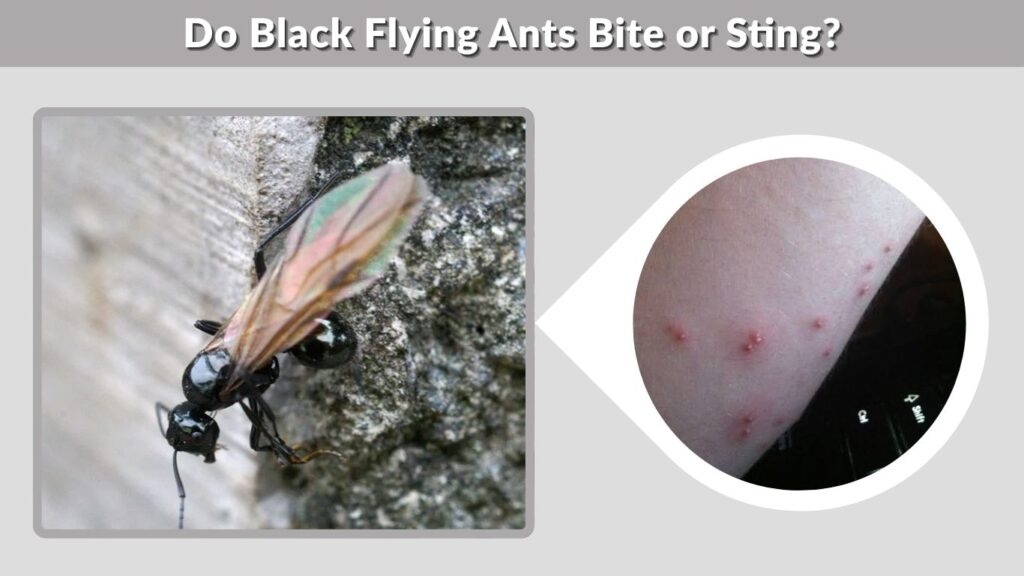
Whether a black flying ant can bite or sting depends on its species. Most reproductive ants are focused on mating and do not actively attack people.
Carpenter ants can bite with their mandibles and may apply formic acid to the area, potentially causing temporary burning or irritation. They do not possess functional stingers. Other ant species may have stingers, although a pointed structure on the end of a flying ant is not always one—it may be part of the insect’s reproductive anatomy.
Black flying ants are not poisonous. Some species can deliver venom through a sting, but the common black swarmers seen around homes usually present little danger.
Possible Bite or Sting Symptoms
A bite or sting may cause:
- Localized pain or burning
- A small red or raised mark
- Mild swelling
- Itching
- Temporary tenderness
Wash the area with soap and water and apply a cold pack wrapped in cloth for about 20 minutes if it is swollen. Avoid scratching, as broken skin can become infected. Seek emergency care for breathing difficulty, swelling of the mouth or throat, faintness, or other signs of a severe allergic reaction. NHS guidance on insect bites and stings
How to Get Rid of Black Flying Ants
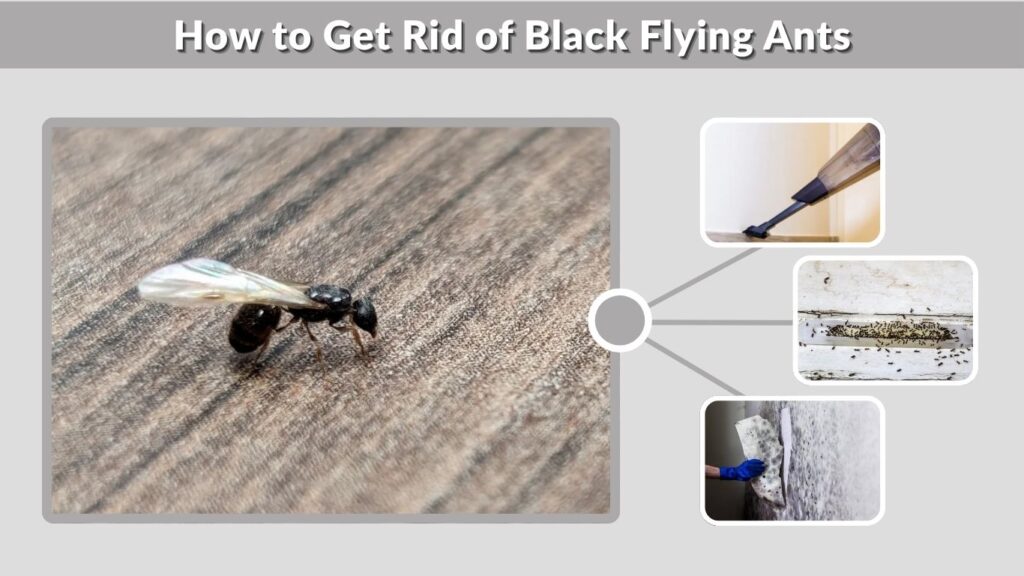
Removing visible swarmers is only the first step. If the insects are emerging from an indoor colony, the underlying nest must also be addressed.
Remove the Swarmers
Vacuum flying and dead ants from windows, floors, and walls. Empty the contents into a closed bag outdoors. This provides immediate control without spreading insecticide throughout the room.
Keep several specimens in a sealed container if you are uncertain whether they are ants or termites.
Locate the Nest or Entry Point
Watch for walking ants after the swarm ends. They may lead toward a wall opening, window frame, foundation crack, or outdoor nest.
Inspect damp wooden areas carefully when large carpenter ants are present. Look for moisture damage, smooth internal galleries, coarse sawdust-like material, and ant body parts around possible nest openings.
Use Ant Bait
Place an appropriately labeled ant bait near active trails and follow the manufacturer’s instructions. Workers carry slow-acting bait back to the colony and share it with other members.
Avoid spraying repellent insecticide near the bait. It can prevent ants from feeding and may cause certain colonies to split or move to another location.
Correct Moisture and Structural Problems
Repair leaking pipes, roof damage, faulty gutters, and poorly sealed windows. Replace badly decayed wood and improve ventilation in damp crawl spaces or attics.
Move firewood away from the house, remove rotting stumps, and trim branches that touch the roof or siding. These measures are especially important for preventing carpenter ants.
Arrange a Professional Inspection
Professional assistance is recommended when large black flying ants repeatedly emerge indoors, the nest cannot be located, or damaged wood is discovered. An inspection is also necessary when the insects may be termites.
FAQs
Are big black flying ants always carpenter ants?
No. Many large black swarmers are carpenter ants, but field ants and other species can have a similar appearance. Look for a smoothly rounded thorax, pinched waist, bent antennae, and unequal wings. Nesting activity near damp wood strengthens the possibility of carpenter ants.
Can black ants grow wings?
Only reproductive males and queens develop wings. Workers remain wingless throughout their lives. A mature colony produces winged adults when conditions favor mating. After mating, fertilized queens remove their wings and search for suitable places to begin new colonies.
Why are black flying ants outside my house?
An established outdoor colony may be releasing reproductive ants for a mating flight. Warmth, humidity, and recent rain commonly trigger this behavior. Outdoor swarmers are usually temporary, but inspect the building if large numbers continually emerge from siding, roofing, or foundation openings.
Do black flying ants cause structural damage?
Most black flying ants do not damage structures. Carpenter ants can excavate galleries in damp or decaying wood, potentially worsening existing damage. Termites present a different and often more serious risk because their colonies consume cellulose within wooden building materials.
How long will a black flying ant swarm last?
The most visible part of a mating flight may last only a few hours. Individual ants can remain around windows or lights for several days. Repeated swarms from the same indoor area suggest a nearby colony rather than a single temporary outdoor event.