
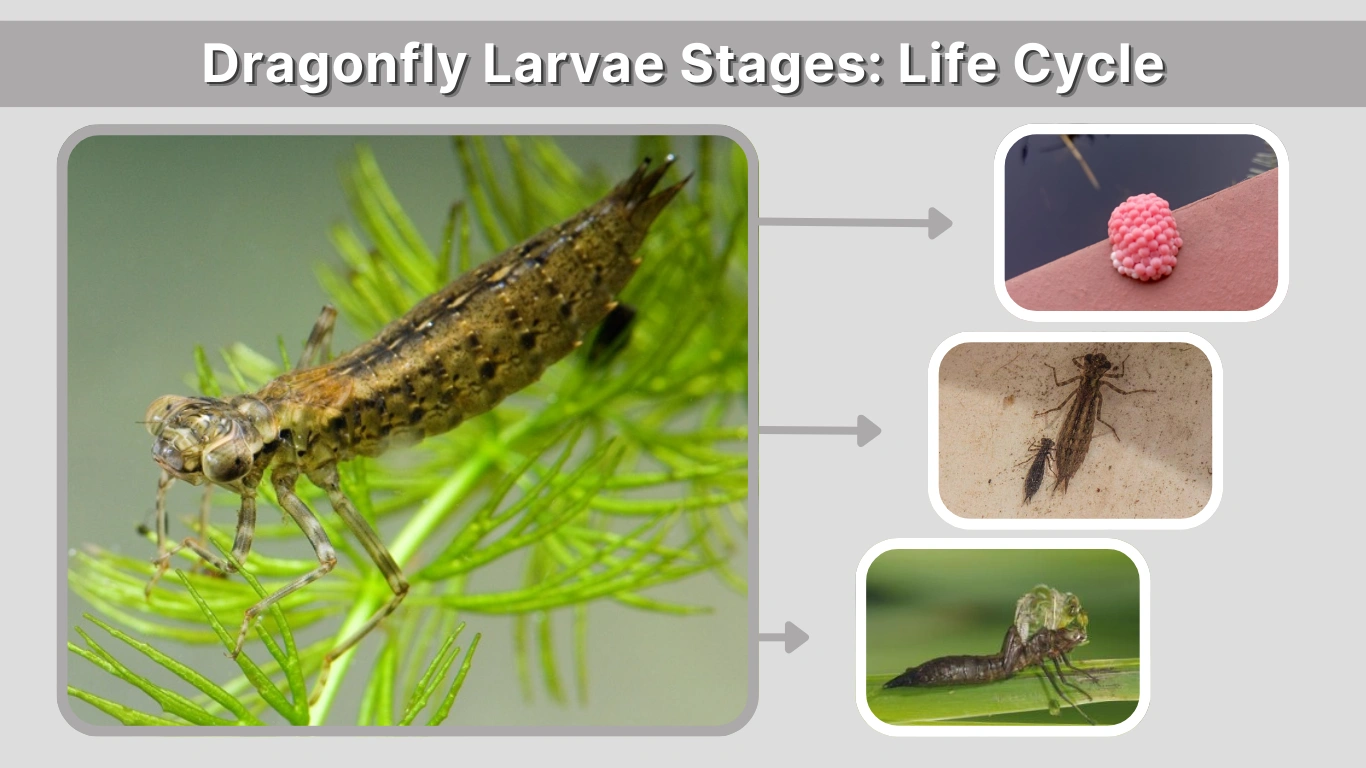
Dragonflies are among the oldest insects on Earth, with ancestors dating back more than 300 million years. While we often admire their fast, colorful flight above ponds and lakes, most of a dragonfly’s life is spent underwater. The larval stage—also called the nymph or naiad stage—is the longest and most important phase of its development. During this time, dragonflies grow, hunt, and prepare for their dramatic transformation into winged adults. Understanding dragonfly larvae stages reveals how these remarkable insects survive and thrive.
Overview of the Dragonfly Life Cycle

Dragonflies undergo incomplete metamorphosis, also known as hemimetabolism. Unlike butterflies, which pass through egg, larva, pupa, and adult stages, dragonflies have only three main life stages:
- Egg
- Larva (nymph or naiad)
- Adult
There is no pupal stage. Instead, the larva gradually grows and develops into an adult through a series of molts. Each stage plays a vital role, but the larval stage is by far the longest, sometimes lasting several years depending on the species and environment.
Stage 1: The Egg Stage

The life of a dragonfly begins when a female lays her eggs in or near water. Dragonflies typically choose calm freshwater habitats such as ponds, lakes, marshes, or slow-moving streams.
Where Eggs Are Laid
Different species lay eggs in slightly different ways:
- Directly into the water
- Inside aquatic plants
- On submerged vegetation
- In mud or damp soil near water
Some females dip their abdomen repeatedly into the water to release eggs, while others insert them into plant tissue for protection.
How Long Eggs Take to Hatch
The hatching period varies depending on species and environmental conditions. In warm climates, eggs may hatch within a few weeks. In cooler regions, eggs can overwinter and hatch in spring.
Environmental Factors
Several factors influence egg survival:
- Water temperature
- Oxygen levels
- Water quality
- Predators such as fish and other insects
Once the egg hatches, the dragonfly enters its most significant life phase—the larval stage.
Stage 2: Dragonfly Larva (Nymph or Naiad)

The larval stage is the longest and most transformative period of a dragonfly’s life. Unlike the graceful flying adult, the larva is a powerful underwater predator.
What Does a Dragonfly Larva Look Like?
Dragonfly larvae look very different from adults. They have:
- A thick, oval-shaped body
- Large compound eyes
- Six legs
- No wings (at first)
- A unique extendable lower jaw called a labium
Their dull brown or green coloring helps them blend into muddy or plant-filled environments.
Early Larval Stage
When dragonfly larvae first hatch, they are tiny and vulnerable. At this stage:
- They remain hidden among plants or debris.
- They feed on microscopic organisms and very small aquatic insects.
- Survival depends heavily on camouflage and stillness.
Even at a young age, dragonfly larvae are active hunters. Rather than chasing prey, they usually wait patiently and strike when something comes close.
Middle Development Stages (Instars)

As dragonfly larvae grow, they pass through multiple developmental phases called instars. Each instar ends with a molt.
What Is Molting?
Molting occurs when the larva sheds its exoskeleton to allow for growth. Because insects have rigid outer skeletons, they must shed them periodically to increase in size.
Dragonfly larvae may molt 10 to 15 times before reaching maturity.
After each molt:
- The body becomes larger.
- The legs grow stronger.
- The hunting ability improves.
- Small wing pads begin to appear on the thorax.
Growth and Development
During these middle stages, larvae become more aggressive predators. Their diet expands to include:
- Mosquito larvae
- Small crustaceans
- Tadpoles
- Other aquatic insects
They play a crucial role in controlling mosquito populations in freshwater ecosystems.
Unique Adaptations of Dragonfly Larvae
Dragonfly larvae are highly specialized for underwater survival. Several unique adaptations make them efficient hunters.
Extendable Jaw (Prehensile Labium)
One of the most remarkable features of a dragonfly larva is its extendable lower jaw. This structure acts like a spring-loaded arm.
When prey approaches:
- The labium shoots forward in a fraction of a second.
- It grabs the prey with sharp hooks.
- The prey is pulled back to the mouth for consumption.
This lightning-fast strike makes dragonfly larvae formidable predators.
Underwater Breathing and Jet Propulsion
Dragonfly larvae breathe through internal gills located in their rectum. Water is drawn in and oxygen is absorbed.
Interestingly, when they forcefully expel water, they create a jet propulsion effect. This allows them to move quickly through the water—an unusual but effective escape and hunting mechanism.
Duration of the Larval Stage

Depending on the species and environmental conditions, dragonfly larvae can live underwater for one to five years. In colder climates, development may take longer because growth slows in low temperatures.
This extended underwater period allows them to grow strong and fully develop before emerging as adults. When the final larval stage is reached, the dragonfly prepares for one of the most dramatic transformations in the insect world.
Late Larval Stage: Preparing for Transformation
As dragonfly larvae approach maturity, noticeable changes begin to occur. The most visible sign is the development of larger wing pads on the thorax. These pads contain the folded wings that will expand once the insect becomes an adult.
During this stage, larvae:
- Reach their maximum underwater size
- Become highly efficient hunters
- Feed more aggressively to store energy
- Spend more time near the edges of their habitat
Their bodies are fully formed internally, and the final molt will transform them from aquatic predators into flying insects.
The Molting Process and Its Risks

Throughout their development, dragonfly larvae molt many times. However, the final molt—called emergence—is the most critical and dangerous.
What Happens During Molting?
Before each molt, the larva:
- Stops feeding
- Forms a new, soft exoskeleton beneath the old one
- Splits the old skin and slowly pulls itself free
Immediately after molting, the larva is soft and vulnerable. It must remain still until the new exoskeleton hardens.
Risks During Molting
Molting is a risky process because:
- The larva cannot defend itself effectively
- Predators may attack during this vulnerable period
- Improper shedding can lead to deformities
Despite these dangers, molting is essential for growth and development.
Final Stage: Emergence from Water
When the larva is fully mature, it leaves the water for the first time. This typically happens at night or in the early morning to reduce the risk of predators and dehydration.
Climbing to Safety
The larva crawls out of the water onto:
- Plant stems
- Reeds
- Rocks
- Dock edges
Once securely attached, it begins the final transformation.
The Transformation Process
The exoskeleton splits open along the back of the thorax. Slowly, the adult dragonfly pulls its head, thorax, legs, and abdomen out of the larval skin, which remains attached to the surface. This empty shell is called an exuvia.
After emerging:
- The wings are soft and crumpled.
- Body fluids pump into the wings to expand them.
- The wings harden and dry over several hours.
Only after this process is complete can the dragonfly fly for the first time.
Challenges and Survival Rates
Dragonfly larvae face numerous threats during their underwater years.
Aquatic Predators
Common predators include:
- Fish
- Frogs
- Water beetles
- Larger dragonfly larvae
Despite being predators themselves, larvae are also prey in the aquatic food web.
Environmental Threats
Human activities can significantly affect larval survival:
- Water pollution
- Habitat destruction
- Wetland drainage
- Climate change and drought
Because dragonfly larvae are sensitive to water quality, scientists often use them as indicator species to measure ecosystem health.
Survival from Egg to Adult
Only a small percentage of eggs survive to adulthood. Many are eaten or fail to develop. However, those that do survive contribute to maintaining balanced freshwater ecosystems.
Differences Between Dragonfly and Damselfly Larvae
Although dragonflies and damselflies are closely related, their larvae have key differences.
Dragonfly larvae:
- Stocky, thicker bodies
- Internal gills (inside the rectum)
- Move using jet propulsion
Damselfly larvae:
- Slender, elongated bodies
- Three leaf-like external gills at the tail
- Swim with a side-to-side motion
These differences help scientists identify species in freshwater habitats.
Why Dragonfly Larvae Matter in Ecosystems
Dragonfly larvae play an essential ecological role.
Natural Pest Control
They consume large numbers of mosquito larvae, helping control mosquito populations naturally. This reduces the spread of mosquito-borne diseases in many regions.
Food Web Contribution
Larvae serve as both predators and prey, maintaining balance within aquatic ecosystems.
Indicators of Water Quality
Healthy dragonfly populations often indicate clean, well-oxygenated water. A decline in larvae may signal environmental problems.
FAQs
How long do dragonfly larvae live underwater?
Dragonfly larvae typically live underwater for one to five years, depending on the species and climate. In warmer regions, development may be faster, while colder climates can slow growth. Most of a dragonfly’s life is spent in this aquatic stage before emerging as an adult.
What do dragonfly larvae eat?
Dragonfly larvae are carnivorous predators. They feed on mosquito larvae, small aquatic insects, tadpoles, tiny fish, and crustaceans. Using their extendable jaw, they ambush prey with remarkable speed. Their diet expands as they grow larger and stronger through successive molts.
How many times do dragonfly larvae molt?
Dragonfly larvae usually molt between 10 and 15 times before reaching maturity. Each molt allows the larva to grow larger and develop more advanced features, including wing pads. The final molt occurs outside the water and results in the emergence of the adult dragonfly.
Can dragonfly larvae bite humans?
Dragonfly larvae can pinch with their mouthparts if handled, but they are not dangerous to humans. Their bite is mainly a defensive reaction. While it may cause minor discomfort, they do not inject venom and pose no serious threat.
Do all dragonflies spend years as larvae?
Most dragonfly species spend at least one year as larvae, but the exact duration varies. Some develop more quickly in warm climates, while others may remain underwater for several years. Environmental conditions strongly influence the length of the larval stage.