
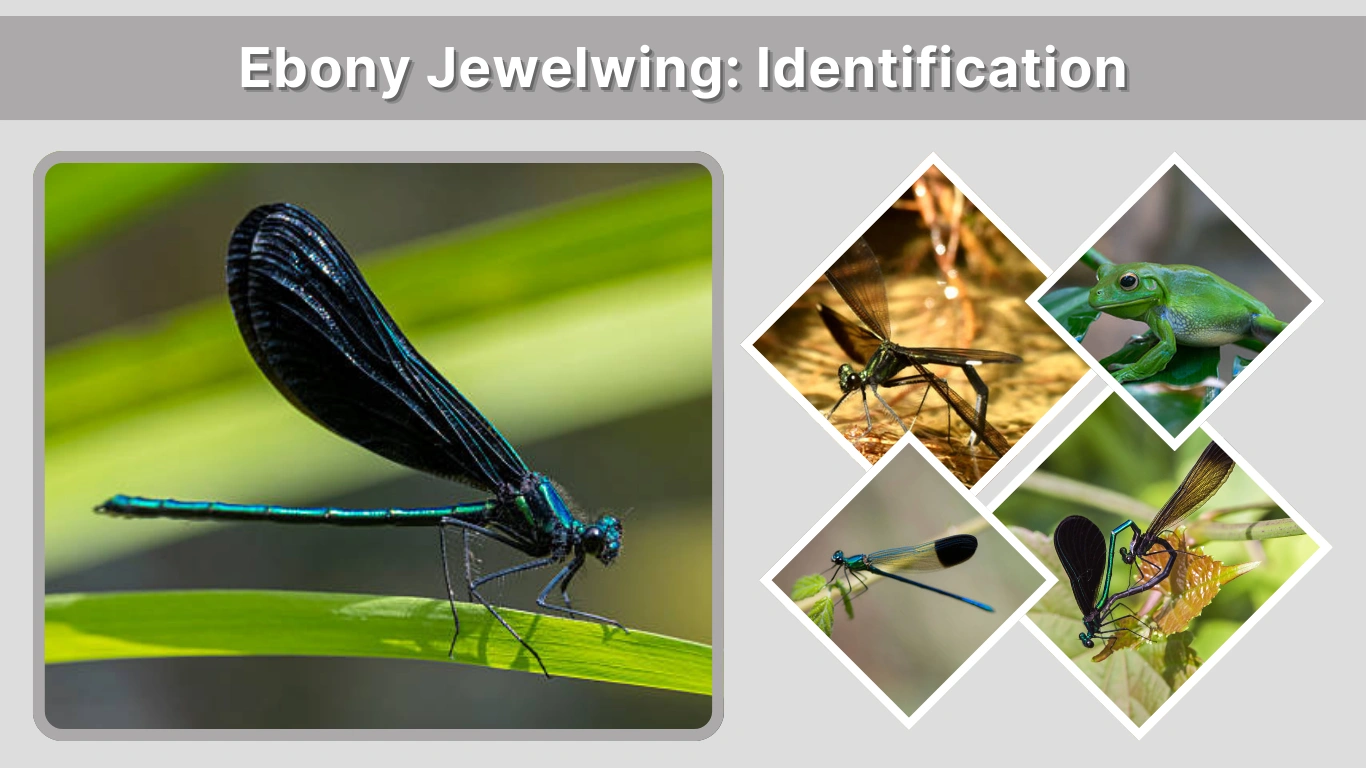
The Ebony Jewelwing is one of the most striking damselflies found in North America. With its shimmering metallic body and dark, velvety wings, this elegant insect stands out along woodland streams and rivers. Scientifically known as Calopteryx maculata, it belongs to the broad-winged damselfly family. Often mistaken for a dragonfly, the Ebony Jewelwing is actually a damselfly, identifiable by its slender body and wings that fold together over its back when at rest.
What Is Ebony Jewelwing?
The Ebony Jewelwing is a species of broad-winged damselfly native to eastern and central North America. It belongs to the family Calopterygidae, a group known for their colorful, metallic bodies and wide wings. Unlike many smaller damselflies, jewelwings are slightly larger and more robust in appearance.
As a member of the order Odonata, the Ebony Jewelwing shares ancestry with dragonflies. However, there are clear differences. Damselflies typically have slimmer bodies, eyes set farther apart, and wings that fold neatly over their backs when perched. Dragonflies, in contrast, hold their wings open and have bulkier bodies.
The Ebony Jewelwing is especially admired for its graceful flight and vivid coloration, making it a favorite among nature observers and photographers.
Physical Characteristics and Identification

The Ebony Jewelwing is one of the easiest damselflies to recognize due to its broad wings and metallic body. Unlike many thin, pale-colored damselflies, this species has a richer, more dramatic appearance. Sunlight enhances its iridescent green or blue-green body, while its wings create a bold contrast, especially in males.
Below are the key identification features:
- Body Color: Metallic emerald green to blue-green with a glossy sheen
- Wing Shape: Broad and rounded compared to most damselflies
- Male Wings: Solid black or deep charcoal, velvety in appearance
- Female Wings: Smoky brown with a distinct white stigma (small white patch near the tip)
- Body Length: Approximately 1.5–2 inches (38–50 mm)
- Wing Position at Rest: Folded together over the back
- Flight Style: Slow, fluttering, butterfly-like movement
These combined traits make the Ebony Jewelwing stand out clearly from dragonflies and other damselfly species found near freshwater habitats.
Habitat and Geographic Distribution

The Ebony Jewelwing is widely distributed throughout eastern North America, extending from southern Canada down through the eastern United States. It is especially common in regions with abundant freshwater streams and rivers.
These damselflies prefer clean, slow-moving water surrounded by trees or shrubs. Wooded streams provide ideal conditions because they offer perching spots, shelter from strong winds, and aquatic vegetation for egg-laying.
Water quality is extremely important for this species. Because their larvae develop underwater, they thrive in areas with low pollution and healthy aquatic ecosystems. As a result, their presence often indicates good environmental conditions.
Ebony Jewelwings are most active from late spring through mid-to-late summer. During warm months, they can frequently be seen resting on leaves, twigs, or grasses near the water’s edge.
Life Cycle of the Ebony Jewelwing

Like all damselflies, the Ebony Jewelwing undergoes incomplete metamorphosis, meaning it does not have a pupal stage like butterflies. Instead, it transitions gradually from aquatic nymph to winged adult.
Egg Stage
The life cycle begins when the female lays her eggs in aquatic plants. Using her ovipositor, she inserts eggs into submerged stems or leaves just below the water’s surface. In some cases, the female may partially submerge herself while laying eggs, remaining underwater for short periods.
The eggs remain hidden within plant tissue, where they are protected from many predators.
Nymph (Larval) Stage
After hatching, the young damselflies enter the nymph stage. This aquatic phase can last several months to more than a year, depending on environmental conditions.
Ebony Jewelwing nymphs are active predators. They feed on small aquatic invertebrates such as insect larvae and tiny crustaceans. Using extendable mouthparts, they quickly capture prey in the water.
During this stage, the nymph molts multiple times as it grows. Each molt allows it to shed its exoskeleton and develop further.
Adult Emergence
When the nymph is fully developed, it climbs out of the water onto vegetation. Its outer skin splits open, and the adult damselfly slowly emerges. At first, its wings are soft and crumpled. Over time, they expand and harden as fluids are pumped through them.
Once its wings are fully formed and dry, the Ebony Jewelwing takes its first flight, beginning the final stage of its life above water.
Behavior and Mating Rituals
Ebony Jewelwings are known for their graceful flight and fascinating courtship displays. Males are highly territorial and often choose a prime stretch of stream where they perch on leaves or branches. From these perches, they watch for rival males and potential mates.
If another male enters the territory, brief aerial chases may occur. These encounters are usually nonviolent but clearly competitive. Males also perform fluttering wing displays to attract females, showing off their dark, shimmering wings in the sunlight.
When a female accepts a male, the pair forms a “tandem” position, with the male clasping the female behind her head using specialized appendages. Mating then occurs in a distinctive heart-shaped wheel position common among damselflies.
After mating, the female lays her eggs in aquatic vegetation. In some cases, the male remains nearby to guard her from competing males while she deposits her eggs.
Diet and Ecological Role

The Ebony Jewelwing plays an important role in freshwater ecosystems both as a predator and as prey.
During the nymph stage, these damselflies feed on small aquatic organisms such as insect larvae, tiny crustaceans, and other invertebrates. Their predatory behavior helps regulate populations of smaller aquatic species.
As adults, Ebony Jewelwings consume small flying insects, including mosquitoes, flies, and gnats. They catch prey midair or pick insects from vegetation. Because they feed on pest insects, they contribute to natural pest control.
In turn, Ebony Jewelwings are food for birds, frogs, fish, and spiders. This makes them an integral part of the freshwater food web. Their sensitivity to pollution also makes them valuable bioindicators of clean, healthy streams.
Ebony Jewelwing vs. Similar Species
Several other broad-winged damselflies share similar habitats, which can sometimes cause confusion for observers.
American Rubyspot Comparison
The American Rubyspot (Hetaerina americana) is one of the species most commonly mistaken for the Ebony Jewelwing. While both species inhabit streams and rivers, male Rubyspots have clear wings with bright red patches near the base. In contrast, male Ebony Jewelwings have fully dark wings without red markings.
Females of both species may appear somewhat similar, but the presence or absence of colored wing patches helps distinguish them.
Other Broad-Winged Damselflies
Other species within the genus Calopteryx may have differently colored wings, such as bluish or partially tinted wings. Paying attention to wing color, body sheen, and geographic location can help narrow down identification.
Careful observation of wing patterns is usually the fastest way to tell species apart.
Conservation and Environmental Importance
Currently, the Ebony Jewelwing is not considered endangered. However, like many freshwater species, it is vulnerable to habitat destruction and water pollution.
Urban development, agricultural runoff, and sedimentation can degrade stream habitats. Because Ebony Jewelwing larvae require clean, well-oxygenated water, polluted streams can significantly reduce their populations.
Protecting riparian zones, reducing chemical runoff, and preserving natural waterways are essential steps in supporting not only Ebony Jewelwings but entire freshwater ecosystems. Their presence often signals a healthy environment.
Quick Facts About the Ebony Jewelwing
- Scientific name: Calopteryx maculata
- Family: Calopterygidae
- Order: Odonata
- Length: 1.5–2 inches (38–50 mm)
- Wings: Broad; black in males, smoky brown with white stigma in females
- Habitat: Wooded streams, rivers, and creeks
- Active season: Late spring through summer
- Diet: Small aquatic invertebrates (larvae); flying insects (adults)
- Lifespan: Several months as adults; longer aquatic nymph stage
FAQs
Is the Ebony Jewelwing a dragonfly or damselfly?
The Ebony Jewelwing is a damselfly, not a dragonfly. Damselflies have slender bodies, eyes that are spaced apart, and wings that fold together over their backs when resting. Dragonflies are bulkier and hold their wings open horizontally.
Are Ebony Jewelwings harmful to humans?
No, Ebony Jewelwings are harmless to humans. They do not sting or bite people. While they are predators of small insects, they pose no threat to humans and are beneficial because they help control mosquito and fly populations.
Why are they found near clean water?
Ebony Jewelwings lay their eggs in aquatic plants, and their larvae live underwater for months. Clean, oxygen-rich water is essential for larval development. Because of this, they are commonly found near unpolluted streams and are considered indicators of good water quality.
When is the best time to see them?
The best time to see Ebony Jewelwings is from late spring through mid-summer on warm, sunny days. They are most active near wooded streams and are often spotted resting on leaves or flying slowly along the water’s edge.