
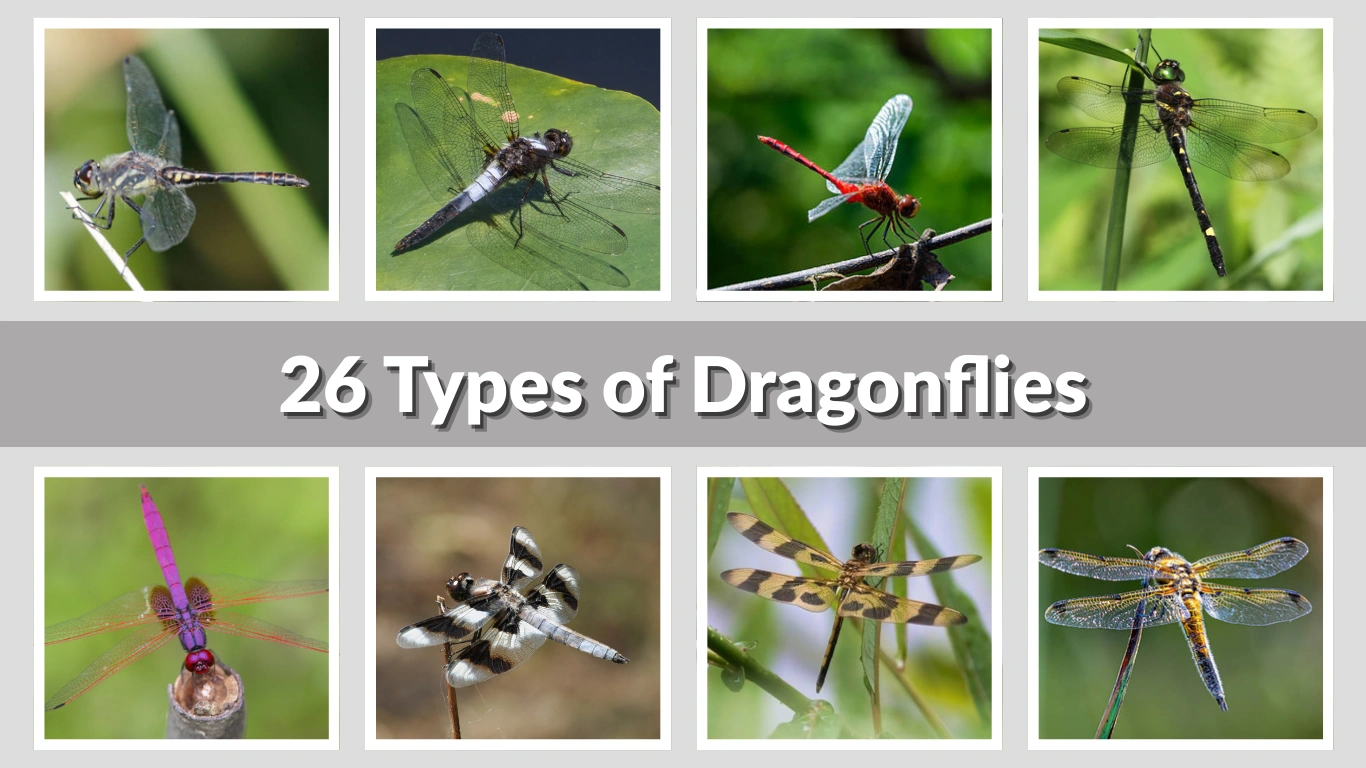
Dragonflies are some of the most fascinating insects in the natural world—fast, colorful, and incredibly skilled hunters. With thousands of species worldwide, each dragonfly has its own unique colors, patterns, and behaviors. This list highlights 26 notable types of dragonflies, offering a quick overview of their appearance and natural habitats. Whether you’re a nature lover or a casual observer, these species provide a glimpse into the beauty of dragonfly diversity.
1. Common Green Darner

The Common Green Darner is one of the most recognizable dragonflies in North America, famous for its bright green thorax and powerful, fast flight. Often seen patrolling ponds and lakes, it’s a long-distance migrant that can travel hundreds of miles. This species plays a vital role in controlling mosquito and other insect populations.
Identification
- Large dragonfly, typically 7–8 cm (2.8–3.1 in) in length
- Bright green thorax with a long, slender blue or brownish abdomen
- Clear wings with a slight amber tint near the base in some individuals
- Large, touching compound eyes that are usually green to bluish
- Strong, direct flight often seen cruising above open water
Habitat and Range
Common Green Darners are widespread across much of North America and parts of Central America. They frequent ponds, lakes, marshes, and slow-moving streams with abundant vegetation. During migration, they can also be seen far from water, crossing fields, coastal areas, and even urban landscapes as they move between breeding and non-breeding grounds.
Behavior and Diet
These dragonflies are powerful aerial predators, capturing prey in flight. They feed mainly on mosquitoes, flies, and other small flying insects, helping to keep local insect populations in check. Common Green Darners are often observed patrolling territories over open water or along shorelines, occasionally perching on vegetation but spending much of their time on the wing.
Life Cycle and Migration
The life cycle includes an aquatic nymph stage that lasts several months, during which the larvae prey on tadpoles, small fish, and aquatic insects. After emerging as adults, some populations remain local while others undertake long migrations, sometimes forming large swarms. Their multi-generational migratory cycle allows the species to track suitable climates and breeding sites throughout the year.
2. Eastern Pondhawk

The Eastern Pondhawk is a bold, agile dragonfly commonly found near ponds, marshes, and quiet lakes. Known for its striking color difference between males and females, this species is a strong predator and frequently perches low on vegetation or the ground while hunting.
Identification
- Adult males are powdery blue with green faces
- Females and immature males are bright green with dark banded abdomens
- Medium-sized dragonfly, about 4.5–6 cm long
- Clear wings with slender, dark veins
- Often perches on the ground or low plants while waiting for prey
Habitat and Range
This species is widespread across the eastern and central United States. It prefers calm freshwater environments such as ponds, marshes, lake edges, and slow streams. Eastern Pondhawks thrive in sunny, open spaces where they can hunt effectively.
Behavior and Diet
Eastern Pondhawks are aggressive predators, often chasing down flying insects with speed and precision. They feed on mosquitoes, flies, butterflies, and even other dragonflies. Males defend territories vigorously, frequently engaging in aerial chases to keep rivals away from prime perching or breeding spots.
Life Cycle
Their life cycle begins with aquatic nymphs that inhabit shallow, vegetated waters. These nymphs are stealthy ambush predators. After completing their development, they emerge as adults in late spring and summer. Adults live several weeks, actively hunting and breeding throughout the warm months.
3. Blue Dasher

The Blue Dasher is a small yet vibrant dragonfly recognized for its striking coloration and energetic behavior. Common across much of North America, it thrives in warm, sunny habitats and is often seen darting over ponds, marshes, and quiet streams.
Identification
- Adult males feature a bright blue abdomen with a white face
- Females and juveniles display brown and yellow striped bodies
- Distinctive dark wing patches near the tips
- Medium–small size, typically 3–4 cm long
- Often perches on reeds, twigs, and grasses close to water
Habitat and Range
Blue Dashers inhabit a wide range across the United States, southern Canada, Mexico, and the Caribbean. They prefer still or slow-moving waters such as ponds, lakes, ditches, and marshy pools. Open, sunny environments with abundant vegetation offer ideal hunting and breeding grounds.
Behavior and Diet
This dragonfly is highly active, frequently seen darting out from perches to capture small insects midair. It preys on mosquitoes, gnats, small flies, and other soft-bodied insects. Males are territorial and often defend small patches of shoreline or vegetation against rivals.
Life Cycle
Blue Dasher nymphs live underwater, feeding on aquatic insects and other tiny organisms until they are ready to emerge. Adults typically appear in late spring through summer. Their life span is short but active, with constant hunting, mating, and perching behavior that makes them easy to observe around freshwater habitats.
4. Widow Skimmer

The Widow Skimmer is a visually striking dragonfly known for its bold wing patterns and widespread presence across North America. It is often seen gliding over ponds, meadows, and wetlands, where its distinctive markings make it easy to recognize in flight and at rest.
Identification
- Broad black wing bands on both sexes
- Males develop additional white patches on the wings as they mature
- Thorax is dark brown; abdomen dark with pale side stripes in females
- Medium–large size, typically 5–6.5 cm long
- Often perches on tall grasses, reeds, and stems near water
Habitat and Range
Widow Skimmers thrive across most of the United States and southern Canada. They favor still or slow-moving freshwater habitats such as lakes, ponds, marshes, and quiet backwaters. Open, sunny areas with tall vegetation provide ideal perching and hunting locations.
Behavior and Diet
These dragonflies are strong, graceful fliers and skilled aerial hunters. They feed on small flying insects including flies, gnats, mosquitoes, moths, and occasionally smaller dragonflies. Males defend territories along the water’s edge, using their bold wing patterns to display dominance.
Life Cycle
Nymphs develop underwater, preying on aquatic insects and tiny vertebrates. After emerging in late spring or summer, adults spend their time feeding, mating, and patrolling territories. The species is commonly observed throughout the warm months, with individuals often returning to the same perches repeatedly.
5. Twelve-Spotted Skimmer

The Twelve-Spotted Skimmer is a bold and easily recognizable dragonfly thanks to its distinctive wing pattern. Found across much of North America, it is a frequent visitor to ponds, marshes, and calm lakes, where it often perches prominently on reeds or sticks.
Identification
- Each wing has three dark spots, totaling twelve across all four wings
- Mature males also develop white patches between the dark spots
- Medium–large size, about 5–6.5 cm long
- Brownish thorax with a pale-striped abdomen
- Frequently perches on tall stems near open water
Habitat and Range
This species is widespread across the United States and southern Canada. It inhabits still or slow-moving freshwater environments such as ponds, marshes, and quiet lake edges. Twelve-Spotted Skimmers prefer open, sunny areas where they can glide and hunt with ease.
Behavior and Diet
The Twelve-Spotted Skimmer is a powerful flyer and adept predator, capturing insects like mosquitoes, flies, moths, and small beetles in midair. Males are territorial and patrol specific stretches of shoreline, often returning repeatedly to favorite perches.
Life Cycle
Nymphs live underwater, feeding on aquatic insects and small organisms until they are ready to emerge. Adults appear through late spring and summer, spending their days hunting, patrolling, and mating. Their bold wing markings make them one of the most recognizable dragonflies in the region.
6. Four-Spotted Chaser

The Four-Spotted Chaser is a widespread dragonfly known for its distinctive wing spots and energetic flight. Often found around ponds, bogs, and marshy lakes, it is a favorite among nature observers due to its bold, easily identifiable markings and lively behavior.
Identification
- Four dark spots located at the nodes (midpoints) of all four wings
- Additional dark shading near the wing bases
- Medium-sized dragonfly, typically 4–5.5 cm long
- Brownish body with a slightly widened abdomen
- Frequently perches on reeds and low vegetation around the water
Habitat and Range
The Four-Spotted Chaser is common across Europe, Asia, and parts of North America. It thrives in cool, shallow, and well-vegetated wetlands such as bogs, marshes, ponds, and slow-moving streams. It prefers sunny areas with open water and abundant insects.
Behavior and Diet
This species is an active aerial hunter, catching small flying insects including mosquitoes, midges, and flies. Males are territorial and often chase off rivals with rapid, hovering flights. They frequently return to the same favorite perches while monitoring their territory.
Life Cycle
Nymphs develop underwater, feeding on aquatic invertebrates until they mature. Adults typically emerge in late spring and early summer. Once airborne, they spend their time feeding, mating, and patrolling territory. Their distinctive wing spots make them easy to identify during flight or at rest.
7. Scarlet Darter

The Scarlet Darter, also known as the Scarlet Dragonfly, is a vibrant species easily recognized by its brilliant red coloration. Common in warm regions, it is often seen basking near sunny ponds, lakes, and slow-moving waters, where its vivid hue stands out strikingly against green vegetation.
Identification
- Mature males are bright scarlet red across the body
- Females and juveniles are yellow-brown with lighter markings
- Medium size, typically 3.5–4.5 cm long
- Clear wings with slight amber at the bases
- Frequently perches on stones, twigs, or exposed vegetation
Habitat and Range
Scarlet Darters inhabit warm climates across Europe, Africa, and parts of the Middle East. They prefer shallow lakes, ponds, marshes, and slow streams, especially in sunny, open landscapes. Their tolerance for warm temperatures allows them to thrive in dry or semi-arid regions.
Behavior and Diet
These dragonflies are active hunters, often seen flying low over water or resting on sunlit perches between feeding bouts. They prey on small flying insects such as flies, mosquitoes, and midges. Males display territorial behavior, defending preferred basking and breeding sites.
Life Cycle
Nymphs live in shallow, vegetated waters, feeding on aquatic insects and tiny crustaceans. Adults typically emerge in late spring through summer. Their bright coloration makes them one of the most visually striking dragonflies in their range. Adults spend their days hunting, mating, and basking in warm, open areas.
8. Emperor Dragonfly

The Emperor Dragonfly is a large, powerful species admired for its vibrant colors and impressive flight. Commonly seen around lakes, ponds, and marshlands, this dragonfly is known for patrolling long stretches of water with remarkable speed and agility.
Identification
- Striking bright green thorax with a vivid blue abdomen in males
- Females are green with brownish or greenish abdomens
- Large size, typically 7–8 cm long
- Clear wings with strong, dark veins
- Frequently flies continuously and rarely perches for long
Habitat and Range
The Emperor Dragonfly is widespread across Europe, parts of Asia, and North Africa. It prefers still or slow-moving freshwater habitats with ample vegetation, such as lakes, marshes, gravel pits, and large ponds. It thrives in warm, sunny areas with abundant insect life.
Behavior and Diet
This species is a dominant aerial predator, pursuing prey in fast, sweeping flights. It feeds on flies, butterflies, damselflies, and even smaller dragonflies. Males patrol territories aggressively, often chasing away rivals while continuously flying above open water.
Life Cycle
Nymphs develop in freshwater for one to two years, feeding on aquatic insects, tadpoles, and small fish. Adults emerge in late spring and summer. Once airborne, they spend their days hunting, mating, and guarding territories. Their bold colors and constant motion make them one of the most striking dragonflies to observe.
9. Black Saddlebags

The Black Saddlebags is a distinctive dragonfly named for the large dark patches on its hindwings, giving the appearance of tiny “saddlebags.” Common across much of North America, it is frequently seen gliding over open fields, ponds, and wetlands, often forming small groups in flight.
Identification
- Large black patches on the hindwings resembling saddlebags
- Slender black abdomen with slight coloration near the base
- Medium–large size, about 5.5–7 cm long
- Clear forewings with dark hindwing markings
- Often seen gliding rather than perching frequently
Habitat and Range
Black Saddlebags are widespread throughout the United States, southern Canada, and parts of Mexico. They favor open freshwater habitats such as ponds, marshes, lakeshores, and grassy fields. They are also strong migrants and may appear far from their breeding waters.
Behavior and Diet
Known for their graceful, gliding flight, Black Saddlebags spend much of their time soaring above open spaces. They feed on small flying insects like flies, mosquitoes, and midges. Males often patrol large aerial territories, and these dragonflies sometimes gather in loose flocks during migration periods.
Life Cycle
The nymphs develop in shallow, vegetated waters where they prey on aquatic insects and small organisms. Adults emerge in late spring through summer. This species is known for its migratory habits, with some populations traveling long distances each year. Adults spend most of their time in the air, hunting and moving between feeding and breeding sites.
10. Wandering Glider

The Wandering Glider is a remarkable dragonfly known for its incredible migratory abilities and constant gliding flight. Found on nearly every continent, it favors open, warm areas and is often seen far from water—one of the few dragonflies capable of long-distance ocean crossings.
Identification
- Yellow to reddish-brown body with a slender abdomen
- Broad, clear wings ideal for long gliding
- Medium size, typically 4.5–6 cm long
- Large, reddish-brown eyes
- Frequently seen flying high and rarely perches for long
Habitat and Range
Wandering Gliders have one of the widest distributions of any dragonfly, occurring across the Americas, Africa, Asia, and Australia. They breed in temporary rain pools, ponds, marshes, and flooded fields. Their migratory lifestyle allows them to appear in open fields, coastal areas, and even urban regions.
Behavior and Diet
This species is constantly in motion, using warm air currents to glide effortlessly for long distances. They capture small flying insects midair, feeding on gnats, mosquitoes, and tiny flies. Their wandering nature often leads them to form large swarms during migration or after heavy rains.
Life Cycle
Wandering Gliders breed in temporary or newly formed bodies of water created by rainfall. Their nymphs develop quickly to take advantage of these short-lived habitats. Adults are strong migrants, capable of crossing oceans and continents. They spend their lives traveling, feeding, and reproducing wherever suitable water appears.
11. Halloween Pennant

The Halloween Pennant is a beautifully patterned dragonfly named for its orange-and-black wing markings that resemble autumn colors. Often seen perched at the tips of tall grasses, it sways like a tiny flag in the wind—one of its most charming behaviors.
Identification
- Orange wings with brown or black banding
- Slender yellow-orange body with dark stripes
- Medium size, typically 3.5–5 cm long
- Clear, delicate wing structure that allows fluttering perches
- Often rests on the very tips of stems, swaying gently
Habitat and Range
This species is widespread across the eastern and central United States. It inhabits ponds, marshes, lakes, and slow-moving streams, especially in open, sunny meadows with tall vegetation. Halloween Pennants often perch far from the water’s edge while hunting.
Behavior and Diet
Halloween Pennants are graceful fliers, using light, fluttering movements to capture small insects midair. Their prey includes mosquitoes, small flies, midges, and gnats. Males establish small territories near water but often perch high on grasses to scan for food and mates.
Life Cycle
Nymphs develop underwater in vegetated areas, feeding on aquatic insects and tiny crustaceans. Adults typically emerge in early to mid-summer. Their bright wing colors and distinctive perching behavior make them easy to observe as they hunt, mate, and rest throughout the warm season.
12. Red-Veined Darter

The Red-Veined Darter is a colorful and adaptable dragonfly known for its striking red tones and bright wing veins. Common in warm regions, it often inhabits ponds, lakes, marshes, and even temporary water sources, making it one of the most flexible species in its range.
Identification
- Mature males have bright red bodies with red-tinted wing veins
- Females and juveniles are yellow-brown with subtle markings
- Clear wings often show a small amber patch at the base
- Medium size, typically 3.5–4.5 cm long
- Frequently perches on rocks, vegetation, or sunlit ground
Habitat and Range
Red-Veined Darters are widespread across Europe, Africa, the Middle East, and parts of Asia. They thrive in warm, sunny habitats with still or slow-moving water, including ponds, lakes, marshes, reservoirs, and temporary rain pools.
Behavior and Diet
These dragonflies are active hunters, often flying low over water or open ground to catch prey. They feed on small flying insects like mosquitoes, midges, and flies. Males defend small territories but frequently move between perches, maintaining a wide hunting range.
Life Cycle
Nymphs develop in shallow, vegetated waters, feeding on aquatic insects and tiny invertebrates. Adults typically emerge in late spring through autumn. Because of their adaptability, Red-Veined Darters often appear in newly formed water bodies after rains, quickly colonizing suitable breeding sites.
13. Common Hawker

The Common Hawker is a large, fast-flying dragonfly known for its striking blue and yellow markings and strong aerial agility. Often seen patrolling over lakes and moorlands, it is one of the most familiar species in northern regions.
Identification
- Males have blue spots along a dark abdomen with yellow side stripes
- Females feature yellow or greenish spots and markings
- Clear wings with dark veins and slight amber near the base
- Large size, typically 7–8 cm long
- Often seen flying rapidly over open water or heathland
Habitat and Range
Common Hawkers are widespread across northern and central Europe, parts of Asia, and some regions of North America. They prefer acidic wetlands such as bogs, heathland pools, forest ponds, and moorland lakes. They thrive in cool climates with abundant vegetation.
Behavior and Diet
These dragonflies are powerful, persistent fliers, often patrolling long stretches of water in search of prey. They feed on flies, mosquitoes, moths, and sometimes smaller dragonflies. Males defend territories while in constant flight, rarely perching for long.
Life Cycle
Common Hawker nymphs develop underwater for up to two years, feeding on aquatic insects and small creatures. Adults emerge in summer and early autumn. Once mature, they spend their days hunting, mating, and flying low over water or through open heathlands, making them easy to spot during warm, sunny days.
14. Southern Hawker

The Southern Hawker is a striking and approachable dragonfly known for its vivid green and blue markings. Common in woodland ponds and slow-moving waters, it often flies close to observers, making it a favorite among nature enthusiasts.
Identification
- Males have bright blue and green spots along a dark abdomen
- Females feature green and yellow markings with less blue
- Clear wings with dark veins and slightly tinted bases
- Large size, typically 7–8 cm long
- Often hovers close to people and patrols shaded water edges
Habitat and Range
The Southern Hawker is widespread across much of Europe, especially in central and southern regions. It prefers smaller freshwater habitats such as woodland ponds, garden pools, lakes, and shaded streams. This species thrives in warm, sheltered areas.
Behavior and Diet
Southern Hawkers are agile hunters, capable of hovering, darting, and maneuvering through dense vegetation. They feed on flies, midges, mosquitoes, and sometimes small butterflies or damselflies. Males actively patrol territories, often returning to the same flight paths repeatedly.
Life Cycle
Nymphs develop in ponds and slow waters, feeding on aquatic insects and small invertebrates for one to two years. Adults emerge in summer and early autumn. Known for their inquisitive nature, they often approach people during flight before continuing their patrols, making them easy to observe up close.
15. Yellow-Winged Darter

The Yellow-Winged Darter is a graceful dragonfly recognized for its warm-toned wings and slender build. Found in sunlit open wetlands, it is especially noticeable when its lightly tinted wings catch the light during flight.
Identification
- Clear wings with a soft yellow tint, especially near the base
- Slender abdomen; males often have red-orange bodies
- Females are yellow-brown with subtle striping
- Medium size, typically 3–4 cm long
- Frequently perches on grasses and reeds around open water
Habitat and Range
Yellow-Winged Darters are common across Europe and parts of Asia. They prefer warm, sunny habitats such as lakesides, marshes, ponds, damp meadows, and slow-moving streams. They are often abundant in areas with shallow, vegetated water.
Behavior and Diet
These dragonflies are agile hunters, darting through low vegetation to catch small insects. Their diet includes mosquitoes, midges, gnats, and tiny flies. Males defend small territories but often shift perches, especially when scanning for prey or mates.
Life Cycle
Nymphs live in shallow freshwater, feeding on aquatic insects and microinvertebrates. Adults emerge from late spring through autumn. Their yellow-tinted wings and low, hovering flight make them easy to spot as they hunt, rest, and patrol sunlit wetland edges.
16. Spotted Skimmer

The Spotted Skimmer is recognized for its distinct wing markings and lively flight patterns. Often found near ponds and marshy waters, it is a common and eye-catching species thanks to its speckled wings and active behavior.
Identification
- Clear wings marked with small dark spots near the tips
- Slender abdomen with pale side stripes
- Medium size, typically 4–5.5 cm long
- Brownish thorax with subtle patterning
- Frequently perches on reeds, grasses, and low vegetation
Habitat and Range
The Spotted Skimmer inhabits still or slow-moving freshwater bodies such as ponds, lakes, marshes, and bog edges. It is found across various regions of North America, often preferring sunny wetland areas with plenty of vegetation for perching.
Behavior and Diet
This dragonfly is an agile aerial hunter, capturing small insects like flies, gnats, and mosquitoes in midair. Males are territorial and often patrol short stretches of shoreline, returning repeatedly to favorite perches as they monitor their surroundings.
Life Cycle
Nymphs develop underwater, feeding on aquatic insects and tiny crustaceans. Adults typically appear in late spring through summer. Their spotted wings and frequent perching make them easy to identify as they hunt and patrol wetland habitats.
17. Banded Pennant

The Banded Pennant is a delicate and graceful dragonfly known for its striking wing bands and fluttering flight. Often seen perched at the tops of grasses, it gently sways in the breeze—much like a small pennant flag.
Identification
- Wings display bold dark bands across the middle
- Slender body, often blue or grayish in males
- Females show more brown and yellow tones
- Medium size, typically 3.5–5 cm long
- Often perches on tall stems, swaying lightly in the wind
Habitat and Range
Banded Pennants are found across the southeastern and eastern United States. They favor calm freshwater habitats such as ponds, marshes, lakes, and slow-moving streams. Open, sunlit meadows and grassy shorelines are prime locations to spot them.
Behavior and Diet
These dragonflies have a gentle, fluttering flight that helps them catch small insects such as mosquitoes, gnats, and tiny flies. Males commonly perch high on grasses to watch for intruders or potential mates, giving them excellent visibility.
Life Cycle
Nymphs live underwater, feeding on aquatic insects and small invertebrates. Adults emerge in summer and remain active through the warm months. Their distinctive wing bands and pennant-like perching behavior make them a visually striking species to observe.
18. Azure Hawker

The Azure Hawker is a striking northern dragonfly known for its vivid blue coloration and cold-tolerant nature. Typically found in cooler climates, it thrives in bogs and heathland pools where few other dragonflies can survive.
Identification
- Males have bright azure-blue spots along a dark brown abdomen
- Females may be brown with blue or yellow markings
- Clear wings with darker veins and slightly smoky bases
- Medium size, typically 5–6 cm long
- Often seen flying low over bogs or resting on vegetation
Habitat and Range
Azure Hawkers inhabit northern Europe, Siberia, and Arctic regions, favoring cold, acidic wetlands. They thrive in bog pools, heathland ponds, and tundra wetlands, preferring quiet, undisturbed areas with sphagnum moss and shallow water.
Behavior and Diet
These dragonflies are agile hunters, preying on small insects such as midges, mosquitoes, and tiny flies. They often fly low over water or bask on sunlit vegetation to warm themselves. Males patrol territories but are less aggressive compared to other hawkers.
Life Cycle
Azure Hawker nymphs develop slowly in cold waters, feeding on aquatic insects and small invertebrates. Adults emerge in early to mid-summer when temperatures rise. Their tolerance for cold environments makes them one of the few dragonflies thriving in northern climates.
19. Blue-Eyed Darner

The Blue-Eyed Darner is a graceful and striking dragonfly known for its brilliant blue eyes and bold abdominal patterns. Frequently found near lakes, ponds, and marshes, it is admired for its smooth flight and vivid coloration.
Identification
- Bright blue eyes, a key identifying feature
- Males have blue spots along a dark brown abdomen
- Females feature green or blue markings depending on maturity
- Medium–large size, typically 6–7 cm long
- Often seen flying swiftly over open water or along shorelines
Habitat and Range
Blue-Eyed Darners are widely distributed across western and central North America. They inhabit lakes, ponds, marshes, slow streams, and irrigation canals. These dragonflies prefer sunny environments with plenty of open airspace for patrolling.
Behavior and Diet
This species is an active aerial hunter, catching insects such as flies, mosquitoes, and midges in flight. Males patrol long stretches of shoreline, rarely perching for long. Females often remain near vegetation as they search for suitable egg-laying sites.
Life Cycle
Nymphs develop underwater for several months to a year, feeding on aquatic insects and small invertebrates. Adults emerge in late spring to summer and spend their time hunting, mating, and patrolling territories. Their vivid blue eyes make them one of the most easily recognized dragonflies in their range.
20. Crimson Marsh Glider

The Crimson Marsh Glider is a vibrant and eye-catching dragonfly known for its brilliant red coloration. Common in warm climates, it is often seen near ponds, rice fields, marshes, and slow-moving waters where it perches boldly on exposed twigs.
Identification
- Males are bright crimson red with a violet sheen on the thorax
- Females are yellow-brown with subtle striping
- Clear wings with slight amber near the bases
- Medium size, typically 4–5 cm long
- Frequently perches on open, sunlit twigs or reeds
Habitat and Range
Crimson Marsh Gliders are widely distributed across South Asia, Southeast Asia, and parts of the Middle East. They inhabit ponds, marshes, paddy fields, and slow-flowing streams, especially in warm, humid regions with abundant vegetation.
Behavior and Diet
These dragonflies are active and territorial hunters. They capture small flying insects such as mosquitoes, gnats, and midges. Males often defend sunny perches, returning repeatedly to the same exposed twig to scan for prey or rivals.
Life Cycle
Nymphs develop in freshwater habitats, feeding on aquatic insects and small invertebrates until they mature. Adults emerge during the warm months and remain active through monsoon and post-monsoon seasons. Their striking red color and bold perching behavior make them easy to spot in marshy landscapes.
21. River Cruiser

The River Cruiser is a sleek, fast-flying dragonfly recognized for its long, slender body and habit of patrolling rivers and streams. Known for its strong, continuous flight, it rarely perches, making sightings exciting for observers.
Identification
- Long, slender abdomen with yellow or green stripes
- Clear wings with strong dark veins
- Medium–large size, typically 6–8 cm long
- Bright green or yellowish thorax
- Usually seen flying nonstop along river corridors
Habitat and Range
River Cruisers are found across North America, particularly in the eastern and central regions. They prefer flowing freshwater habitats including rivers, streams, and large creeks. They thrive in clean, well-oxygenated waters with forested or semi-open banks.
Behavior and Diet
These dragonflies are impressive aerial hunters, capturing flying insects like flies, mosquitoes, moths, and even small butterflies. They fly long patrol routes up and down rivers, rarely stopping to perch. Males defend stretches of water while searching for mates.
Life Cycle
Nymphs live on river bottoms, hiding among stones and debris while feeding on aquatic insects and small invertebrates. Adults emerge in late spring through summer. Their fast, cruising flight makes them one of the more challenging dragonflies to observe closely.
22. Swamp Darner

The Swamp Darner is a large and striking dragonfly known for its emerald-green thorax and bold abdominal rings. Often seen patrolling forested wetlands, it is one of the biggest and most powerful dragonflies in North America.
Identification
- Large size, typically 7.5–10 cm long
- Bright green thorax with bold brown or black abdomen rings
- Clear wings with strong dark venation
- Long abdomen gives it a wasp-like profile in flight
- Often flies high among trees or low over swampy areas
Habitat and Range
Swamp Darners are widespread across the eastern and southeastern United States. They inhabit forested wetlands, swamps, marshes, and heavily vegetated ponds. These dragonflies prefer shaded, humid environments with abundant breeding pools.
Behavior and Diet
Powerful and agile, Swamp Darners hunt flying insects such as mosquitoes, beetles, and moths. They often fly long circuits through wooded areas, occasionally descending to water edges to feed or rest. Males patrol forest pools, searching for females to mate with.
Life Cycle
Nymphs develop in shallow, vegetated waters, feeding on aquatic insects and small invertebrates. Adults typically emerge in late spring and summer. Their size, speed, and brilliant green coloration make them one of the most impressive dragonflies to encounter in wetland habitats.
23. Metallic Green Darner

The Metallic Green Darner is a vibrant and impressive dragonfly admired for its shimmering green thorax and swift, powerful flight. Common in warm regions, it is often seen patrolling ponds, lakes, and marshes with relentless energy.
Identification
- Bright metallic green thorax with a long, slender abdomen
- Abdomen may show blue, brown, or bronze tones depending on sex and age
- Clear wings with strong, dark veins
- Large size, typically 7–8 cm long
- Rarely perches, spending most of its time in flight
Habitat and Range
Metallic Green Darners are found across parts of North and Central America. They prefer still or slow-moving freshwater habitats including ponds, marshes, lakes, and sheltered coves. Sunlit areas with open water provide ideal hunting grounds.
Behavior and Diet
These dragonflies are strong, agile hunters, capturing insects such as mosquitoes, flies, moths, and even smaller dragonflies while on the wing. Males patrol long stretches of shoreline, often flying continuously without landing. Their metallic coloration flashes in sunlight as they move.
Life Cycle
Nymphs live underwater, feeding on aquatic insects and tiny fish until they mature. Adults emerge in spring and summer. Their swift flight and vivid green thorax make them one of the most eye-catching dragonflies to observe near freshwater habitats.
24. Ruby Meadowhawk

The Ruby Meadowhawk is a small but brilliantly colored dragonfly recognized for its deep red body and bold presence around ponds and marshes. Its vivid hues and perched posture make it a favorite among dragonfly watchers.
Identification
- Males are bright ruby red from thorax to abdomen
- Females are yellow-brown with subtle dark markings
- Clear wings with small amber patches at the bases
- Small–medium size, typically 3–4 cm long
- Often perches on rocks, twigs, and low vegetation near water
Habitat and Range
Ruby Meadowhawks are found across much of North America, especially in the northern and central United States and southern Canada. They prefer calm freshwater environments such as ponds, marshes, bog edges, and small lakes. Sunlit, open areas with low vegetation are ideal.
Behavior and Diet
These dragonflies are active hunters, feeding on mosquitoes, small flies, midges, and gnats. Males defend small territories, often returning repeatedly to the same perch while scanning for rivals or potential mates.
Life Cycle
Nymphs develop in shallow freshwater, feeding on aquatic insects and small invertebrates. Adults emerge in mid to late summer. Their vivid red coloration becomes brighter as they mature, making them highly noticeable around their preferred wetland habitats.
25. Chalk-Fronted Corporal

The Chalk-Fronted Corporal is a distinctive dragonfly named for the pale, chalky patches on the front of its thorax. Common in northern regions, it is frequently seen basking on logs, rocks, and dock edges near quiet lakes and ponds.
Identification
- Pale white or chalky patches on the front of the thorax
- Males have a dark body with powdery white pruinescence on the abdomen
- Females are brown with similar pale thoracic patches
- Medium size, typically 4–5 cm long
- Often perches low on logs, rocks, or the ground near water
Habitat and Range
Chalk-Fronted Corporals are widespread across the northern United States and much of Canada. They prefer calm freshwater bodies such as woodland ponds, lakes, bogs, and slow streams. They are commonly seen in sunny, quiet areas with open perching spots.
Behavior and Diet
These dragonflies are bold perchers, frequently resting on exposed surfaces while scanning for prey. They hunt small flying insects including mosquitoes, flies, beetles, and midges. Males often defend small territories near the shoreline and return to their favored perches repeatedly.
Life Cycle
Nymphs live in shallow, vegetated waters, feeding on aquatic insects and tiny invertebrates. Adults emerge in late spring and remain active through summer. Their habit of perching openly makes them easy to observe as they hunt, mate, and patrol their preferred wetland habitats.
26. Black Meadowhawk

The Black Meadowhawk is a sleek and striking dragonfly known for its dark coloration and graceful flight. Common in northern wetlands, it often perches low on vegetation or the ground, making it easy to observe near quiet ponds and marshes.
Identification
- Males are nearly all black with slight dark red or brown tones
- Females are yellow-brown with dark markings
- Clear wings with subtle amber near the base in some individuals
- Small–medium size, typically 3–4 cm long
- Often perches low on grasses, logs, or wetland vegetation
Habitat and Range
Black Meadowhawks are found across northern North America, especially in Canada and the northern United States. They prefer bogs, marshes, ponds, and slow-moving waters in cool, open habitats with plenty of low vegetation.
Behavior and Diet
These dragonflies hunt small flying insects such as mosquitoes, gnats, and tiny flies. Males often patrol low over wetlands, returning to the same perches while watching for rivals or mates. Their dark coloration helps them absorb heat in cooler climates.
Life Cycle
Nymphs live in shallow, vegetated waters, feeding on aquatic insects and other small organisms. Adults emerge in summer and early autumn. Their dark bodies and low, hovering flight make them distinctive and easy to identify among northern meadowhawks.